-
-
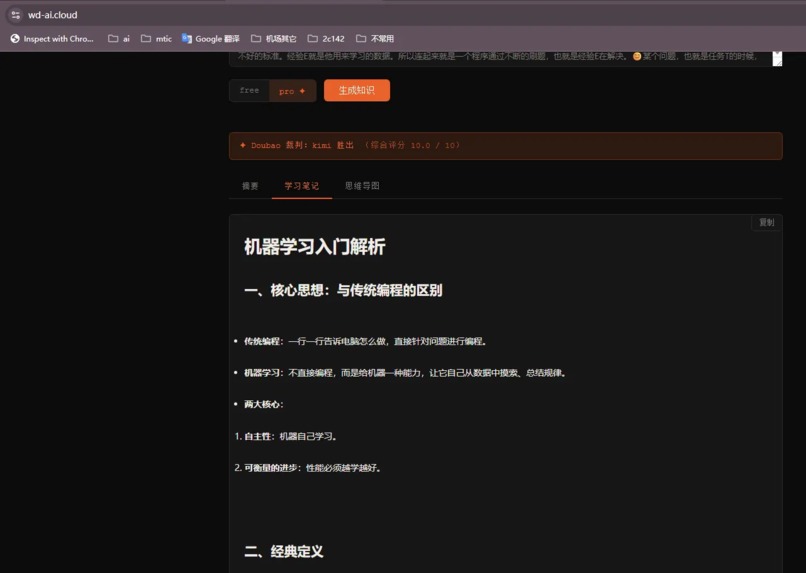
Study notes rendered as structured Markdown with headings and bullet points
-
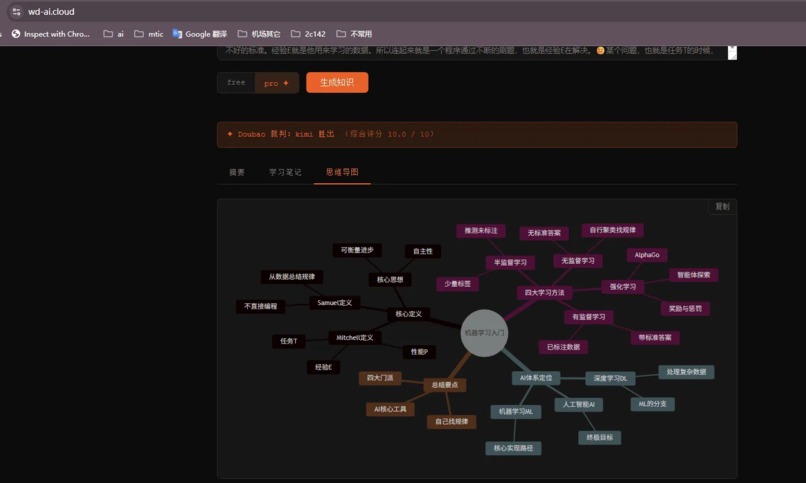
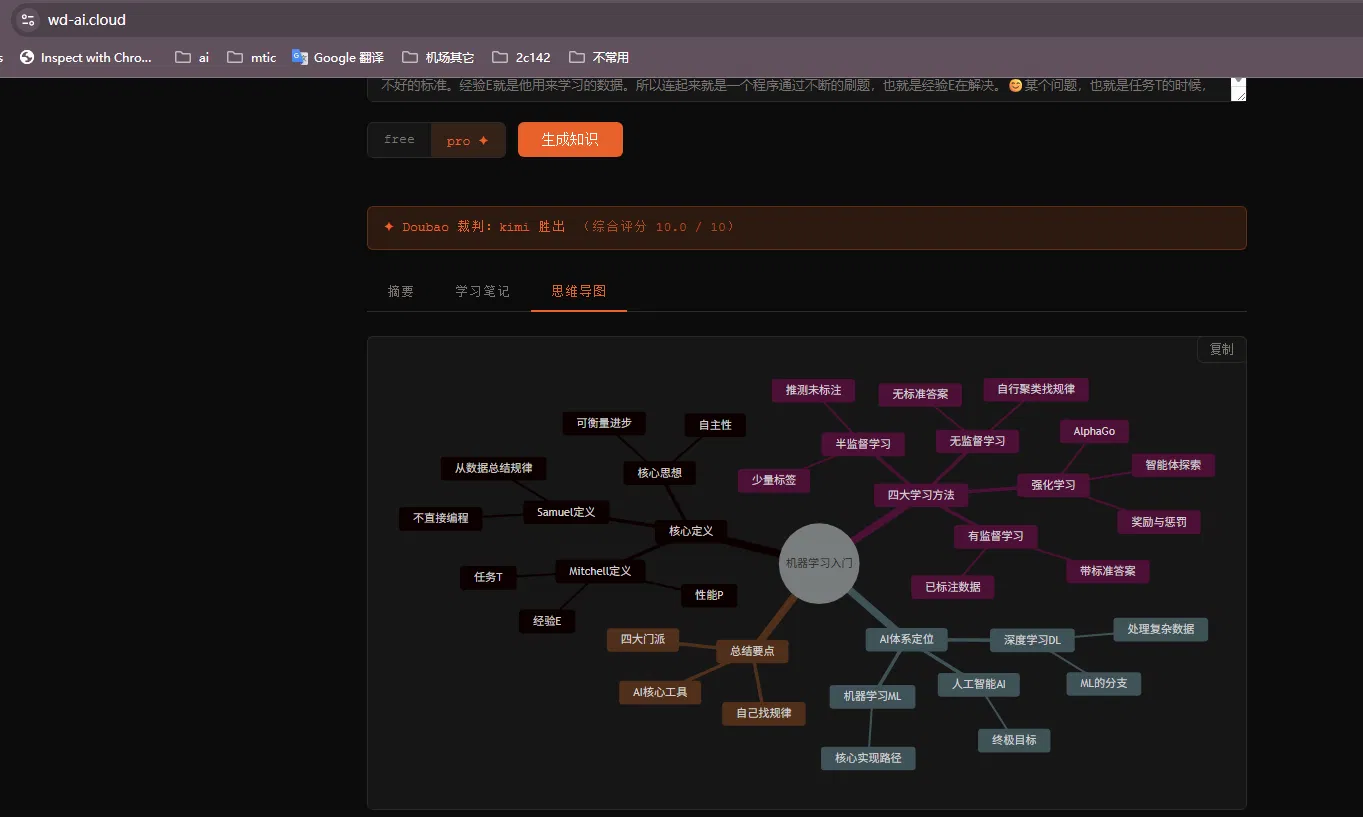
Mind map rendered from Mermaid syntax — visual knowledge tree generated by AI
-
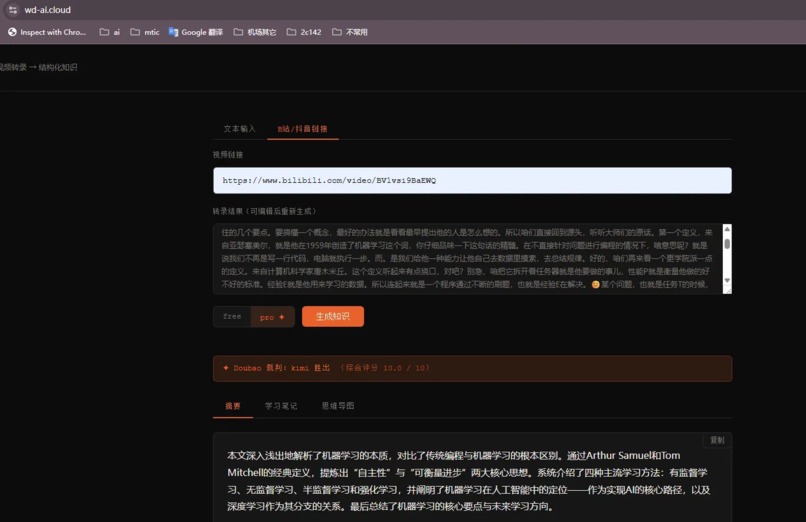
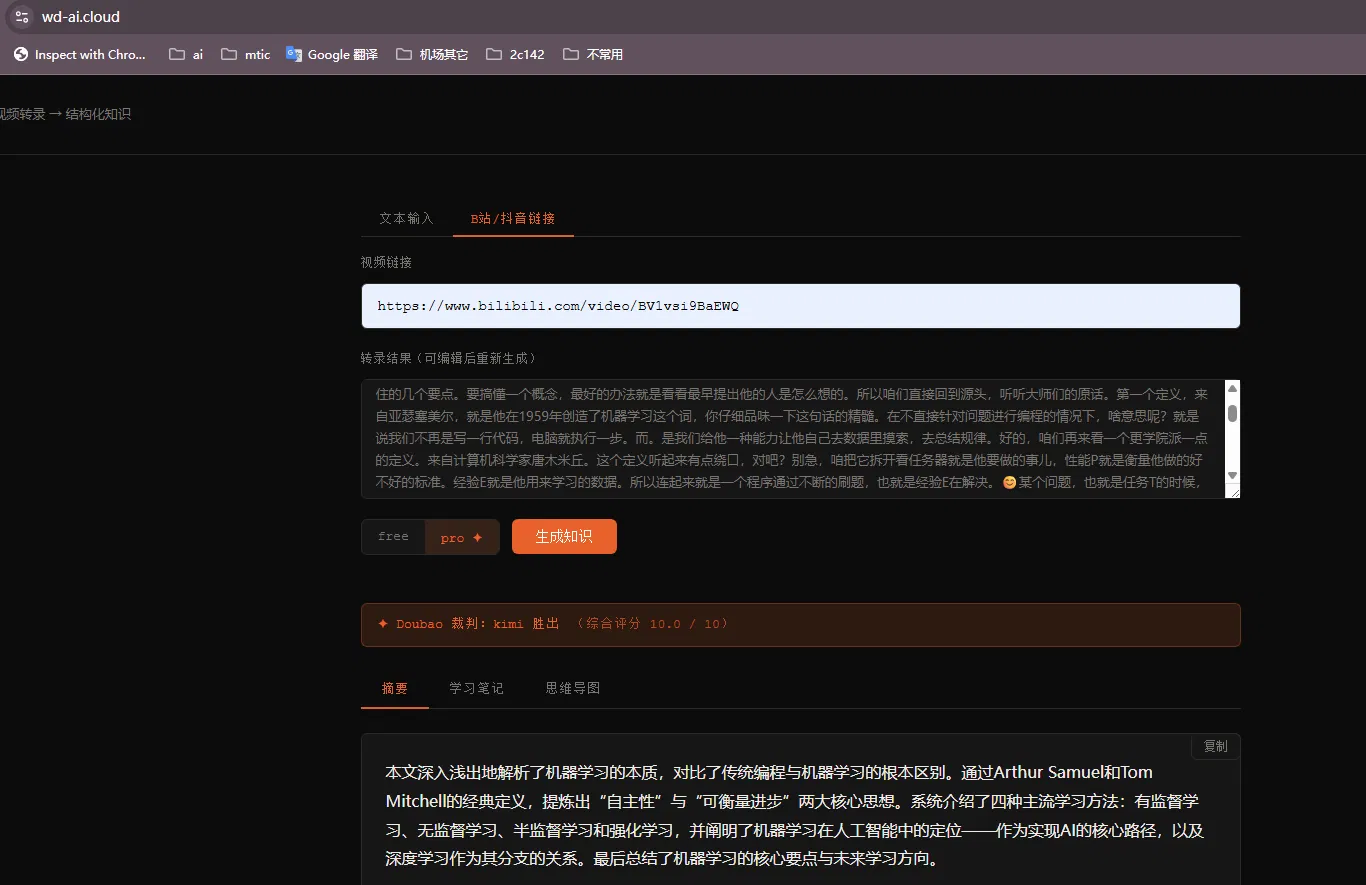
Pro mode: Doubao judge picks the winner between DeepSeek and Kimi, with scores shown
Inspiration
Exam-prep students in China routinely face 3-hour lecture videos on Bilibili and Douyin. Tools like NotebookLM serve YouTube and English content — China's 200M+ exam-prep learners have nothing equivalent. Watching at 2x speed still wastes time, and nothing gets retained as reviewable notes. I built Distill to turn passive video watching into structured, reusable knowledge assets — transcripts, summaries, documents, and mind maps.
What it does
Paste a Bilibili video link, or just paste raw text directly, and Distill:
- Downloads and transcribes the video audio automatically (Bilibili ingestion built this hackathon)
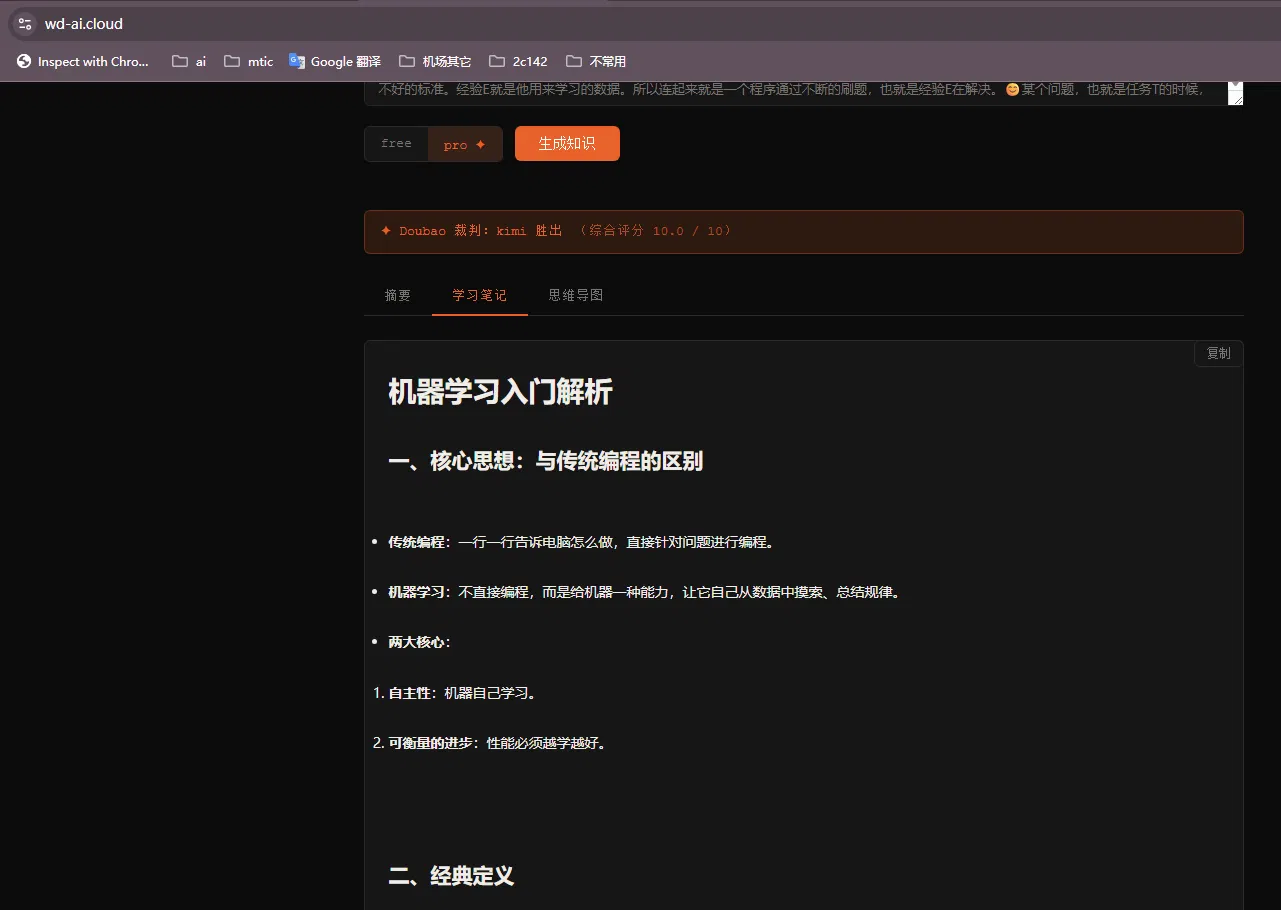
- Generates an adaptive-structure summary and a structured study document via LLM
- Renders a Mermaid mind map for visual review
- Compares multiple LLMs side by side — two models generate in parallel; an independent judge model evaluates both and picks the better output, with scores shown to the user
A 7-minute Bilibili lecture — from URL to summary, study notes, and mind map — in under 60 seconds.
The product is live at https://wd-ai.cloud.
How we built it
Built entirely solo — full-stack development, DevOps, prompt engineering, and product design by one person over the hackathon period.
- A multi-model LLM orchestration layer: DeepSeek and Kimi generate in parallel on the same transcript, with Doubao acting as an independent judge that scores both outputs on coverage, structure, and factuality before picking a winner
- End-to-end Bilibili ingestion pipeline: paste a video URL, and the system downloads the audio (yt-dlp), transcribes it via a cloud ASR API (SiliconFlow, running the SenseVoiceSmall model), and feeds the transcript straight into the LLM router — no manual transcript copy-pasting required
- A Next.js 15 (App Router) frontend with TypeScript, covering both direct-text input and URL-based ingestion in a single interface
- All three models run through a single unified gateway (Volcano Ark), differentiated only by model parameter — simplifying key management for a solo-maintained project
- Deployed on a dedicated server via Docker Compose
Challenges we ran into
- Silent data corruption from an unstable CDN edge: our video-to-audio pipeline would occasionally report a successful download — correct exit code, plausible file size — while the actual audio was a truncated 5-second stub instead of the full lecture. The failure mode wasn't a crash; it was confidently wrong data. We added a post-download duration check (via ffprobe) with an automatic retry that deliberately switches download strategy on each attempt, plus explicit cache invalidation so retries don't just re-serve the same bad file. The bigger lesson: "the process exited 0" is not the same guarantee as "the data is correct," and any pipeline ingesting third-party media needs a validation step that's independent of the tool's own success signal.
- Mermaid rendering reliability: LLMs love generating invalid graph syntax. Constraining output to a strict tree structure dramatically reduced render failures.
- Prompt structure vs. content diversity: forcing a fixed What/Why/How template degraded quality on general-purpose videos; we switched to adaptive structuring based on content type.
What we learned
Shipping an AI product solo means the bottleneck is rarely the model — it's orchestration, output reliability, and the unglamorous edges of third-party integrations. The hardest bugs weren't in our own logic; they were in trusting that an external system (a CDN, a download tool's caching behavior) did what it claimed. Building defensively — validating outputs instead of just trusting exit codes — turned out to matter more than getting the LLM prompts exactly right on the first try. Prompt engineering is empirical: measure, don't assume.
What's next
- Asynchronous processing with progress streaming (the current pipeline is synchronous HTTP, which works for short clips but won't scale to hour-long lectures without queuing)
- Two-tier LLM caching (exact-match + semantic cache) to cut inference costs
- Observability stack: structured logs → metrics → distributed tracing
- WeChat Mini Program login for the Chinese market
- Migrating the LLM orchestration logic into a visual workflow engine (n8n) for easier extensibility
Built With
- deepseek
- docker
- mermaid
- nextjs
- nginx
- siliconflow
- typescript
- yt-dlp


Log in or sign up for Devpost to join the conversation.