-
-
-
-
-
-
-
-
Dashboard
-
-
OPTIONS
-
Inspiration
One of us grew up around Pune's auto belt, in Chakan, where Tier-1 suppliers build controllers for EV makers. The pattern there is always the same. A supplier emails "goods dispatched, please release payment." The buyer pays. A week later the line stops, and it turns out nothing ever left the supplier's dock.
Then we looked at the numbers:
- One hour of downtime in a large car plant costs about $2.3M (Siemens, 2024).
- Maruti Suzuki couldn't build ~46,000 cars in a single quarter because of missing chips.
- Duplicate payments are the #1 cause of lost profit in accounts payable (apexanalytix, 2026).
- Business-email fraud cost companies $2.77B in one year (FBI IC3).
Lying suppliers aren't the real problem. The buyer carries all the risk: overpriced quotes, slipped dates, double invoices, fake bank-account changes, and deadlines that collapse because one part got stuck. So we built a team of AI agents that works for the buyer.
What it does
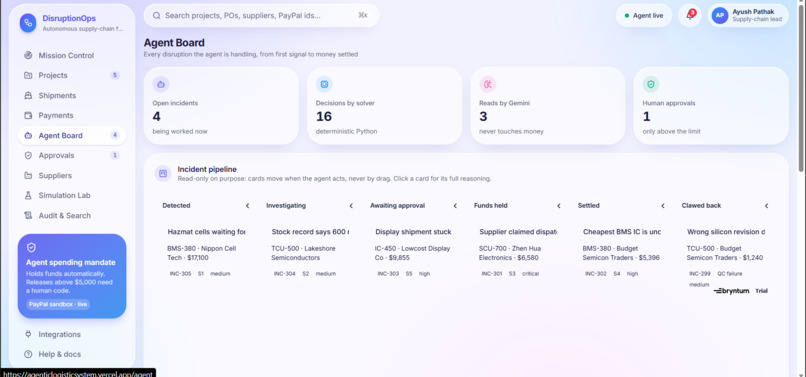
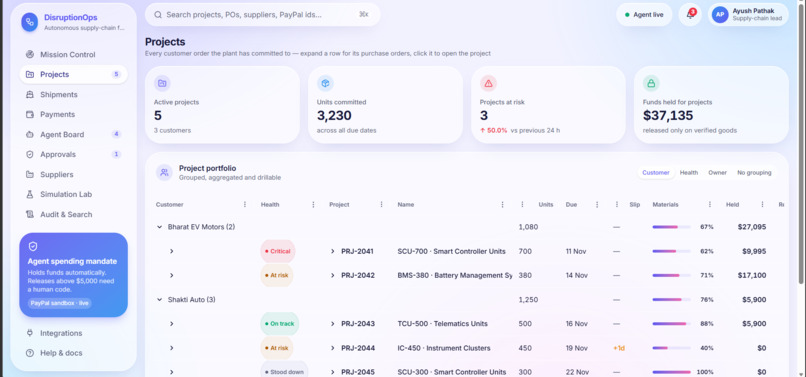
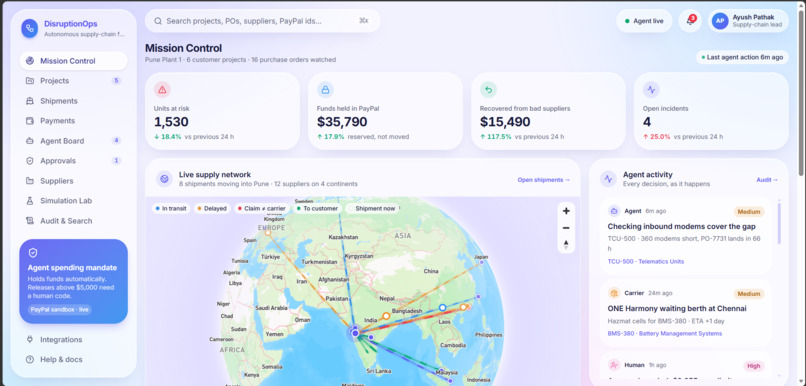
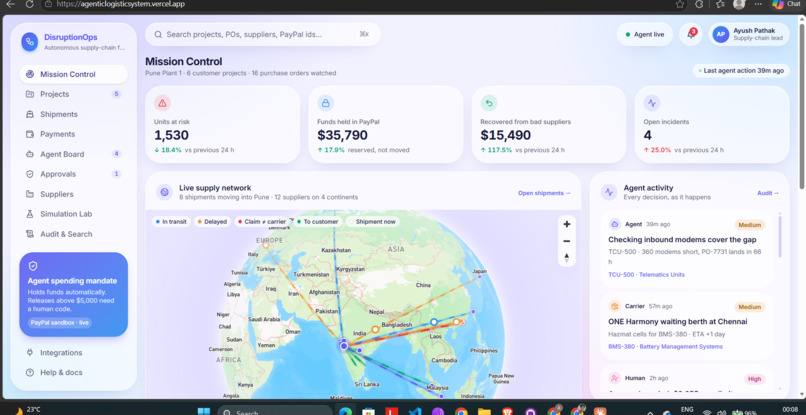
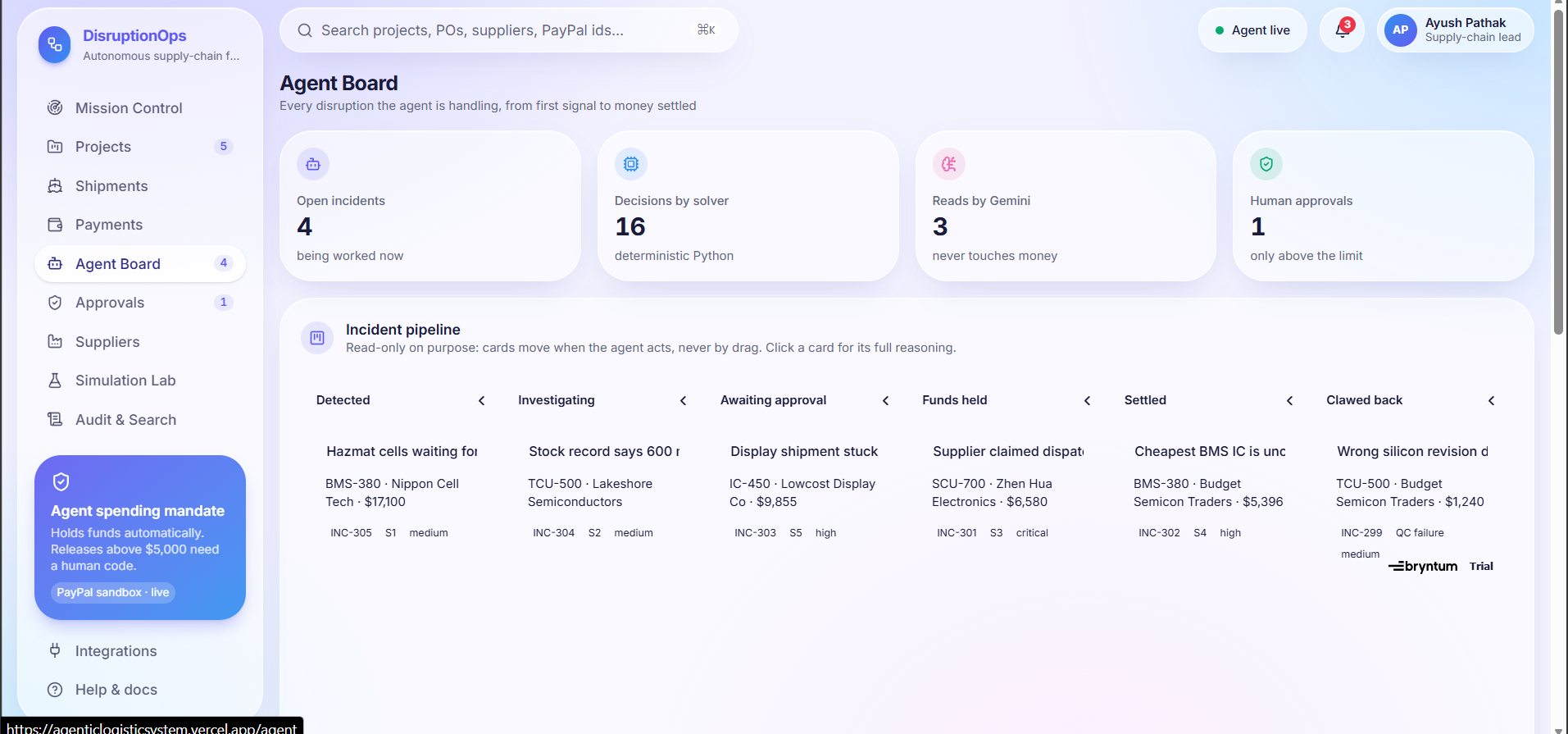
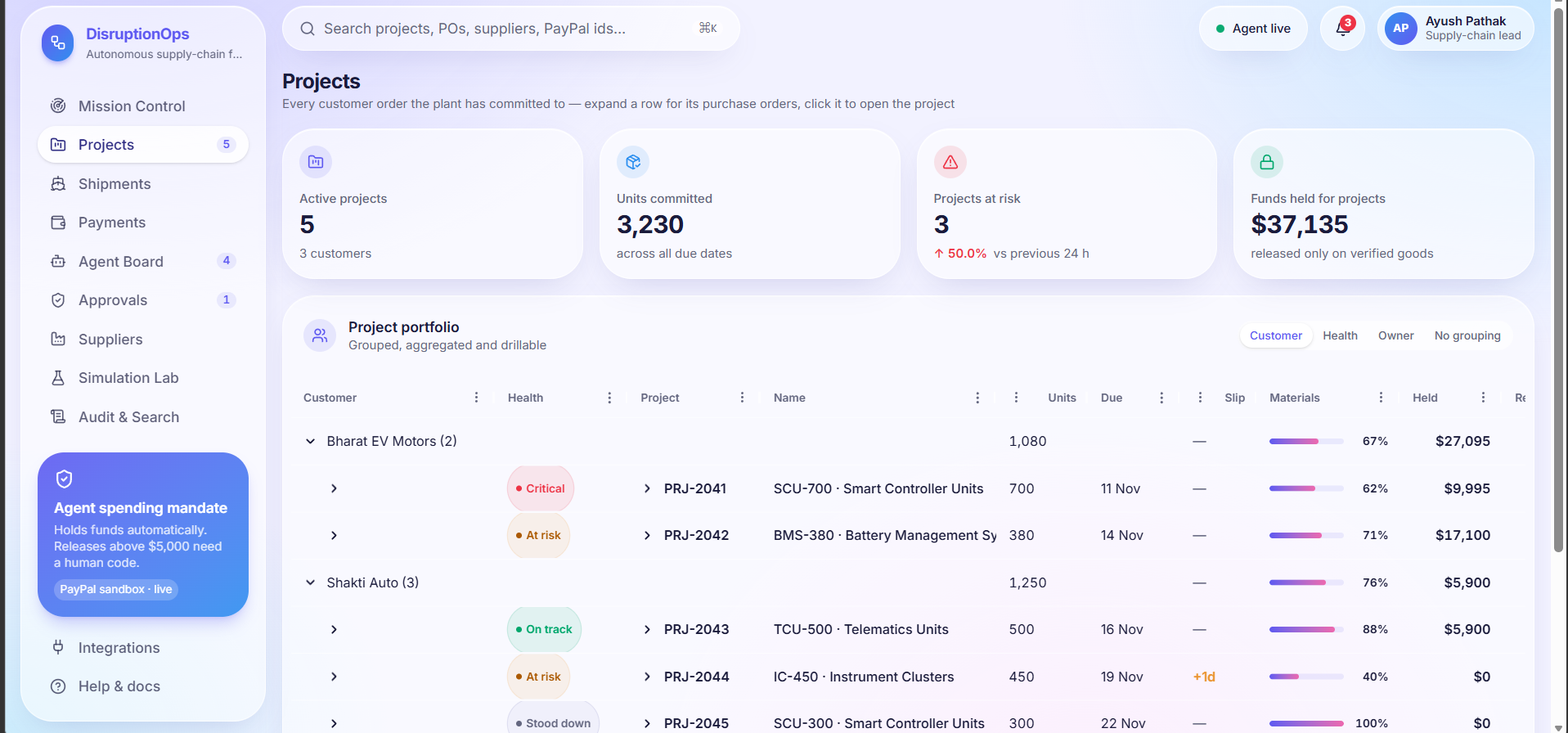
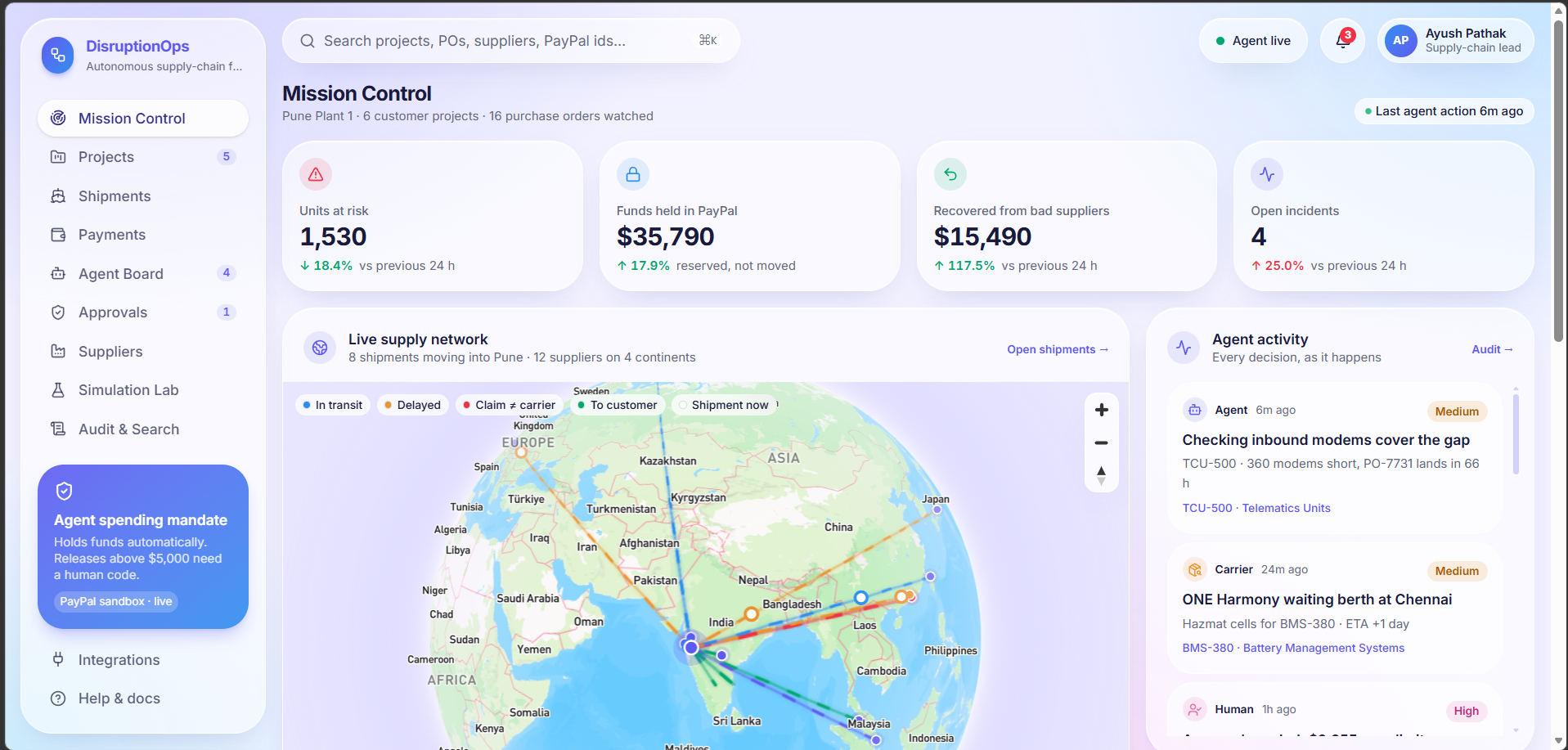
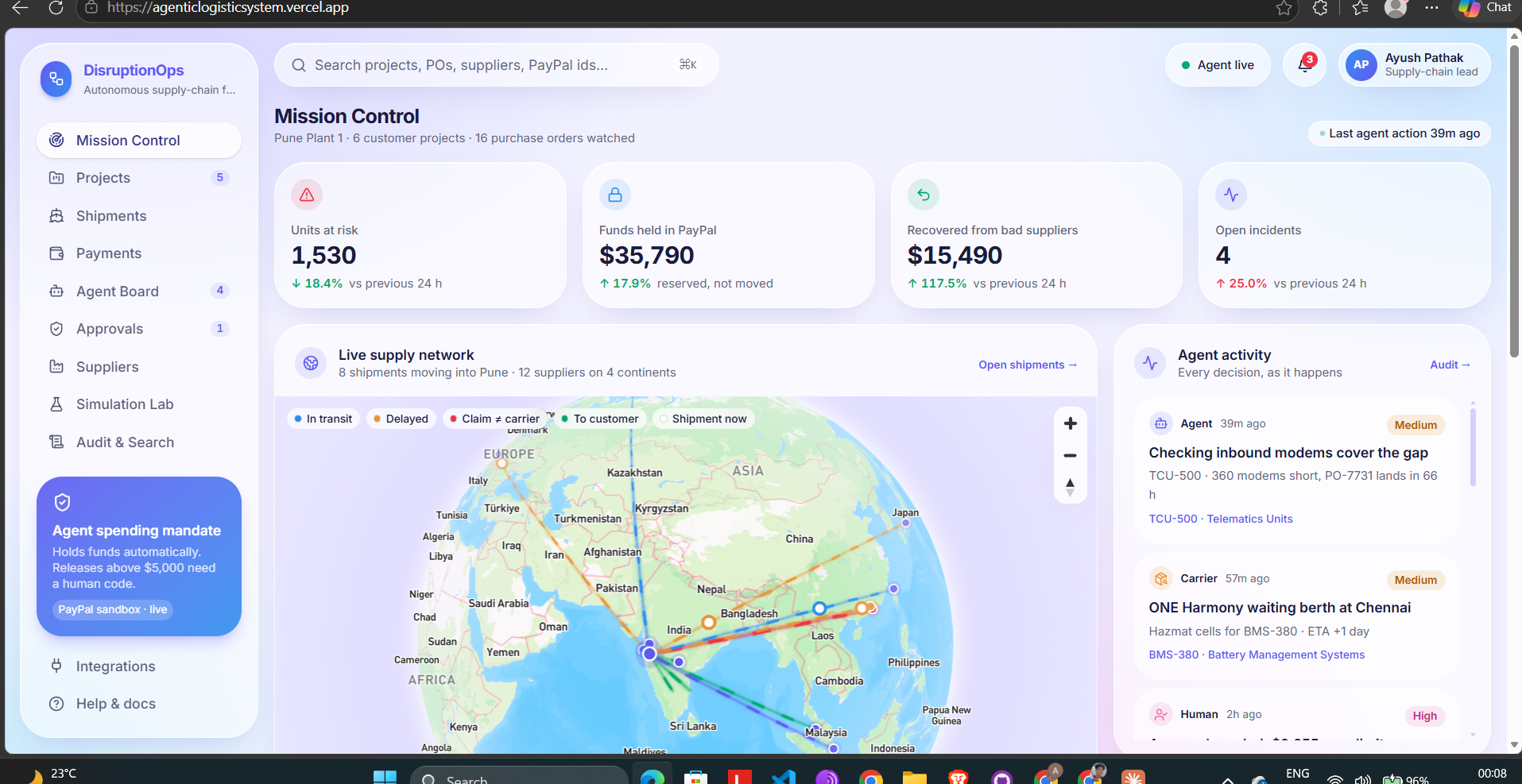
DisruptionOps is a buyer-side multi-agent system. It watches every customer project, part, supplier, shipment and dollar.
A Supervisor (LangGraph) routes every turn to one of eight specialists:
| Agent | Job |
|---|---|
| Sentinel | Risk triage; patrols buy timers, supplier push-outs and expiring PayPal holds |
| Investigator | Builds the evidence; Gemini reads supplier claims against carrier truth |
| Liaison | Every email: RFQs, chases, and payee-change confirmations to the contact on file |
| Sourcing | Deterministic solver, informed by long-term supplier memory |
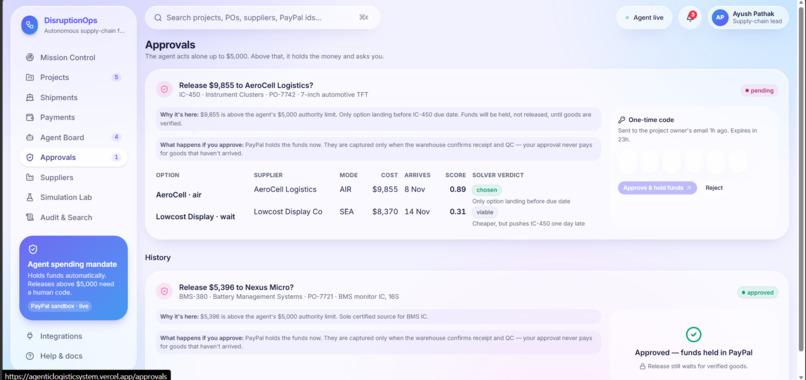
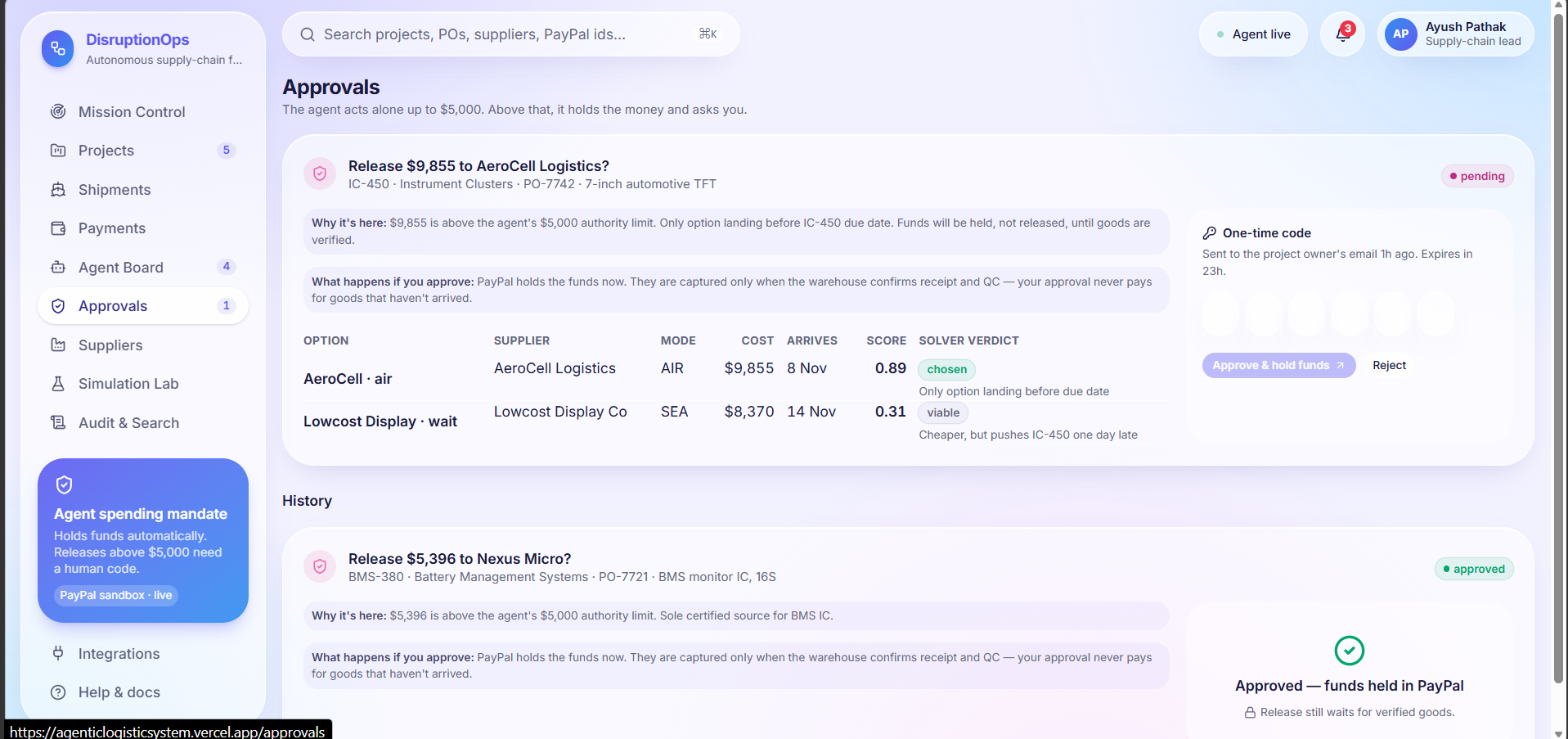
| Approval | Pauses the graph with interrupt() until a human decides |
| Procurement | Raises purchase orders |
| Treasurer | The only agent that can move money, with no LLM inside; every PayPal call goes through the guards |
| Verifier | Closes an incident only when usable stock covers the need |
A Copilot (Gemini ReAct agent) answers questions using read-only tools, including the PayPal Agent Toolkit.
The Buyer Shield: guards between the agents and your money
| Guard | What it stops |
|---|---|
| Fair price | Broker markups (a quote at 4.6× should-cost was blocked) |
| Budget envelope | Spending past a project's cap for its date window |
| Payee lock | "We changed our bank account" fraud: 72 h cooling-off, confirmation sent to the contact on file, owner sign-off |
| Duplicate shield | The same PO or invoice paid twice (CC-7725 vs CC-7725-A) |
| Pay-on-proof | Paying for goods that never shipped: PayPal hold, captured only on a verified receipt |
| Late credit + quality holdback | The late penalty and rejected units come off the capture; retention waits for line acceptance |
| Hold expiry | A PayPal hold expiring during a long ocean voyage |
| Early-pay + chargebacks | Takes 2/10 discounts when they beat the cost of capital; bills suppliers for rework by PayPal invoice |
Buy timers. Every part on every project gets an order-by date:
$$ t_{\text{order-by}} = t_{\text{need}} - L_{\text{lead}} - T_{\text{transit}}(\text{mode}) - B_{\text{buffer}} $$
When a timer turns red, the Sentinel hands the part to the team. The order still has to pass every guard before PayPal holds the money.
Late-delivery credit, enforced through a PayPal partial capture:
$$ C = V_{PO} \cdot p_{LD} \cdot \frac{d_{late}}{7}, \qquad \text{capture} = V_{\text{accepted}} - C - R_{\text{retention}} - D_{\text{early-pay}} $$
Early-pay optimizer: a "2/10 net 30" term is worth paying early when
$$ r = \frac{d}{100-d}\cdot\frac{365}{n_{net}-n_{disc}} \approx 37\% > \text{cost of capital} $$
Verified live on the deployed system (PayPal sandbox):
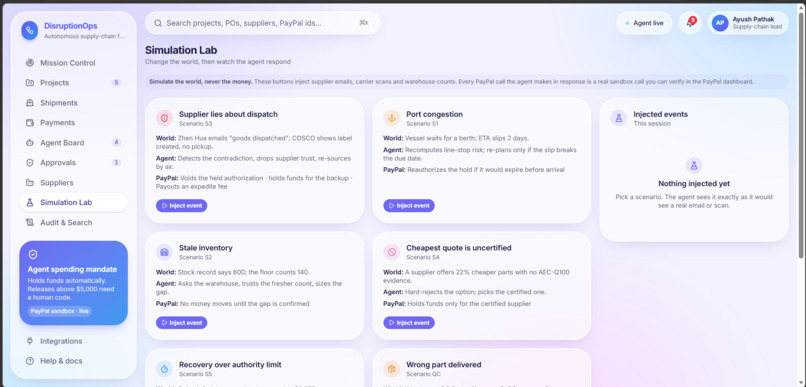
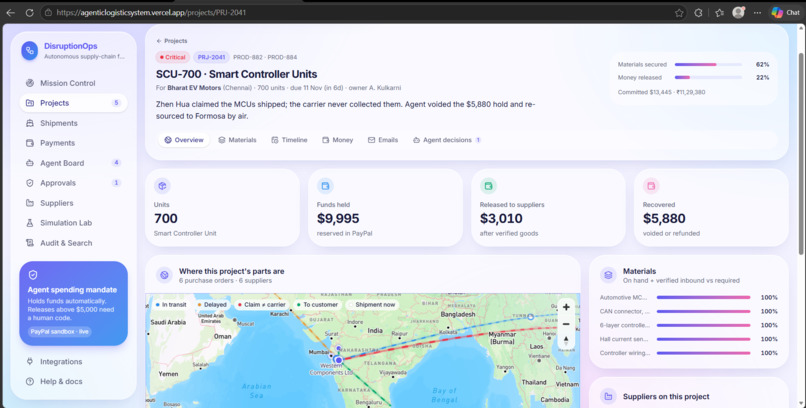
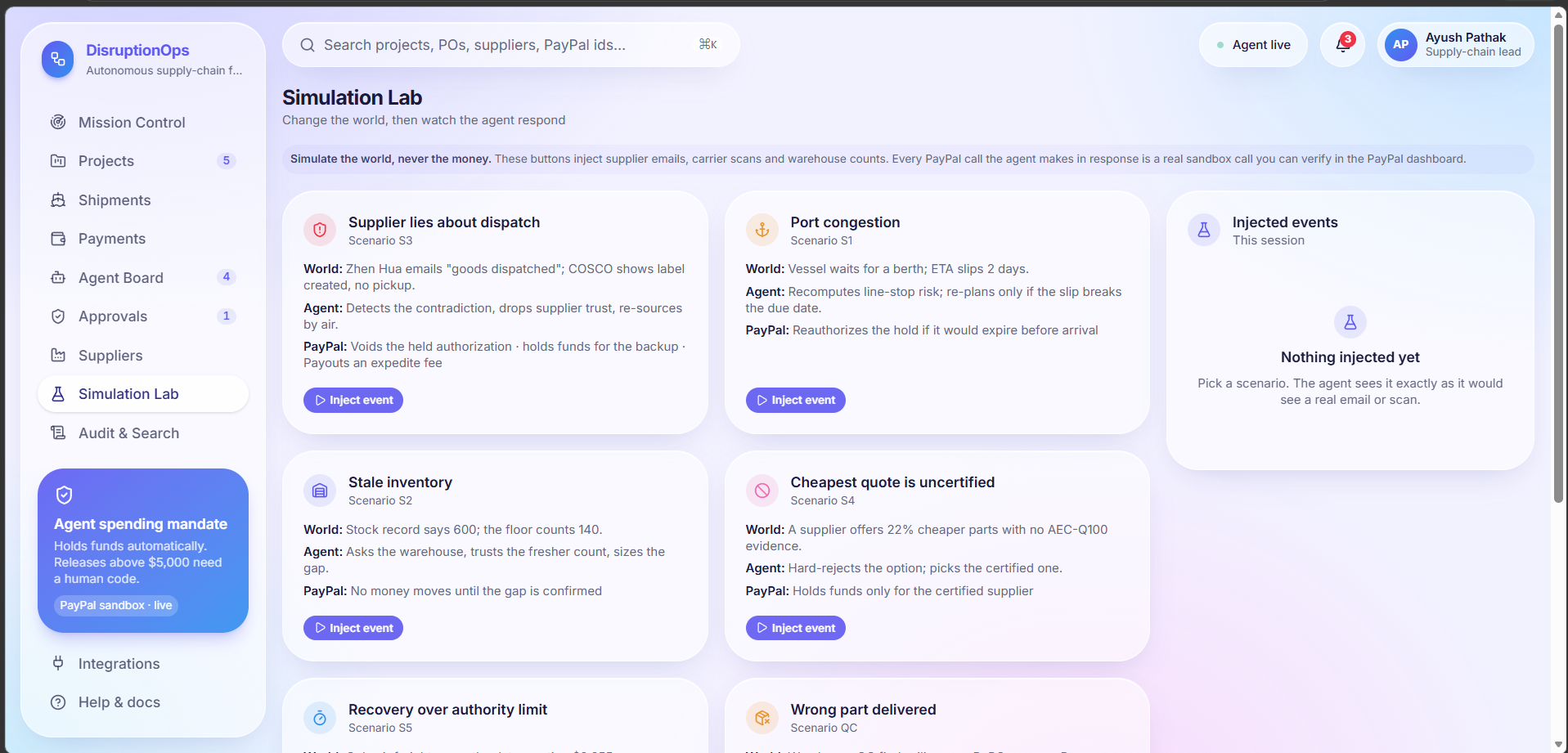
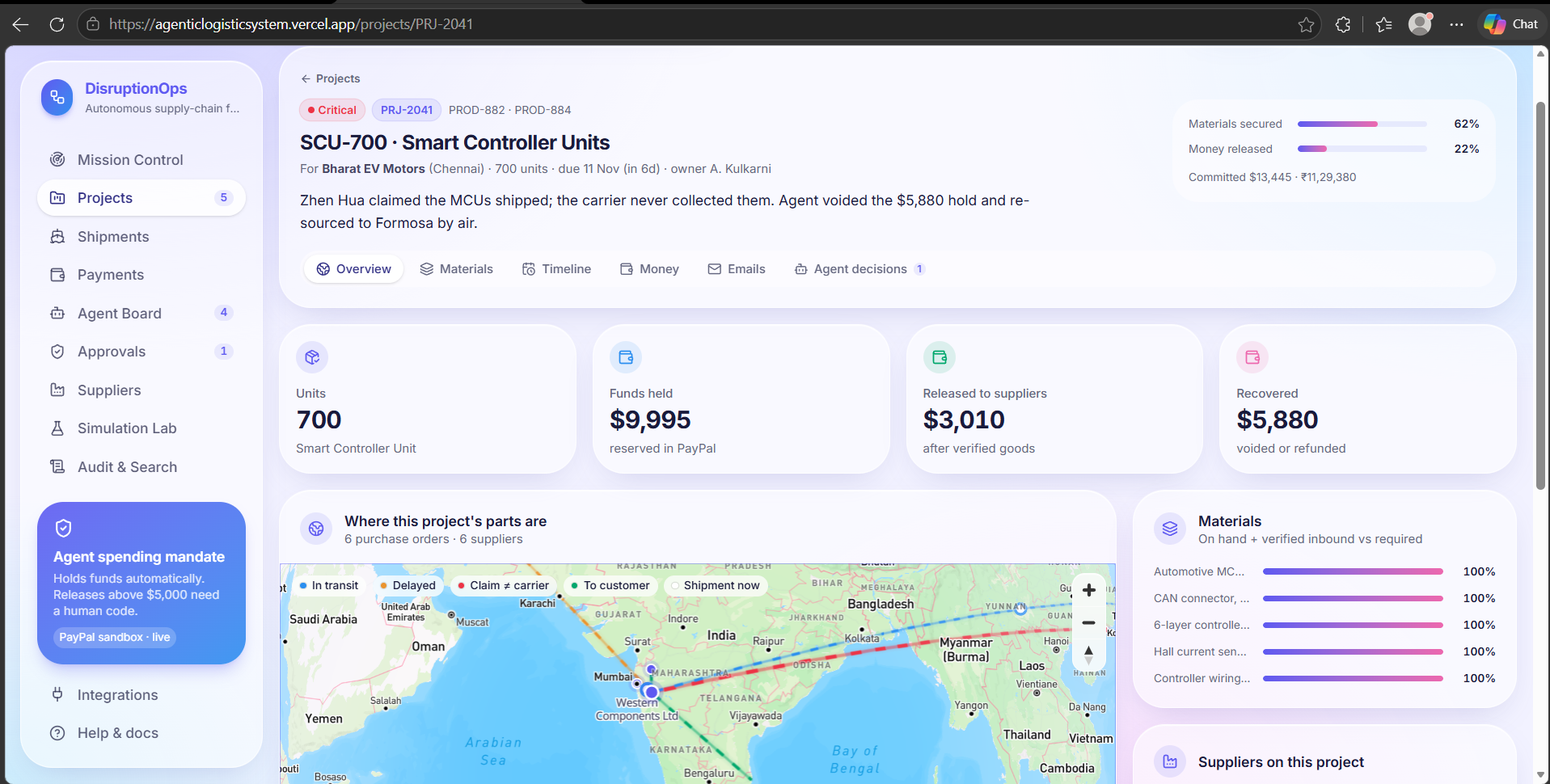
- Supplier lie caught. A supplier claimed "dispatched" while the carrier showed "no pickup". The Investigator caught it, and the Treasurer voided the $1,404.76 PayPal hold.
- Memory used. Sourcing excluded that supplier because of its record in long-term memory.
- Human approval mid-run. The graph paused for approval and resumed on the same thread, raising a new PO and hold.
- Broker quote blocked. A quote at 4.6× should-cost was refused: $3,400 overcharge stopped.
- Late, partly rejected delivery (PO-7718, 6 days late, 380/400 units passed):
- −$174.88 late credit;
- $408.05 retention held;
- $3,497.55 captured and paid out to the locked payee.
- Duplicate invoice refused (
CC-7725-A). - Early-pay discount of 2% taken (37%/yr vs 12% cost of capital).
- Chargeback sent to a supplier as a real PayPal invoice (
INV2-JPSU-F5RF-66EG-KFPB). - Inbound email. A supplier's "please pay our new PayPal account" email (look-alike domain) was locked. A "PO-7718 will now ship on 24 Nov" email became a push-out the team chased.
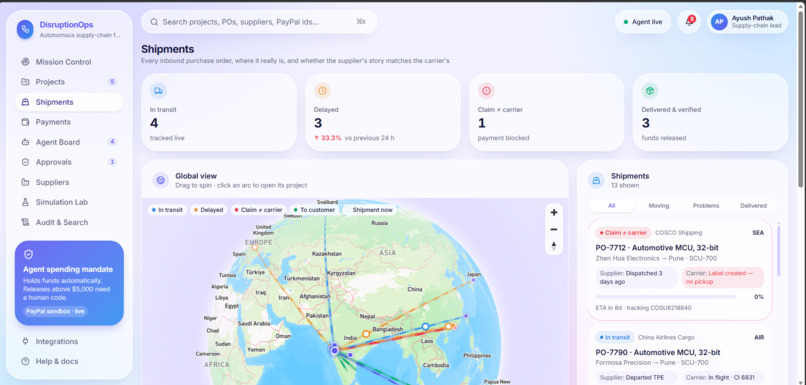
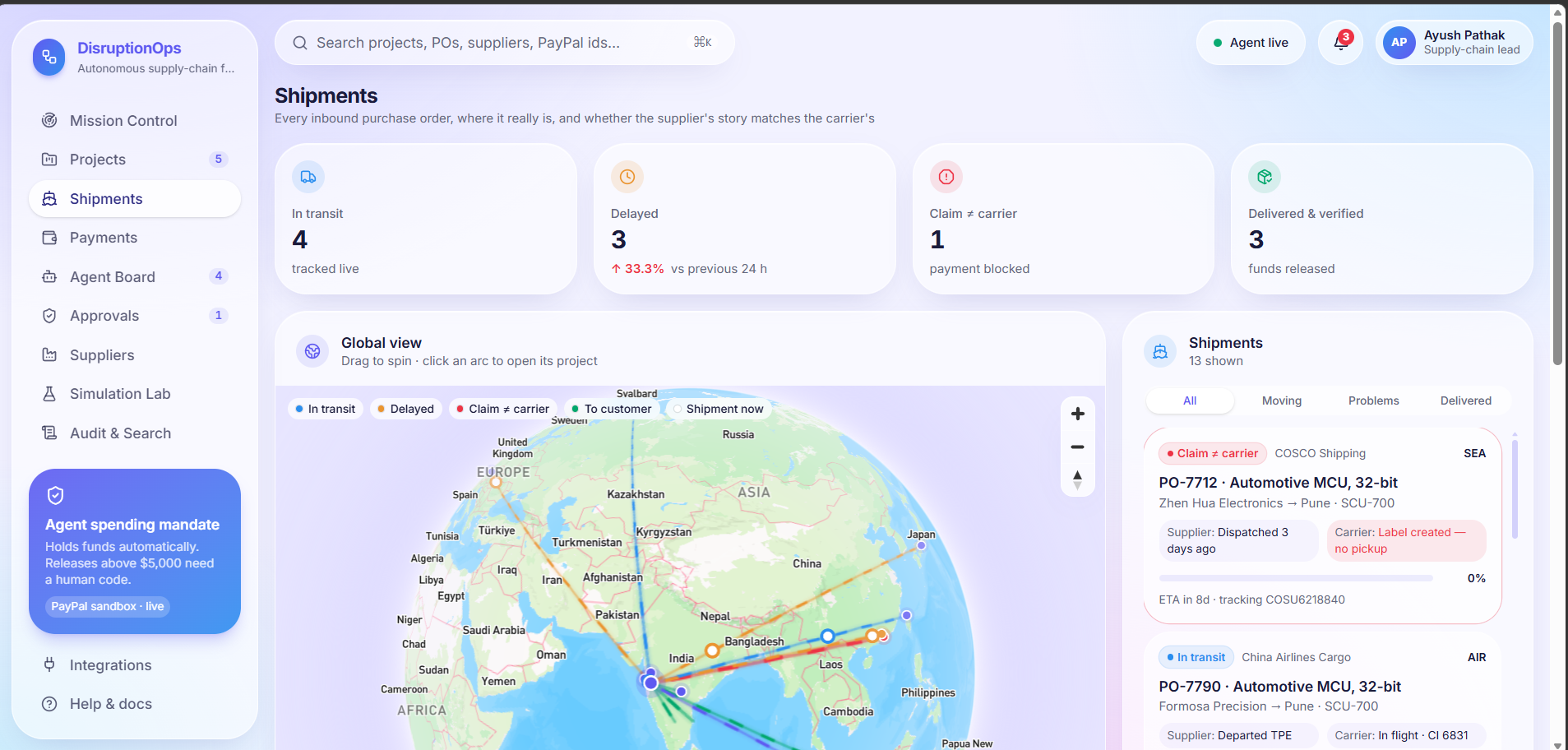
- Hidden shared supplier. Two "independent" connector suppliers turned out to depend on the same plating house, flagged on the globe.
How we built it
The core rule: AI reads, deterministic code decides, and only the Treasurer moves money, through PayPal.
- LangGraph multi-agent graph:
- Supervisor + 8 specialists;
AsyncPostgresSavercheckpoints every turn (one thread per incident, restart-safe);interrupt()/Command(resume=…)for human approvals;AsyncPostgresStorefor long-term memory (supplier trust: trusted / watch / proof-only, plus past incident episodes).
- Gemini reads messy inputs: supplier emails, quotes, claims, QC notes. It drafts messages and powers the Copilot. Its output is treated as untrusted and it never calls a payment API.
- Python (FastAPI) runs:
- the solver (certification, hazmat, budget, due date);
- the three-way match (PO ↔ invoice ↔ goods receipt);
- every guard, with each verdict written to a
guard_eventsledger.
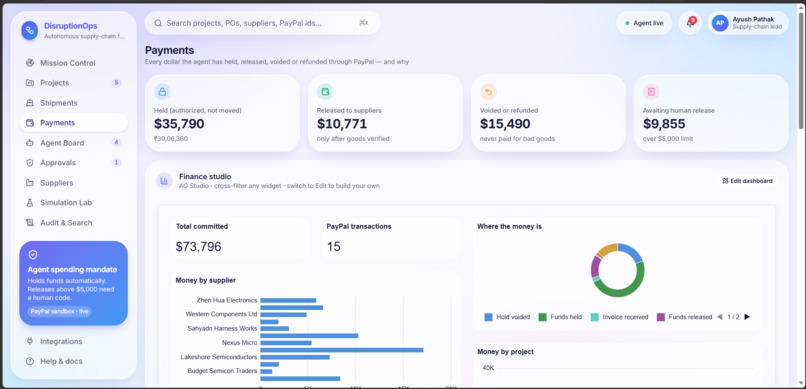
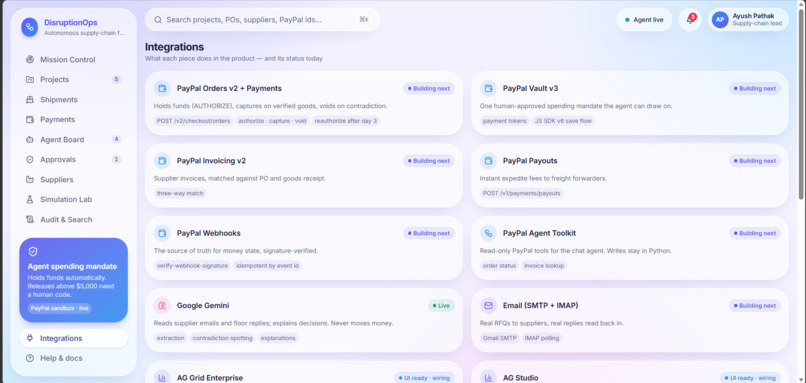
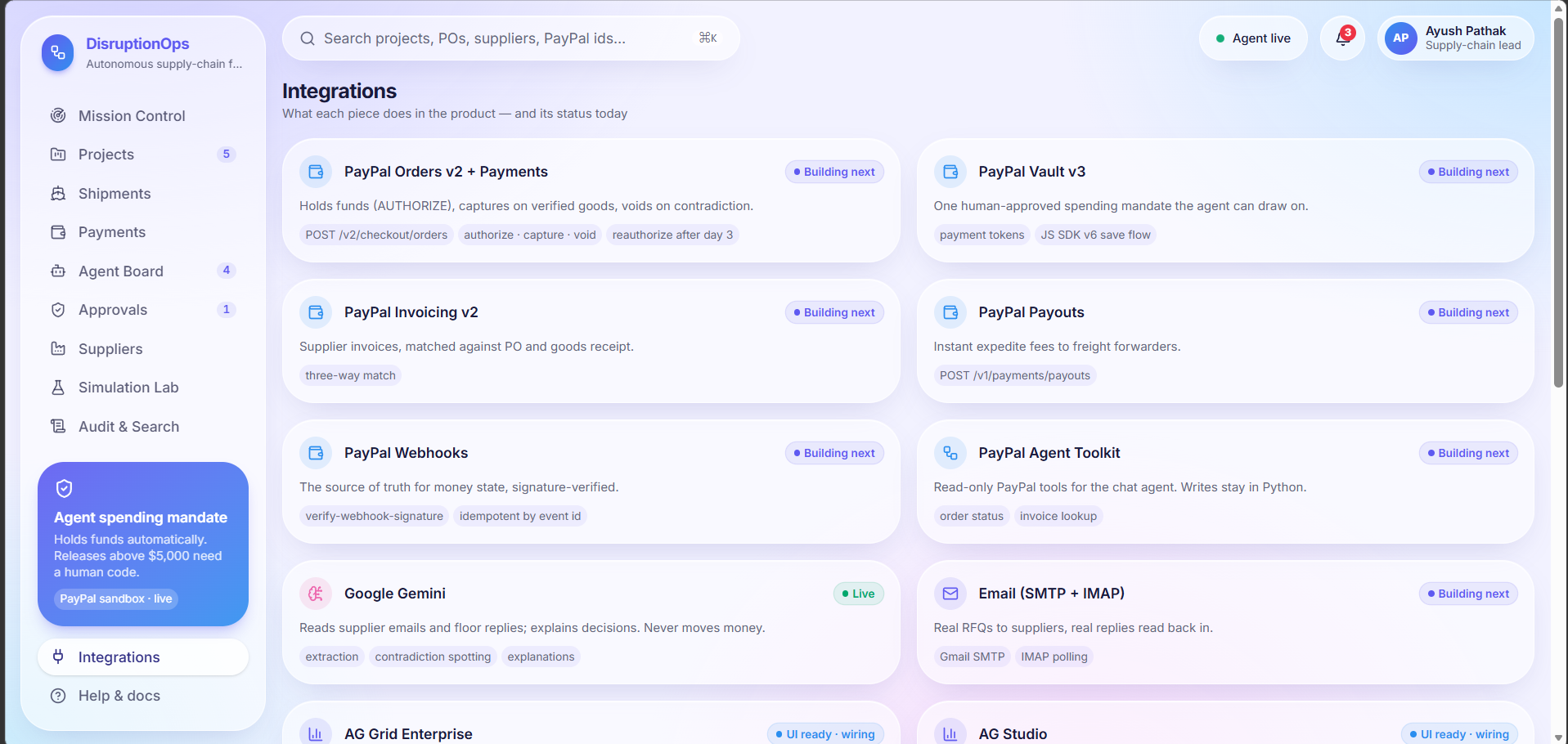
- PayPal (sandbox), the full money lifecycle:
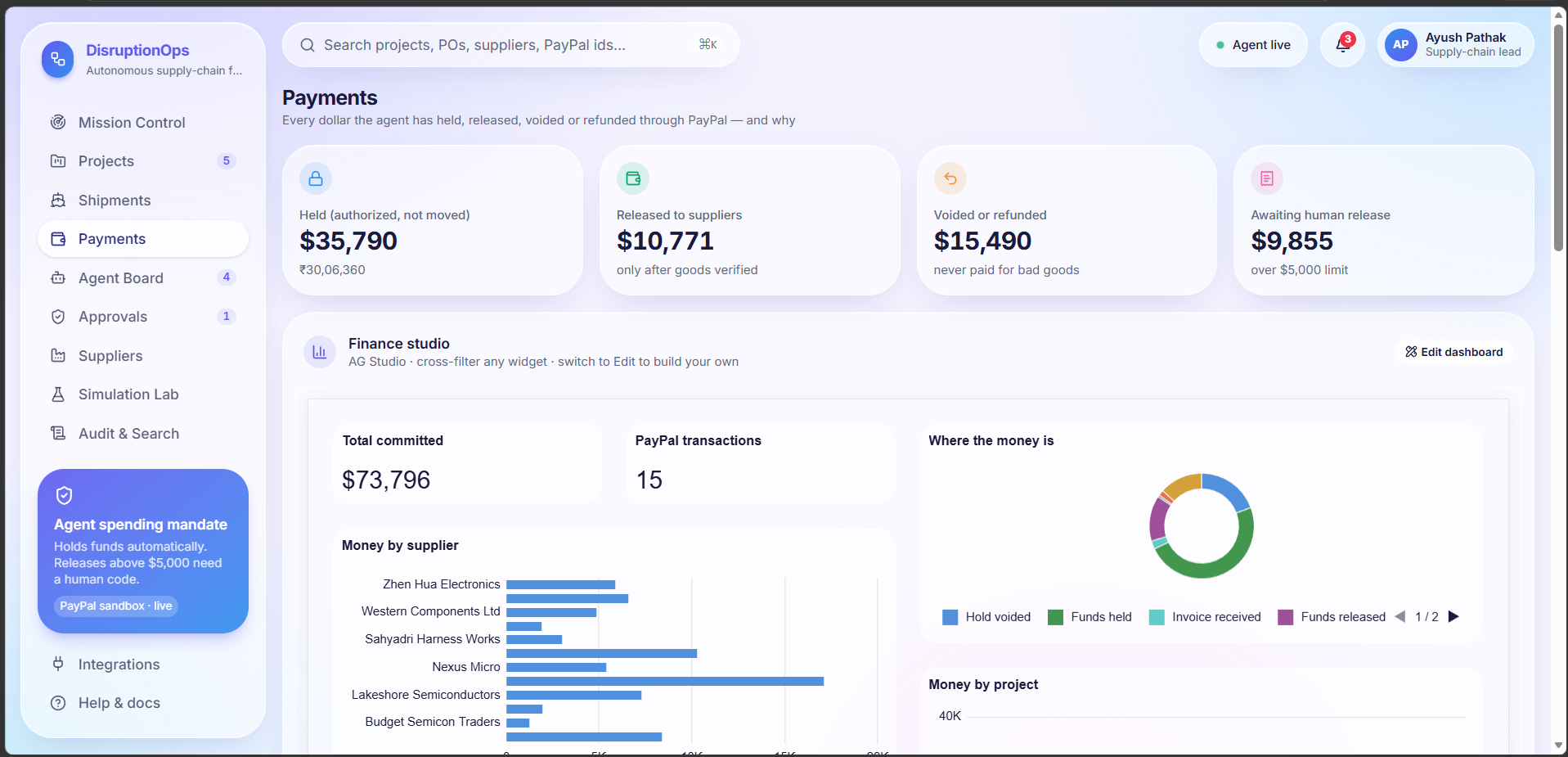
- Vault v3: a one-time human-approved spending mandate.
- Orders v2
AUTHORIZE: holds funds without moving them. - Payments v2: capture, partial capture (
final_capture=falsefor retention), void, refund, reauthorize. - Payouts: only to the locked, verified supplier payee.
- Invoicing v2: supplier chargebacks.
- Webhooks: signature-verified and idempotent; they never overwrite finer states.
- Agent Toolkit: read-only tools for the Copilot.
- Email: SMTP out (approval codes, chases, confirmations) and IMAP in. Supplier replies are parsed and routed to the agents: payee changes, acknowledgements, new ship dates.
- Frontend: React 19 + Tailwind v4, "Lavender Glass" design.
- AG Grid Enterprise: materials tree, PayPal ledger, guard ledger, supplier trust.
- AG Studio: finance dashboards.
- Bryntum Gantt / Scheduler / TaskBoard: timeline with order-by and payment milestones, supplier lanes, incident board.
- Mapbox GL: supply globe with sub-tier links.
- Live Agent Team and Messages screens.
- Infrastructure:
- Supabase Postgres with row-level security per organisation;
- Render (Docker, migrations on boot);
- Vercel;
- a Postman collection for every agent, guard and PayPal endpoint.
Challenges we ran into
- A vaulted PayPal token can't pay a third party directly (
BILLING_AGREEMENT_NOT_FOUND). We redesigned the flow: hold and capture to the platform merchant, then Payout to the verified supplier. That is exactly where Payee Lock, late credits and retention fit. - Concurrency vs tenancy. A PayPal webhook arriving mid-capture reset our per-request tenant setting on Supabase's transaction pooler, so a payout log write failed. We moved to the session pooler, and payment events now inherit their organisation from the payment row.
- Evidence arrives mid-run. The carrier scan that exposes a lie can land while the agents are still working. We coalesce new evidence into one follow-up run on the same thread instead of dropping it.
- Memory that's fair. Our first trust rule banned a supplier after a single late delivery. Now lying or a payee-redirect attempt disqualifies a supplier on its own, while lateness and defects only count when they repeat. Trust is recomputed from history on every read.
- Holds expire. PayPal authorizations expire after 29 days, so the Sentinel reauthorizes long-transit holds.
- Webhooks vs our own states. PayPal's "capture completed" webhook was overwriting "retention held". Reconciliation now keeps finer states.
What we learned
- Supply-chain trust is a payments problem as much as a logistics one. When money moves only on proof, suppliers lose the incentive to lie.
- The best AI-plus-money design is agents for language and coordination, code for decisions, PayPal for custody.
- Real procurement pain (duplicate invoices, payee fraud, unenforced late penalties) is boring, and worth billions.
What's next
- Live PayPal onboarding for supplier accounts.
- Real commodity-index feeds for automatic price cuts.
- Sub-tier supplier declarations collected over email.
- A pilot with a Chakan Tier-1 plant.
Built With
- ag-grid
- ag-studio
- asyncpg
- bryntum
- docker
- fastapi
- gemini
- langgraph
- mapbox
- paypal
- paypal-orders-api
- paypal-payouts
- paypal-vault
- paypal-webhooks
- postgresql
- python
- react
- render
- shadcn-ui
- supabase
- tailwindcss
- typescript
- vercel
- vite
- zustand

