-
-
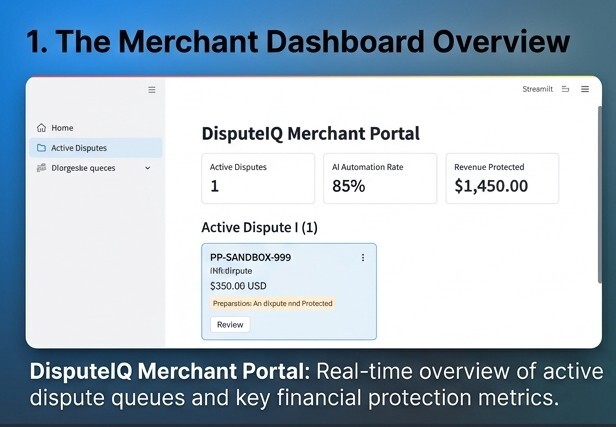
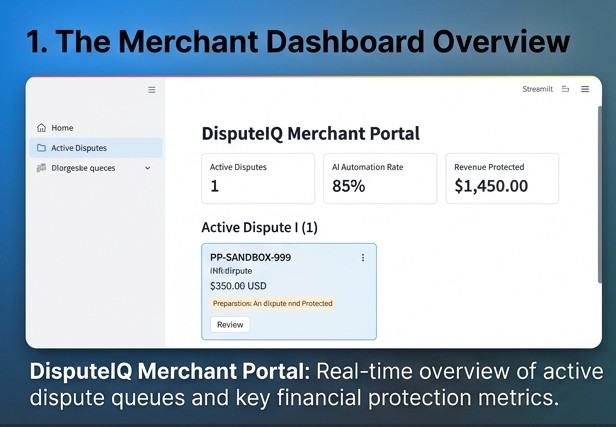
Dashboard Overview: Highlights the key metrics and active queue state.
-
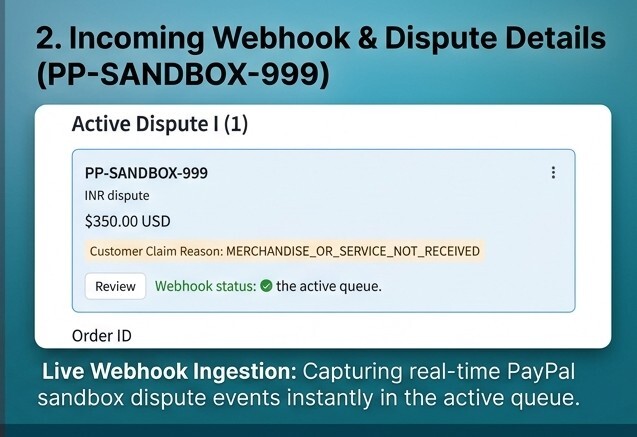
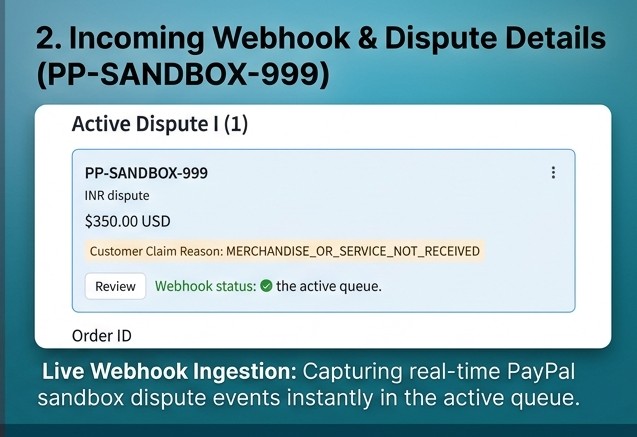
Webhook & Dispute Details: Zooms in on the exact details of PP-SANDBOX-999 and the webhook status.
-
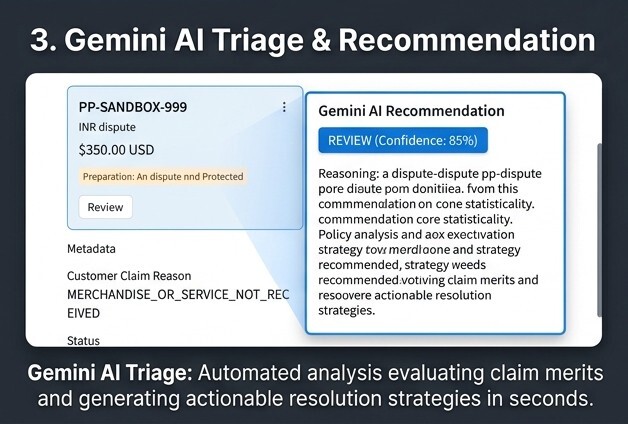
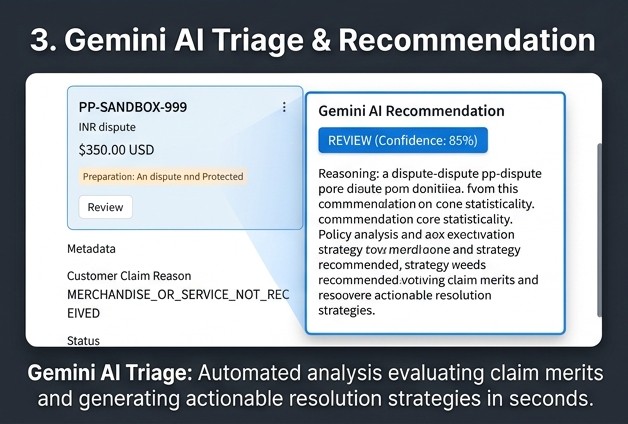
AI Triage & Recommendation: Expands the Gemini AI analysis view, showing the confidence score and automated reasoning.
-
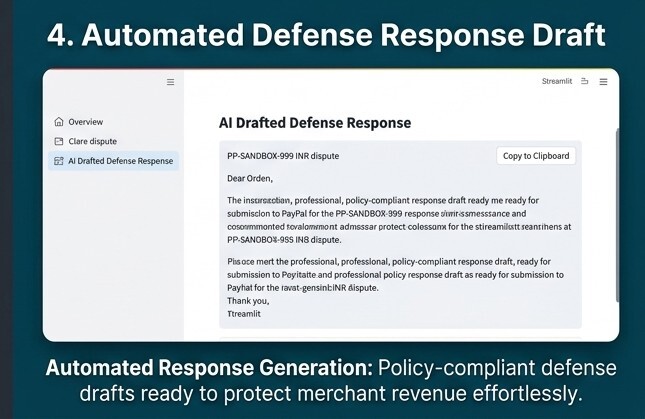
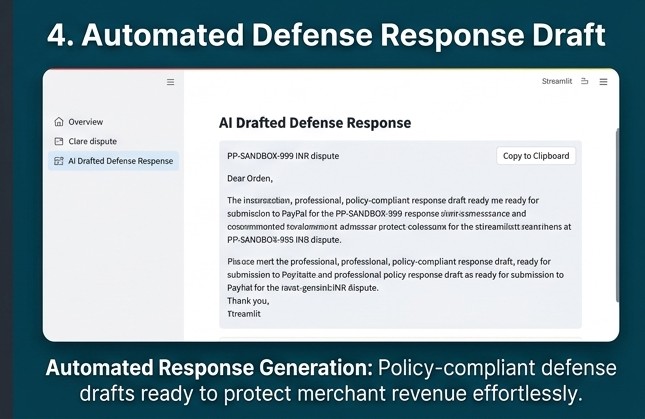
Automated Defense Response: Displays the fully drafted, policy-compliant response ready for merchant action.
Inspiration
Online merchants lose billions of dollars annually to chargeback fraud and operational fatigue. When a customer files a dispute (like an Item Not Received claim), merchants are flooded with unstructured event data, tight resolution deadlines, and complex policy requirements. Manually triaging each case leads to missed deadlines, lost evidence, and unnecessary revenue loss. We built DisputeIQ to bridge real-time payment gateway webhooks with advanced generative AI—turning a stressful administrative burden into an automated, data-driven defense system.
What it does
DisputeIQ is an automated chargeback resolution portal designed for online merchants:
- Webhook Ingestion: Captures incoming PayPal dispute webhooks (
CUSTOMER.DISPUTE.CREATED) in real time. - AI Triage Engine: Uses Gemini AI to analyze raw dispute payloads, evaluate claim reasons, and generate a confidence score alongside actionable recommendations (
ACCEPT,REJECT, orREVIEW). - Response Generation: Drafts professional, policy-compliant merchant defense responses ready for submission to payment processors.
- Merchant Dashboard: Provides a clear Streamlit interface tracking active disputes, automation rates, protected revenue, and historical resolutions.
How we built it
DisputeIQ is built on a modular architecture:
- Backend: Powered by FastAPI to handle incoming webhook requests asynchronously, run business logic, and manage SQLite database transactions.
- Database: SQLite (
disputes.db) for lightweight, persistent storage of incoming webhooks, raw JSON payloads, and resolution histories. - AI Integration: Integrated with the Google GenAI SDK (
gemini-3.8-flash) to parse dispute parameters, analyze shipping evidence gaps, and output structured JSON recommendations. - Frontend: Built with Streamlit, featuring custom CSS styling, dynamic status metrics, and expander components to inspect AI reasoning and raw PayPal data.
- Deployment & Testing: Cloud deployment on Render, validated end-to-end using PowerShell testing suites simulating live PayPal sandbox events.
Challenges we ran into
- Environment Synchronization: Resolving database desynchronization between local development environments and live cloud deployments on Render required careful URL routing and dynamic database loading.
- Network & Socket Stability: Mitigating intermittent SSL handshake drops during external API calls required building exponential backoff retry loops and robust fallback mechanisms so the merchant dashboard remains resilient.
- Data Deserialization: Normalizing varying nested structures inside raw PayPal webhook payloads (strings vs. pre-parsed JSON dicts) to ensure smooth rendering on the Streamlit frontend.
Accomplishments that we're proud of
- End-to-End Validation: Successfully building and validating a live pipeline where a simulated PayPal webhook triggers Gemini AI analysis and instantly updates the merchant dashboard in seconds.
- Graceful Degradation: Designing a backend that gracefully handles network interruptions without losing dispute state or breaking the user experience.
- Clean UI/UX: Crafting a clear dashboard that transforms raw financial metadata into actionable business metrics and ready-to-use dispute defense drafts.
What we learned
- Asynchronous Resilience: Gained deep experience in fault-tolerant API design, specifically how to build retry layers and fallback paths around generative AI calls within payment pipelines.
- Seamless Webhook Architecture: Standardized methods for testing and decoupling webhook receivers from frontend visualization dashboards.
What's next for DisputeIQ
- Automated Evidence Assembly: Integrating directly with carrier APIs (FedEx, UPS, DHL) to automatically pull proof of delivery and tracking manifests based on order IDs.
- Direct PayPal Resolution API: Adding one-click dispute defense submission directly back into PayPal's Disputes API to eliminate manual copy-pasting.
- Multi-Gateway Support: Expanding webhook handlers to support Stripe, Square, and Shopify chargebacks under a unified AI triage command center.
