Inspiration
We were inspired by how many chauffeur companies still receive bookings through WhatsApp and other messaging apps. Dispatchers spend valuable time reading customer messages, checking addresses, verifying flight details, and manually creating bookings. We wanted to explore how GPT-5.6 could automate this repetitive work while ensuring factual information comes from trusted services and the final decision remains with a human dispatcher.
What it does
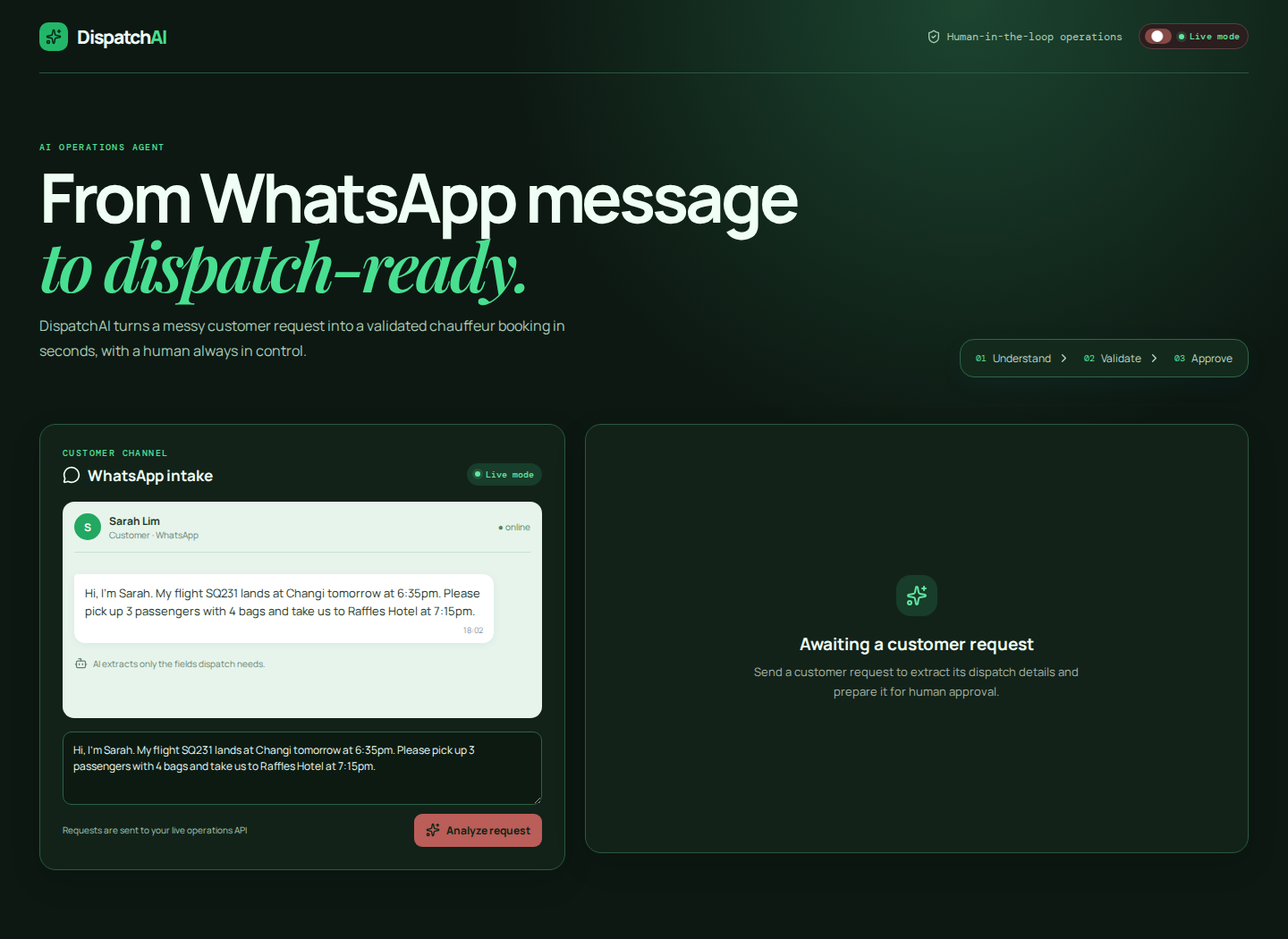
DispatchAI is an AI Operations Agent that transforms natural-language customer messages into structured chauffeur booking drafts.
Using GPT-5.6, it extracts booking details such as pickup location, destination, date, time, passenger count, luggage, and flight number. The application validates Singapore addresses with OneMap, retrieves flight information from a mock flight service, and presents a booking draft for dispatcher review. The dispatcher can edit, approve, or reject the booking, ensuring human oversight before it becomes operational.
DispatchAI supports two operating modes:
- Demo Mode provides a reliable end-to-end demonstration using deterministic extraction, demo validation, mock flight information, and in-memory bookings.
- Live Mode uses GPT-5.6 for booking extraction, OneMap for Singapore address validation, and Supabase for booking persistence.
How we built it
We built DispatchAI using a modern full-stack architecture.
Frontend
- React
- TypeScript
- Vite
- Tailwind CSS
- shadcn/ui
Backend
- FastAPI
AI
- OpenAI GPT-5.6
Database
- Supabase PostgreSQL
External Services
- OneMap API
- Mock Flight API
The FastAPI backend orchestrates the workflow by sending customer messages to GPT-5.6 for information extraction, validating Singapore addresses with OneMap, retrieving flight information from the mock flight service, and storing booking drafts in Supabase. The application presents a complete booking summary, confidence score, warnings, and follow-up prompts before allowing the dispatcher to approve or reject the booking.
To ensure a reliable hackathon experience, we implemented both Demo Mode and Live Mode. Demo Mode provides deterministic behaviour without requiring external services, while Live Mode demonstrates production-ready integrations with OpenAI, OneMap, and Supabase.
Challenges we ran into
One of our biggest challenges was deciding what the AI should do—and what it should not do.
GPT-5.6 is excellent at understanding natural language and extracting structured booking information, but operational facts such as addresses, flight status, terminals, and gates should never be invented. We therefore separated AI reasoning from factual validation by relying on OneMap and external services as the source of truth.
Another challenge was balancing a dependable hackathon demonstration with a realistic production architecture. This led us to design separate Demo and Live modes, allowing us to demonstrate the complete workflow even when external services are unavailable.
Accomplishments that we're proud of
We're proud that DispatchAI demonstrates a complete AI-assisted operational workflow instead of simply generating chat responses.
Some highlights include:
- AI-powered booking extraction using GPT-5.6
- Singapore address
Built With
- api
- css
- fastapi
- flight
- gpt-5.6
- mock
- onemap
- openai
- postgresql
- python
- react
- shadcn/ui
- supabase
- tailwind
- typescript
- vite
Log in or sign up for Devpost to join the conversation.