Inspiration
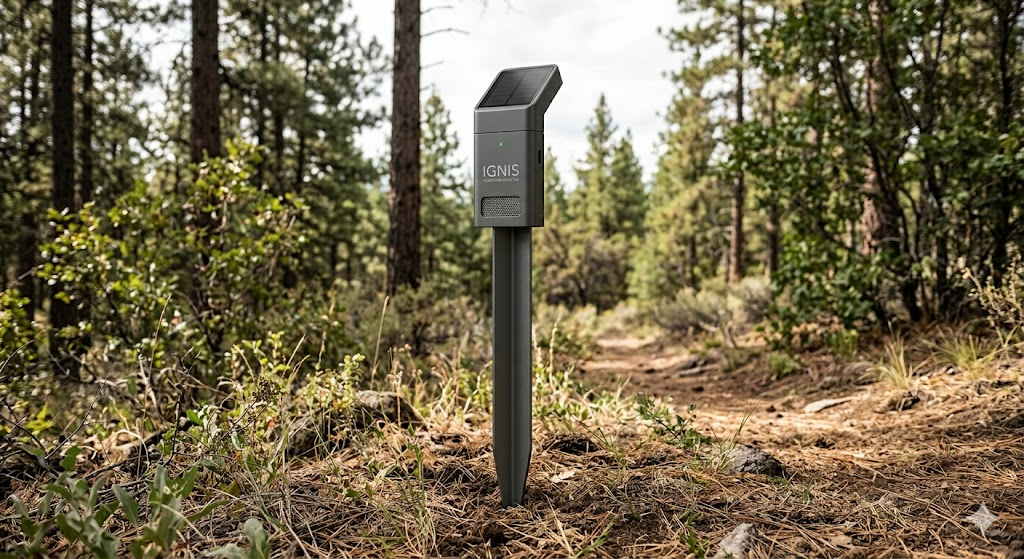
Our inspiration comes from local occurrences of wildfires in San Diego, California. The livelihood of field workers, farm owners, homeowners, and companies in high fire risk zones. People in our local community are the most affected by these, and we want to take part in reducing the risks that come with wildfires.
What it does
We are able to predict where the fire front is approaching and give companies, farmers, and fire rangers enough time to respond before a wild mass outbreak occurs within the zone.
How we built it
We used an Arduino uno q with temperate, moisture, wind, and location aware sensing to communicate with other sentinel stations and ground stations to communicate where we are likely to have an outbreak.
Challenges we ran into
Our main challenge was the lack of hardware modules available. We would like to integrate a low power radar sensor to detect underground movement in a forward direction and combine it with the other underground and above ground sensors to better predict our information. Another thing we would have liked to do was to integrate a camera that would allow for smoke visibility in satellite blocked locations to predict a line of sight fire.
Another challenge was the lack of supporting documentation to the brand new Arduino uno sensor. It was incredibly capable, but our minimal understanding made it a hard ramp up, but once we were better accustomed to it, we were able to make faster changes.
Our final challenge was being overly ambitious without having properly surveyed the realm of possibilities that could be accomplished within the allowed time frame and sensor capabilities.
Accomplishments that we're proud of
Being able to implement our hardware that runs as an MVP to provide telemetric data in real time and accurately predict without a high false alarm rate.
Another large accomplishment we are proud of was being able to create a rudimentary interface that the end user is able to tell where our sentries are located, the data they are producing, and if a fire front is happening or everything is working as expected. There are a lot of kinks to work out from it, but we are happy that we can notify the user where preventative action needs to be taken.
What we learned
We learned how to look for problems before trying to fit a solution into a made up niche problem. We learned how to differentiate between a customer, a user, a technician, and understand that they are not the same. Each requires different levels of understanding and different levels of data awareness. An engineer may want the raw data, but the end user just needs to know if they need to take immediate action or if they are able to think of other unrelated tasks.
How to work under constraint and adapt to the hardware limitations, look at legacy documentation that might be applicable. Communication from sentry to base station. Work distribution among the teammates and collaborate whenever a roadblock was faced.
What's next for Dispatch
We would like to implement more sensors to better predict underground fires. Being able to create more sentinels to determine their awareness range and communication range. Being aware of the options to be more cost-efficient, modular, combine data fusion from satellite imagery to inform our sentinels when to turn on for use of power reduction and only have them active during high intensity zones. Additionally, we would like to add more information such as earthquake detection (low frequency signals), ground movement detection with radar modules for faster underground fire detection. More interactive dashboard with previous logging information and transfer the data to machine learning modules.


Log in or sign up for Devpost to join the conversation.