-
-

Dispatch
-
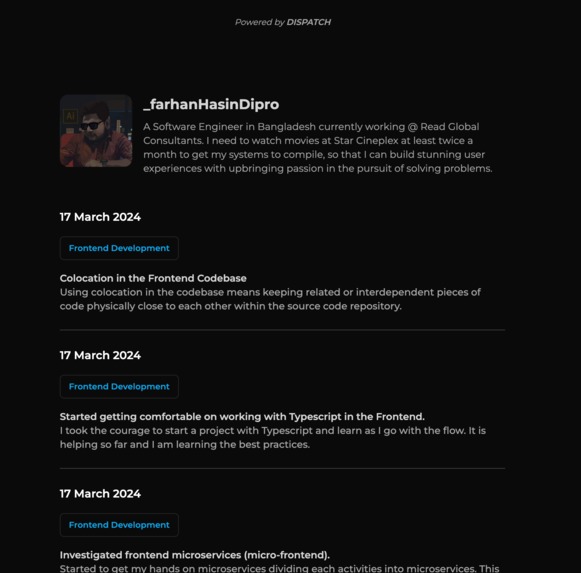
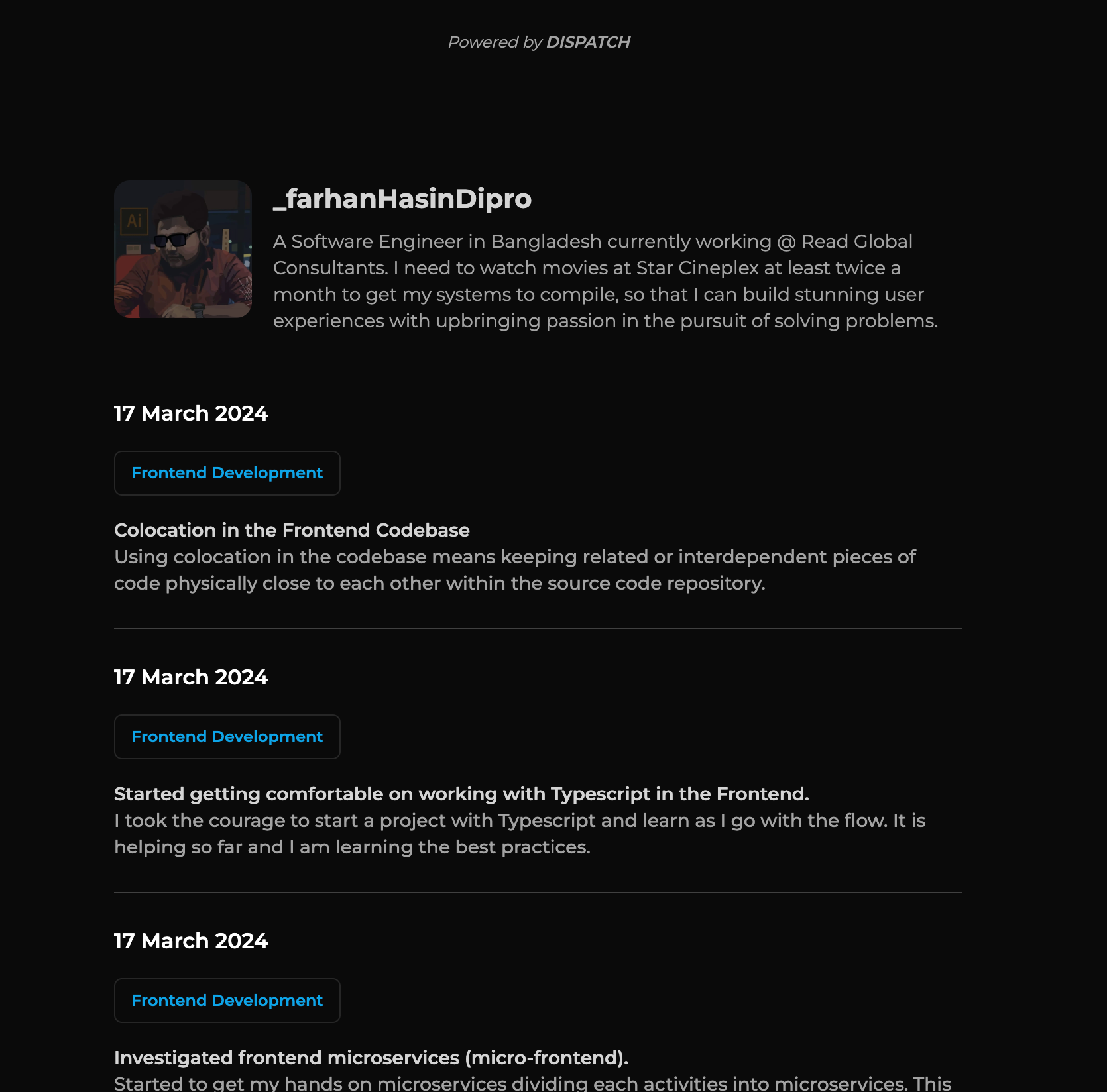
Public Page for your Dispatch Profile

Inspiration
There are a lot of good software engineers/developers who faces the following problems.
- They did a course and the projects done there were not feasible and worthy of sharing in a portfolio.
- They got a job, worked there for 1 year but do not have permission to share those projects.
- They are not getting time to do personal projects, or build their own portfolio as they want to build the backend themselves, but did not get the chance to learn backend yet.
- They know they are good developers because they are exploring new stuff in their work everyday. Working on new, exciting features, or learning new topics, but not getting the time to do something worth showcasing those skills.
- Thus, if this person applies to jobs, they get rejected.
What it does
Dispatch is a platform that solves these problems by providing an interface that looks like a timeline. Aspiring developers can use this platform to get into the limelight until they build their own projects/portfolios. They can add activities based on certain tags provided by us. The activity logs can be seen in the dashboard and the public page can be previewed. This public page can be shared among recruiters during job applications to put a lasting impression. The activities can be related to anything related to Software Engineering that they are doing in their daily lives/current jobs. Sometimes we do quite interesting things, or apply concepts at our jobs, but since those projects are not allowed to be shared and the developer is not finding time to use those concepts to build a new project, they can simple add that concept as an activity in Dispatch.
Example; Topic: Implemented a notification system using Tanstack Query and Object Mapping Thoughts: Achieving this using Tanstack Query and Object Mapping helped me learn a lot of things and also have a good practice of Javascript Objects and code optimization.
How we built it
We maintained a dark mode clean and minimalistic user interface which is quite trending among aspiring Software Engineers nowadays. Our app's frontend is built using NextJS with Typescript and is styled with TailwindCSS and HeadlessUI. The backend is built using Convex and the authentication is handled using Clerk.
Challenges we ran into
One interesting problem that we ran into was querying many-to-many relations in Convex with pagination. However, we managed to solve that issue by diving into the type system of Convex. You can find our solution in the convex/logs.ts file.
Accomplishments that we're proud of
But we are happy to pull off a working MVP as the timeline was our limelight.
What we learned
Primarily we learned how to build apps in the fastest way possible using Convex. Since we have a template ready we can launch other MVPs really fast now.
What's next for Dispatch
We will be working on Dispatch's next version which would include the following:
- A timeline: Showing the activities of the latest year, every month. This is where the developer gets to showcase what stuff he has been doing on a daily basis.
- Feats: Shows byteSizeVictories -> What stuff they are capable of doing now. currentlyFightingFor -> What they want to learn. skills.
- Work: Showcasing their work experience.
- Projects: They can showcase their featured projects and learning projects.
- Blogs: Showcase blogs written in markdown.
- Education: Showcasing their achieved degrees.
- On the web: All social links
- AI Search Engine: Recruiters can ask anything they would like to ask the person during a real interview and the AI would answer the questions. This will help massively to minimize the tedious initial pre-screening recruitment processes.
You can take a sneak peak of what's to come here: https://dispatch-theta.vercel.app/portfolio
Built With
- clerk
- convex
- headlessui
- nextjs
- tailwindcss
- typescript

Log in or sign up for Devpost to join the conversation.