-
-
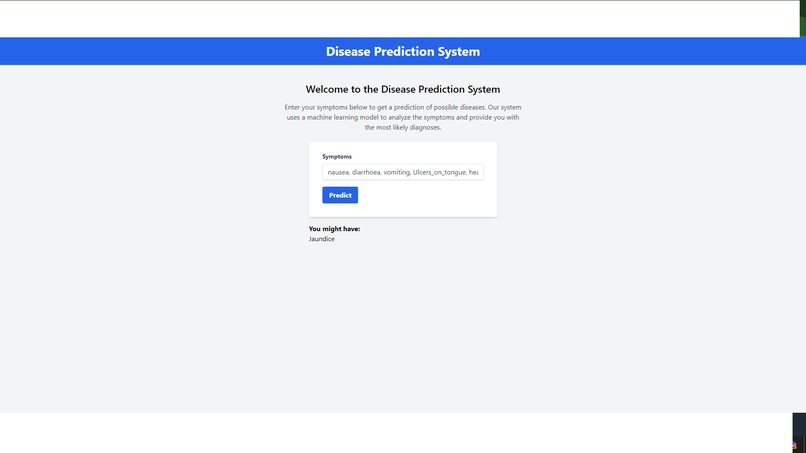
Disease predictor in action.

Inspiration
Our inspiration came from observing how challenging it is for patients to receive timely and accurate diagnoses. We aimed to create a tool that could assist both patients and healthcare providers by predicting potential diseases based on symptoms.
What it does
The Disease Predictor AI is a machine learning model designed to predict potential diseases based on a set of input symptoms. Users provide a list of symptoms, and the AI outputs a list of potential diseases that match the symptoms. This can help in early diagnosis and guiding patients towards appropriate medical consultation.
How we built it
We built the Disease Predictor AI using the following technologies:
Backend: Flask (Python) for serving the model and handling API requests. Machine Learning: XGBoost for training the disease prediction model. Frontend: A simple HTML interface for user interaction. Deployment: The model is deployed on a local server using Flask, and we used Postman for API testing. The model was trained using a dataset of symptoms and diseases, and the Flask API was built to handle requests and provide predictions based on the trained model.
Challenges we ran into
We faced several challenges during the development process:
Model Serialization Issues: We encountered problems with loading and saving models due to version mismatches. This was resolved by ensuring consistent library versions across environments. API Integration: Integrating the machine learning model with the Flask API required handling complex data formats and ensuring smooth data flow. Deployment: Deploying the model on a local server presented issues with configuration and compatibility, which were addressed by adjusting server settings and ensuring all dependencies were correctly installed.
Accomplishments that we're proud of
We are particularly proud of the following accomplishments:
Successfully developing a machine learning model that can predict diseases with a reasonable degree of accuracy. Creating a functional API that allows users to interact with the model and receive predictions. Overcoming technical challenges related to model serialization and deployment.
What we learned
Through this project, we learned:
The importance of version control in machine learning environments to avoid compatibility issues. Best practices for integrating machine learning models with web APIs. How to handle and preprocess data effectively for use in machine learning models.
What's next for Disease Predictor AI
Future plans for the Disease Predictor AI include:
Enhancing the model with more comprehensive datasets to improve prediction accuracy. Adding more features to the user interface for better interaction and usability. Exploring deployment options on cloud platforms for scalability and wider accessibility.

Log in or sign up for Devpost to join the conversation.