-
Disease Detection
Inspiration
In rural areas, many people face difficulty accessing doctors and hospitals. Often, they don’t understand their symptoms or which medicine to take. This inspired us to build a simple yet powerful system that can help anyone quickly detect possible diseases from their symptoms and get basic guidance, even if they don’t live near a medical facility.
What it does
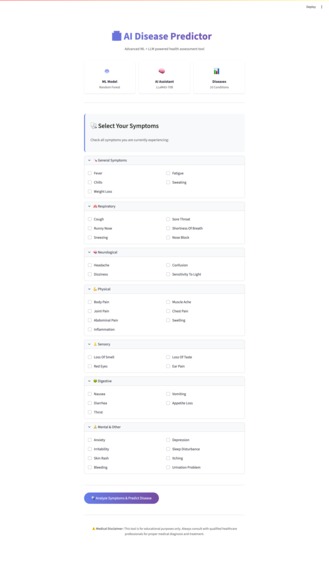
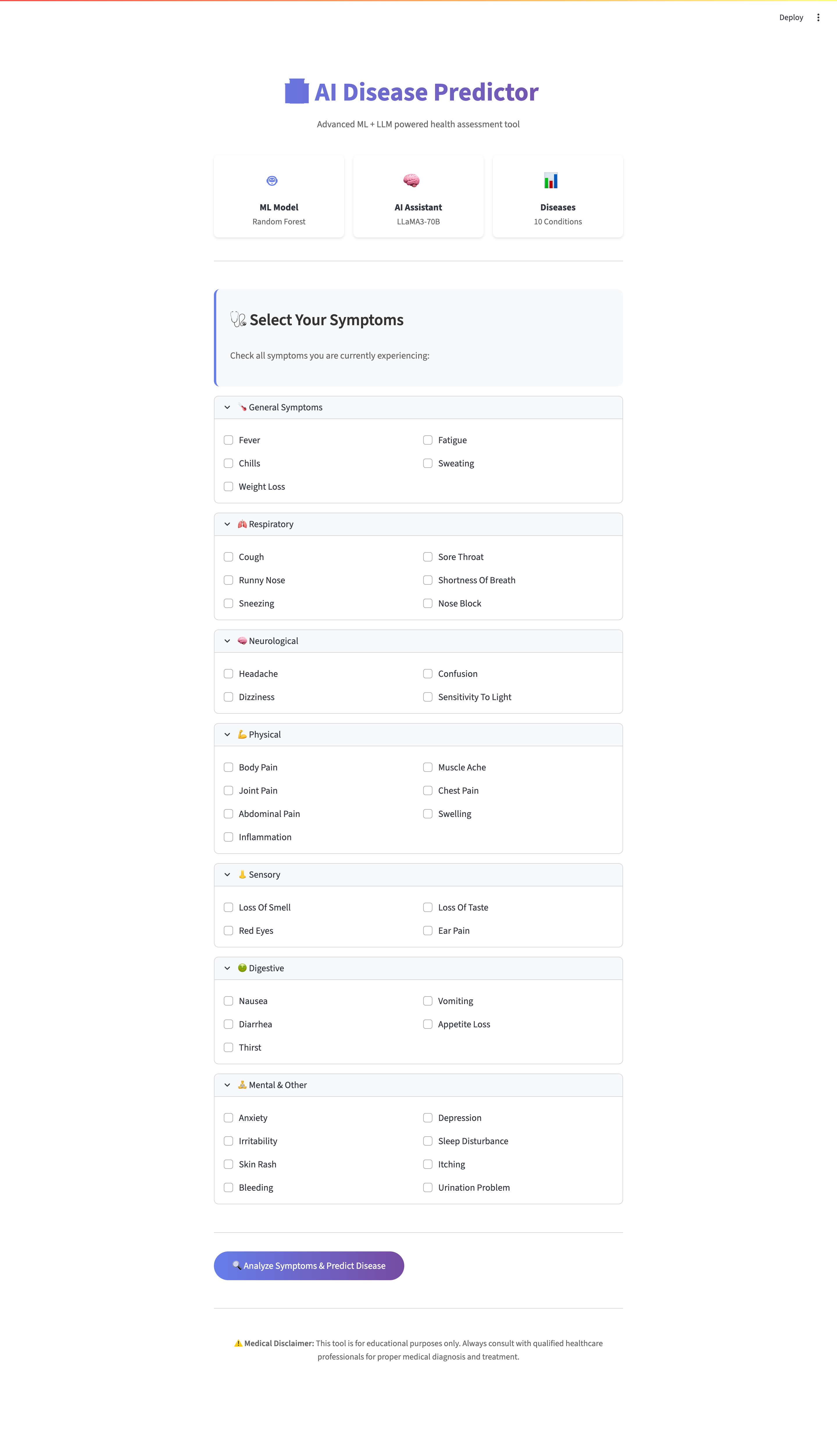
Our Disease Detection system allows users to enter their symptoms, and it predicts possible diseases using a trained machine learning model. Along with predictions, it suggests basic medicines, lifestyle tips, and when to consult a doctor. The system acts as a smart health assistant that empowers people with quick health insights.
How we built it
Dataset – We collected disease-symptom datasets from open medical sources.
Machine Learning Model – We trained a classification model (Decision Tree/Random Forest) using Python’s scikit-learn to map symptoms → diseases.
Frontend – Built using React.js for a simple and user-friendly interface where users can input symptoms.
Backend – Implemented with Flask/Node.js to handle requests, connect the model, and return predictions.
Integration – Connected frontend and backend, ensuring real-time predictions.
Challenges we ran into
Finding a clean and reliable dataset was tough. Many datasets were incomplete or inconsistent.
Training the model to balance accuracy while keeping predictions fast was challenging.
Designing the UI in a way that even a non-technical rural user could easily use the app.
Accomplishments that we're proud of
We successfully built a working prototype that can predict diseases from user symptoms with good accuracy.
The app gives not only predictions but also basic remedies and advice, making it more useful.
Our system works on web and mobile, which means accessibility for a wider audience.
What we learned
How to preprocess real-world medical datasets and handle missing values.
Building and training machine learning models for classification tasks.
Full-stack integration: connecting React frontend, backend APIs, and ML model.
Importance of user-centered design in healthcare applications.
What's next for Disease Detection
Improve accuracy by using deep learning and larger datasets.
Add multilingual support so rural communities can use the app in their local language.
Integrate with telemedicine, allowing users to connect directly with doctors after predictions.
Add voice input so that even non-literate users can interact with the app.
Built With
- pandas
- streamlit


Log in or sign up for Devpost to join the conversation.