-
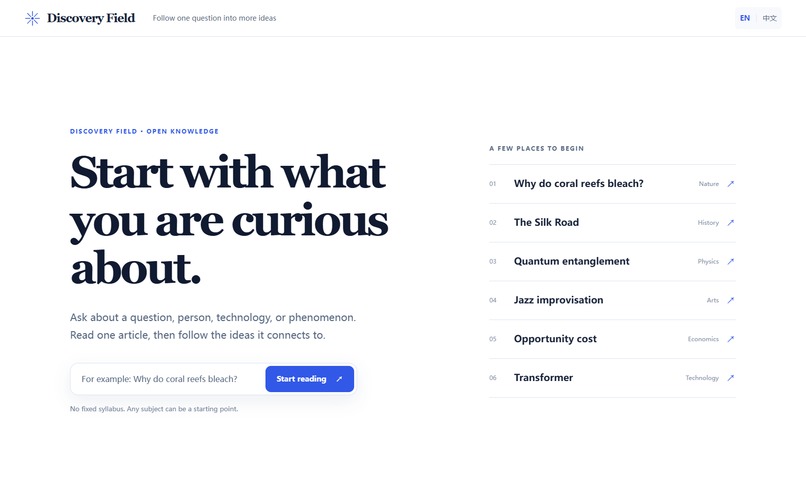
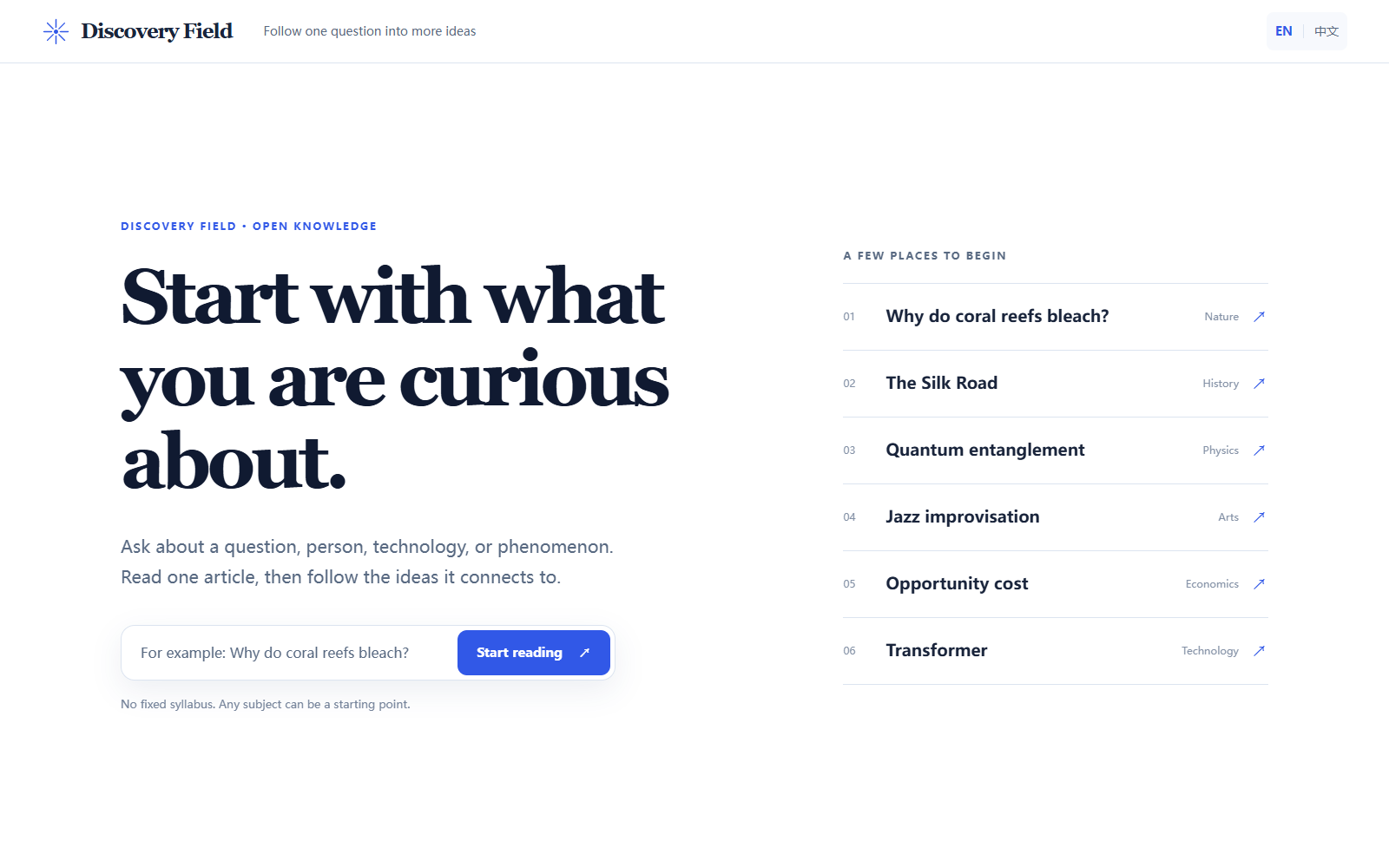
Start with a question: an open search across science, history, arts, economics, and technology.
-
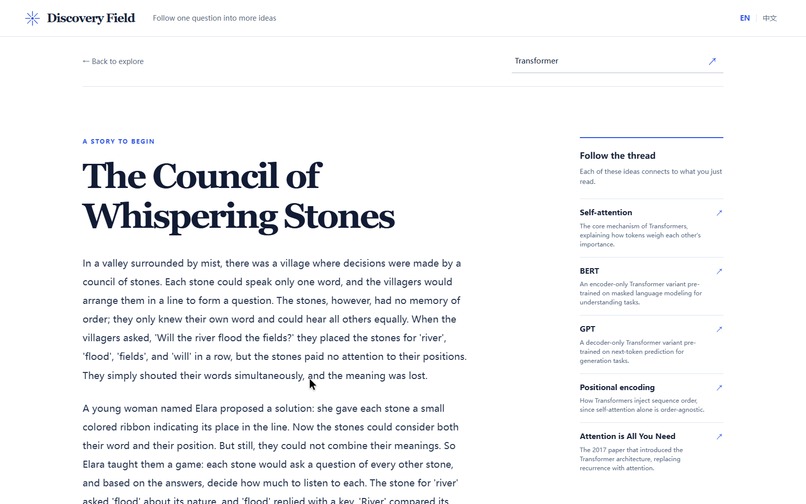
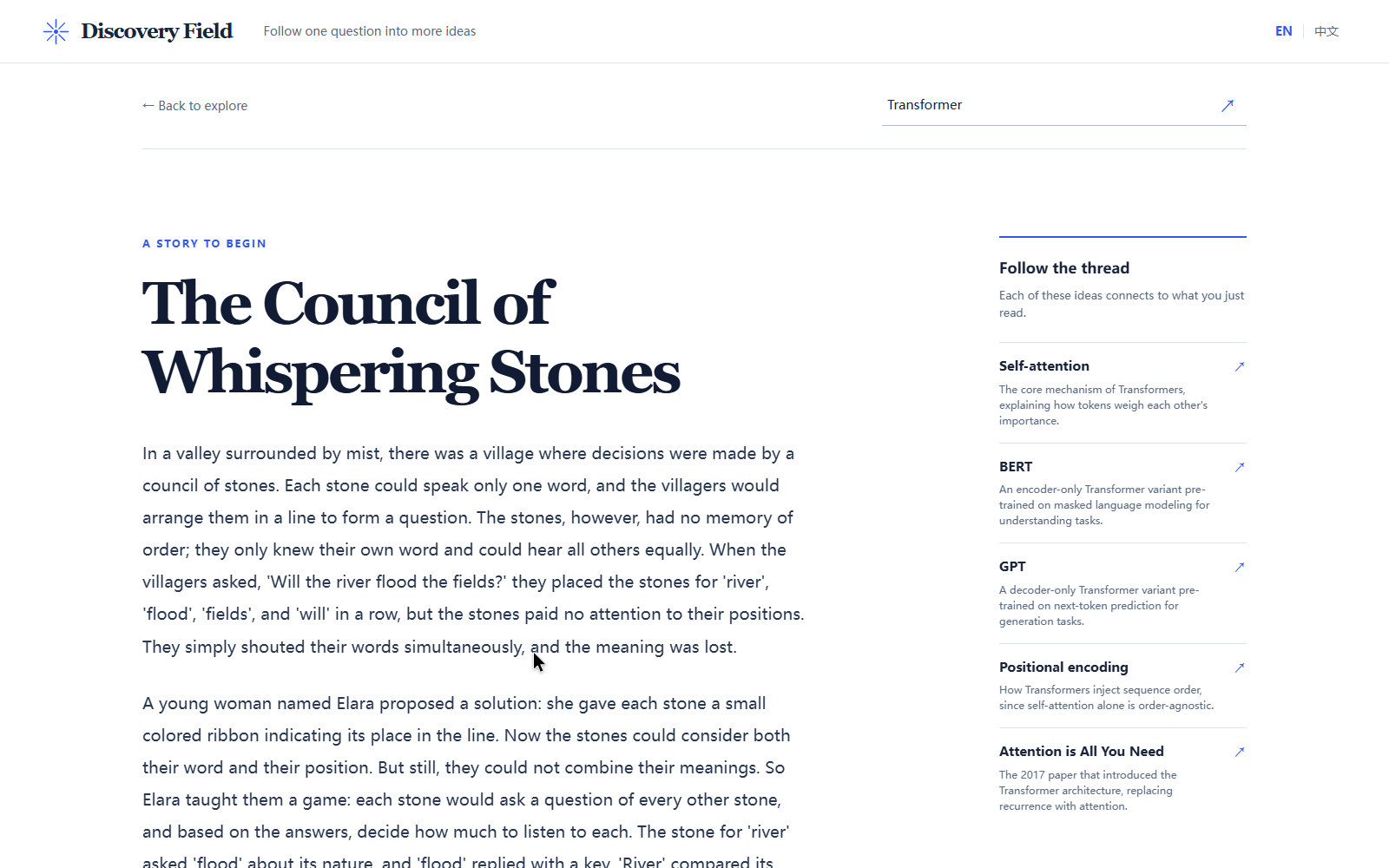
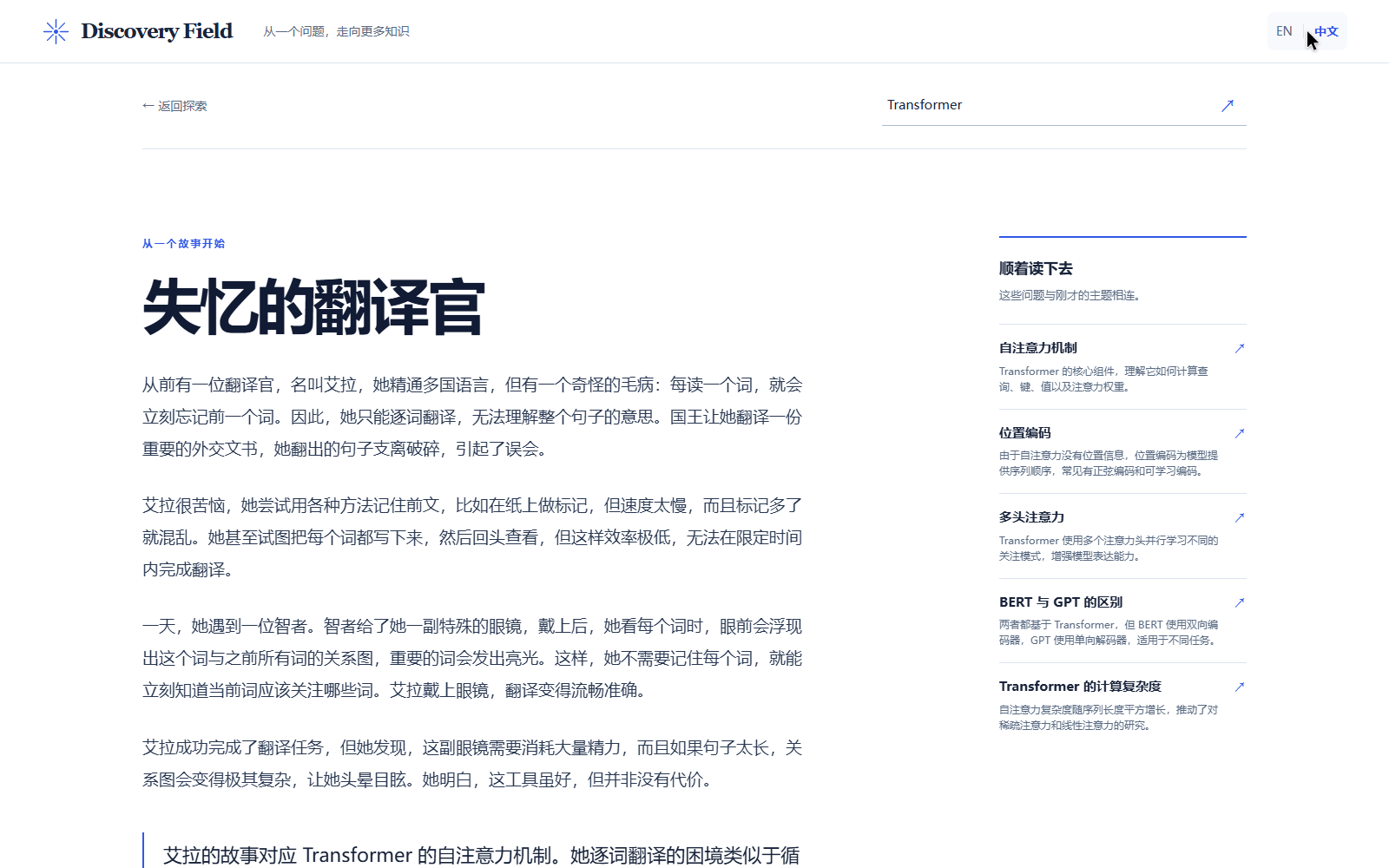
An advanced concept starts as a complete fictional story, before the technical reveal.
-
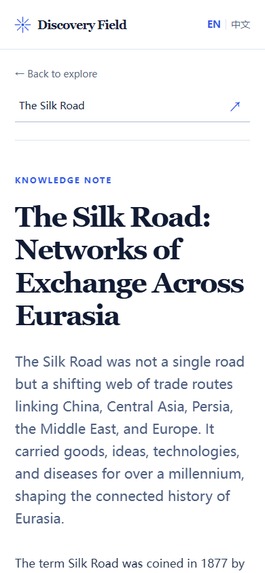
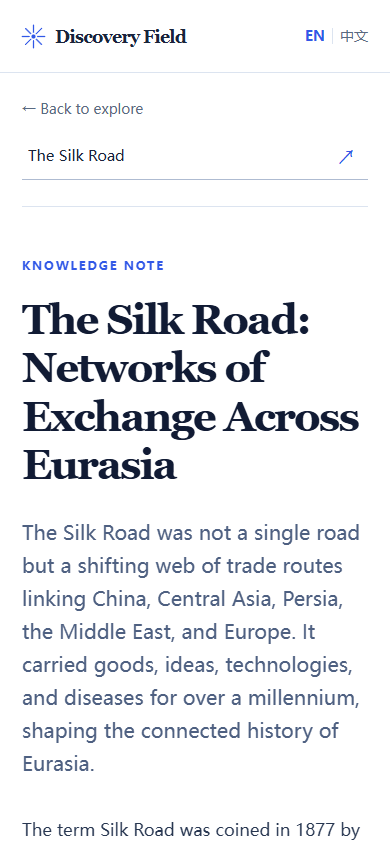
The same article reader adapts to a 390-pixel mobile viewport.
-
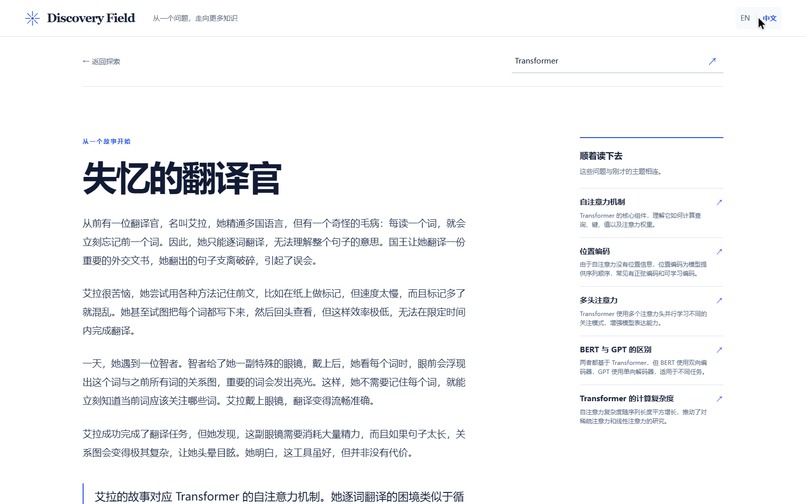
Simplified Chinese offers another reading version of the same requested topic.
-
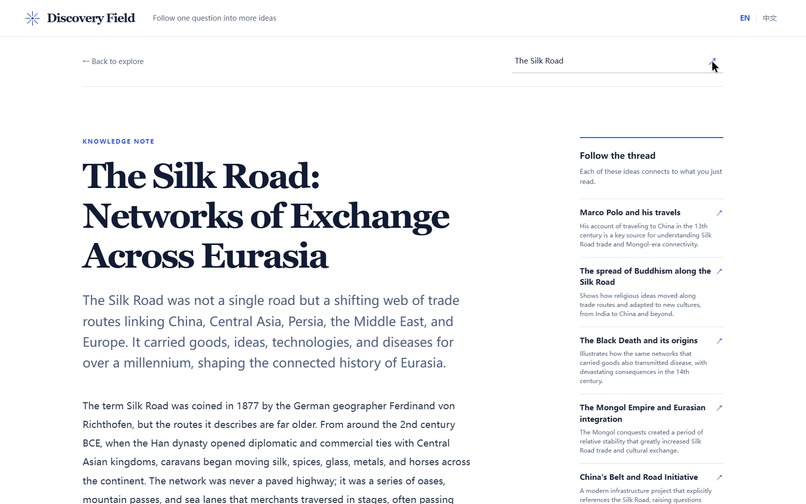
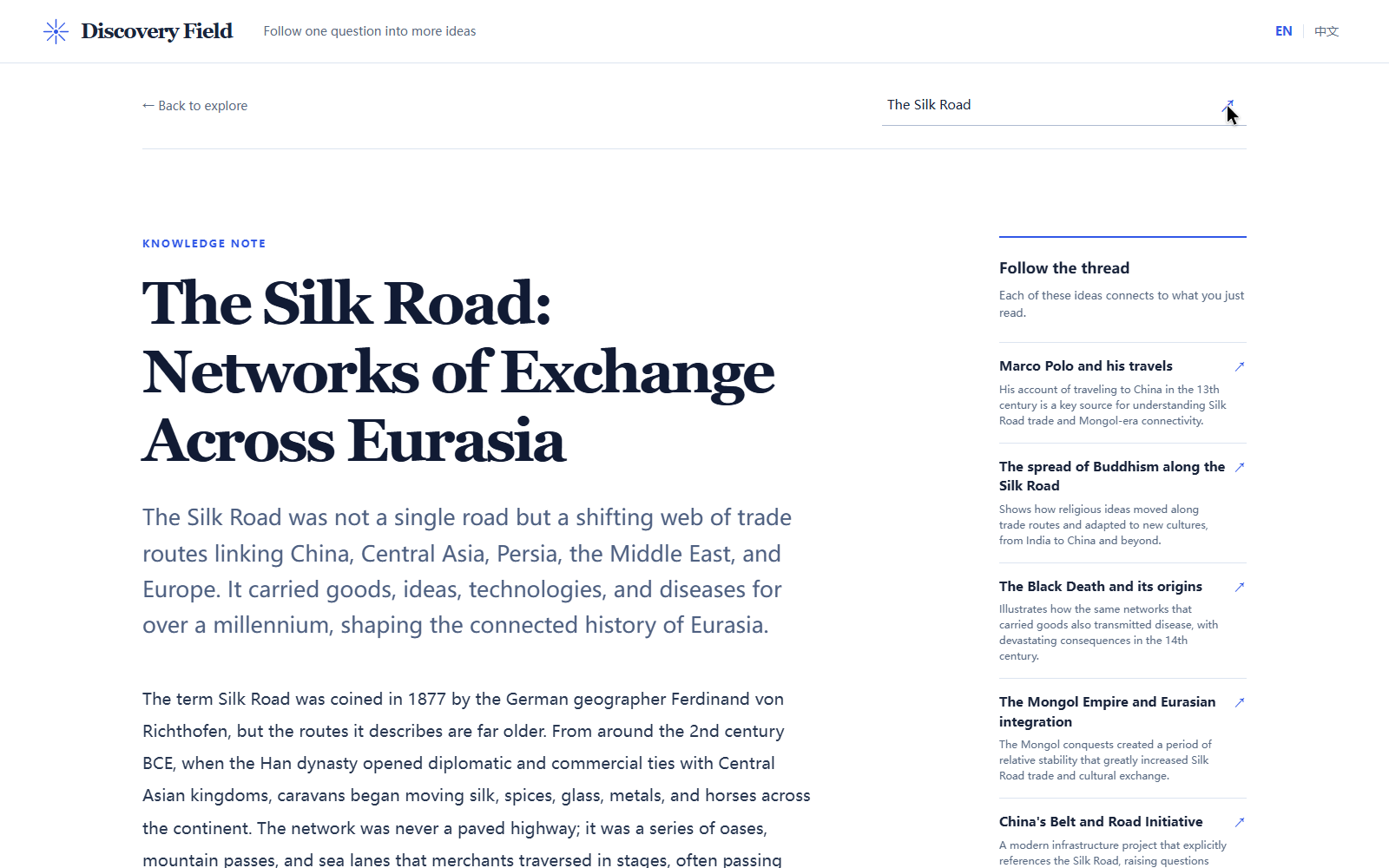
Factual topics use direct prose instead of fictionalized history.
Inspiration
Curiosity rarely arrives as a syllabus. Someone wonders why a coral reef turns white; someone else wants to understand an idea they encountered in an AI paper. Both need a place to start without first proving what they already know.
Discovery Field began as an adaptive-learning prototype. During development, we found that grading and prerequisite gates were getting between the reader and the idea. The current version takes a simpler direction: enter a topic, read a coherent explanation, and follow a connection that interests you.
What it does
Discovery Field is an English and Simplified Chinese knowledge reader. A user can search for a question, person, phenomenon, or technical concept—not just choose from a fixed course.
For advanced concepts, the article starts with a fictional story. A character faces a problem, tries an approach, and encounters its consequences. Only after the story does the article reveal the concept, explain the actual mechanism, and map the story's images to the underlying ideas. Those mappings also make room for the analogy's limits.
Ordinary factual topics are explained directly rather than turned into invented history. Related-topic links offer several directions to explore. There are no learner tests, grades, locked lessons, or mandatory questionnaires in the public experience.
How we built it
The application uses Next.js, React, TypeScript, Tailwind CSS, and Zod. A server-side route sends the selected topic and language to a configured DeepSeek Chat Completions endpoint. The API key never needs to be present in client code.
The response must satisfy a strict, bounded article contract before it reaches the reader. Story, reveal, explanation, metaphor mapping, and related topics are separate fields rendered in an intentional order. Provider failures become safe error codes with a retry control, not invented articles or raw error dumps.
Identical concurrent requests share their in-flight work. The reader also keeps already-loaded language versions in memory, so switching back does not require another generation during the same visit. These are request-efficiency measures, not a permanent library or a guarantee of factual accuracy.
Challenges
The hardest decision was removing features. An earlier version could give an encouraging result for an answer that did not demonstrate understanding. That made a clean interface less important than an honest product boundary. We removed assessment from the public reader instead of presenting a model's judgment as proof of learning.
Another challenge was getting stories to explain rather than decorate. The output contract preserves the complete story, delays the reveal, and then requires a separate technical explanation. Structure can be validated; educational quality still needs human review.
Accomplishments
The working prototype demonstrates open-topic reading, bilingual navigation, story-first technical explanations, and related-topic exploration on desktop and mobile. Automated tests cover article contracts, service failures, navigation, language behavior, and responsive rendering. Live-provider captures are documented separately from tests that use mock responses.
What we learned
More features do not automatically make a better learning experience. Giving readers freedom, readable prose, and a clear account of uncertainty can matter more than assigning them a score. We also learned to separate a valid JSON response from a trustworthy explanation: one is a software check; the other requires evidence and editorial judgment.
What's next
The next priorities are source retrieval with verifiable citations, expert review of selected articles, and observation of real readers. A public service also needs rate limits and cost controls. Illustrations should clarify the specific idea rather than simply fill space. These are planned improvements, not features claimed by this submission.
AI and limitations disclosure
Codex / ChatGPT, Gemini through Antigravity, and MiMo assisted development, writing, debugging, and review. DeepSeek generates runtime articles. Full disclosure is in the README and Built With list. The prototype is not an independently verified encyclopedia, has no measured learning-outcome claim, and does not yet retrieve or verify sources. It depends on a paid API service.

Log in or sign up for Devpost to join the conversation.