Inspiration
Every year, nearly 1 in 5 hospital patients in the US is readmitted within 30 days — often because the instructions they received at discharge were too complex to follow. Discharge summaries are written for clinicians, not patients. They're filled with medical jargon, Latin abbreviations, and implied next steps that a stressed, just-discharged patient is unlikely to decode correctly at home.
We built the Discharge Summary Translator to close that gap: an A2A agent that takes a clinical discharge note, rewrites it in plain language the patient can actually act on, and flags whether the patient is at elevated risk of coming back.
What it does
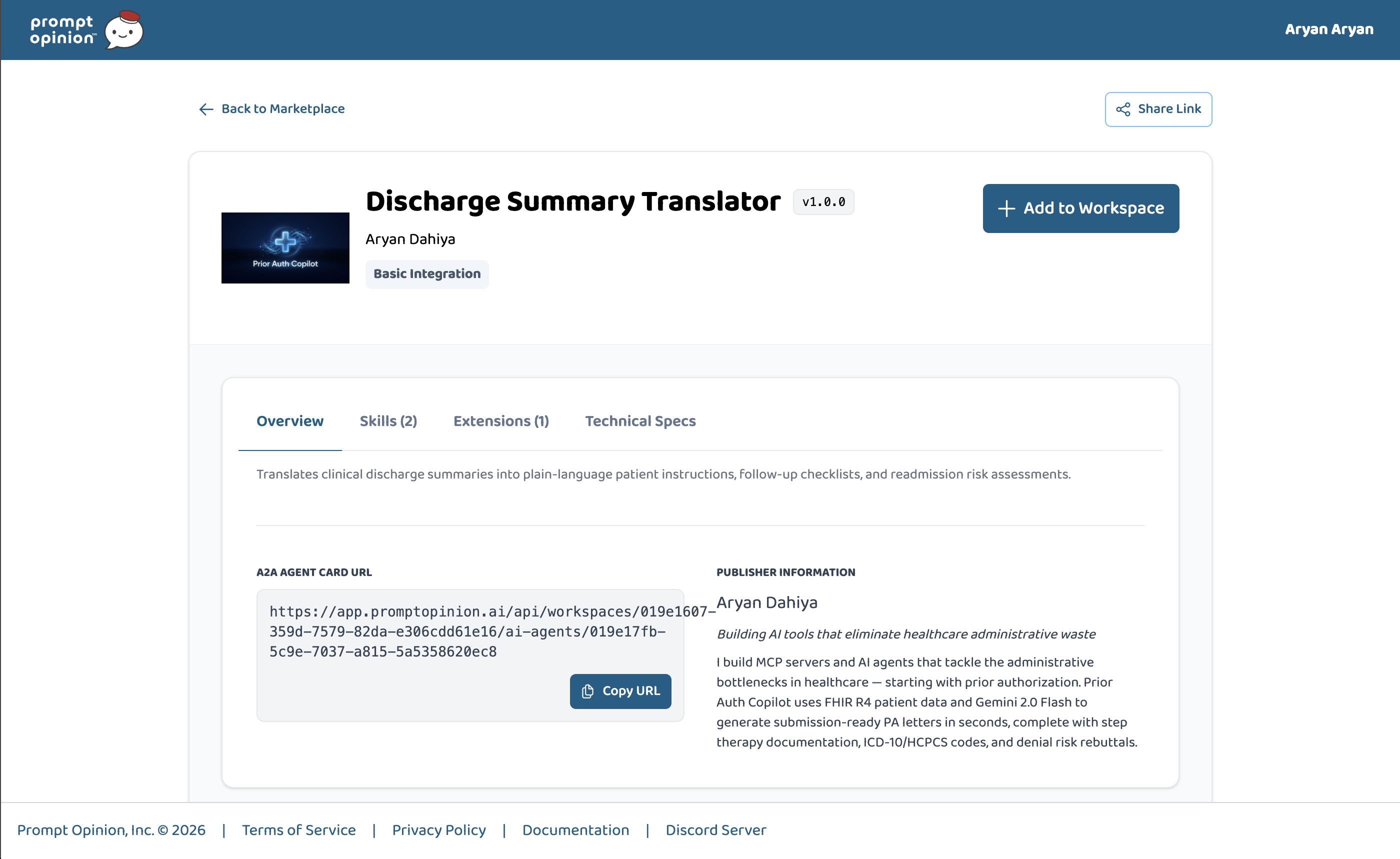
The Discharge Summary Translator is a BYO Agent built on the Prompt Opinion platform with A2A protocol enabled. It exposes two skills:
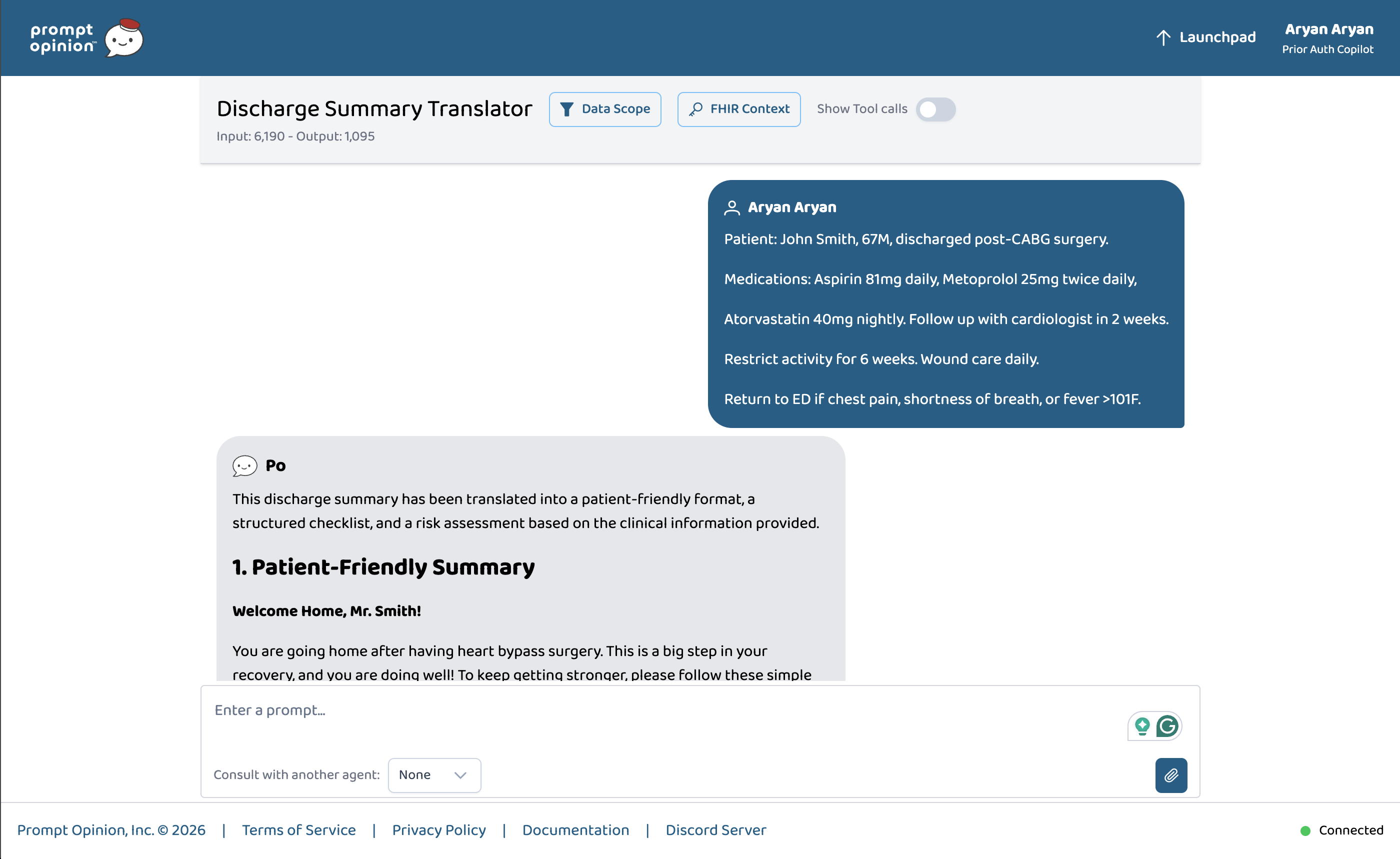
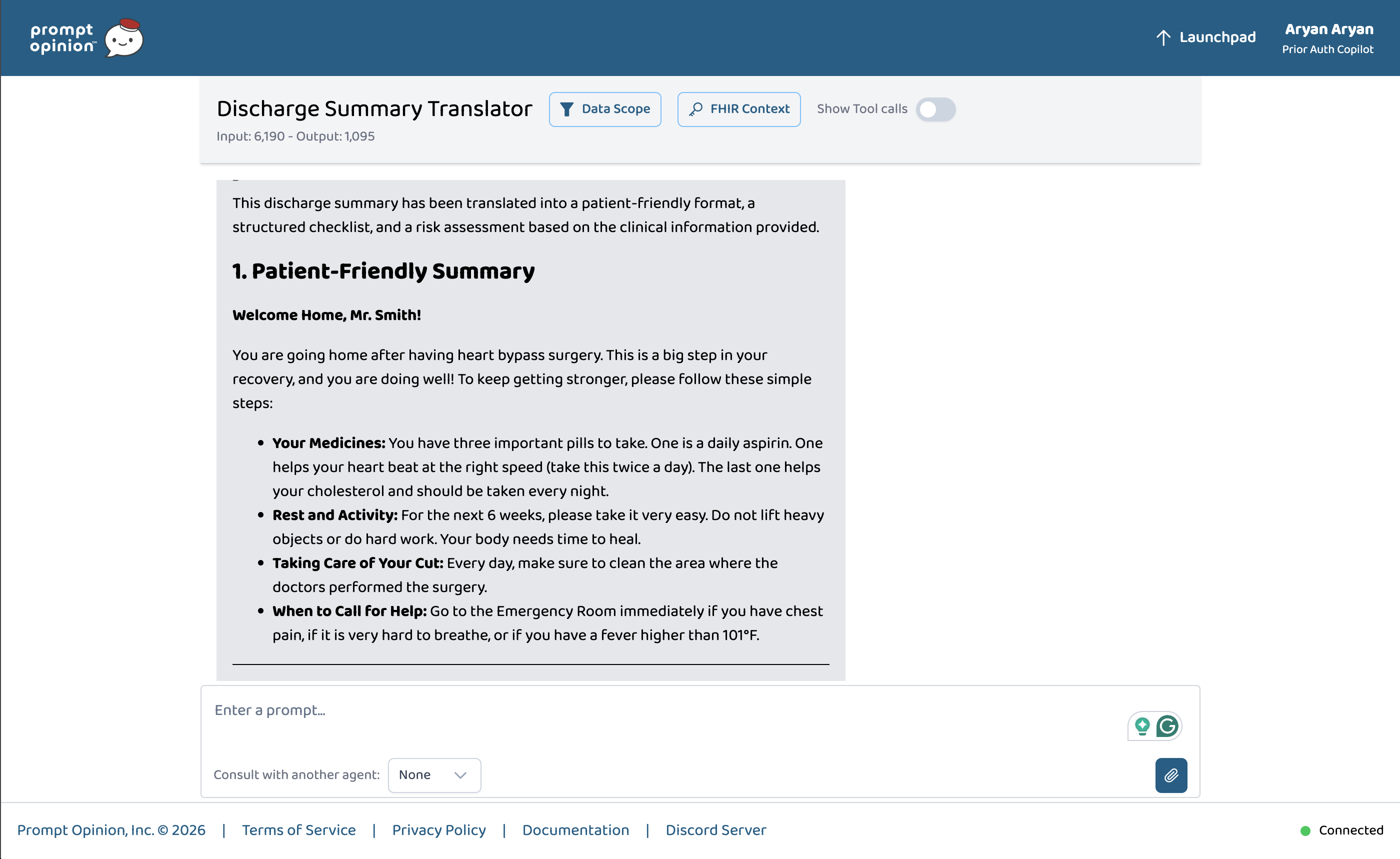
• translate_discharge_summary — Takes a clinical discharge note (with FHIR R4 context) and produces a plain-language version: medication instructions, follow-up appointments, warning signs to watch for, and activity restrictions — all in simple, actionable language.
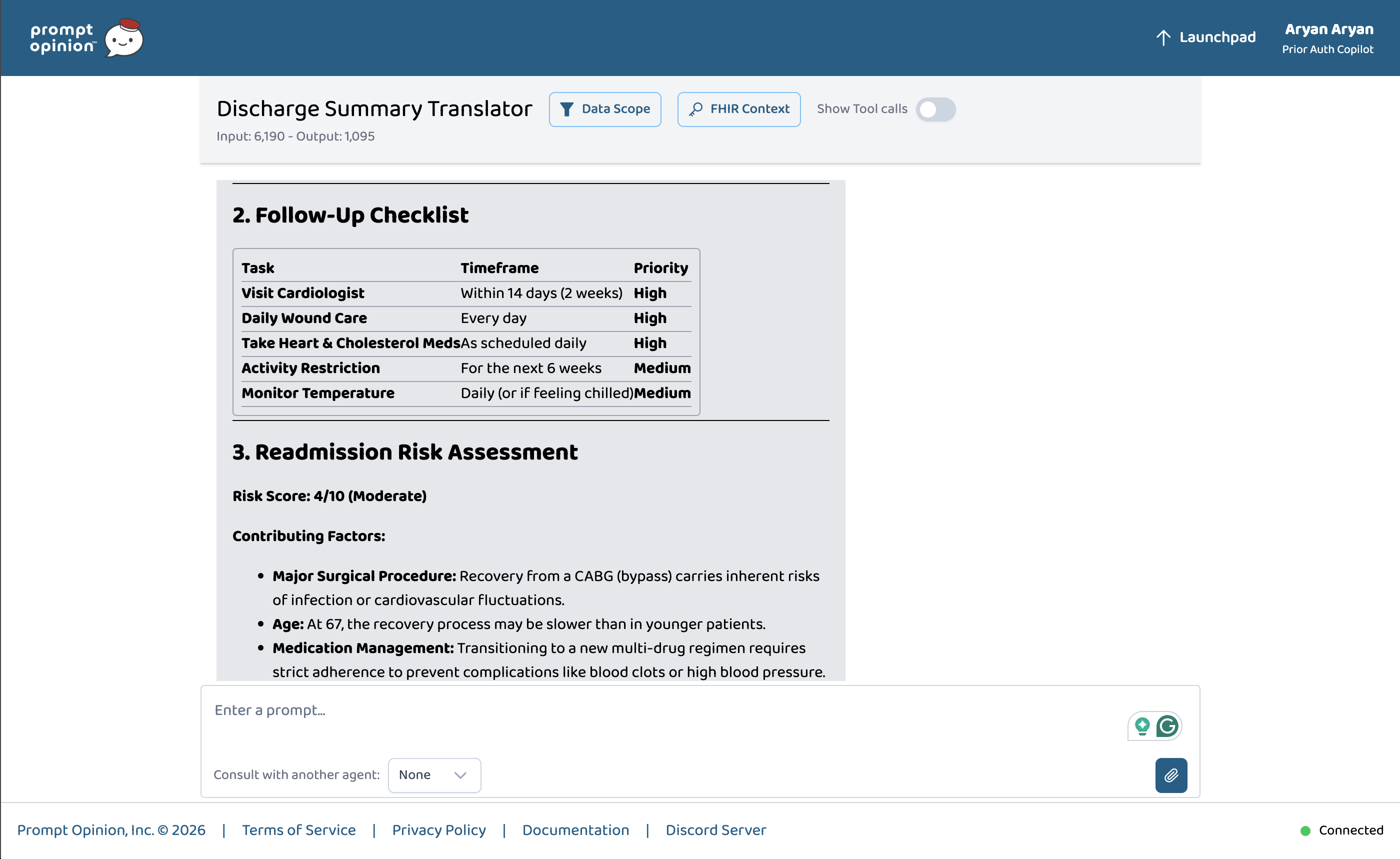
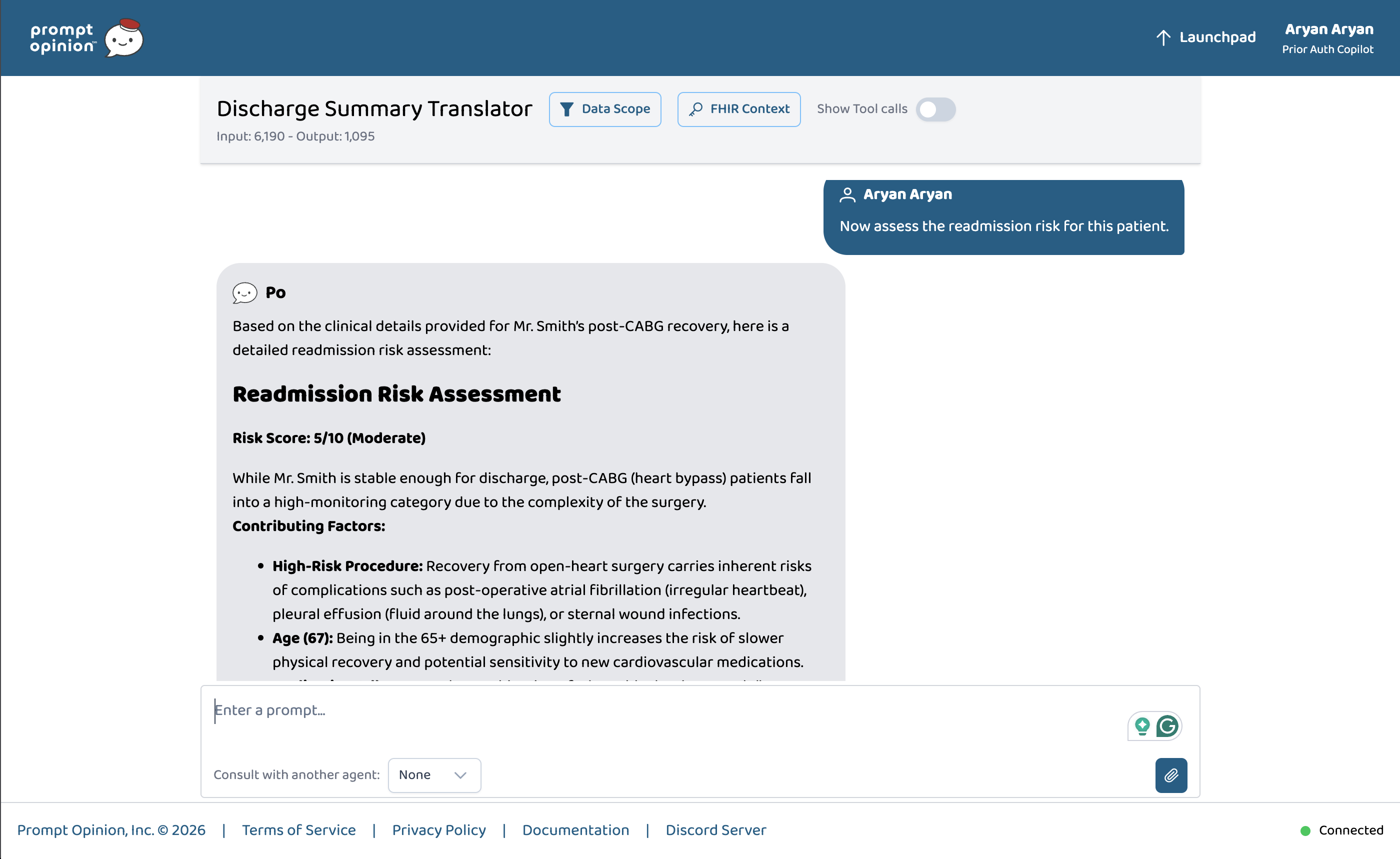
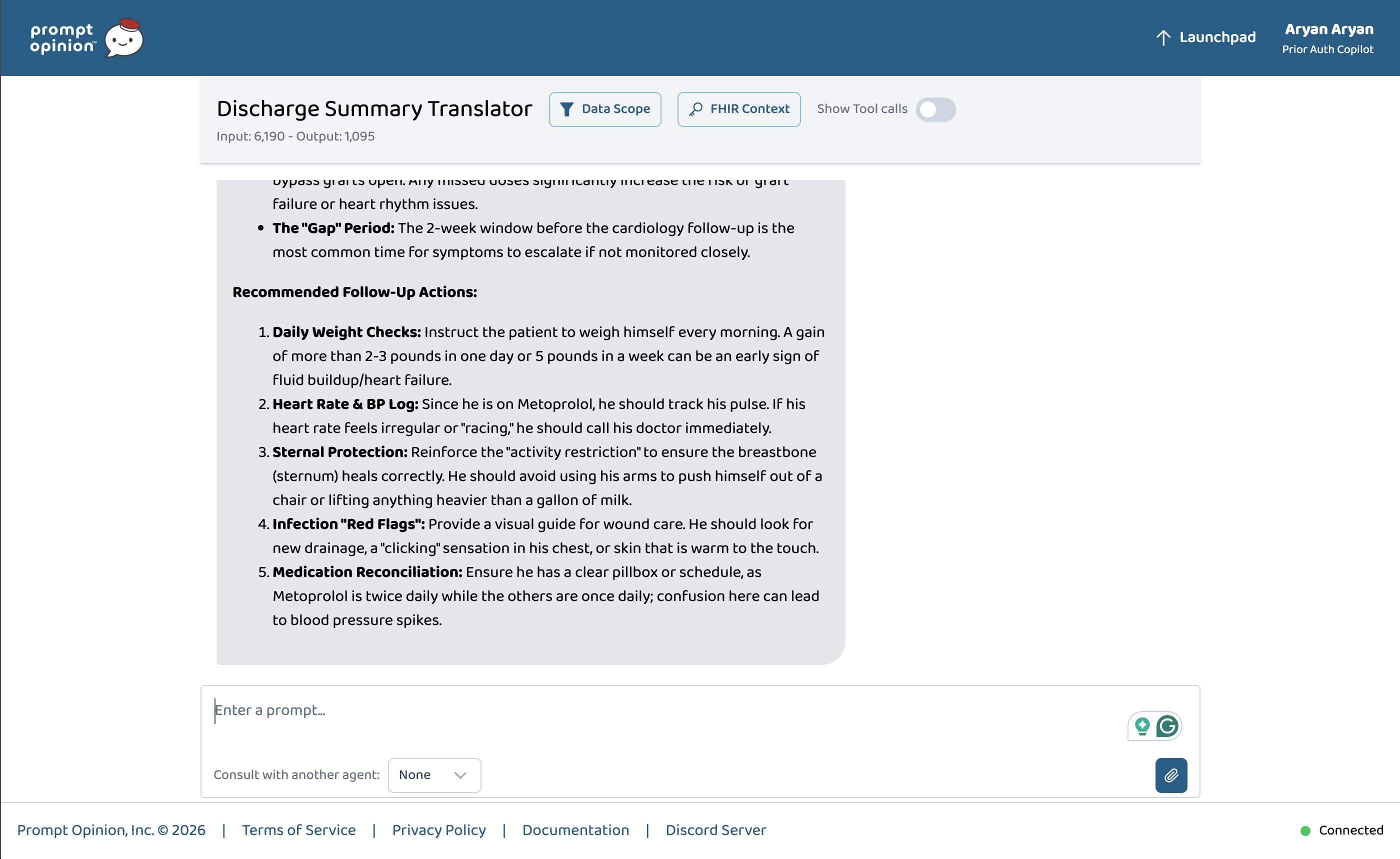
• assess_readmission_risk — Analyzes the discharge summary context to estimate whether the patient is at elevated risk of a 30-day readmission, surfacing the key contributing factors so care coordinators can intervene proactively.
All data is synthetic. No PHI is processed or stored at any point.
How we built it
The agent was built entirely within the Prompt Opinion platform as a Custom BYO Agent. The system prompt was carefully engineered to ground the agent in clinical communication best practices — using a reading level of grade 6–8, avoiding jargon, and structuring output into clearly labeled sections (medications, follow-up, red flags, activity).
The FHIR context extension was enabled so the agent can reason over structured FHIR R4 resources — conditions, medications, care plans — alongside the free-text discharge note. A2A protocol was enabled to allow other agents and orchestrators to invoke the two skills programmatically.
The agent was then published to the Prompt Opinion Marketplace for discovery.
Challenges we ran into
The hardest part was prompt design. Clinical language is dense and ambiguous — the same medication name can appear under its brand name, generic name, or INN. Getting the translation skill to consistently produce output that is both accurate enough for a clinician to trust and simple enough for a patient to act on required extensive iteration.
Calibrating the readmission risk assessment was also non-trivial. Without a real ML model, the agent reasons over clinical signals in the FHIR context (comorbidities, prior admissions, medication complexity) and must communicate uncertainty appropriately — flagging elevated risk without alarming patients or over-triggering false positives.
Accomplishments that we're proud of
We're proud of how much clinical utility we packed into a zero-code agent build. The FHIR context extension proved powerful — being able to reason over structured medication and condition lists alongside the free-text note meant the translations were meaningfully more accurate than a naive summarization approach.
The readmission risk skill also surfaces genuinely useful signals: polypharmacy, prior readmission history, unresolved diagnoses — things that a care coordinator could realistically act on with a follow-up call.
What we learned
Prompt Opinion's BYO Agent setup is surprisingly fast for healthcare use cases. The FHIR context extension removes a lot of the boilerplate we'd otherwise need to build ourselves. A2A protocol is the right abstraction for this — a translation agent shouldn't be a monolith, it should be composable with orchestration layers, scheduling agents, or EHR connectors above it.
We also learned that "plain language" is harder than it sounds. Patients aren't a monolith — literacy levels, primary language, and health literacy all vary. The next version of this agent should accept a patient profile and adapt reading level and language accordingly.
What's next for Discharge Summary Translator
• Multilingual support — translate summaries into Spanish, Hindi, Mandarin based on patient preference • Adaptive reading level — accept patient health literacy score and calibrate output accordingly • EHR connector — integrate with a live FHIR server (Epic Sandbox, HAPI) so real discharge notes can be pulled in via OAuth • Pair with Prior Auth Copilot — chain the two agents so a discharge triggers an automatic prior auth check for follow-up prescriptions
Built With
- a2a
- agent
- ai
- byo
- context
- data
- discharge
- extension
- fhir
- healthcare
- language
- natural
- opinion
- patient
- planning
- processing
- prompt
- protocol
- r4
- safety
- synthetic

Log in or sign up for Devpost to join the conversation.