-
-
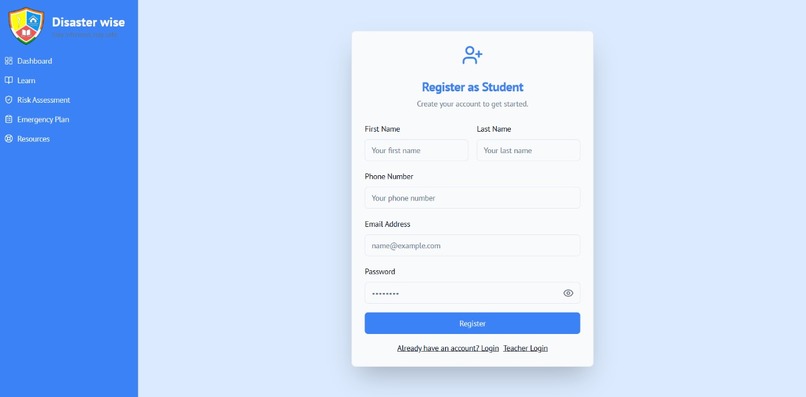
Register Page
-
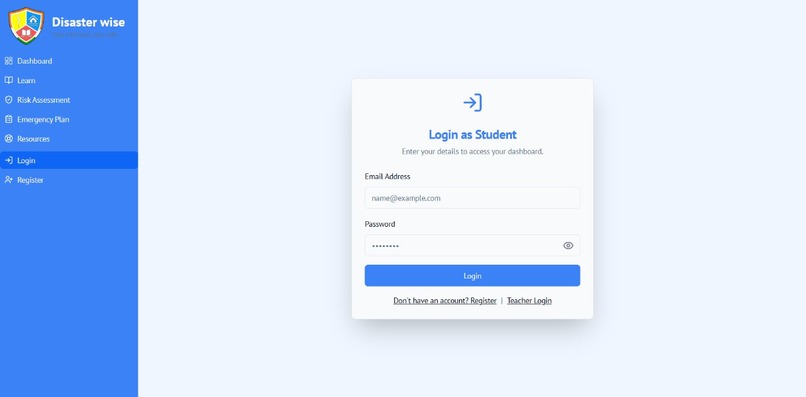
Login Page
-
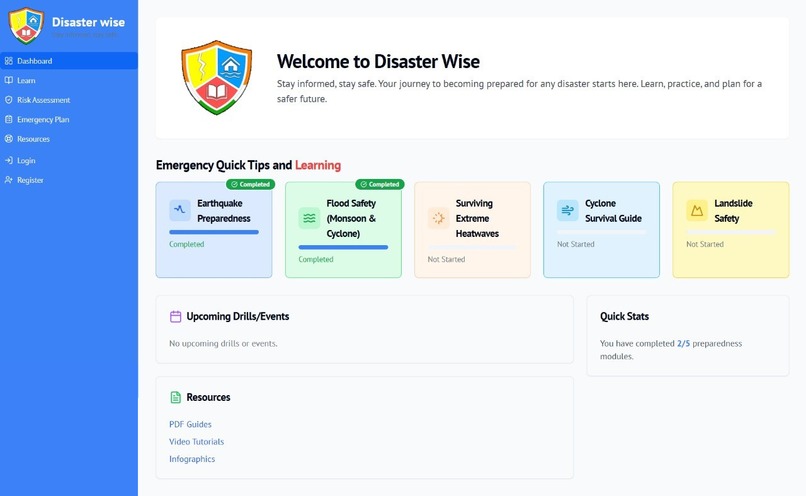
Homepage
-
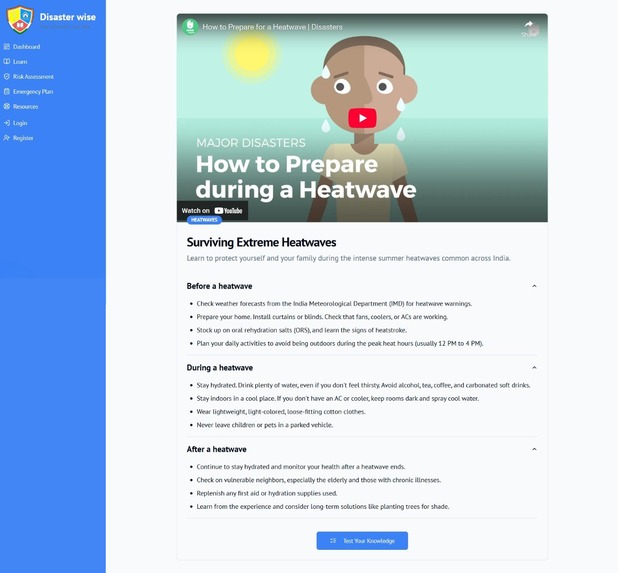
Lessons / Modules
-
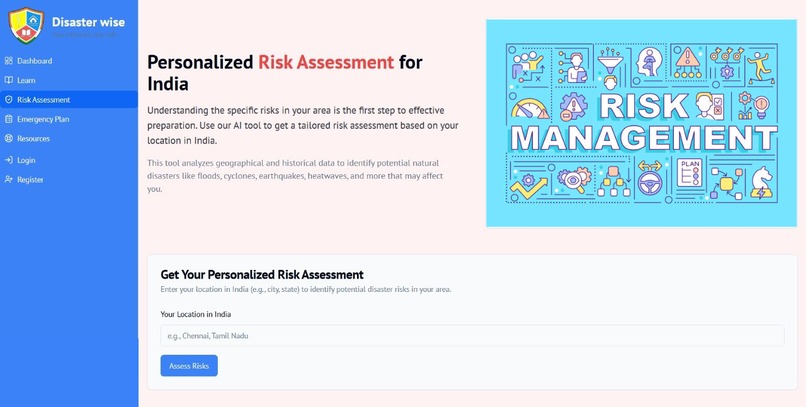
Risk Assessment of an Area
-
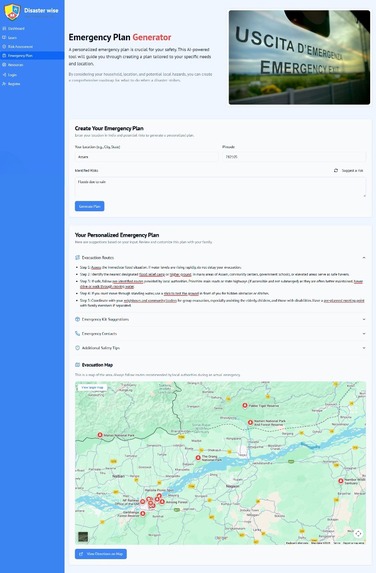
Emergency Plan Generator
-
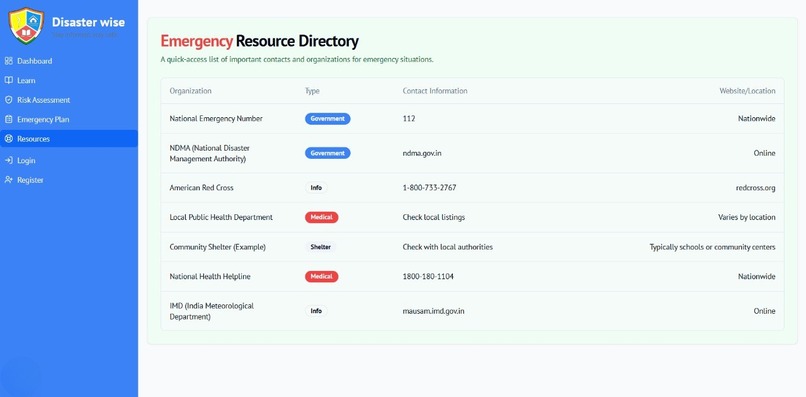
Basic Resources and Helpline Numbers


Inspiration
Every year, India continues to suffer from an average of 8–10 major natural disasters, affecting millions of students and their families. From the 2013 Uttarakhand floods to the 2023 Sikkim flash flood and earthquakes that frequently shake the Northeast, each event showed just how ill-prepared schools and colleges often are.
When we read reports from the National Disaster Management Authority (NDMA) stating that less than 1% of Indian schools have formal disaster preparedness training, it became clear that awareness, not just infrastructure, was the missing link.
Our team was inspired by a simple but powerful question:
“What if every student in India could learn how to stay safe — not through textbooks, but through experience?”
That idea became the foundation of DisasterWise.
What it does
Educates students on disaster preparedness using interactive 3D animations along with AR-based drills. Delivers gamified lessons, including quizzes, "would you rather" decisions, and real-life consequence simulations. Provides region-specific modules for earthquake, flood, fire, and cyclone, among other things. Works seamlessly on smartboards, tablets, and mobiles, making classroom training even more engaging. Track progress with dashboards showing preparedness scores, drill participation, and analytics. Instant notifications and safety warnings in case of emergency drills or actual events. Support for several languages, making it inclusive for diverse regions of India. Encourages practical learning through virtual drills rather than merely passive reading.
How we built it
We followed a modular design approach: Research & Planning– Studied NDMA and UNDRR guidelines on disaster risk reduction in education. Prototype Design: Designed 3 core modules: Home, Lesson, and Dashboard. Implementation: Implemented the frontend using React & Flutter and Firebase for the backend to ease integration and make it scalable. Testing on Smartboards - Assured the UI works in classrooms where interactive boards and projectors are used
Challenges we ran into
Like any other impactful project, DisasterWise had its own share of hurdles: Balancing Technology and Accessibility: We wanted advanced simulations but needed to make sure they worked on low-cost devices used in Indian schools. Creating Realistic Yet Simple Animations: By going without Unity or other heavy 3D engines, we relied on pre-rendered assets to make an application lightweight. Designing for Classrooms, Not Just Phones: Getting the platform to work seamlessly on smartboards meant rethinking how UI scales. Data Availability: Region-specific disaster data collection for personalization of the content was difficult; hence, we started with mock datasets and would later integrate the NDMA APIs. Contrary to this fact, each limitation drove us to innovate-simplicity and purpose go hand in hand.
What we have learned
Bridging Education and Technology: Making lifesaving knowledge engaging and accessible through modern digital tools. Importance of localization: disaster awareness needs to differ based on geographical locations - earthquake-prone vs flood-prone areas. Design for accessibility: Creating lightweight content that runs well on smartboards and other low-end devices. Simplifying complex subjects: turning NDMA guidelines into interactive stories and games that students really enjoy. Collaboration & research: a collaboration process that merges technical, creative and pedagogical insights. User empathy: Understanding how students, teachers, and administrators interact with digital education tools
What's next for DisasterWise
Integrate Real-time Alerts: Connect with NDMA and IMD APIs for live disaster warnings. Add AR & Voice-Based Learning: Students can explore safe evacuation routes with AR and audio guidance. Rollout of Nationwide Pilot: Collaborate with schools and education boards for the integration of DisasterWise into their safety curriculum. Expanding Content Library: Add a number of other modules on first aid, mental health during disasters, and climate resilience. AI-based personalization: Analytics will be used to tailor lessons to each student’s learning pace and region-specific risks. Offline Mode: Ensure access for rural and low-internet regions using preloaded modules. Government & NGO Collaboration: Work with NDMA, NCERT, and UNICEF for scaling up in India.
DisasterWise is more than just an app, it's a step towards a disaster-resilient India. We believe that if even one student is able to remember what to do in a crisis because of this platform, the effort will have been worth it.

