-
-
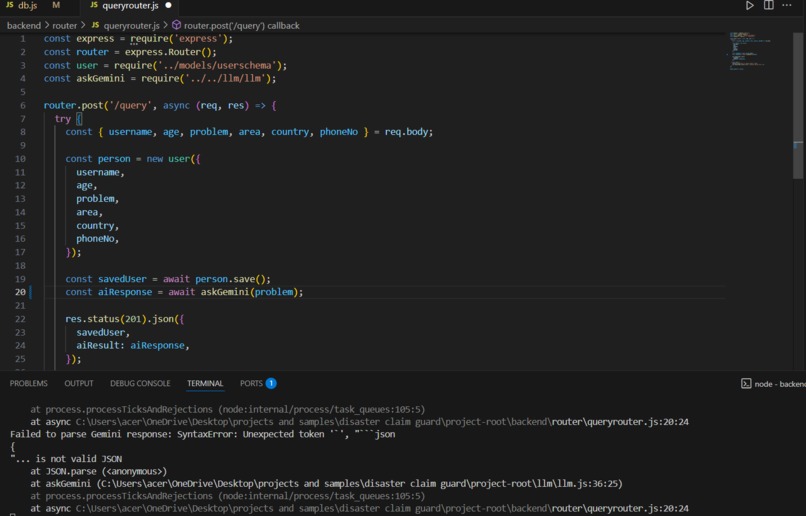
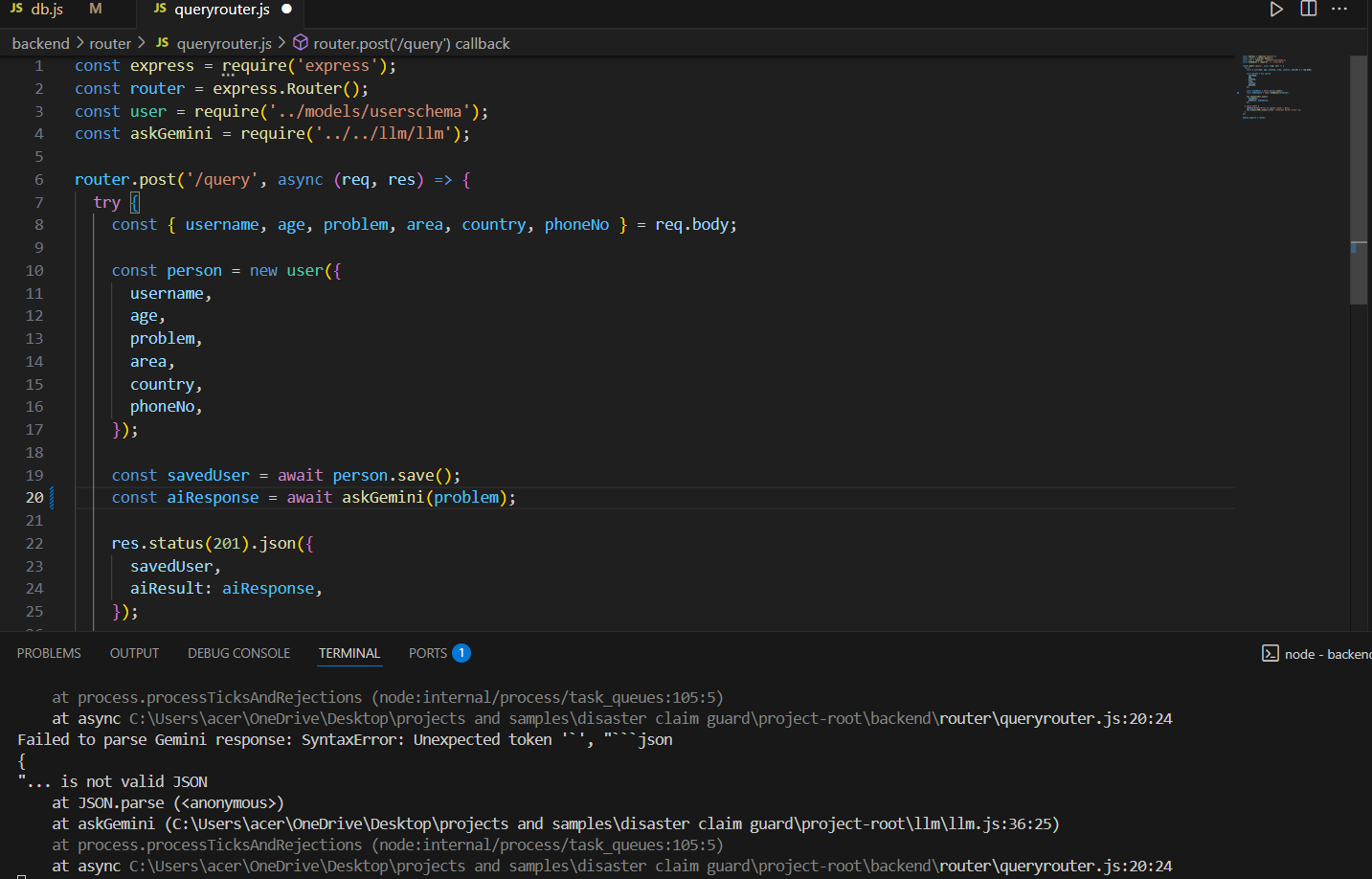
express router
-
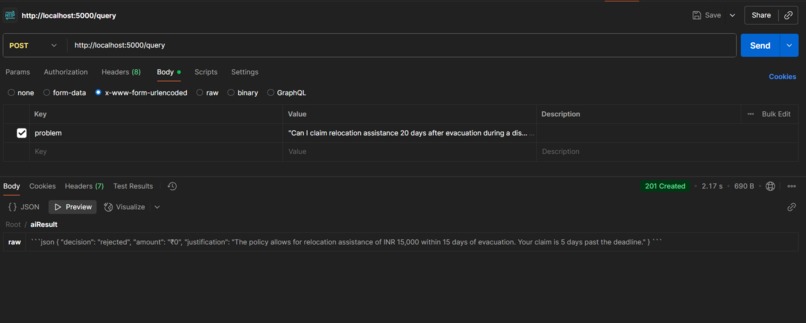
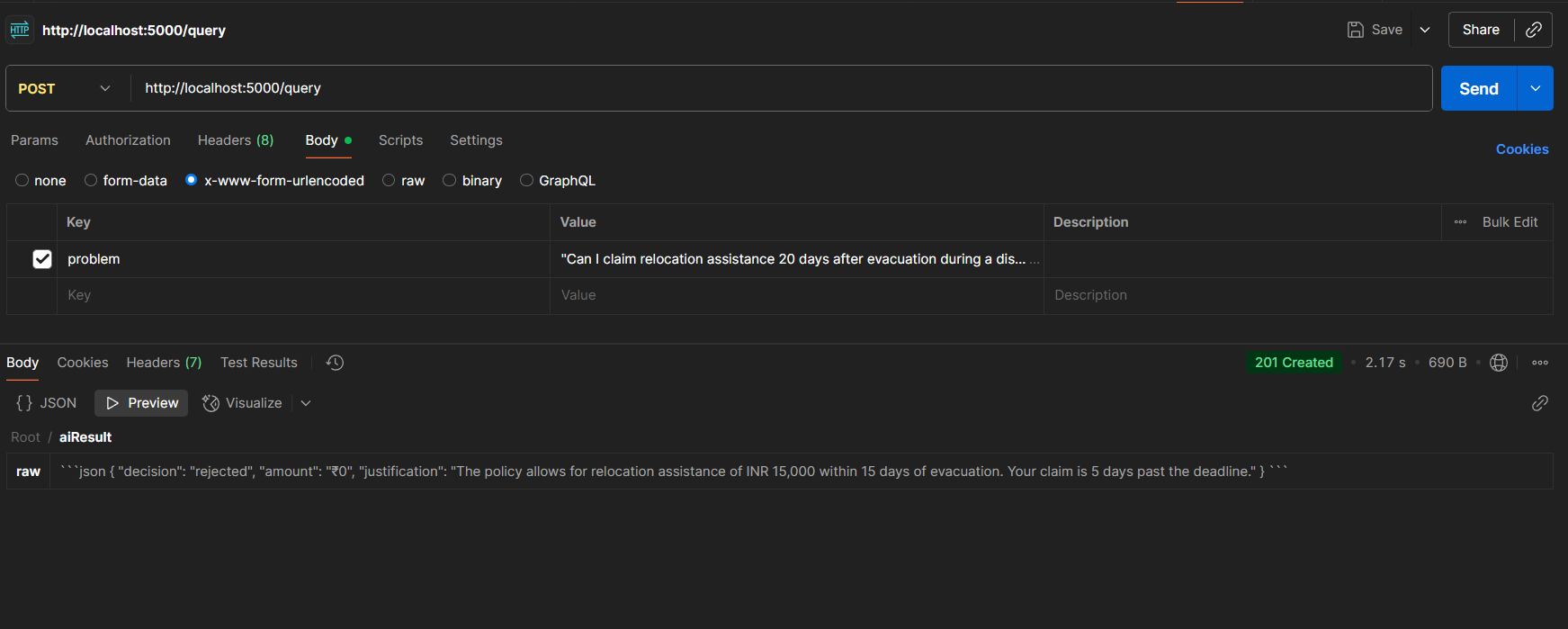
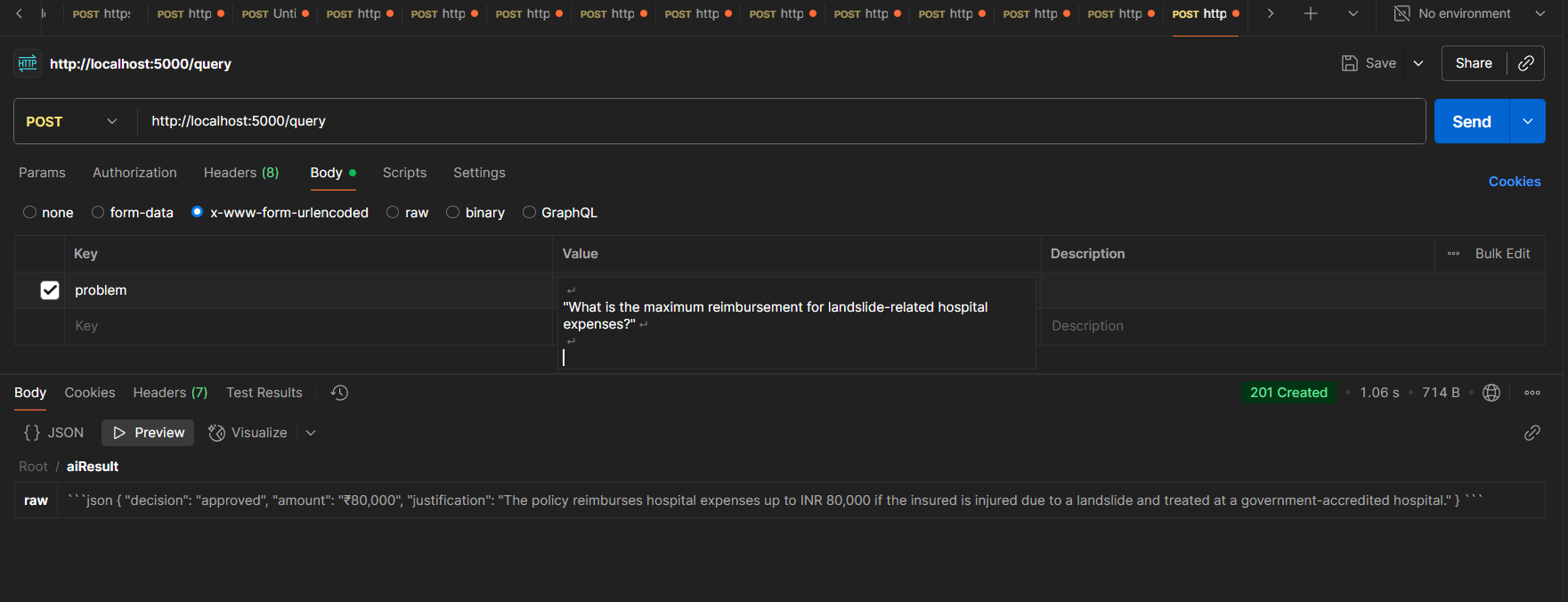
postman testing
-
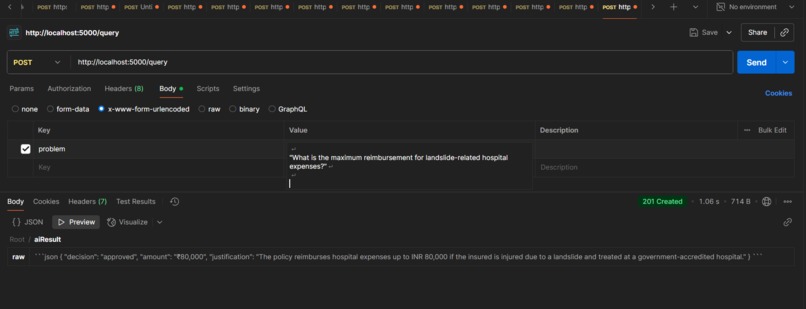
postman testing
-
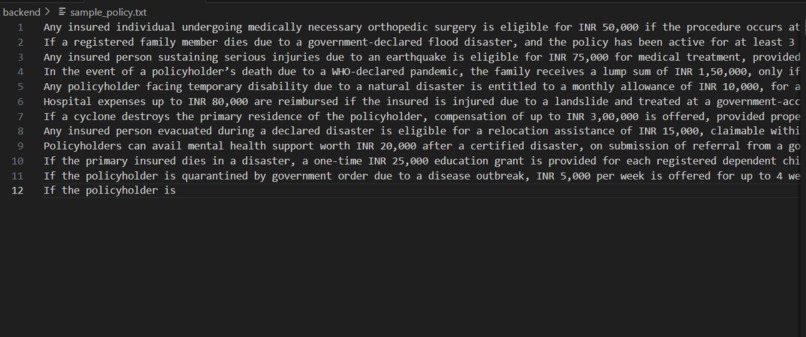
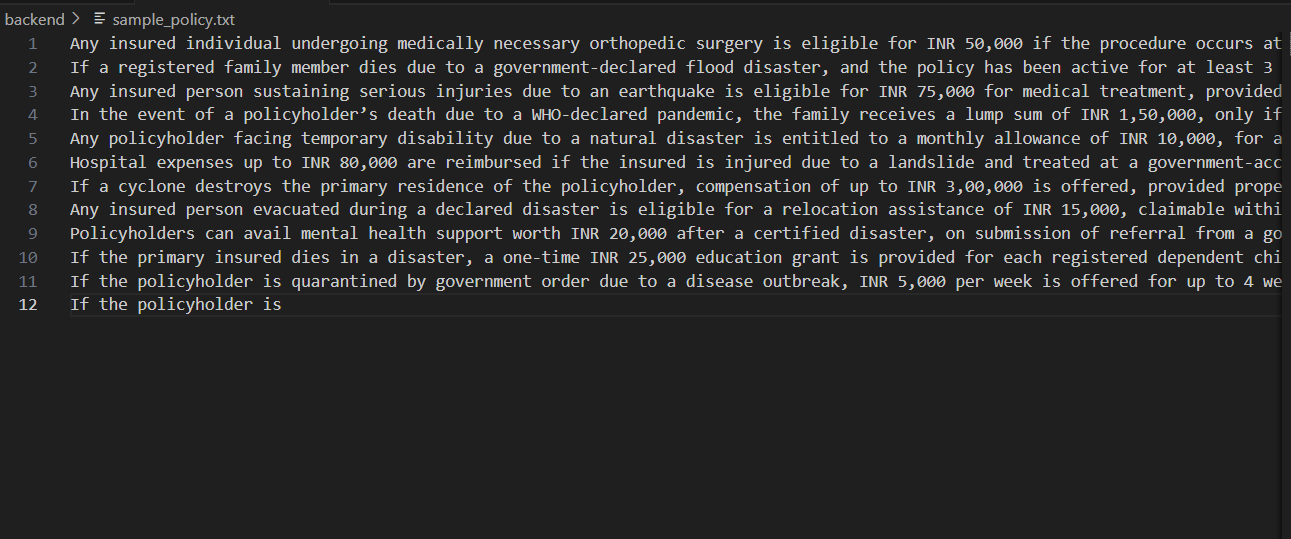
sample policy
-
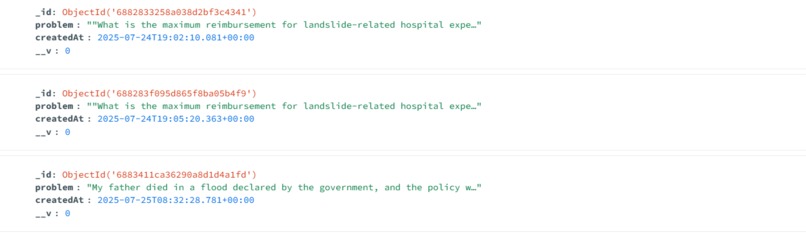
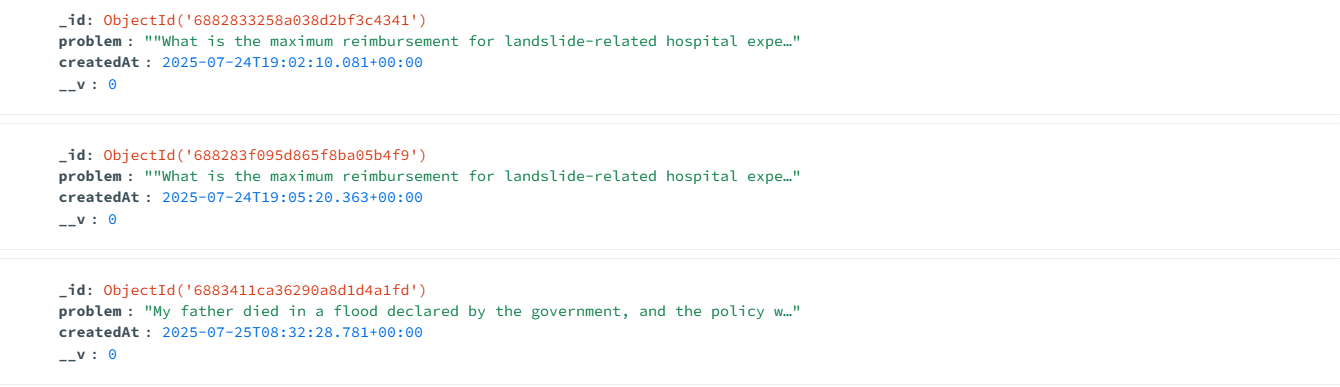
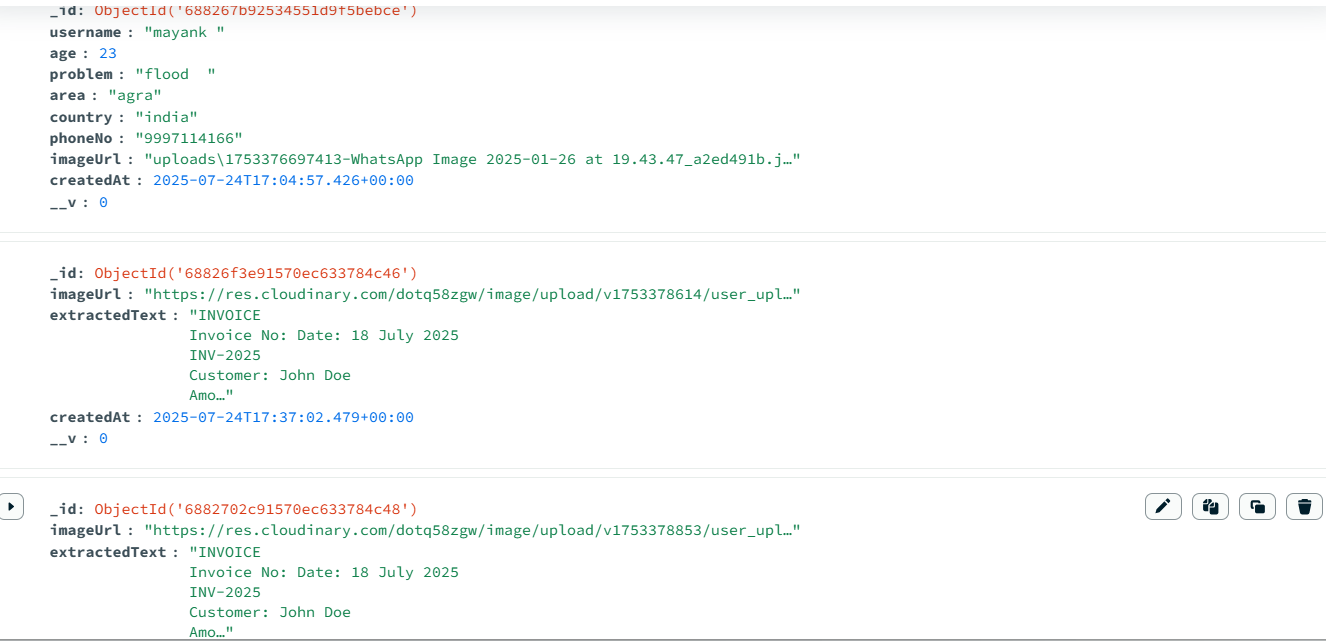
DATABASE
-
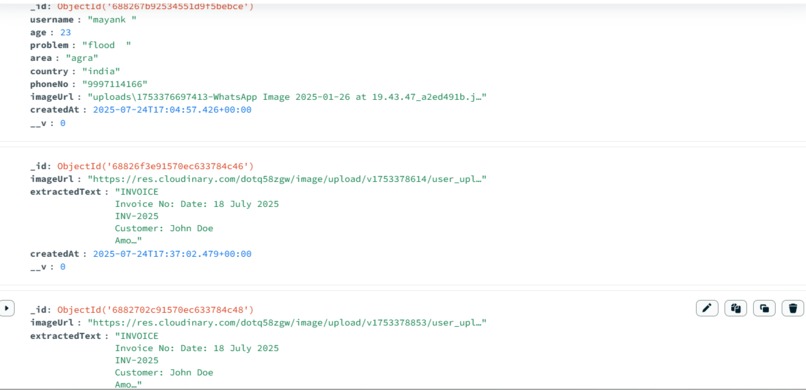
DATABASE
Inspiration:
In recent times, we have witnessed disasters like floods in Mumbai, tragedies in holy places, the devastating COVID-19 pandemic, and even wars. Whenever a disaster strikes, two things matter most: rescuing people and helping them restore and restart their lives. To support this, governments announce financial assistance. But during such times, you are not going to sit and watch television for updates, and current government processes often take a lot of time through officers. That is where DISASTER CLAIM GUARD – AI Assistant for Disaster Claims comes in.
What it does:
Disaster Claim Guard is an AI-powered platform that simplifies and accelerates insurance and government claim evaluations during disasters, pandemics, and emergencies. Victims often struggle with complex policies or lack awareness of entitlements, leading to delays or missed support. Our solution enables users to upload documents (Aadhaar, medical reports, insurance policies) or ask natural language queries (e.g., “My house was destroyed in a flood. Am I eligible for compensation?”).
Using OCR, the system extracts key details, while a Large Language Model (LLM) matches the case with policy clauses to deliver a structured response-decision (approved/rejected), eligible amount, and justification. Once the AI generates the eligibility response, a verification process is triggered to validate the claim details. After successful verification, the approved relief amount is instantly transferred to the beneficiary’s account, ensuring speed and transparency in recovery.
All data is stored in a secure database, allowing governments to analyze which communities are most affected and allocate targeted relief more effectively. The solution is scalable and adaptable to diverse policies and disasters, with strong future potential in insurance, governance, and legal tech.
How we built it:
Disaster Claim Guard was developed using a modular and hybrid approach. The backend built the backend with Node.js and Express to handle queries and document uploads. OCR (Optical Character Recognition) is integrated to extract text from scanned policy documents or identity proofs. This extracted text is passed to Large Language Models (LLMs) such as Google Gemini, which analyze the user’s natural language query and match it against relevant policy clauses. We used MongoDB for storing user data and queries, ensuring scalability. The system then returns a structured JSON response with approval status, eligible amount, and justification. This pipeline was tested through Postman and integrated APIs, ensuring smooth end-to-end claim evaluation.
Challenges we ran into:
The main challenge we faced was understanding the struggles of disaster victims, as many are unable to access the benefits they deserve due to complex and unclear policies. On the technical side, the challenge was to design a system that is both simple for users and robust in execution, which led us to integrate OCR with LLM in the backend. Unlike most projects that stop at giving only “approved” or “rejected” outcomes, our approach goes a step further by providing clause-based justifications. This ensures not only faster claim clarity but also trust and transparency in the process. Additionally, bringing together multiple technologies- OCR, databases, and AI reasoning- while keeping the workflow seamless for end-users was a significant challenge. We had to carefully balance usability with advanced AI logic to make the solution both reliable and easy to adopt.
Accomplishments that we're proud of:
1.Successfully built a working prototype integrating backend + OCR + LLM pipeline. 2.Went beyond standard claim checks (approve/reject) by providing clause-based justifications. 3.Achieved smooth integration of document uploads, query handling, and AI-driven analysis. 4.Designed a scalable system with MongoDB, making it adaptable for government, NGOs, and citizens. 5.First-of-its-kind approach that combines OCR + LLM for disaster claim evaluation.
What we learned:
Through building Disaster Claim Guard, we learned how difficult it is for disaster victims to navigate complex policies and how technology can bridge that gap. On the technical side, we explored integrating OCR with LLMs to process real-world documents and queries, and realized the importance of structured, explainable outputs instead of just simple answers. We also understood the challenges of scaling such solutions for government and NGO use, where accuracy, accountability, and transparency matter the most. Most importantly, we learned that innovation in public service requires balancing human needs with AI-driven efficiency.
What's next for Disaster Claim Guard :
The next step for Disaster Claim Guard is to scale the platform for large-scale use, including integration with private insurance companies. We plan to build a custom LLM for better understanding of queries and use Map AI to detect disasters in real time. A dedicated UI for both government officials and citizens will be developed to make the system more user-friendly. For protection and security, AWS services along with secure login and password mechanisms will be implemented. Additional features will be introduced based on the evolving needs of both users and government agencies.
Built With
- cloudinary
- express.js
- github
- javascript
- llm
- mongodb
- multer
- node.js
- ocr
- postman
- schema
- tesseract.js


Log in or sign up for Devpost to join the conversation.