🎬 Director’s Thought
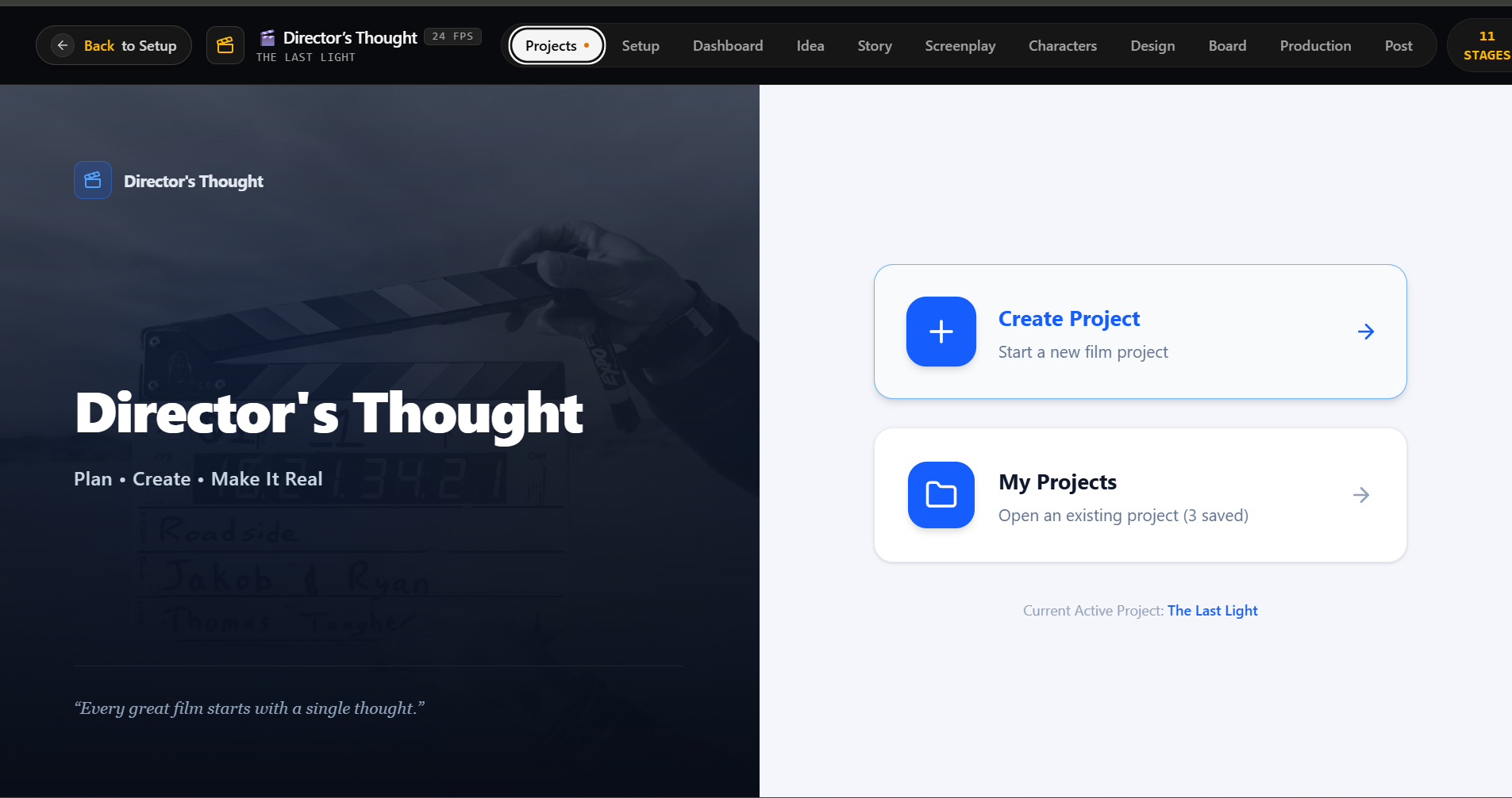
“Every great film starts with a single thought.”
Inspiration
A film may begin with a simple idea, but turning that idea into reality requires hundreds of connected decisions. Directors need to manage scenes, characters, locations, shots, storyboards, equipment, crew, schedules, budgets, permissions, and continuity.
The problem is that these decisions are often scattered across different tools. A small change—such as moving a scene to another location—can create a chain of changes across the entire production.
We were inspired to build Director’s Thought to make filmmaking more intelligent and connected. Instead of treating AI as just a chatbot or image generator, we wanted AI to understand the film as a whole and actively help the director make production decisions.
What it does
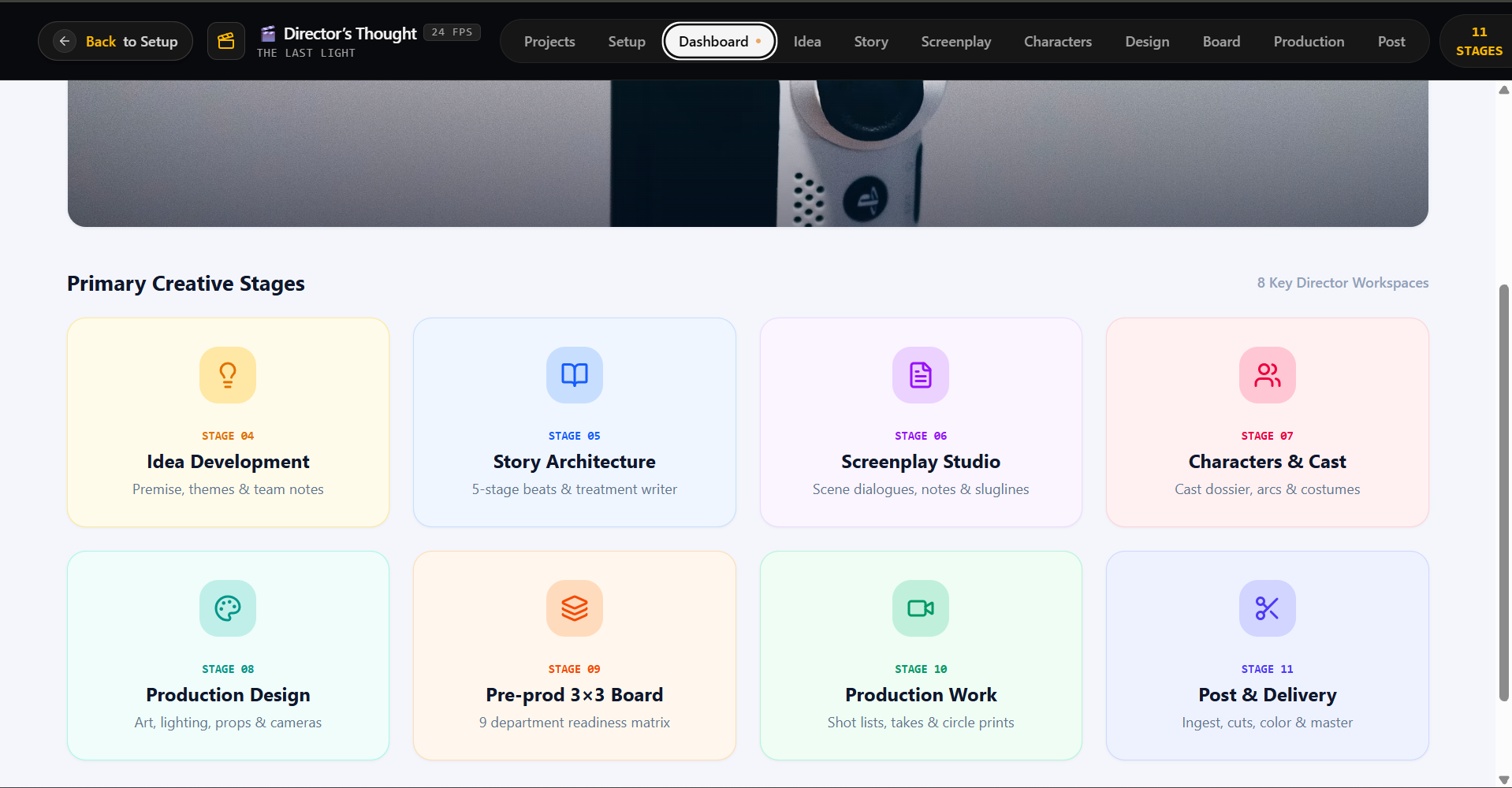
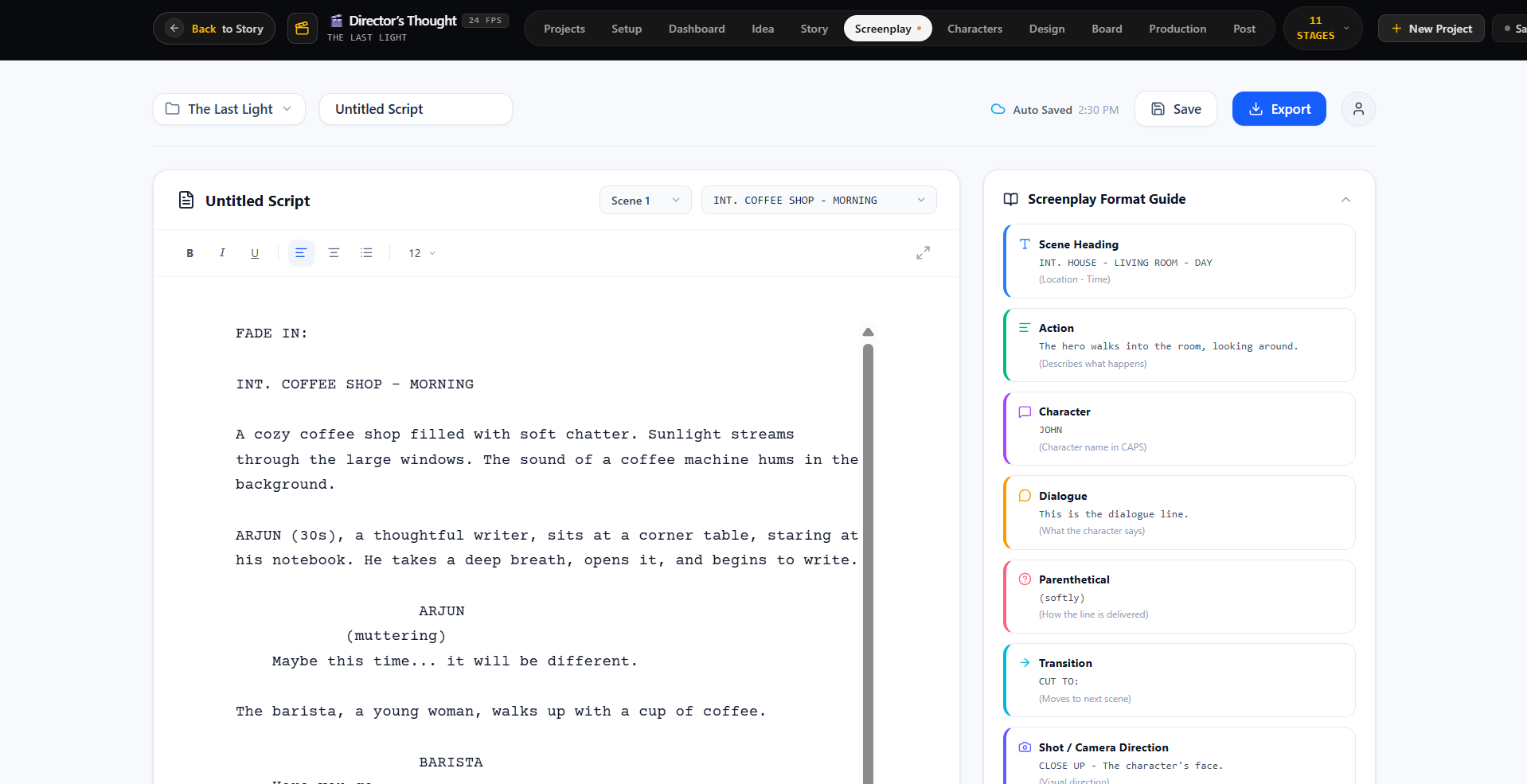
Director’s Thought transforms a screenplay into a connected, shoot-ready production plan.
The platform uses AI to understand the screenplay and assist across the filmmaking workflow:
- Script Analysis — understands scenes, characters, locations, actions, and requirements.
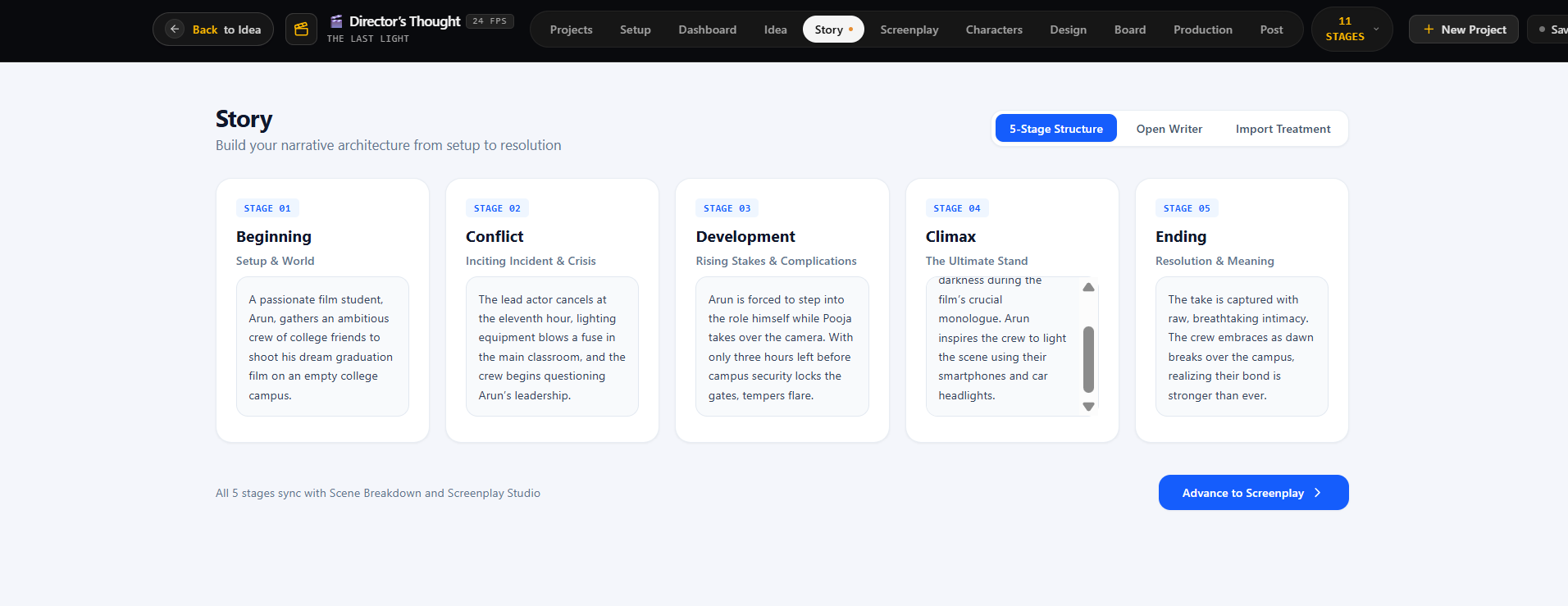
- Scene Breakdown — converts the screenplay into structured production information.
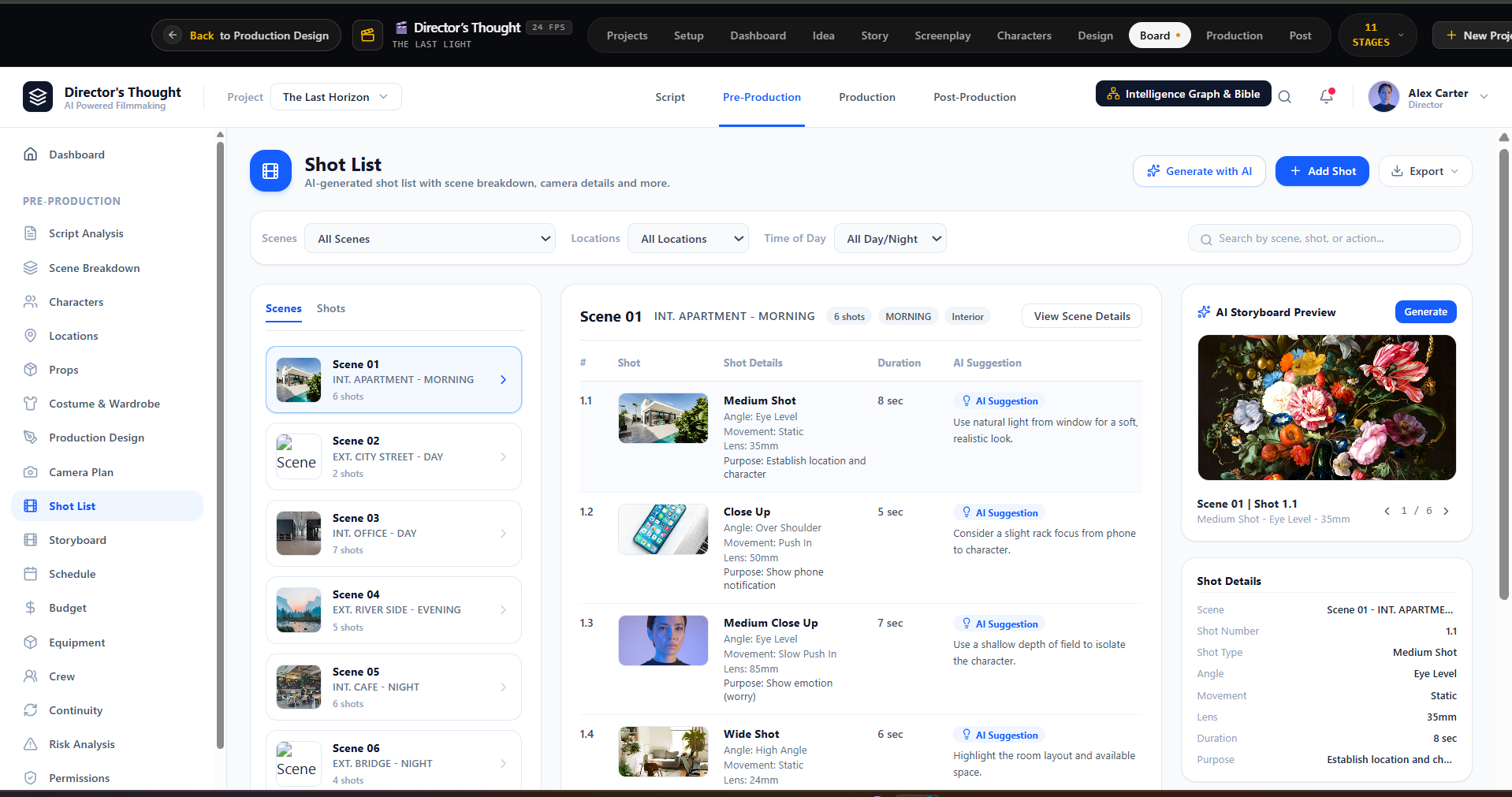
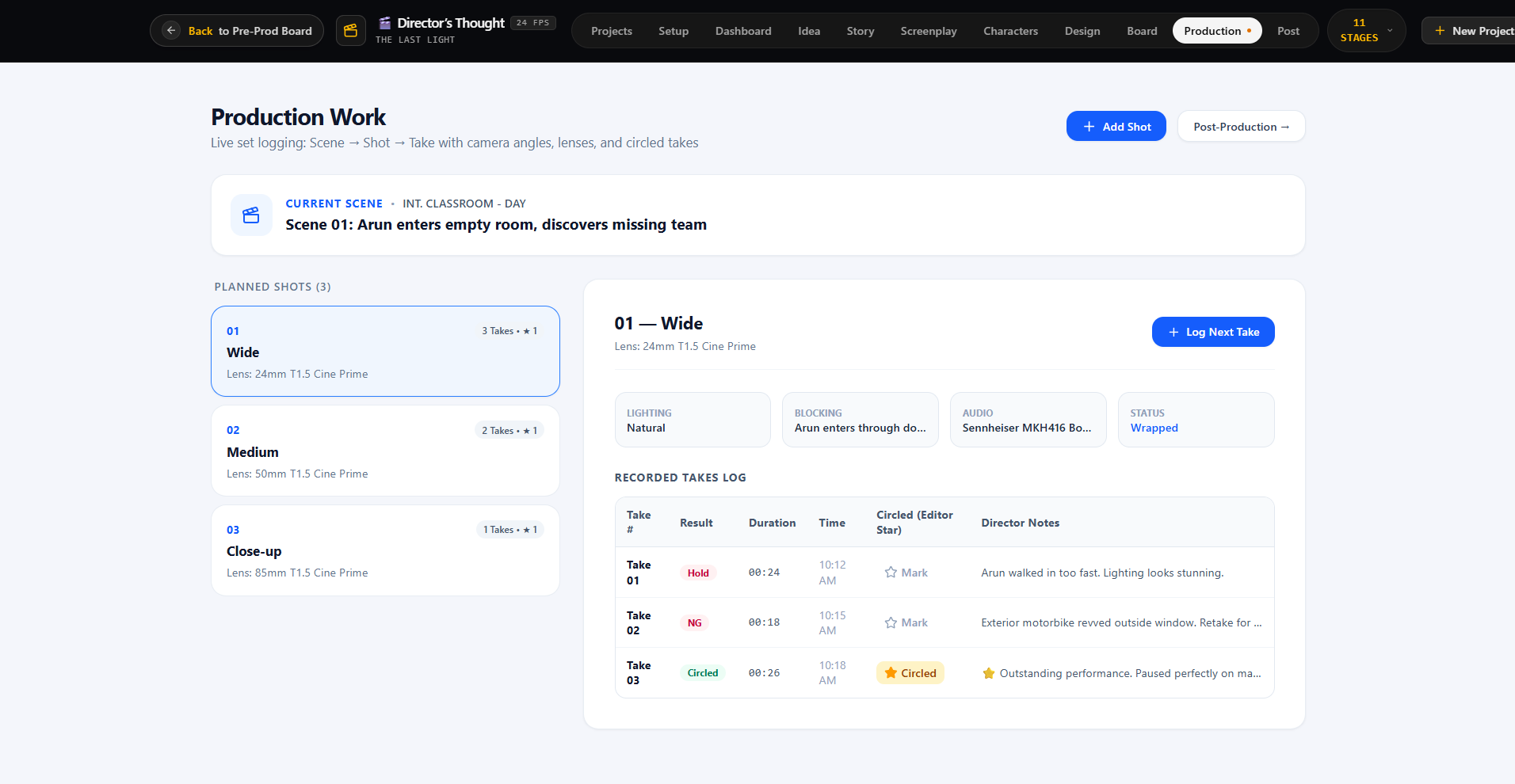
- Shot Planning — helps define camera angles, lenses, movements, lighting, and composition.
- Storyboard Generation — generates visual references for specific scenes and shots.
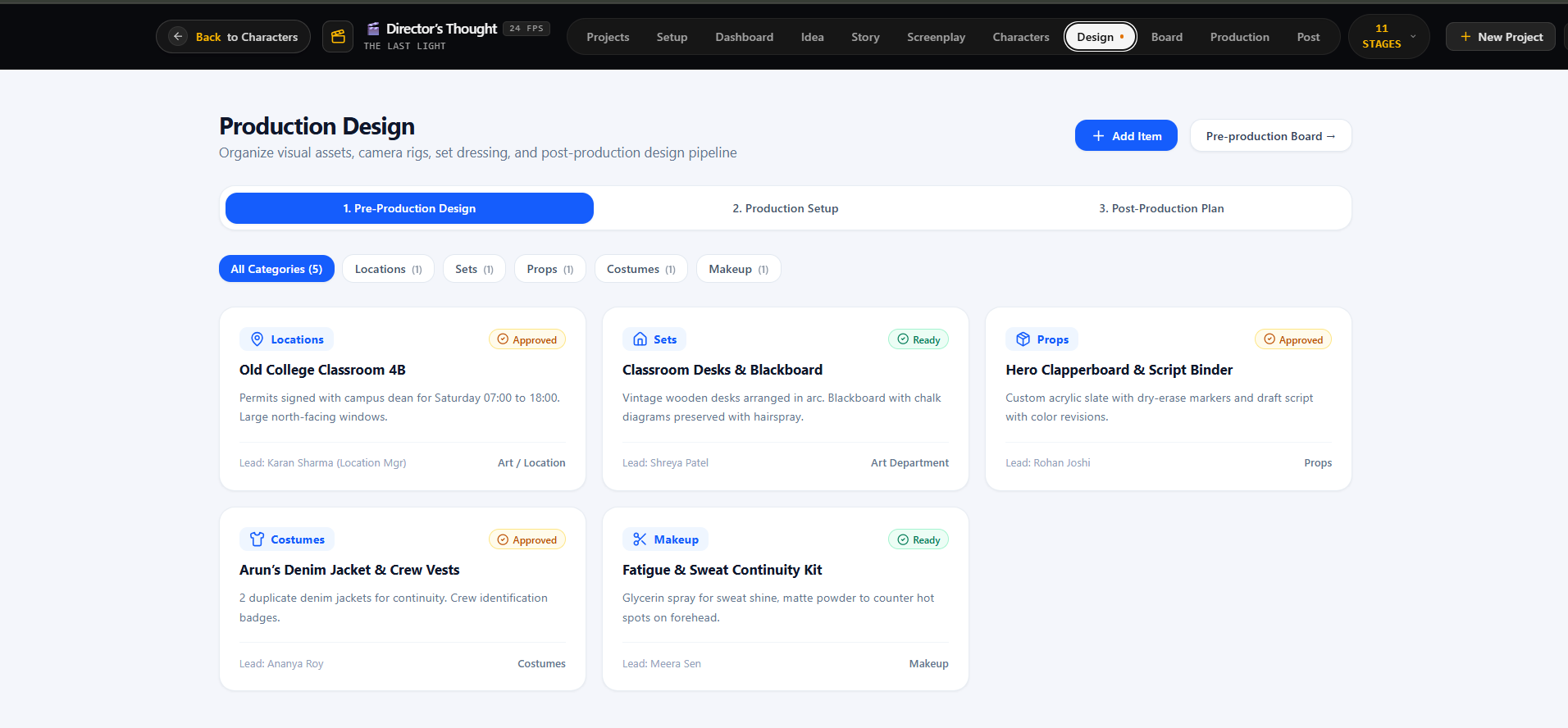
- Production Planning — connects crew, equipment, locations, schedules, and budgets.
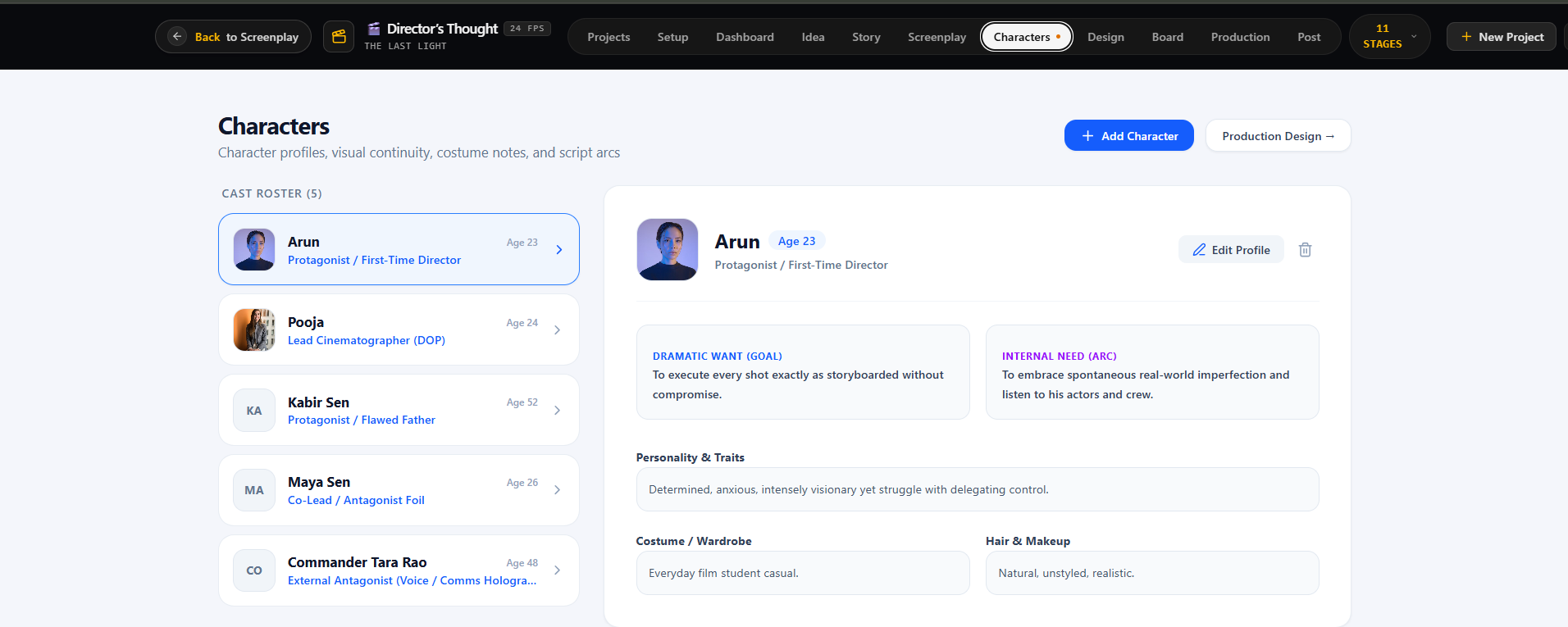
- Continuity — keeps track of characters, props, costumes, locations, and visual consistency.
- Change Impact Analysis — identifies what may be affected when a production decision changes.
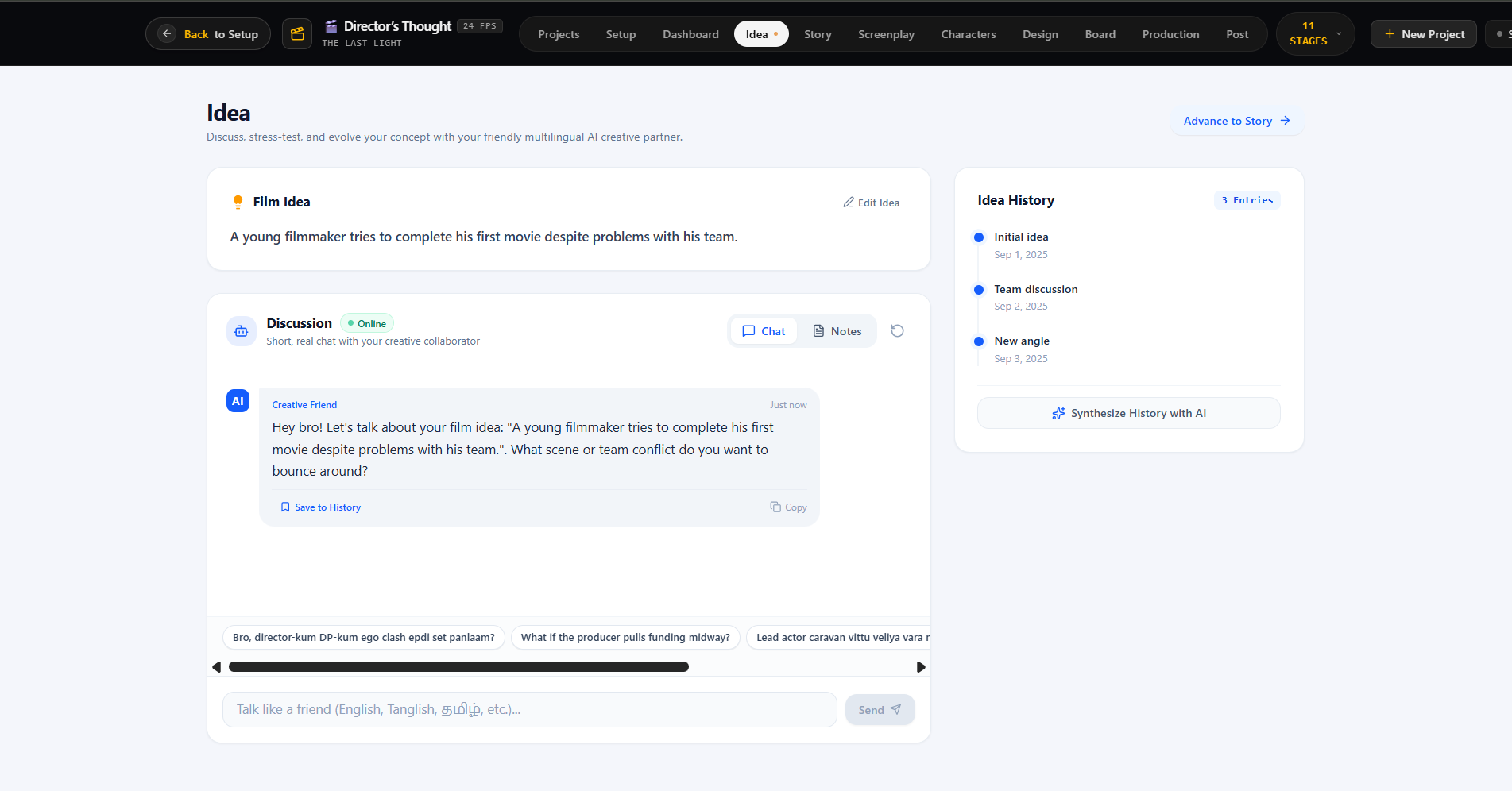
- AI Assistant — provides context-aware recommendations based on the entire project.
For example, if a director changes the location of Scene 12, Director’s Thought can identify the related shots and highlight potential effects on the storyboard, equipment, crew, schedule, transport, permissions, and budget.
This turns AI from a passive assistant into an active production partner.
How we built it
We designed Director’s Thought around a central project model where filmmaking information remains connected rather than isolated in separate modules.
The planned architecture includes:
- Frontend — React / Next.js, TypeScript, Tailwind CSS
- Backend — Node.js with Express / NestJS
- Database — PostgreSQL with Prisma
- AI — BM watsonx.ai, Large Language Models, semantic search, and specialized AI agents
- Agent Orchestration — IBM watsonx Orchestrate for coordinating AI-driven filmmaking workflows
- Cloud InfrastructureI — BM Cloud
- Storage — IBM Cloud Object Storage for storyboards and production assets
- Realtime — WebSockets / Socket.IO
- Background Processing — Redis and BullMQ
- Authentication — JWT / OAuth
- Visual Generation — AI-powered storyboard and image generation
The core workflow is:
Screenplay → AI Understanding → Scene Breakdown → Shot Planning → Storyboard → Production Planning → Change Impact Analysis
We also designed the AI architecture around specialized capabilities such as screenplay analysis, visual planning, production planning, continuity, and change-impact reasoning.
Challenges we ran into
One of our biggest challenges was avoiding the common approach of simply adding a chatbot to a filmmaking application.
We wanted the AI to actually understand relationships between production elements.
For example:
Scene → Shot → Storyboard → Equipment → Crew → Schedule → Budget
Maintaining these relationships requires a carefully structured data model and consistent references between scenes, shots, and production resources.
Another challenge was designing AI-generated storyboards so that they remain connected to the actual production. Instead of generating random cinematic images, every storyboard concept needs to belong to a specific Project → Scene → Shot and maintain relevant characters, location, camera, and visual context.
We also had to balance automation with creative control. A director should not lose control of the creative process simply because AI is involved. Our approach therefore focuses on AI recommendations and proposed actions with human approval for important decisions.
Accomplishments that we're proud of
We are proud of creating a filmmaking concept where AI is integrated into the entire production workflow, rather than being limited to one isolated feature.
Our biggest accomplishment is the idea of connected production intelligence.
A screenplay is not just text. It contains information that affects almost every production decision. Director’s Thought turns that information into a connected system where changes can be traced across the production.
We are also proud of designing an agentic workflow in which AI can:
- Understand the screenplay.
- Break it into production elements.
- Recommend filmmaking decisions.
- Generate shot-specific visual references.
- Detect dependencies between production elements.
- Identify the consequences of changes.
- Propose updates while keeping the director in control.
What we learned
We learned that building useful AI is not only about choosing the most powerful model.
The real challenge is giving AI the right context, structured information, relationships, and ability to take meaningful actions.
We also learned that filmmaking is highly interconnected. A creative decision can quickly become a scheduling, budgeting, equipment, or logistics problem.
Most importantly, we learned that the best human-AI collaboration is not about replacing the director. It is about removing repetitive coordination work so the director can spend more time on storytelling and creative decisions.
What's next for Director's Thought
Our next goal is to evolve Director’s Thought from a production-planning platform into a complete agentic filmmaking workspace.
We plan to:
- Build specialized AI agents for different filmmaking departments.
- Add stronger screenplay-to-production automation.
- Improve character and visual continuity across generated storyboards.
- Introduce intelligent scheduling and budget optimization.
- Add collaborative workflows for directors and production teams.
- Enable AI-assisted shot-list and camera-plan generation.
- Build stronger change-impact reasoning across the production graph.
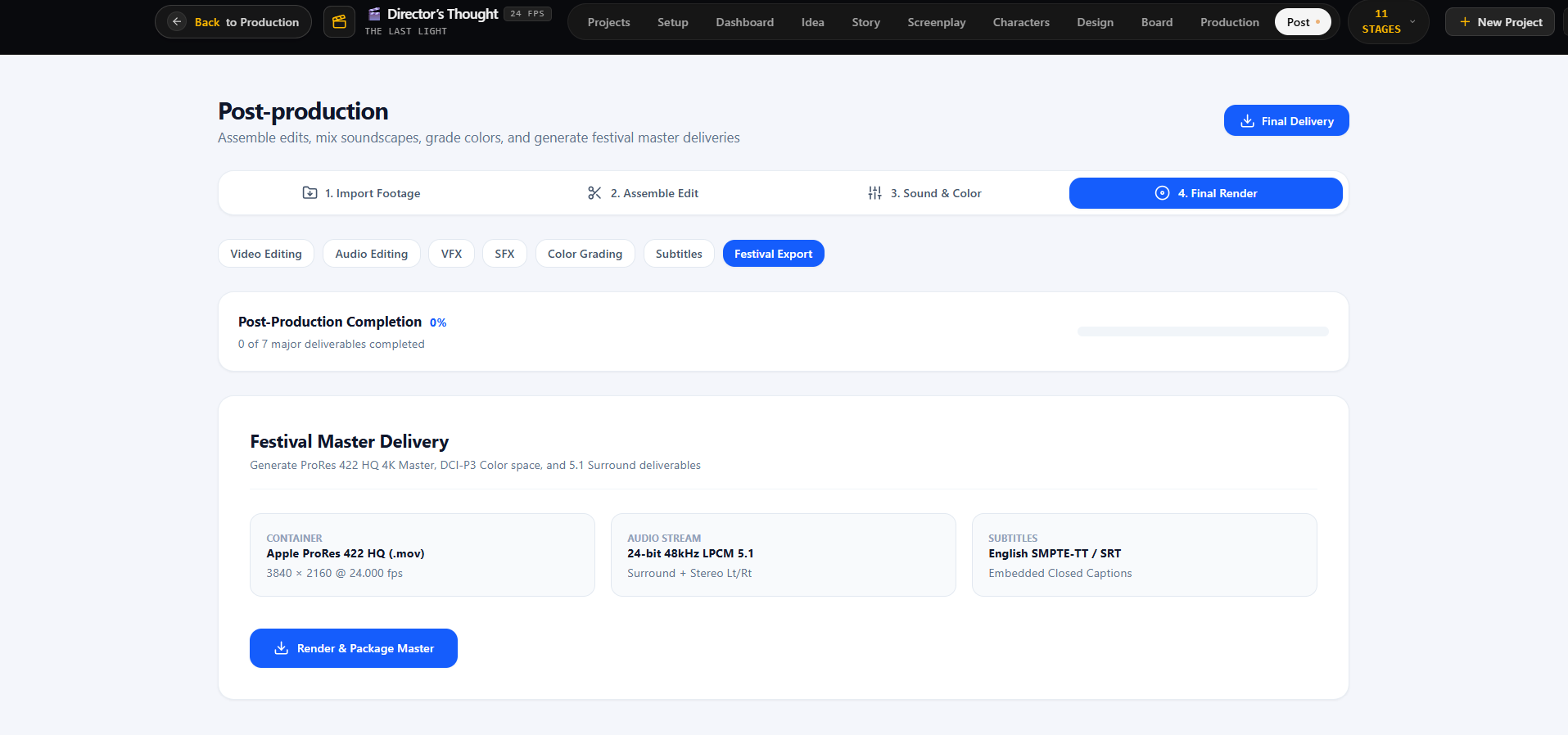
- Eventually extend the platform into production and post-production.
Our long-term vision is simple:
Give every director an intelligent production partner that understands their film from the first thought to the final frame.
Director’s Thought — Every great film starts with a single thought.
Built With
- agentic
- agents
- ai
- bullmq
- cloud
- css
- generative
- ibm
- language
- large
- models
- nestjs
- next.js
- node.js
- orchestrate
- postgresql
- prisma
- react
- redis
- tailwind
- typescript
- watsonx
- watsonx.ai

Log in or sign up for Devpost to join the conversation.