Disclosure
This project was fully completed on 21 November 2026 and originally submitted to SLAY HACKS 2026 (Devpost submission 1313839). No source-code modifications have been made for this Arbiter Hacks submission: repository, live demo and demo video remain identical to the prior hackathon submission.
Inspiration
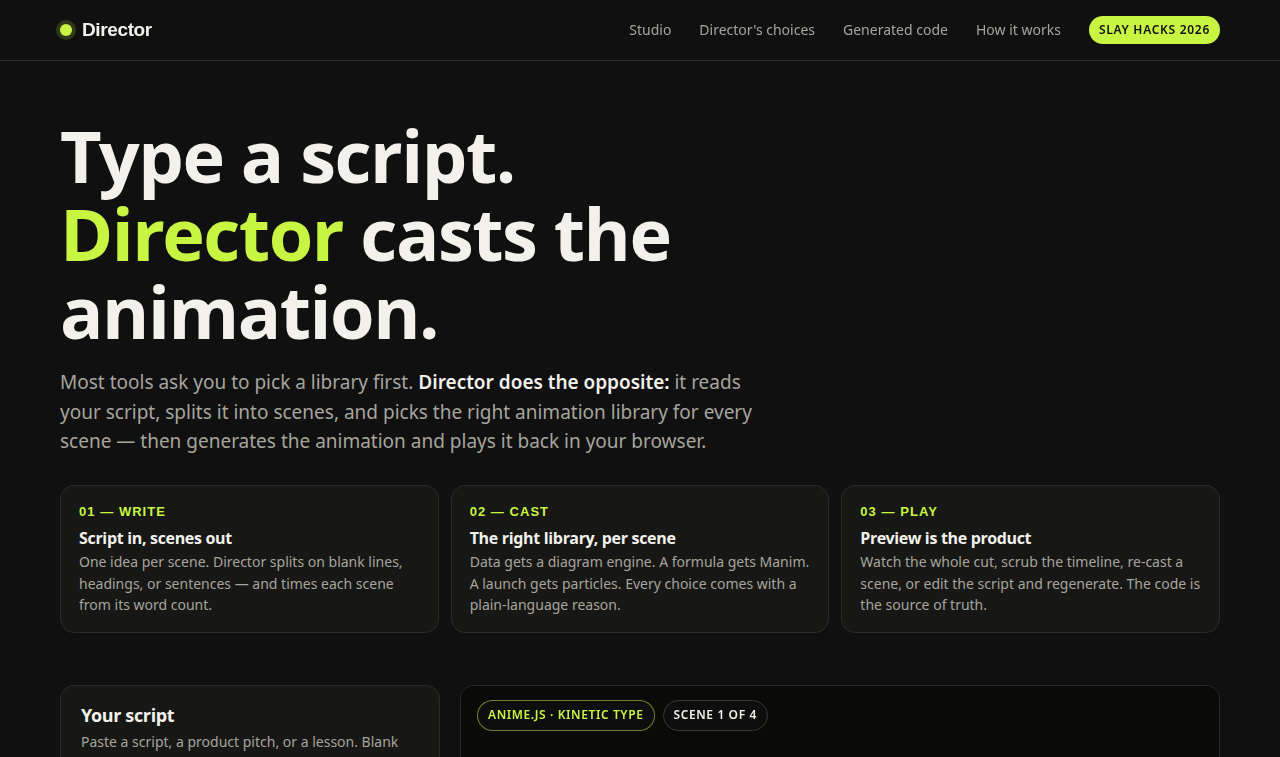
Every animation tool asks you to pick a library first. A product launch, a maths proof and a launch trailer need completely different libraries — but the person writing the script shouldn't have to know that. Director flips the order: describe what you want to say, and it casts the animation for you.
What it does
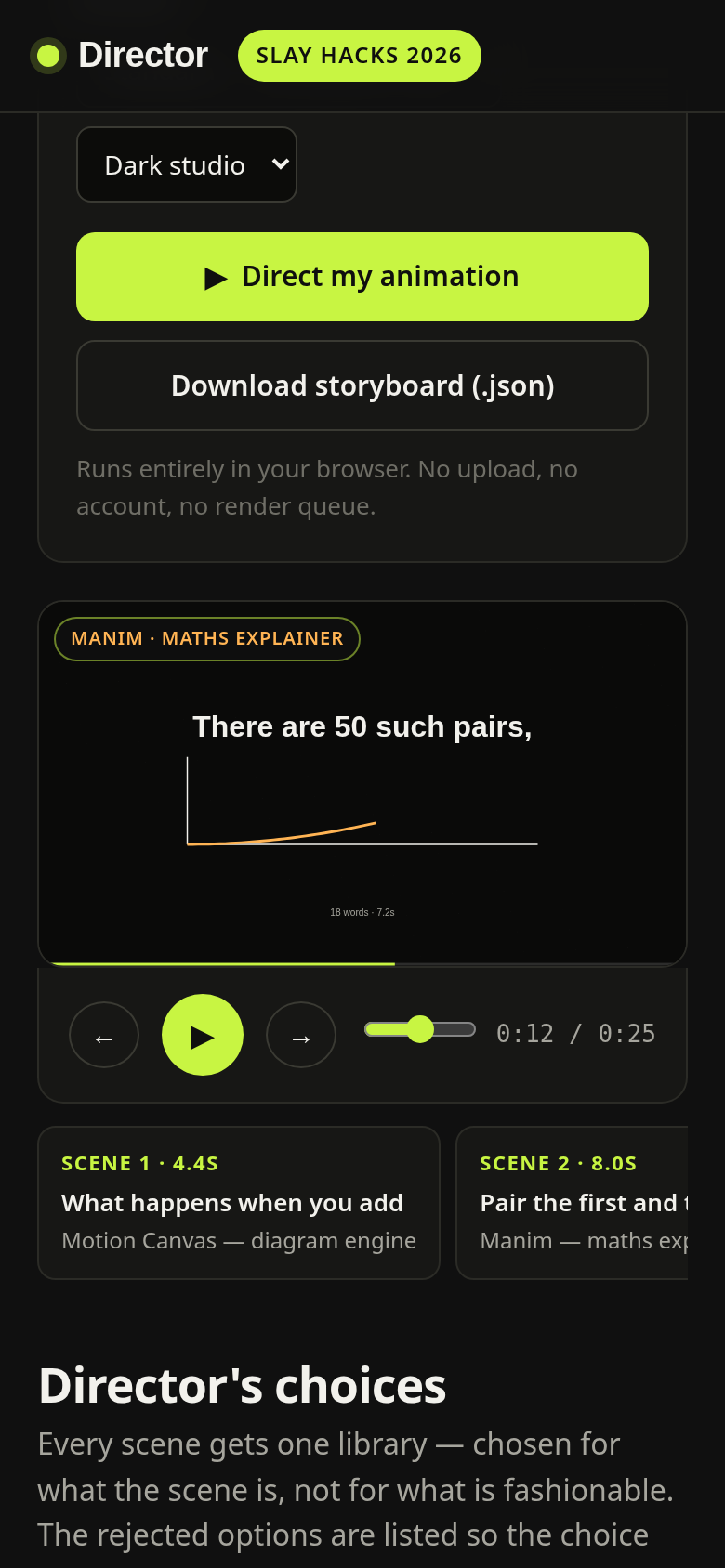
Paste a script, a product pitch, or a lesson. Director splits it into scenes (blank lines start a new scene), classifies each scene by what it is — words, data, a formula, something spatial, or pure energy — and casts it to the right library from a systematic study of 18 free animation/video libraries: Anime.js for kinetic type, Motion Canvas for diagrams, Manim for formulas, Three.js for spatial scenes, Proton for particles. Every scene shows its library choice with a plain-language reason and the rejected alternatives, so the choice can be argued with. The generated code for the scene you are watching is shown and copyable, and the whole cut plays on a 16:9 stage with play/pause, scene navigation, timeline scrub, and pacing control (Calm 130 / Standard 150 / Punchy 185 wpm). The storyboard exports as JSON for a production pipeline.
How I built it
Single-file web app (index.html, ~46 KB), no build step, no backend, no account. The classifier is word-boundary based and was tested against all three built-in presets — 12/12 expected casts. The in-browser player renders each scene with a Canvas 2D renderer in the style of the cast library; the generated code points at the real production pipeline (Remotion for narrated MP4, Manim for maths video, Motion Canvas for diagram video). Tested in real Chrome 158 on desktop 1280px and mobile 390px: zero app errors. The project went through three rounds of review with an AI reviewer (Doubao) before its first submission, fixing 16 + follow-up issues including export safeguards, classifier tie-breaking, responsive canvas scaling, and a full light theme.
Challenges I ran into
The classifier's first tie-break also matched zero-score libraries, which flipped a "light"-only scene to the wrong library — caught by testing and fixed with a minimum activation threshold plus a deterministic priority order. A formula scene rendered its key sentence twice; the duplicate line was removed after review. Making the canvas buffer follow its container across desktop and mobile without blurring took a resize-observer pass.
Entering a second hackathon with the same code raised a compliance challenge of its own: the submission had to disclose the SLAY HACKS origin clearly enough that no judge could read it as a new build, without burying the project under caveats. The disclosure now states the completion date, the original submission number, and that repository, live demo and video are identical — and the same wording is repeated in the repo README and the app footer so the claim is checkable from any entry point.
What I learned
Choosing the right tool matters more than knowing one tool deeply: 18 libraries studied, only 5 directly produce video, and most "animation" libraries are only tweening layers or players. A casting decision is only trustworthy if it shows its reasoning and its rejected alternatives.
What's next
M1 — Real renderers behind the preview. Connect the generated code to real renderers (Remotion for narrated MP4, Manim for maths video, Motion Canvas for diagram video) so the in-browser preview becomes an exportable video instead of a Canvas demonstration of the casting engine.
M2 — Learn from real casts. Collect user cast accept/reject samples — which library choices users keep versus override — and use them to tune the classifier's signals and tie-break priority, instead of tuning it only against the three built-in presets.
Built With
- anime.js
- canvas
- html5
- javascript
- manim
- motion
- proton
- three.js
