-
-
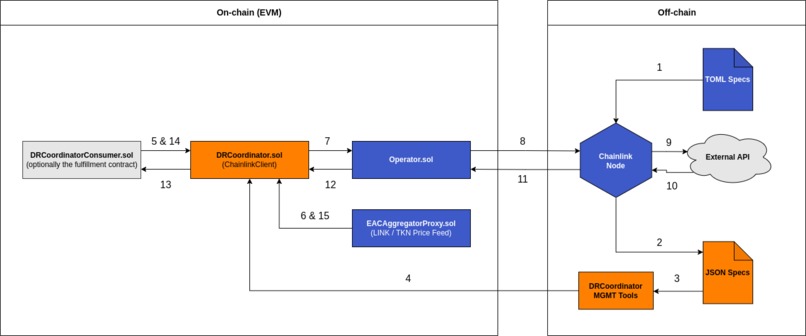
Architecture & Flow
-
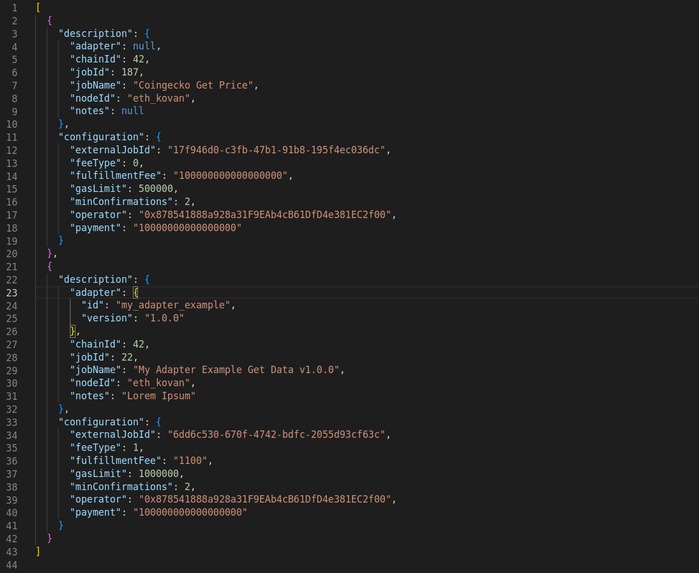
JSON specs file
-
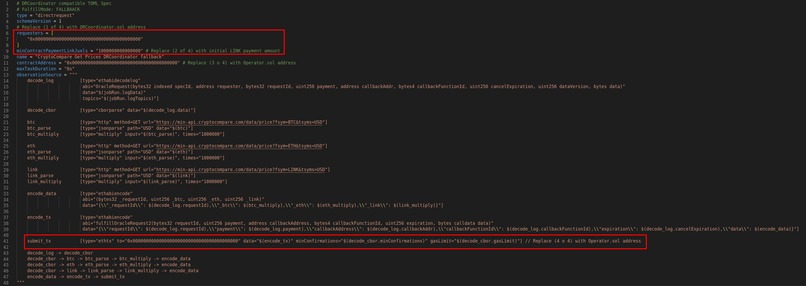
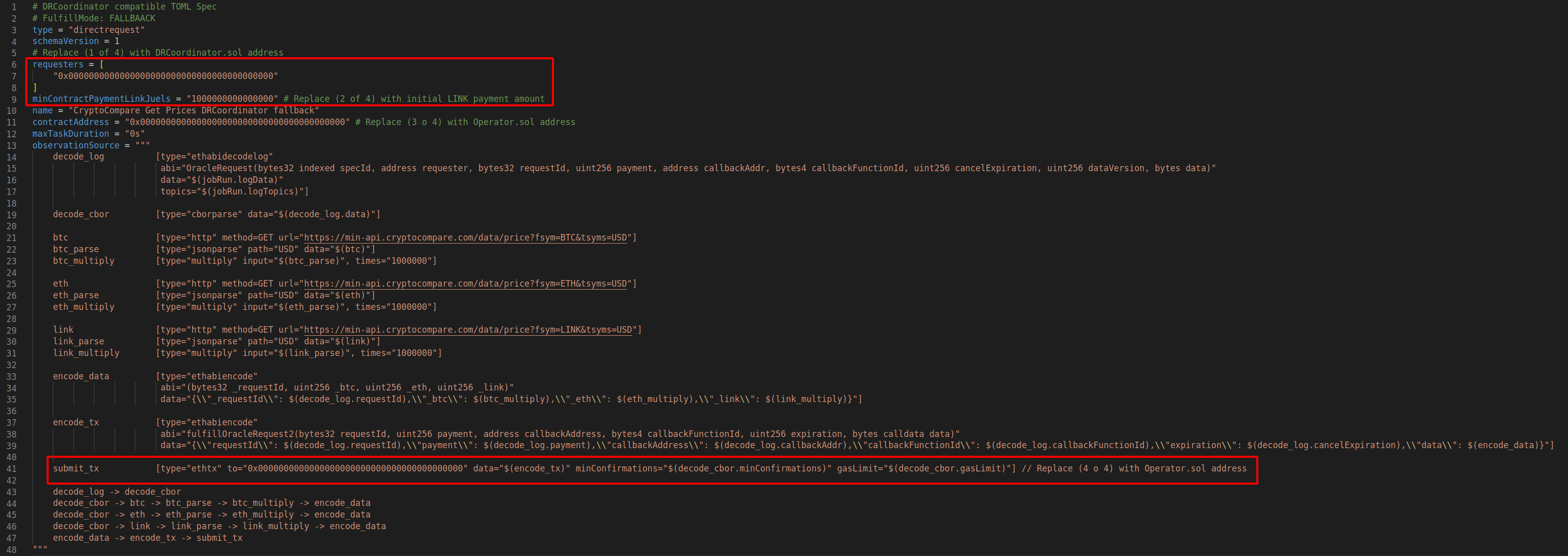
DRCoordinator compatible TOML Spec - Fulfillment via fallback()
-
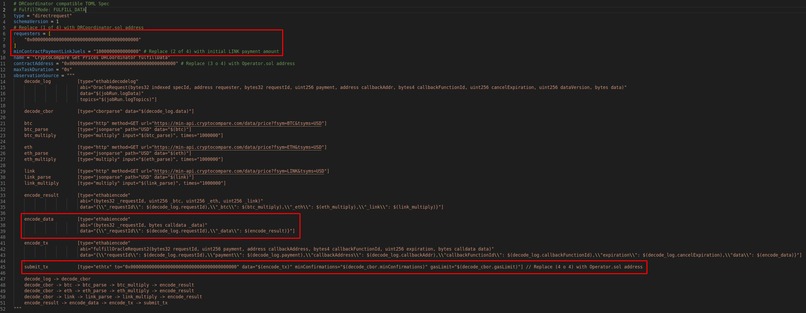
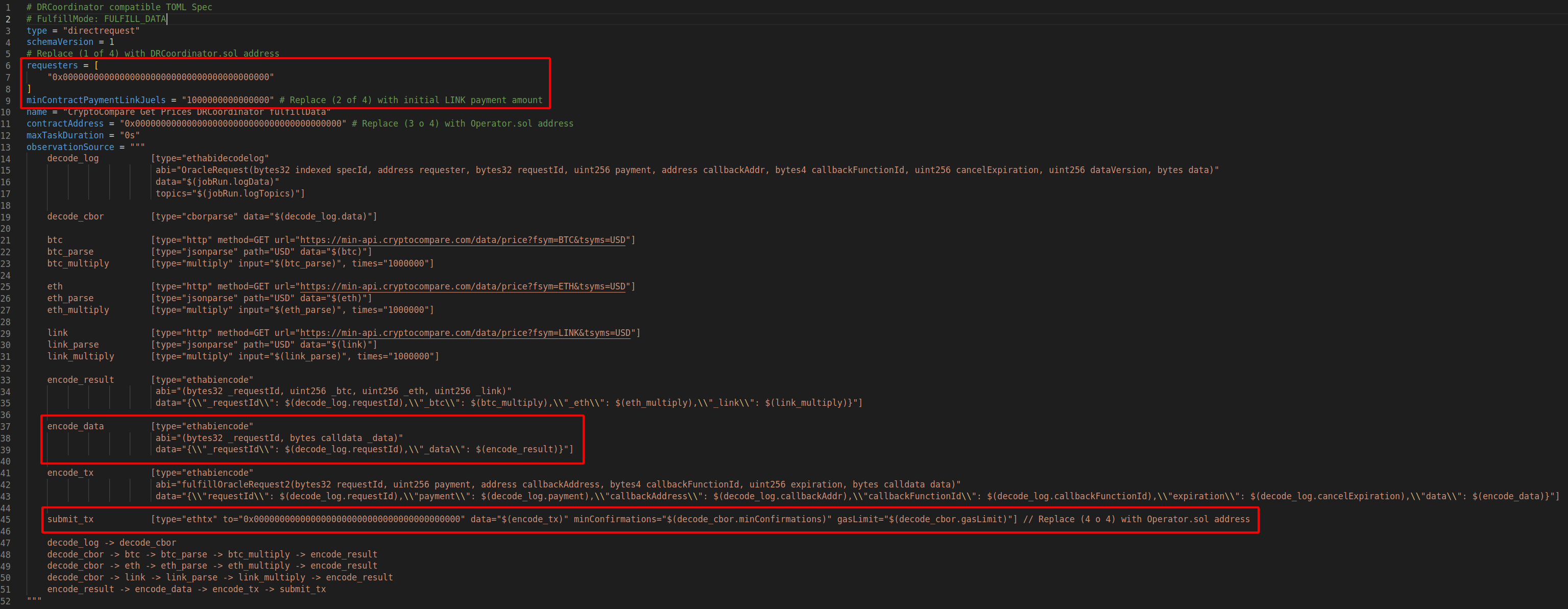
DRCoordinator compatible TOML Spec - Fulfillment via fulfillData()
-

Current Hardhat tasks (more incoming)



Direct Request Coordinator
A framework that enables dynamic LINK payments on Direct Request, syncing the price with the network gas and token conditions. It targets node operators that seek being competitive on their Direct Request operations.
Try it out following this tutorial
Inspiration
Chainlink provides a wide variety of products and services. The market demand has reasonably caused that few of them evolve more than others. Unfortunately, the Direct Request model is lagging and its supporting tooling requires updating to help it to power the next wave of blockchain adoption.
The main problem Direct Request has is its pricing model. It is inaccurate, prone to human error, time consuming, exponentially complex the more layers node operators have (i.e. jobs -> dynamic results -> nodes -> networks, and fulfillment contracts), and unbearable on volatile market and gas spike events. Chainlink node operators seek for profit, and Direct Request jobs do not seem nowadays very appealing to deal with, nor profitable for the time spent on them.
As a personal experience, the same day that the AccuWeather adapter was released, the LINK token was at ~$34 (ETH $4650, LINK/ETH at 0.0073) , and I remember spending quite a bit of time pricing its 3 jobs on each supported network. A month later the LINK token was at ~$17 (ETH $3250, LINK/ETH at 0.0052) and the jobs were theoretically operating on a loss (for the good or the bad there wasn't big adoption yet). The idea of implementing "dynamic LINK prices" (which has always been my project codename) started there. And this willing has been exacerbated by the recent increase on Direct Request integrations across multiple networks, the incrementing gas spikes, and the recent market volatility. As an engineer, I don't want to feel that I'm wasting my engineering time pricing jobs without the right tools, especially knowing that the value I set won't be accurate enough.
I was aware about VRF v2 being released, but it wasn't until a couple of weeks ago that I read the official article that mentions the following improvements:
- A pay-as-you-go pricing model that leverages Chainlink Price Feeds to charge the gas used (converted to LINK) on fulfillment plus a flat fee.
- On-demand callback
gasLimitset by the consumer. - A versatile subscription model with a management app to pre-fund multiple requests.
And I thought, what if...:
- All these features were integrated in Direct Request as well?
- Node operators didn't have to worry about dynamic result sizes, gas limit fine tuning, defensive pricing, gas & token prices and conversions, gas spikes, and market volatility?
- Node operators had a framework to manage this?
Well, these were the motivations behind presenting Direct Request Coordinator (aka, Dr. Coordinator) on the Chainlink Hackaton Spring'22. OK;LG.
What it does
The contract and tools provided allow node operators to:
Charge consumers the exact amount of LINK needed to cover the gas used to fulfill the request, plus some profit margin.
They can also manage job specs
Provide a subscription model for consumers.
It also includes contracts for building DRCoordinator consumer and fulfillment contracts.
Feature Contracts
- It is owned by the node operator. Only one per network is required (no inconvenient having more).
- Interfaces a consumer with 1..N oracle contracts (
Operator). - Stores Specs; a mix of essential data found in a TOML job spec (i.e.
externalJobID), business params (e.g.feeType,fulfillmentFee), and on-chain execution params (e.g.operator,minConfirmations,gasLimit). - Contains the consumers' LINK balances, that can be topped-up by any EOA.
- It leverages the network LINK / TKN Price Feed to calculate the MAX (worst-case scenario using all the
gasLimiton fulfillment) & SPOT (gas used on fulfillment) LINK payment amounts. It takes into account too whether the answer is stale and any L2 Sequencer Health Flag. - It allows cancelling requests as-per-usual (the payment amount is refunded to the consumer's balance).
- It allows to fulfill requests on contracts that are not the requester (i.e.
callbackAddress !== msg.sender).
- It is the
ChainlinkClientequivalent (used on standard consumer contracts): - It is the parent contract for
DRCoordinatorconsumers. - It provides methods for building, tracking and cancelling
DRCoordinatorrequests (to be fulfilled either in the consumer itself on in another contract). - It stores the
LINK,OperatorandDRCoordinatorinterfaces
FulfillChainlinkExternalRequestCompatible.sol:
- It is the contract to be inherited by a fulfillment contract that it isn't the requester (aka. split consumer pattern,
callbackAddress !== msg.sender). - It enables 1..N
DRCoordinator(access controlled) to notify it about the upcoming external fulfillments.
Example Contracts
- A CrytpoCompare API consumer
- Requires TOML job spec (fulfillment via fallback()) or TOML job spec (fulfillment via fulfillData())
- A Sportsdataio API consumer
- Requires TOML job spec (fulfillment via fallback()) or TOML job spec (fulfillment via fulfillData())
Management Tools
A set of Hardhat tasks that allow:
- Deploy, setup and verify a
DRCoordinatorcontract. - Deploy, setup, fund and verify
DRCoordinatorConsumercontracts. - Log the
DRCoordinatorstorage, e.g. configs, Spec keys, Spec details, etc. - Sync JSON spec files with the
DRCoordinatorstorage; create, update and delete (CUD) specs. - Generate a Spec key for the given params, so it can be queried to the
DRCoordinator. - Calculate/simulate MAX and SPOT LINK payment amounts for the given network params.
- Set configuration parameters, pause/unpause the contract, transfer ownership, etc.
- Withdraw the LINK funds of the owner.
Example specs
How I built it
Stack
This framework uses Solidity, TypeScript, Hardhat, ethers.js, TypeChain, Waffle/Mocha/Chai, Chainlink contracts, OpenZeppelin contracts, and Slither.
It just needs a copy of the .env.example with a PRIVATE_KEY and the provider's API key (Alchemy or Infura depending on the network). Optionally, the API key of the Etherscan-like explorer of the network if contract verification is needed.
Scripts
All the call and transaction scripts are documented Hardhat tasks with a big effort on the task argument validations, logging and error messaging. I also included quite a bit of Chainlink-related tooling and utils.
Contracts
The DRCoordinator.sol is a brand new contract that contains a slightly modified version of the VRFCoordinatorV2 functions related with calculating the LINK payment amount. Ideally I'd like to have implemented at least its more versatile subscription model.
The DRCoordinatorConsumer.sol takes the essential and existing tooling from ChainlinkClient (using CustomError), and adds specific one for DRCoordinator requests.
Challenges I ran into
Fulfilling the request is of course the most challenging and critical step.
DRCoordinatoris not thecallbackAddress, nor it has thecallbackFunctionIdof the Chainlink Request. It means when building and sending the Chainlink Request, you have to store and replace critical information about the original request (and load it on the fulfillment). It also forces you to make decisions about TOML job specs format, more or less off/on-chain data processing, etc. My first approach was being consistent and as less invasive as possible with the standard TOML job spec format/tasks. Many node operators have experience adding Chainlink Price Feed jobs, but don't too much tweaking a Direct Request one. For this very reason I handled it via thefallback()function. At some point I decided to experiment an alternative way, via thefulfillData()method, which is not that invasive and feels less hacky. I decided to preserve both ways on this hackaton project, so reviewers can see each one's implications. In fact fulfilling viafulfillData()requires a double encoding at TOML job spec level, and an extraabi.encodePacked(fulfillConfig.callbackFunctionId, _data)atDRCoordinatorlevel.Batch transactions on CUD specs into
DRCoordinator. If the node operator is just adding few JSON specs into the specs file and syncing them withDRCoordinatorthere won't be any problem. But what happens if the node operator has to suddenly deploy +200 jobs on a freshDRCoordinator? I experienced running out of gas and I had to chunk the array of specs.Fine tuning most of the
DRCoordinatorconstants. Few of them started as private variables set at constructor level (with getters & setters), but once I was profiling and benchmarking the contract for different data size cases, etc. I was able to convert them into constants (e.g.GAS_AFTER_PAYMENT_CALCULATION). Also worth mentioning thatMIN_CONSUMER_GAS_LIMITandMAX_REQUEST_CONFIRMATIONShave a values that come from other Chainlink contracts, so extra research on existing code was needed.Calculating the MAX and SPOT LINK payment amount. Despite having the
VRFCoordinatorV2implementation, I wanted to test it myself instead of just copying and pasting it. Also implementing thePERMIRYADfee type.Implementing the
cancelRequest. It couldn't be implemented untilDRCoordinatorsupported consumers' balances.Having the patience for carrying e2e tests (and seeing them failing). It requires to coordinate lots of elements (especially if Chainlink External Adapters (EAs), and/or external fulfillment contracts are involved), and take very specific steps. I relied a lot on integration tests just to spare the effort of making real e2e tests.
Finding the
minConfirmationsbug (reported as GitHub issue). I was running a Chainlink node v1.2.0 and I had to make sure whether was sorted or not on the v1.4.1. I had modify contracts and replicate e2e tests.
Accomplishments that I'm proud of
I'm proud of easing an everyday issue for me and other node operators (business and engineering-wise), and providing a more reliable, trustworthy, and fair product to Direct Request consumers. I'm greatly satisfied too about something as low-key as the Hardhat task arguments verification, and dryrun & forking modes, which provide an extra layer of reliability & security when it comes to run the scripts.
I don't expect at all node operators rushing to adopt this framework and make it "The Standard", nor that it's everyone's cup of tea (e.g. Chainlink Labs engineers, node operators, Direct Request consumers). My whole purpose was to lay the cards on the table about the current Direct Request pricing problem, and having an open conversation altogether about how it can be improved. For instance, which parts can be addressed by Chainlink Labs? Which other ones should be outsourced to 3rd parties? And which ones should be developed in-house by node operators? This implementation is just my current approach to the problem. Nonetheless I'm happy about the result and I have so many ideas to improve it.
What's next for Direct Request Coordinator (DRCoordinator)
You'll find on the repository a more granular list of improvements and topics to address. A high level overview would be:
- Business-wise, aligning it with the business interests with regards to pricing jobs. Also making sure that it is well integrated with metrics v2.
- Engineering-wise, making the contracts more secure/cheap/efficient, better tested and documented. Also improving the tooling experience interacting with
DRCoordinator, gas estimations, and Specs management. I'd like to implement and benchmark alternatives to the current architecture, for instance one whereDRCoordinatorinherits fromOperatorandLINK.transferAndCall()is not needed for Direct Request Coordinator requests paid via subscription. - Chainlink ecosystem-wise, having other node operators and Chainlink Labs engineers giving it a try, and then having a thought about how we can all improve the current Direct Request product. It would make sense to me that the
Operator.solwas extended with similar capabilities than theDRCoordinator, and that the Chainlink node supported similar spec management tasks than the off-chain part of this framework.
What I learned
This journey has been a deep dive into the Chainlink Direct Request model, in particular the ChainlinkClient and the Operator contracts. There is so much thought and quality put on them by their engineers.
Built With
- alchemyapi
- chai
- chainlink
- ethers
- hardhat
- infura
- mocha
- openzeppelin
- slither
- solidity
- typechain
- typescript
- waffle


Log in or sign up for Devpost to join the conversation.