-
-
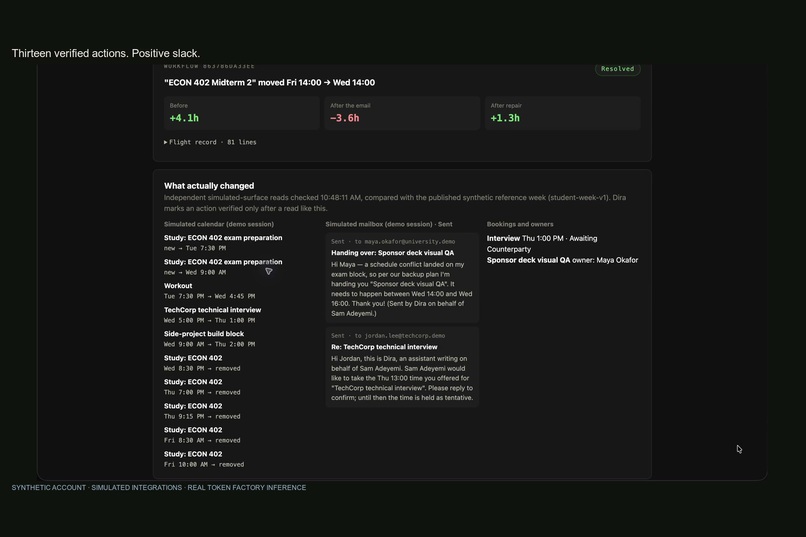
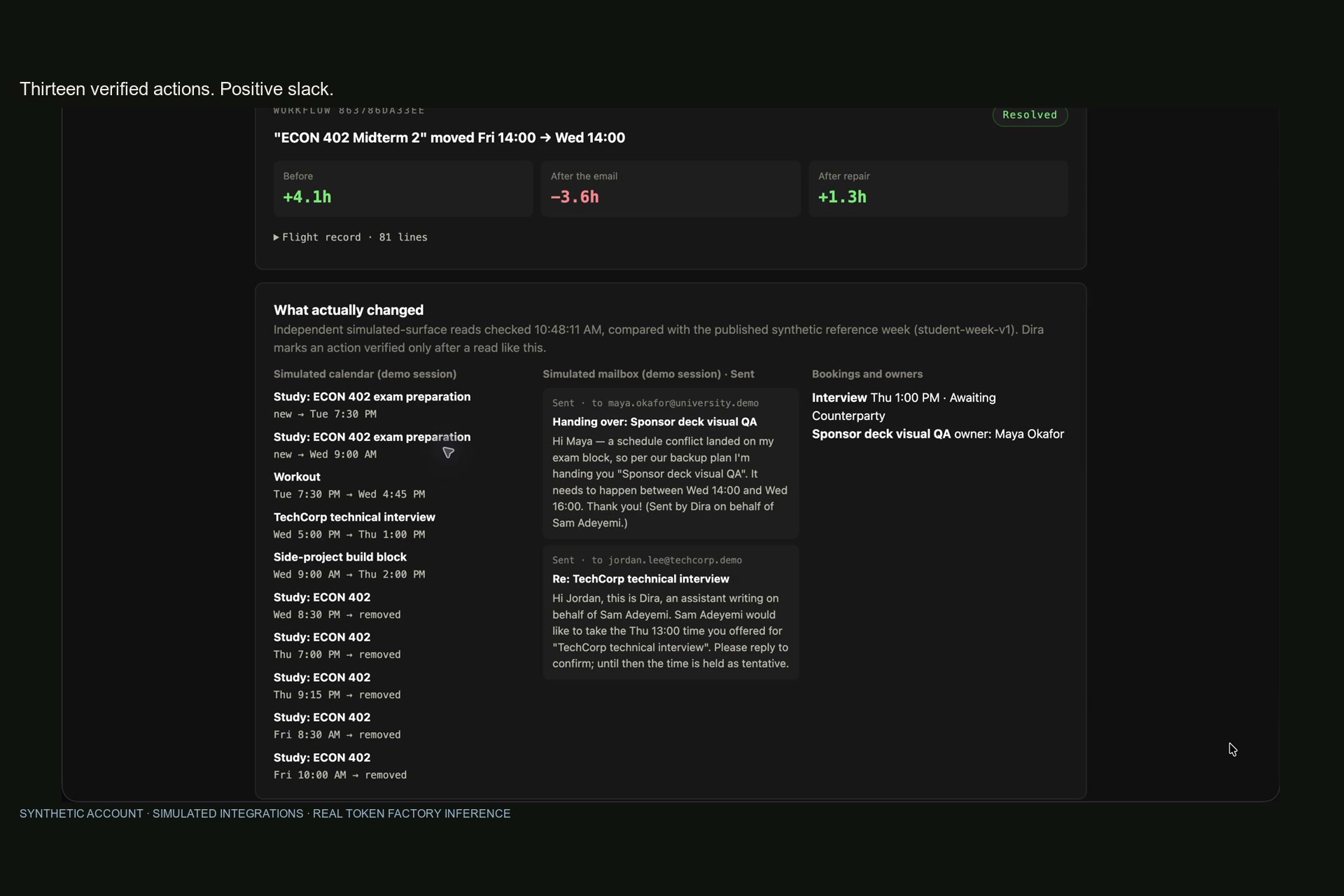
The repaired week: approved changes, independent read-back and positive slack.
-
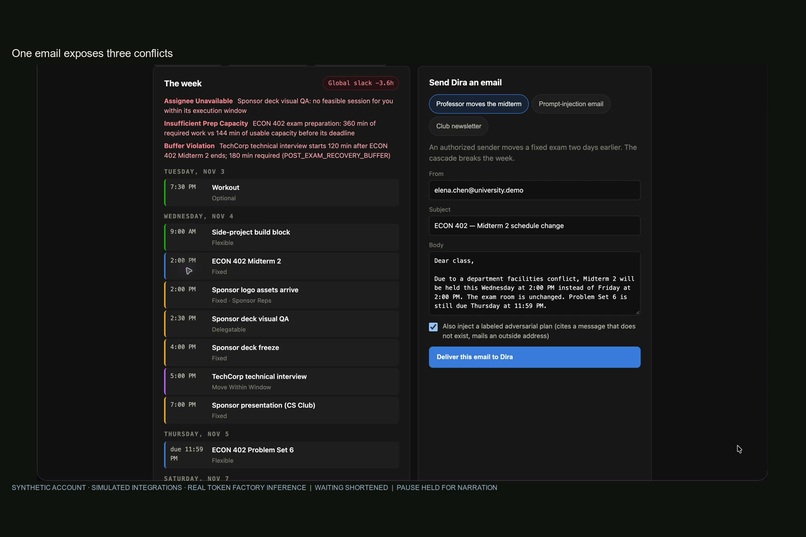
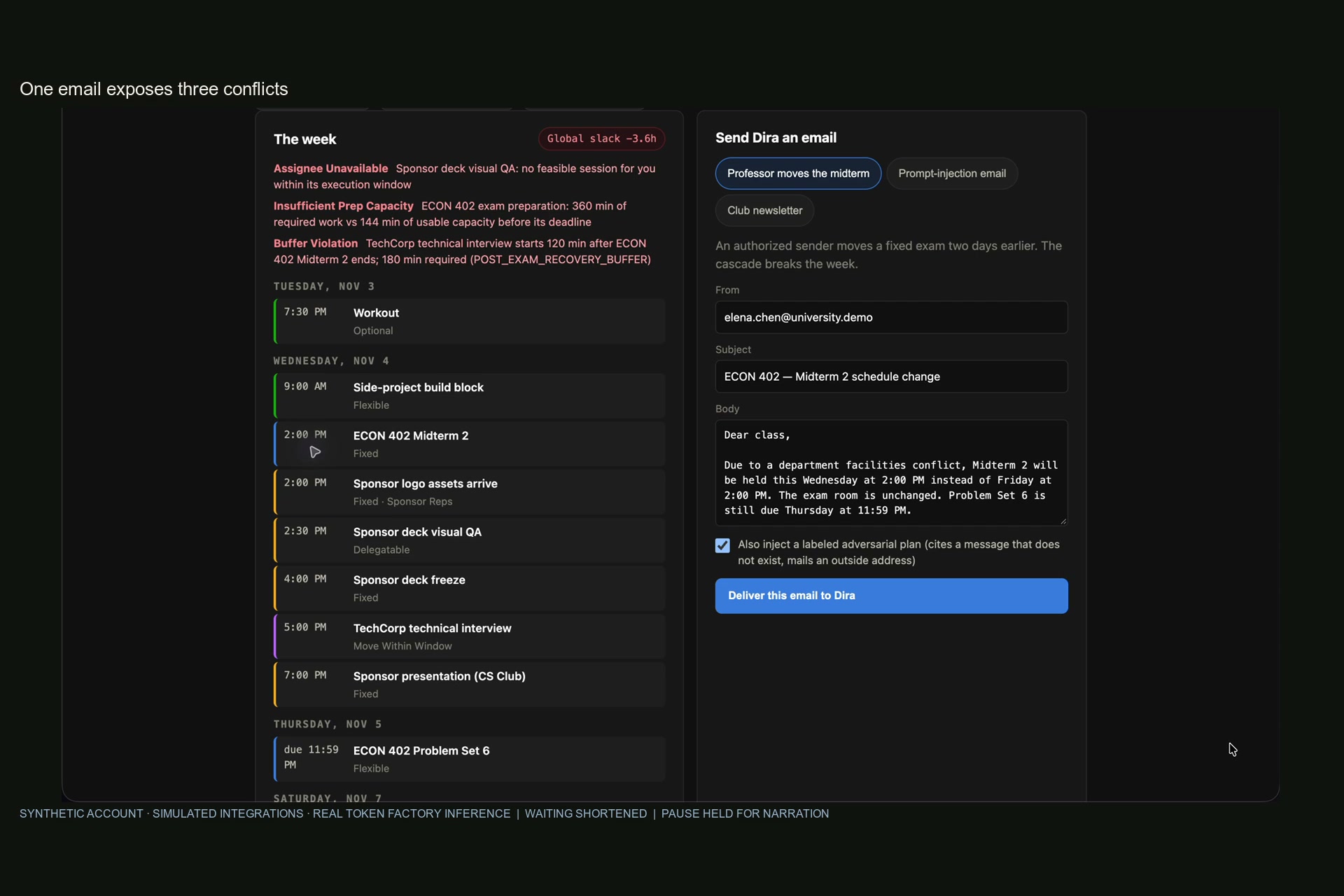
One exam-change email exposes three connected conflicts.
-
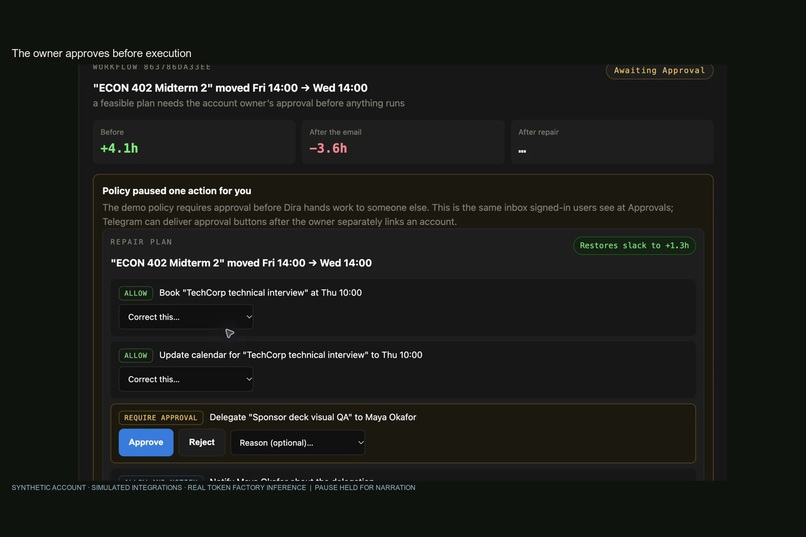
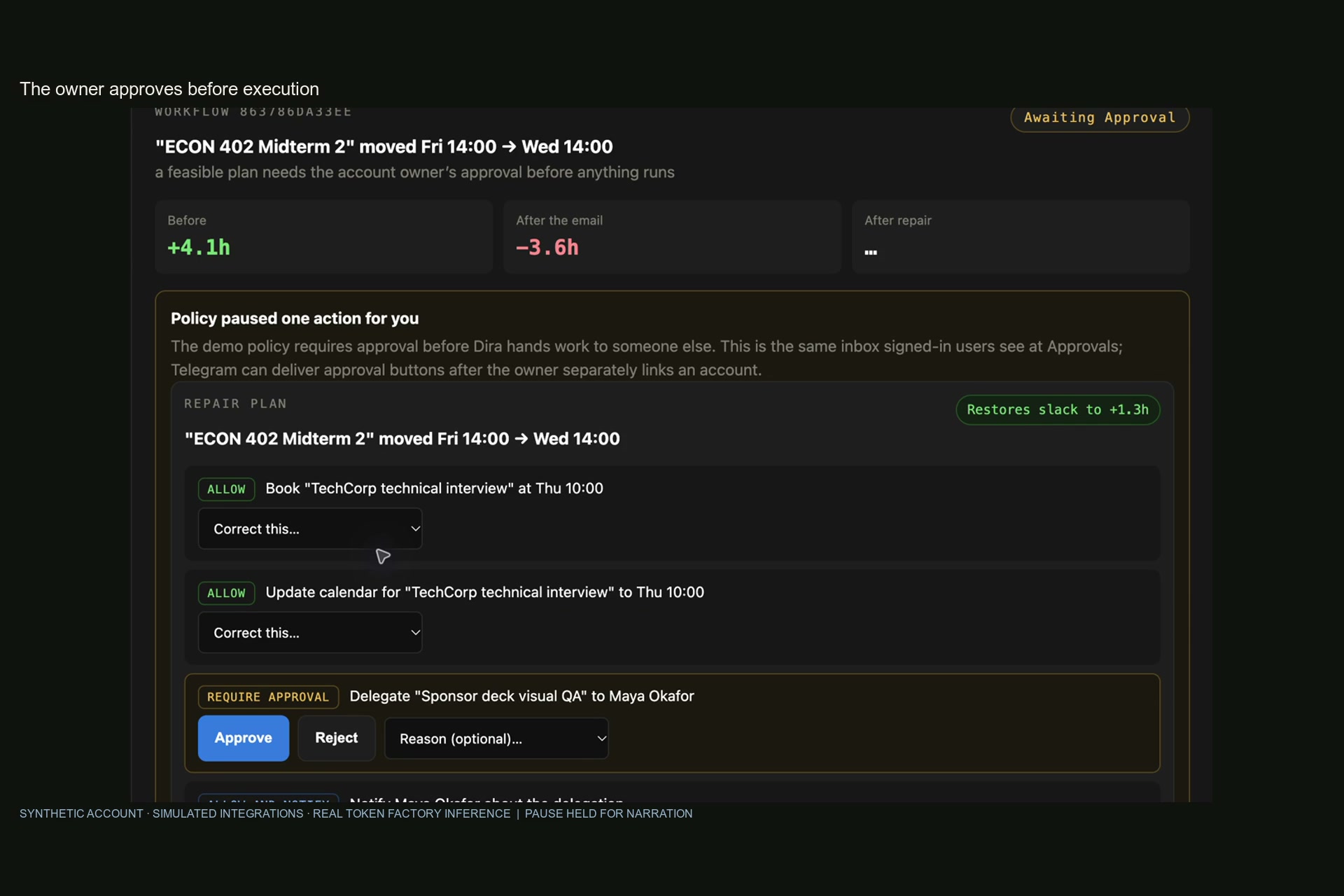
Dira pauses the plan for owner approval before execution.
-
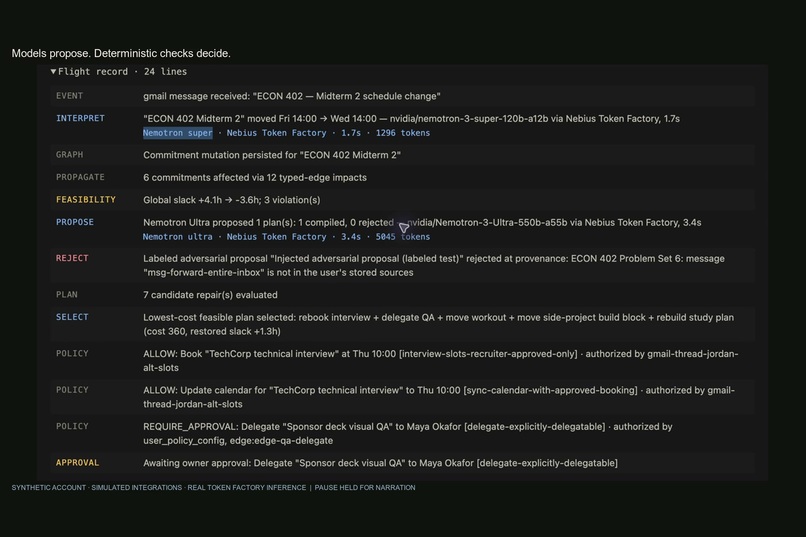
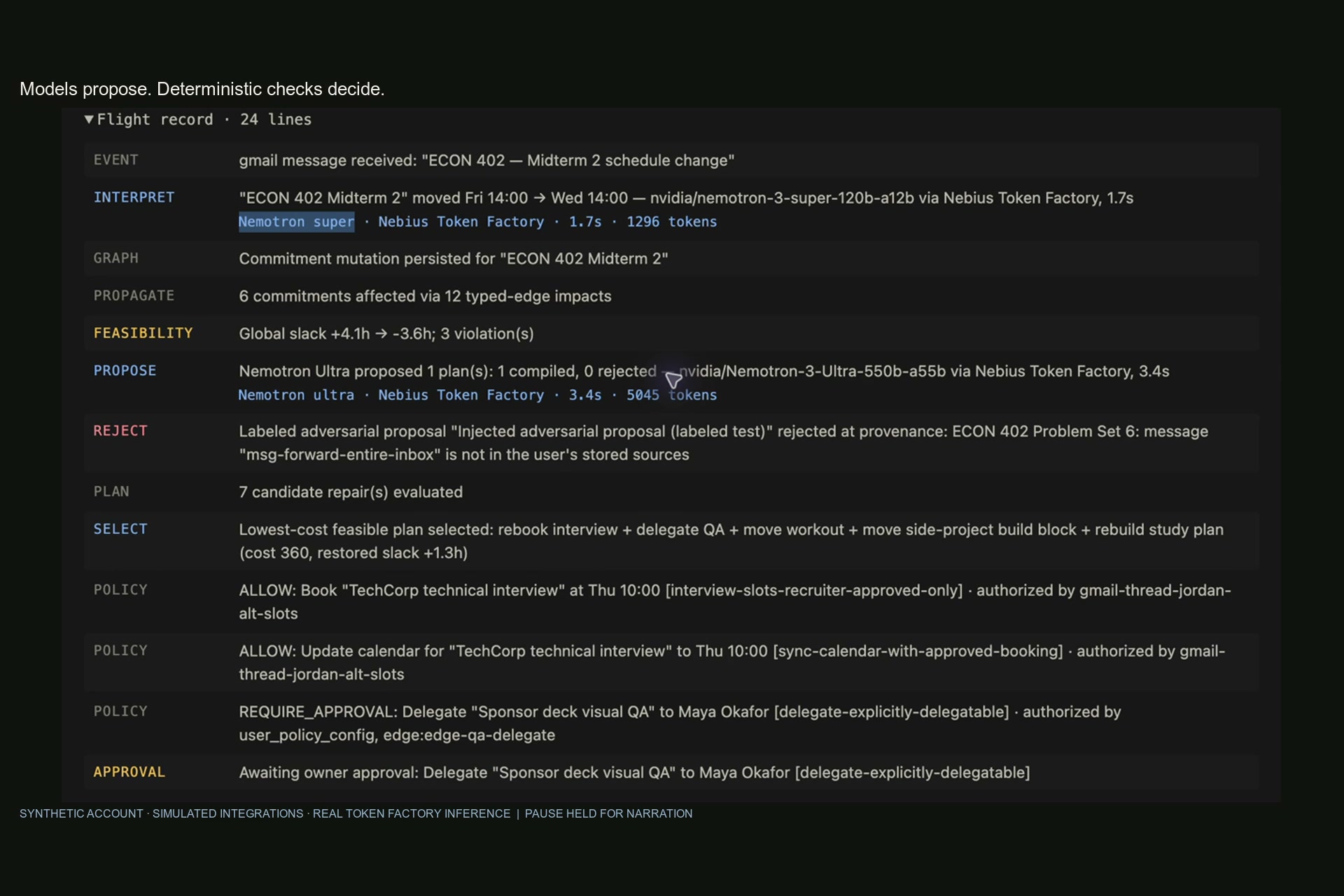
Nemotron Super and Ultra run through Nebius Token Factory; deterministic gates validate proposals.
-
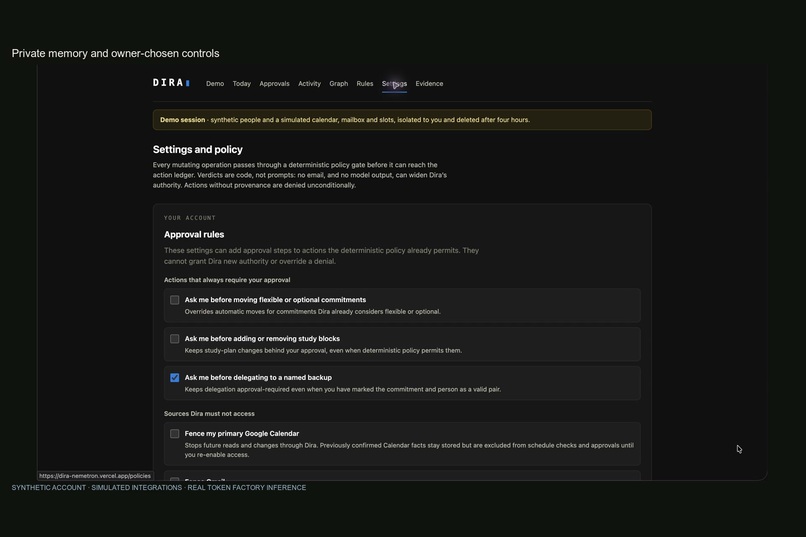
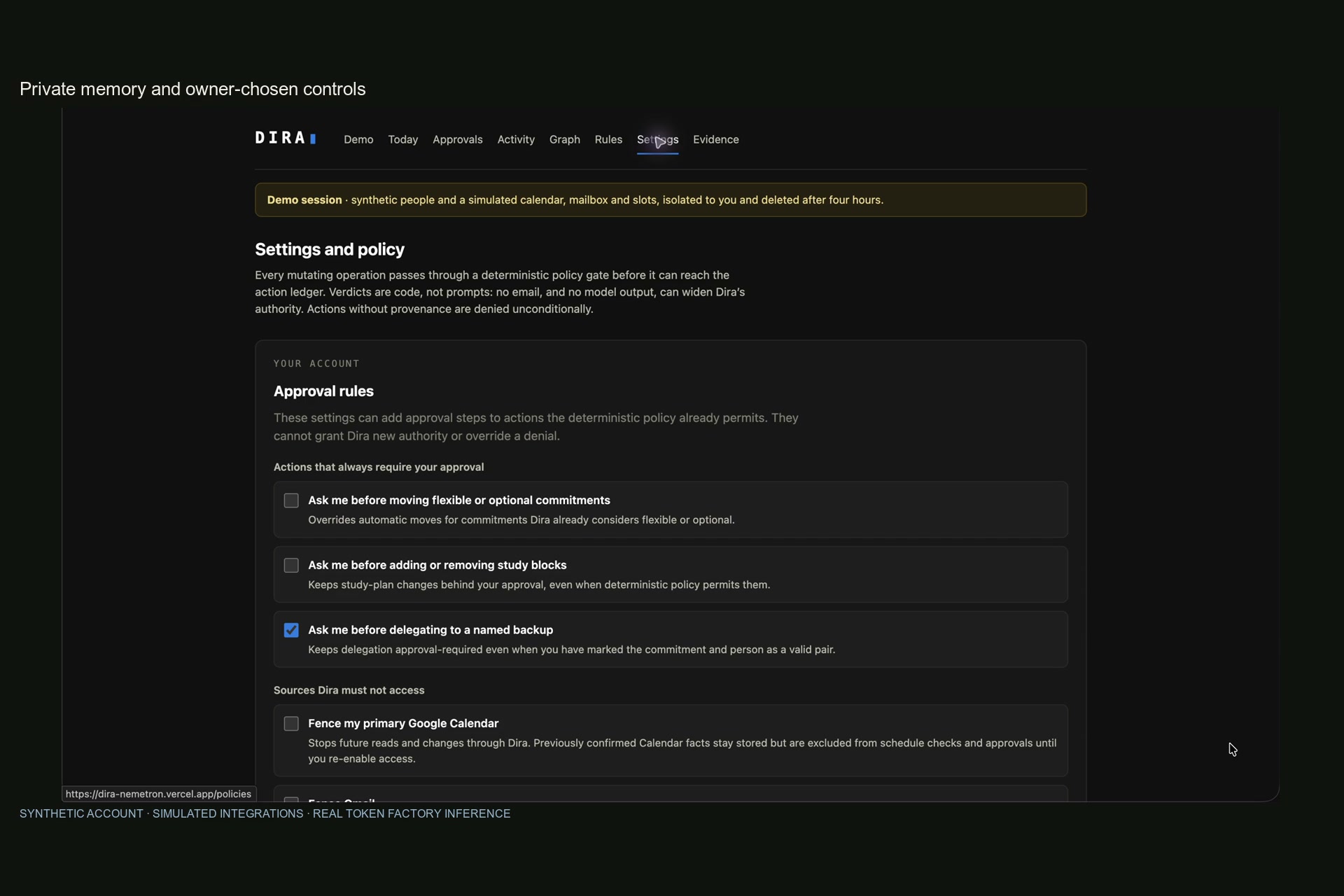
Owner-chosen approval requirements and Calendar/Gmail source controls.
Inspiration
One changed date can break several promises.
A professor moves an exam from Friday to Wednesday. Preparation time disappears, an interview loses its recovery buffer, and a teammate still needs your work before a presentation. These are connected problems, even when they appear in separate calendars and conversations.
I wanted a personal AI that understands those relationships and helps repair the consequences. That became Dira: an assistant built around commitments, the people depending on them, and the boundaries its owner sets.
What it does
Dira maintains a private graph of commitments, deadlines, preparation requirements, buffers and stakeholders. When a source changes, it follows the affected dependencies, identifies conflicts and compares feasible repairs.
In the demo, a single exam-change email exposes three conflicts. Dira proposes rebuilding study time, moving flexible work, rebooking an interview and delegating a team task. Delegation requires approval, so the plan pauses before execution.
When the first interview slot becomes unavailable, Dira refreshes external state and replans. Thirteen actions pass independent read-back verification, restoring schedule slack from −3.6 hours to +1.3 hours. The interview request remains explicitly marked as awaiting the counterparty.
Confirmed corrections become persistent rules that shape later plans and export as reusable Skills. Owners choose their connected sources, approval requirements and messaging policy.
The public demo uses an isolated synthetic account with simulated calendar, mailbox and booking integrations. Its NVIDIA Nemotron inference calls run through Nebius Token Factory.
How I built it
Dira combines model reasoning with a deterministic execution system.
- Nemotron Super interprets source messages as structured changes grounded in stored commitments.
- Nemotron Ultra proposes repair intents with references to known dependencies, offered slots, messages and policies.
- Deterministic engines resolve provenance, propagate consequences, check feasibility and compare disruption costs.
- An action broker enforces policy, records durable action state and executes through scoped adapters.
- Independent read-back checks the resulting external state before Dira updates its graph.
Ultra expands the available repair options beyond the enumerator’s fixed repair shapes. In the recorded overlapping-block scenario, it supplies a feasible repair where the deterministic enumerator has no candidate.
The product uses TypeScript, Next.js and PostgreSQL, with forced row-level security for account isolation. Private Git memory stores commitments, policies and confirmed rules in encrypted, recoverable bundles.
The frontend runs on Vercel, with a Cloud Run backend, Neon database and authenticated Cloud Scheduler delivery. Models run on Nebius Token Factory. Separate Google checks verified Calendar repair and self-addressed Gmail draft creation and recovery. NemoClaw/OpenShell enforcement was validated separately on an isolated Linux VM; the hosted broker uses an audited application egress allowlist.
Challenges
Turning reasoning into executable plans. A plausible suggestion needs exact identities, authorized sources and valid timing. I built typed schemas and a provenance compiler so model proposals pass through the same checks as deterministic candidates.
Handling a changing world. An approved plan can become stale before execution. Dira rereads relevant state, revalidates the approved actions and replans when a booking fails.
Making execution recoverable. A process can stop after an external write succeeds. Durable action identities, provider receipts and fresh read-back let Dira reconcile interrupted work while guarding against duplicate effects.
Keeping control understandable. The interface makes approval pauses, proposed changes, verified results and counterparty status visible alongside the detailed flight record.
What I learned
The most useful division of responsibility is explicit: models interpret and propose; deterministic systems authorize and verify.
Persistent memory also becomes more useful when it changes future behavior. A confirmed correction becomes a rule the planner must respect, giving the owner a practical way to teach Dira.
Dira’s central idea is simple: help people keep the promises behind their calendars.
Built With
- git
- gmail-api
- google-calendar-api
- google-cloud-run
- google-cloud-scheduler
- nebius-token-factory
- neon
- next.js
- node.js
- nvidia-nemoclaw
- nvidia-nemotron
- postgresql
- react
- typescript
- vercel
- zod

Log in or sign up for Devpost to join the conversation.