-
-
Dira Home Page
-
Dira Interventions
-
Dira Commitment Graph
-
Dira Architecture Diagram
Inspiration
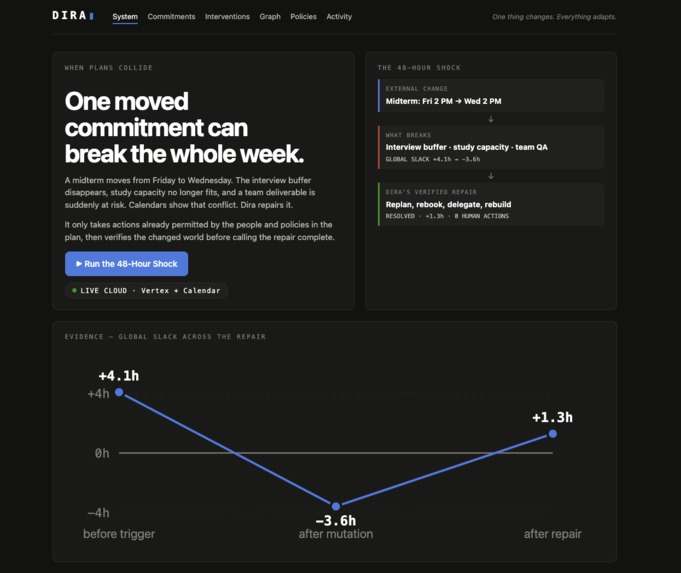
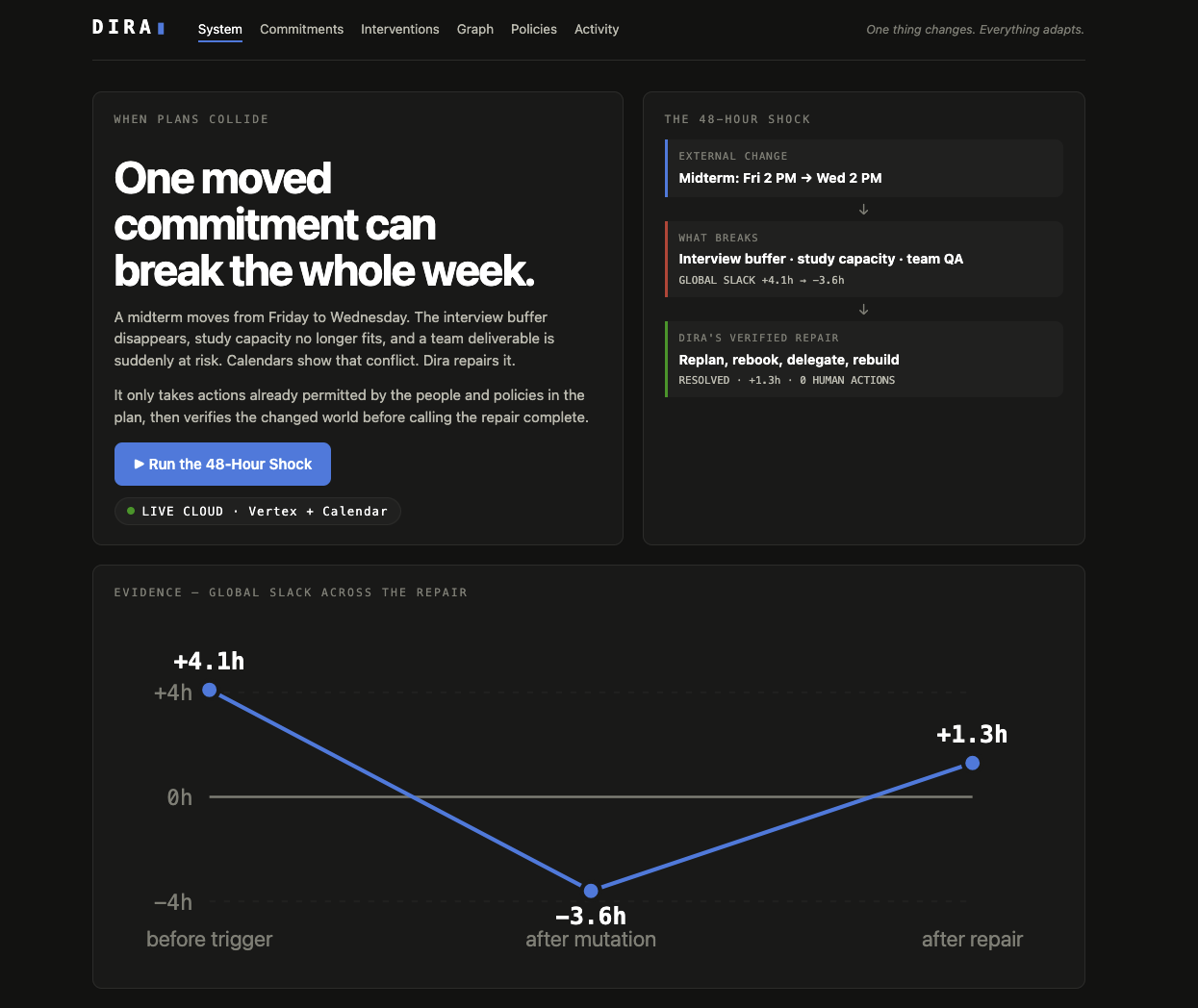
A professor moved my midterm forward by two days. That one email collided with a recruiting interview, wiped out my study time, and made a club deliverable impossible to finish in its window. Every app I owned showed me the damage in red and then waited for me to fix it by hand.
I built Dira because the hard part of a busy week was never remembering what I had to do. The hard part is recomputing everything else that breaks when one thing moves, and then actually doing something about it.
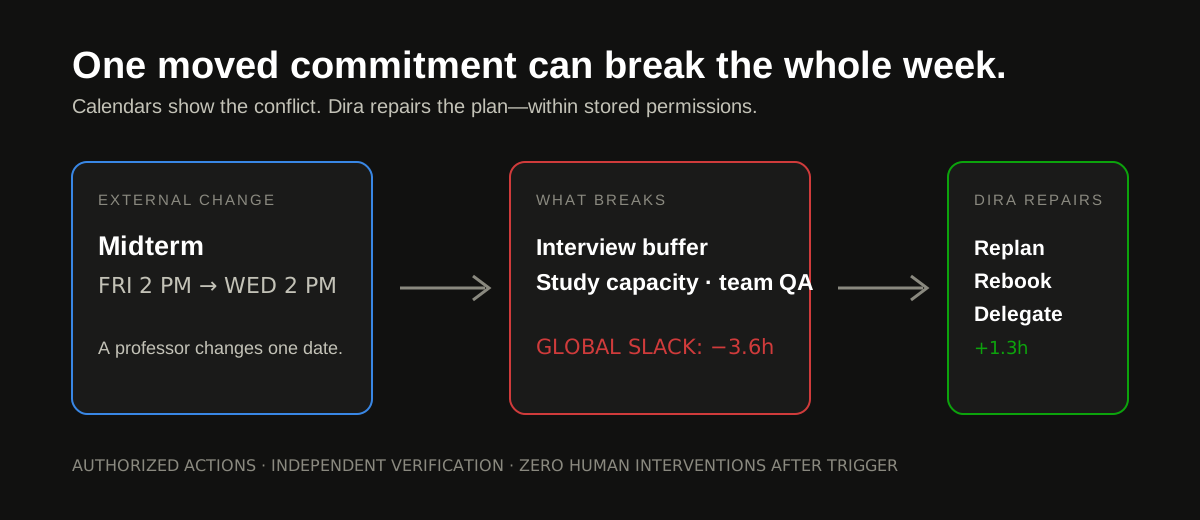
One thing changes. Everything adapts.
What it does
Dira is an autonomous commitment-repair agent. When an authorized external change makes your week infeasible, Dira finds every downstream conflict, chooses repairs it is actually permitted to make, executes them, and then verifies the world really changed before calling the week repaired. You do not prompt it through any of this.
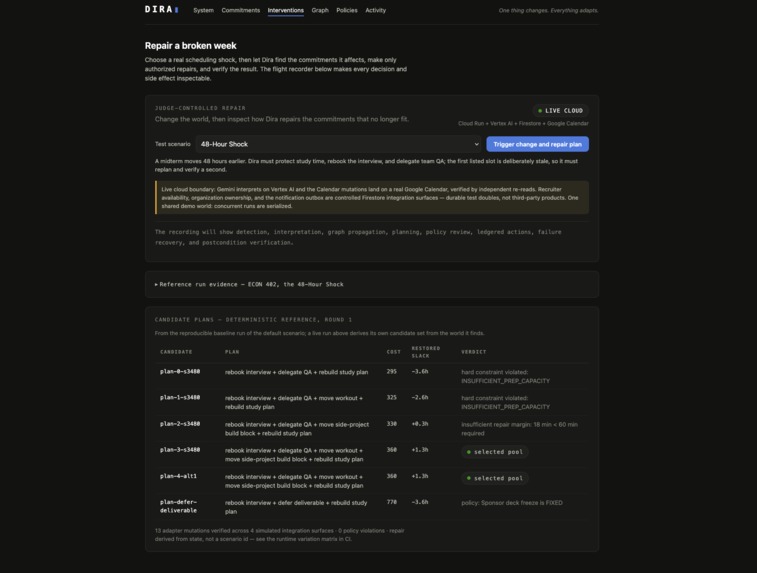
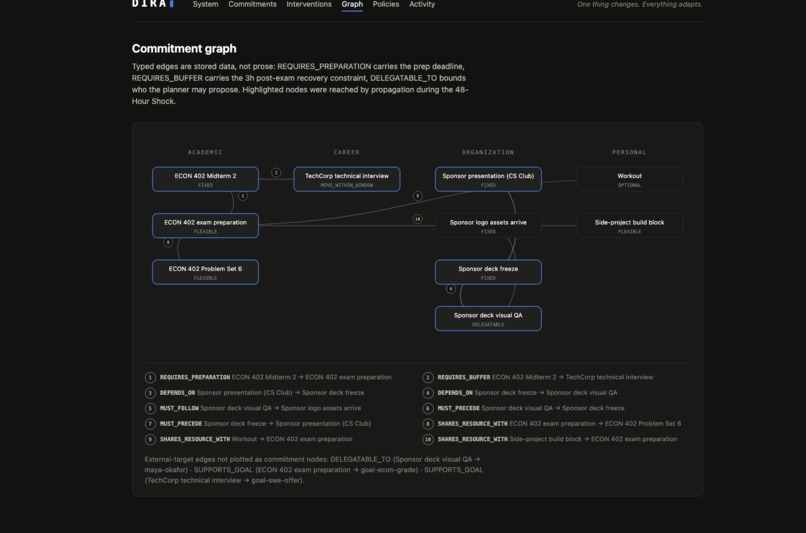
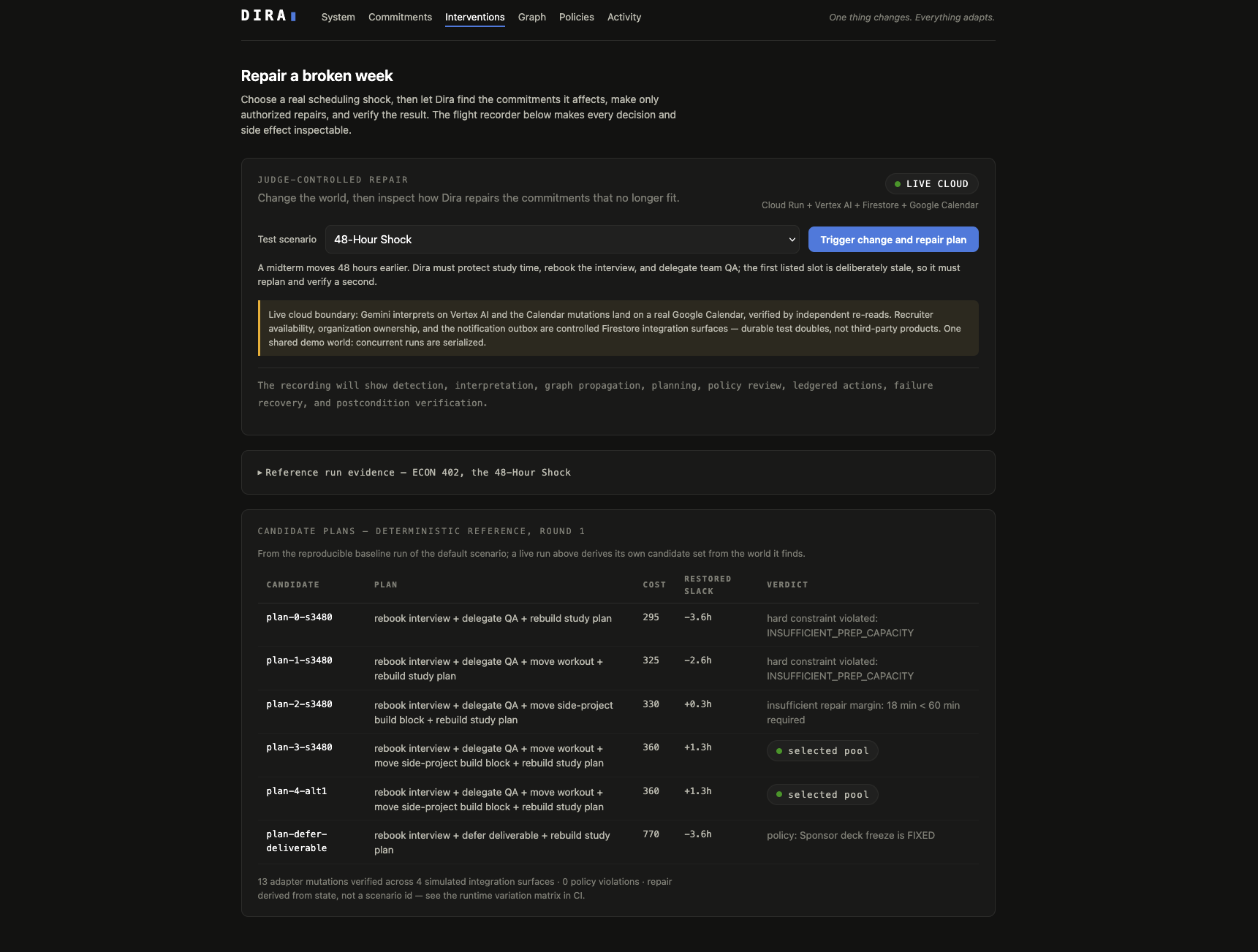
The canonical demo is the 48-Hour Shock. A professor moves a midterm from Friday to Wednesday. Dira extracts the change, walks its commitment graph, and finds six affected commitments and three hard violations. Its feasibility measure, Global Slack, falls from +4.1 hours to negative 3.6: the week no longer fits. Dira then acts. It books the approved interview slot and hits a 409 because that listing was seeded stale. It refuses to pretend the booking worked, refreshes availability, rules the slot out, replans, and books the other approved slot. It delegates visual QA to the one teammate a stored graph edge designates, reclaims two flexible personal blocks, rebuilds the study plan on a real Google Calendar, and re-reads every system it touched. Global Slack ends at +1.3 hours. Zero human actions after the trigger.
The demo also shows what Dira refuses to do. Remove every approved interview slot and it stops safely with an explanation instead of inventing an appointment. Change the world and the plan changes with it, because the plan is derived, not scripted.
Every run ends with a proof-carrying repair receipt: what was protected, what changed, the failure it recovered from, why the losing repair options were rejected, and the independent re-reads that verified the result. Most agents hand you an answer. Dira hands you the evidence.
How I built it
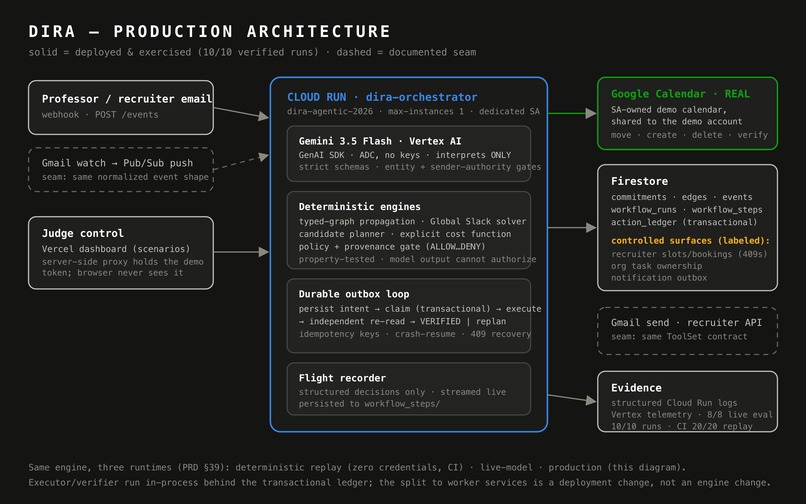
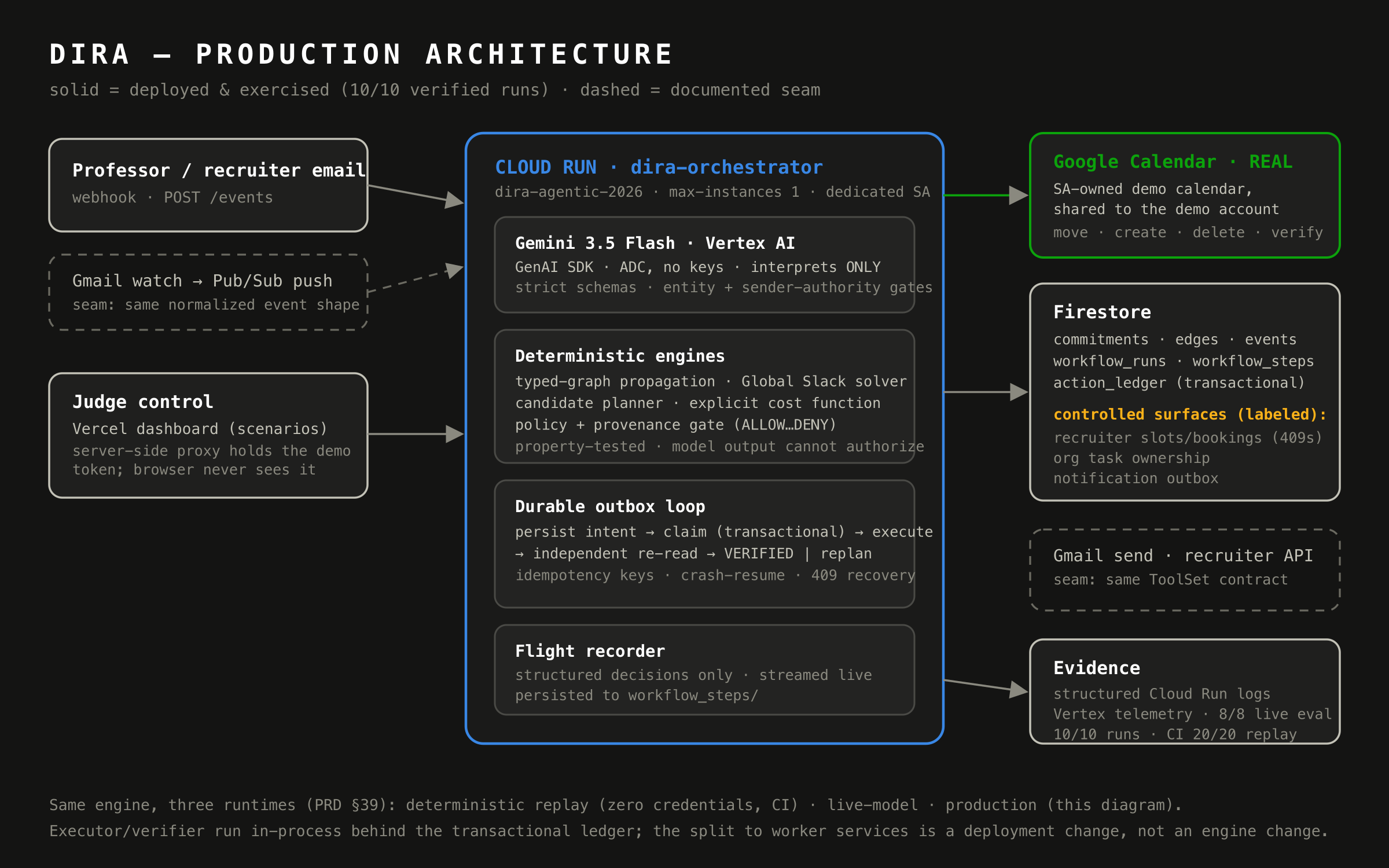
- Gemini 3.5 Flash on Vertex AI, through the Google GenAI SDK, interprets schedule-change language and resolves entities behind strict schemas. It reads language. It cannot authorize actions.
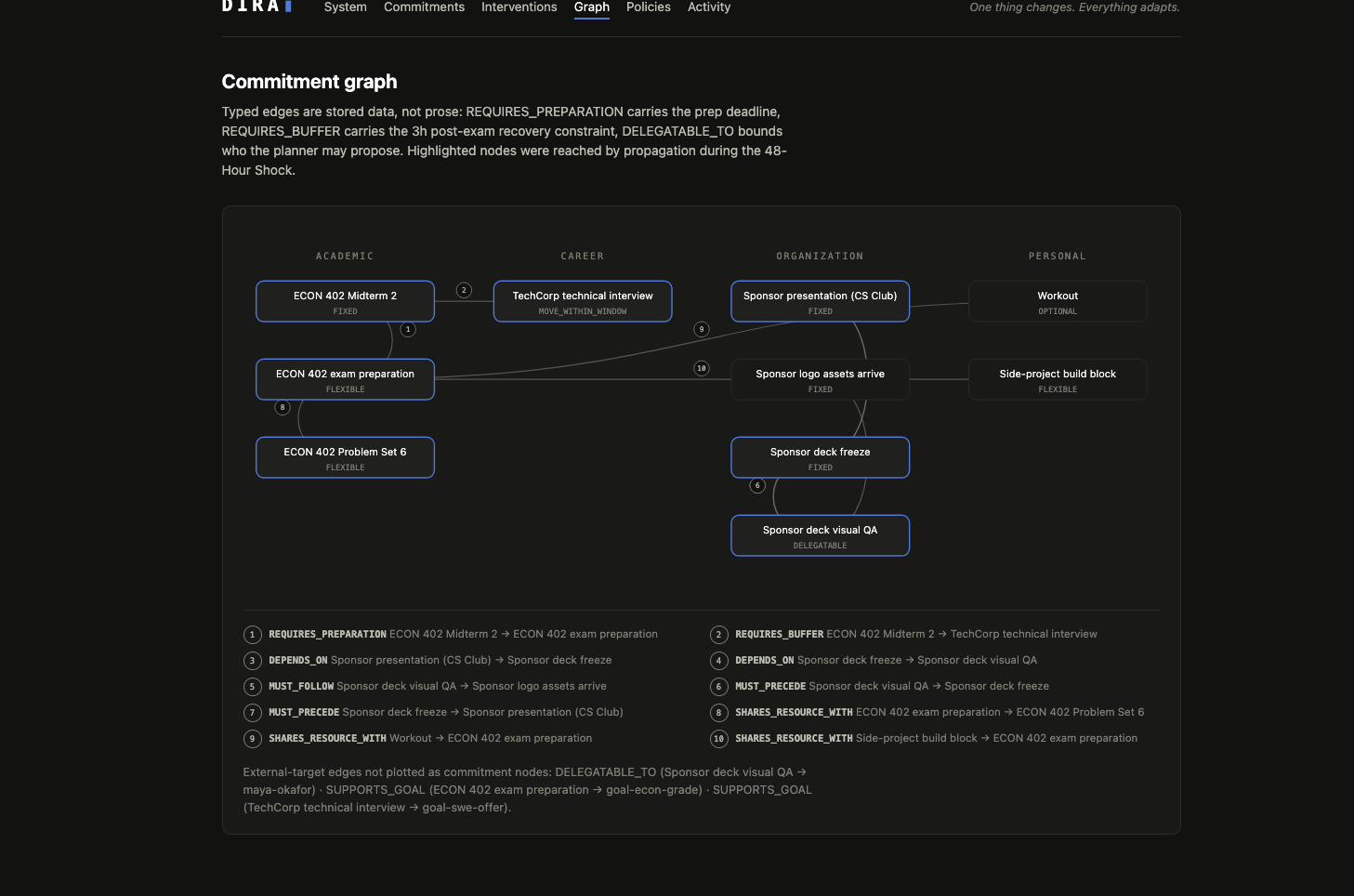
- A typed commitment graph stores commitments, time windows, flexibility, stakeholders, provenance, and executable edges such as
REQUIRES_PREPARATION,REQUIRES_BUFFER, andDELEGATABLE_TO. - Deterministic engines own propagation, Global Slack, planning, and policy. Gemini never performs schedule arithmetic and never declares success.
- A Firestore-backed action ledger persists intent before execution, uses idempotency keys and transactional claims, and keeps execution separate from verification, so a crash or a retry can never double-book.
- Every mutation is verified by re-reading its target. An optimistic tool response never becomes internal truth on its own.
- The deployed boundary is one Cloud Run service using Vertex AI, Firestore, and a real service-account-managed Google Calendar. The Next.js judge console on Vercel labels each run
LIVE CLOUD,DETERMINISTIC EVIDENCE, orCLOUD UNAVAILABLE, so you always know what you are looking at. - A separately deployed Gemma 3n Cloud Run service (CPU,
google/gemma-3n-E2B-it) transcribes short spoken voice notes. It returns only text and holds no tool credentials; its transcript is treated as untrusted input and owner-scoped before it enters the same pipeline as every other trigger. One real spoken note has been run end to end against the deployed stack, from audio through transcription, Gemini interpretation, repair, and verification to RESOLVED, captured indocs/evidence/gemma-voice-run.json.
What makes it autonomous instead of a chatbot
A change enters the system and Dira does the rest: propagates the impact, derives candidate plans from the current world, selects only policy- and provenance-approved actions, survives partial failure, and verifies the resulting state. When authorization or availability runs out, it stops and says so.
Models interpret. Deterministic code decides.
Evidence boundary
The live-cloud demo uses Gemini on Vertex AI, Cloud Run, Firestore, and real Google Calendar mutations with independent verification reads. Recruiter availability, organization-task ownership, and the notification outbox are deliberately labeled controlled Firestore integrations. The outbox is not presented as consumer Gmail delivery, and the demo trigger is not presented as a live Gmail Watch/Pub/Sub integration.
The repository also carries a credential-free deterministic replay, an eight-scenario variation matrix, property and chaos tests, and 20 consecutive replays with zero duplicate mutations and zero policy violations. Those prove the engine separately from the live side effects.
Challenges I ran into
Producing a plan was never the hard part. Acting on one safely while the world keeps moving is. A booking can fail after the planner reads availability. A worker can die after a tool succeeds but before the success is recorded. Dira answers with a specific discipline: persist intent before executing, re-read external state after every write, invalidate failed options, and replan from the world as it is now, not as the plan assumed.
I also treated email-like input as hostile. A mutation must pass a strict schema, resolve to an existing commitment, satisfy sender authority, clear a confidence threshold, carry provenance for each proposed action, and pass deterministic policy. No untrusted text and no model output can widen the agent's authority.
Accomplishments that I'm proud of
- A full autonomous repair loop with a visible recovery sequence:
409 → OBSERVE → REPLAN → VERIFY → RESOLVED. - Deterministic authority boundaries. The model can interpret and never authorize.
- A durable action ledger, idempotent execution, independent verification, and crash-resume coverage.
- 77 tests across unit, integration, property, replay, and chaos suites.
- A credential-free canonical replay with 18/18 assertions, eight runtime variations, and 20/20 injected-failure recovery runs.
- A judge-controlled dashboard that honestly distinguishes live cloud from deterministic evidence.
- A proof-carrying repair receipt that turns a run's diff, recovery, candidate rationale, and verification evidence into something a user can audit.
What I learned
Autonomy is earned by unglamorous work: explicit permissions, provenance, idempotency keys, fresh verification reads, failure handling, and a visible safe stop. The model is valuable exactly where language is ambiguous. The agent's authority and correctness should stay falsifiable everywhere else.
What's next
Gmail OAuth and Workspace delivery, LMS and production recruiting connectors, multi-user negotiation, and a longer-horizon commitment model. Gemma 3n voice intake is deployed and evidenced end to end; the next step is a photo-based official-notice workflow through the same gates.
Built With
- cloud-run
- firestore
- gemini
- gemma
- google-calendar
- google-genai-sdk
- next.js
- typescript
- vercel
- vertex-ai
- vitest
- zod

Log in or sign up for Devpost to join the conversation.