Inspiration
I was inspired by the idea of building a tool that solves a real mathematical problem. This tool was built with the initial intention of solving (and graphically visualising) very difficult diophantine problems which current AI assistants have difficulty getting past especially those related to open problems.
What it does
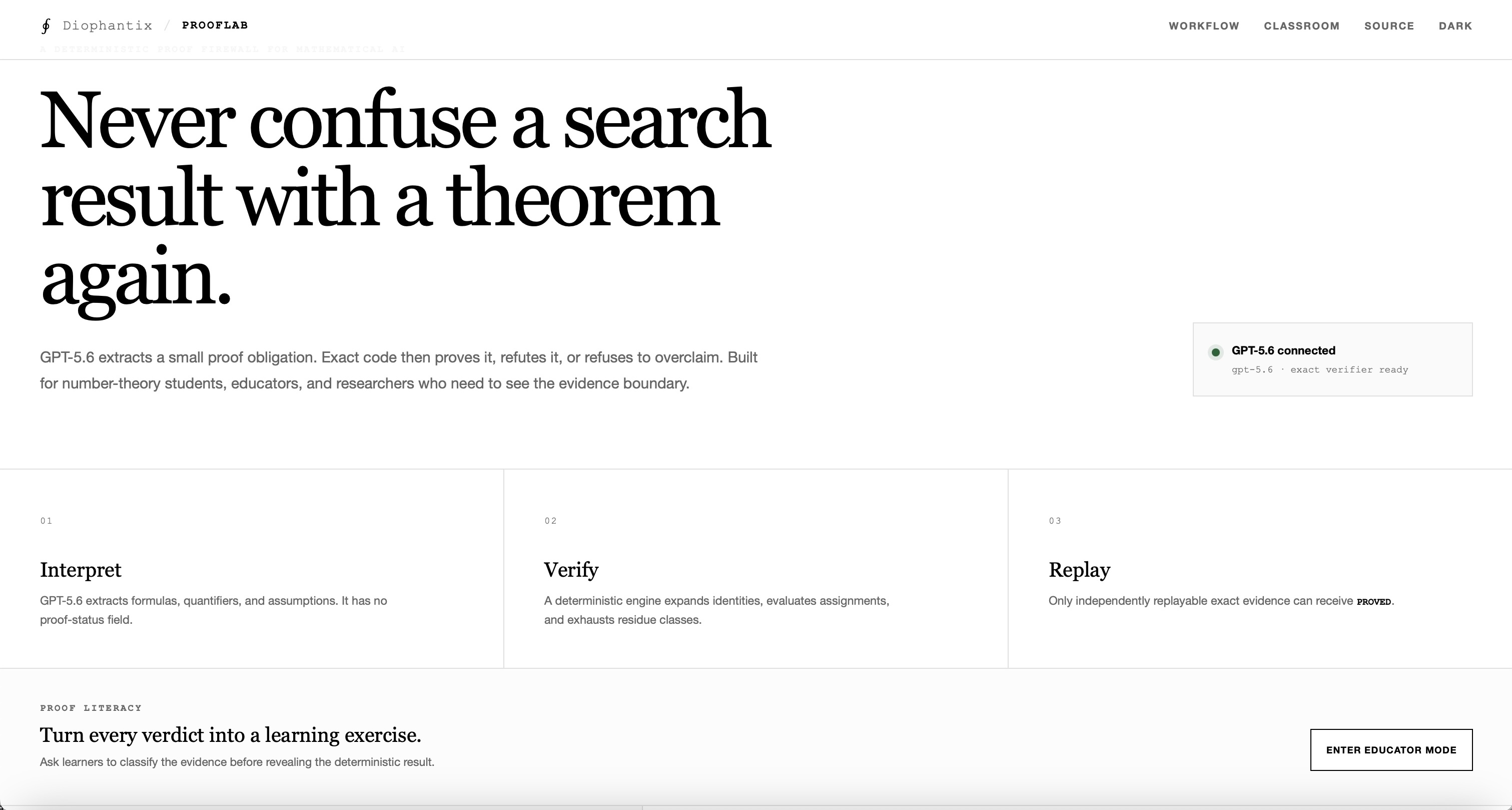
Diophantix ProofLab verifies proofs and mathematical statements. One can simply put a mathematical claim and it quickly determines whether the statement is correct or not. Once the decidability of a problem is open about a problem, it honestly admits so.
How we built it
I built initially with the assistance of Cursor AI and Codex and GPT-5.6 was used in improving the tool and eventually creating ProofLab.
Challenges we ran into
During the earlier phase of building Diophantix, when equations were run in it to be solved, even when it solves it correctly, the graphical illustration was either not working or sometimes even when it did, it was not properly visualising rational points as well as it did for integer points. For ProofLab, when I tested its ability to identify correct proofs with Fermat's Last Theorem,.i.e. $x^3 + y^3 = z^3$, it claimed it was undecided while it's known to be disproven (by Andrew Wiles).
Accomplishments that we're proud of
ProofLab is able to take an input claim and correctly determine its status, and verify correctness with assistance of GPT-5.6.
What we learned
I learned that there is always room for improvement.
What's next for Diophantix ProofLab
I intend to soon train it on solved (once) open problems (especially Diophantine ones) so its methods can be applied to solve other hard problems.
Built With
- codex
- cursorai
- gpt-5.6

Log in or sign up for Devpost to join the conversation.