-
-
DiligentFlowAI
-
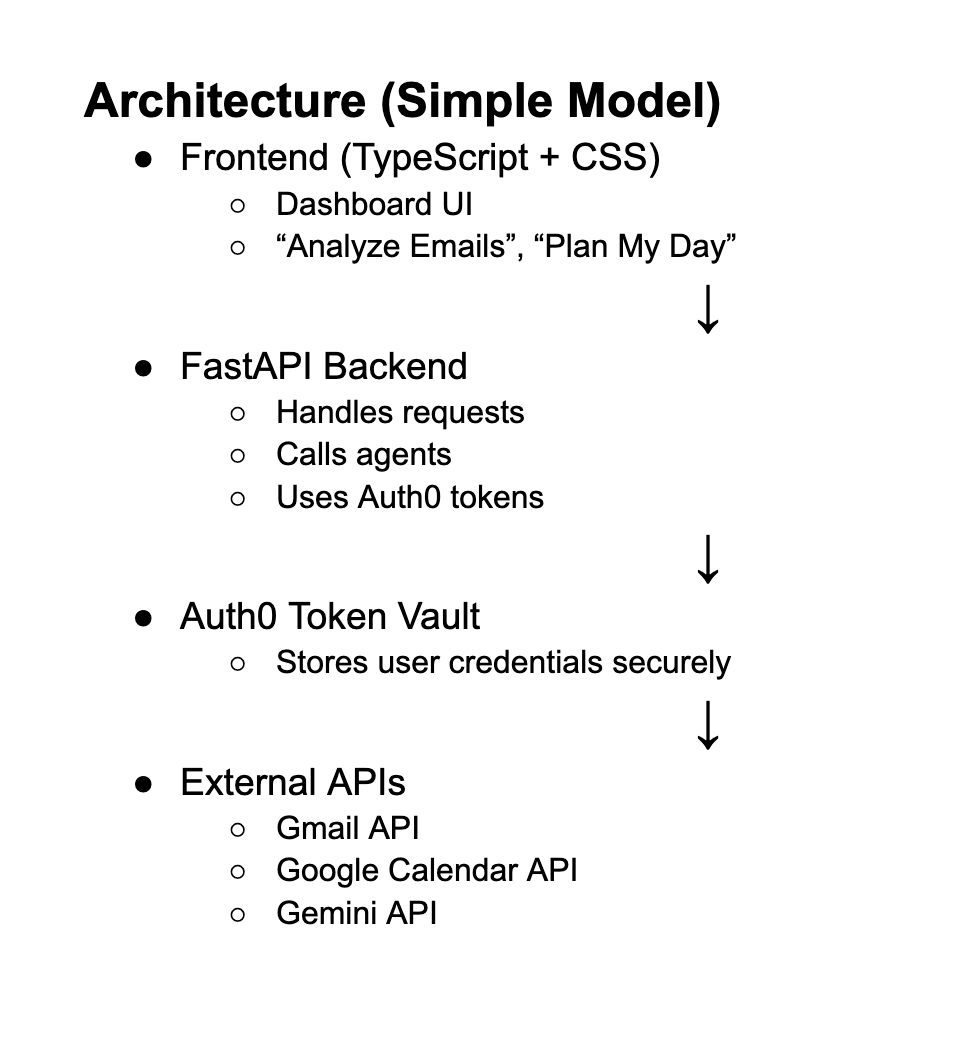
Project Architecture (Simple Model)
-
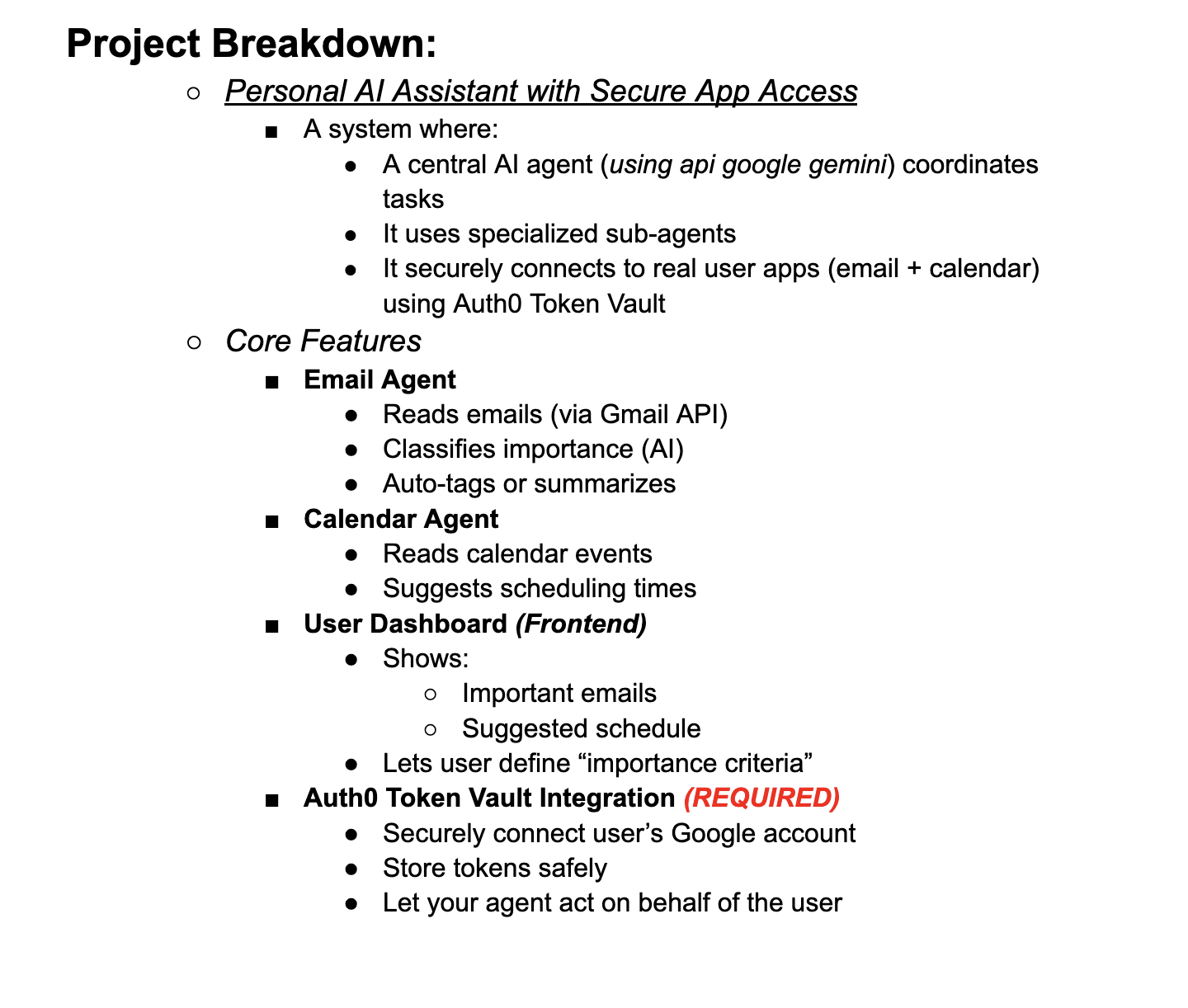
Project Breakdown (Brainstorming/Planning Stage)
Inspiration
We were inspired by the inefficiency of managing multiple apps like email and calendars manually. We wanted to explore how AI agents could securely act on behalf of users to automate these everyday workflows while maintaining user control and privacy.
What it does
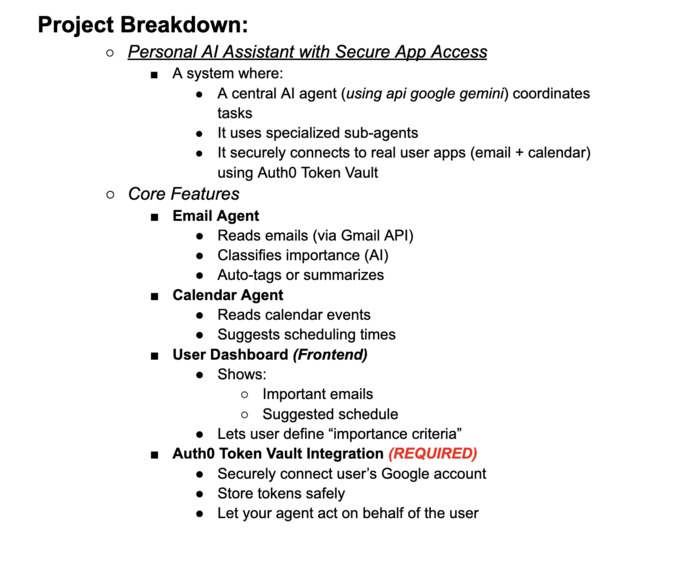
DiligentFlowAI is a secure multi-agent AI system that connects to user applications and automates tasks like email prioritization, summarization, and calendar scheduling. It uses Auth0 Token Vault to safely authenticate and perform actions on behalf of the user.
How we built it
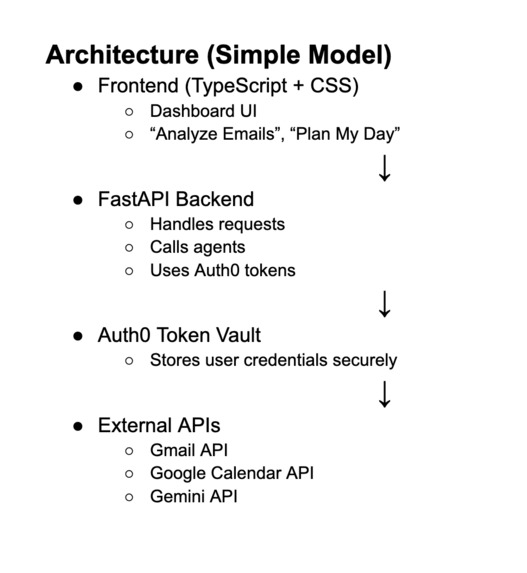
We built a FastAPI backend to handle agent orchestration and API communication, with a TypeScript frontend for user interaction. We integrated Auth0 for authentication and Token Vault for secure access to external services like gmail and google calendar APIs. AI processing is handled through hosted model APIs. We are currently using the Gemini API.
Challenges we ran into
Understanding and implementing secure OAuth flows with Auth0 Token Vault was challenging. Implementing all the apis in a manner that can be accessible to the public and managing communication between multiple agents and ensuring consistent, structured AI outputs also required careful design. We also faced bit of a challenge in deploying the project, it took quite a bit of debugging to finally get it up and running.
Accomplishments that we're proud of
We successfully built a working multi-agent system that securely interacts with real user applications. Integrating Auth0 Token Vault and demonstrating real-world automation with AI agents was a major achievement.
What we learned
We learned how to implement secure authentication and delegated access using Auth0, design modular AI agent systems, and integrate AI models with real-world APIs in a scalable way.
What's next for DiligentFlowAI
We plan to expand agent capabilities, add more integrations (e.g., more productive/task management services), improve personalization, and enhance real-time automation to create a more intelligent and proactive assistant.
Bonus Blog Post
Honestly, DiligentFlowAI started as a rant. We were juggling Gmail, Google Calendar, and multiple dashboards and kept thinking: why does "AI assistance" still mean copying and pasting between tabs? So we decided to build the system we actually wanted to use.
The most difficult part was implementing Auth0 Token Vault correctly. We knew delegated access was necessary because we refused to store raw user credentials. However, implementing it required a deeper understanding of token lifecycles and security boundaries. Every agent action needed to request a scoped, short-lived access token for a specific API. When a token refresh failed during execution, the system had to fail safely instead of corrupting state. We rewrote that error handling logic multiple times before it became reliable.
Multi-agent orchestration introduced another layer of complexity. The system could appear functional while agents disagreed on what completion meant. To address this, we enforced structured JSON communication between agents and treated output validation as a core system requirement. This decision significantly improved consistency and debuggability.
Deployment presented its own challenges. Integrating FastAPI, a TypeScript frontend, Gemini, and Google APIs exposed issues with authentication flows and environment configuration. We began documenting every failure, and that log eventually became more valuable than our initial architecture plan.
What we ultimately learned is that the hardest problems were not AI-related. They were fundamental issues in distributed systems, authentication, and reliability. This project shifted our mindset from building a prototype to building a system that users can actually trust.
Built With
- auth0
- geminiapi
- gmailapi
- googlecalendarapi
- nextjs
- python
- typescript


Log in or sign up for Devpost to join the conversation.