-
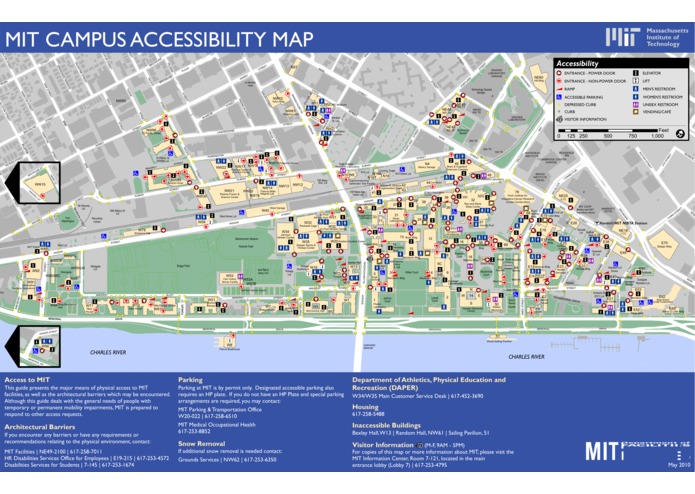
Accessibility map
-

Sample output


Inspiration
-Thought about accessibility problems that can occur in daily life. -Regarding travel, lack of details and support from Google Maps. -Friend decided not to come to MIT due to the lack of support for those with disabilities.
What it does
-Determines the ideal paths to class for those requiring accessibility on the MIT Campus. -Simple concept but is useful and can be implemented at various scales.
How we built it
-Used MIT floor plan to place nodes at intersections and approximated distances between nodes. -Defined elevators and stairs as edges, with stairs taking a third of the time as elevators (supported by empirical evidence). -Used Dijkstra’s shortest path algorithm -Wrote C++ program to determine the shortest path from a starting room (node) to an ending room. -Compared travel times when stairs can be used vs. when only elevators can be used
Challenges we ran into
-Finding the best way to give directions -Mapping room numbers with nodes -Errors with the algorithm
Accomplishments that we're proud of
-We calculated the average travel time across all pairs of nodes: -With stairs: About 100.385 seconds. -Only elevators: About 129.818 seconds. -Travel is ~29.3% slower for those unable to use stairs!
What we learned
-Shortest path algorithms -MIT's floor plans
What's next for Dijkstra's for Disability
-Implement GUI / turn program into an app! -Add more descriptive directions -Use better heuristics for travel time -Expand area of interest to entire MIT Campus (and beyond)!

Log in or sign up for Devpost to join the conversation.