-
-
Image
DigitAtlas — Make Every Digit Count
Challenge: DN-OP-01, Open Innovation Challenge (proposed alignment).
Inspiration and problem
Handwriting recognition is often presented as a single confident label. DigitAtlas makes uncertainty, failure cases and evaluation transparent to learners and educators. It is an independently developed AI/ML demonstration and does not claim validated classroom outcomes.
What it does
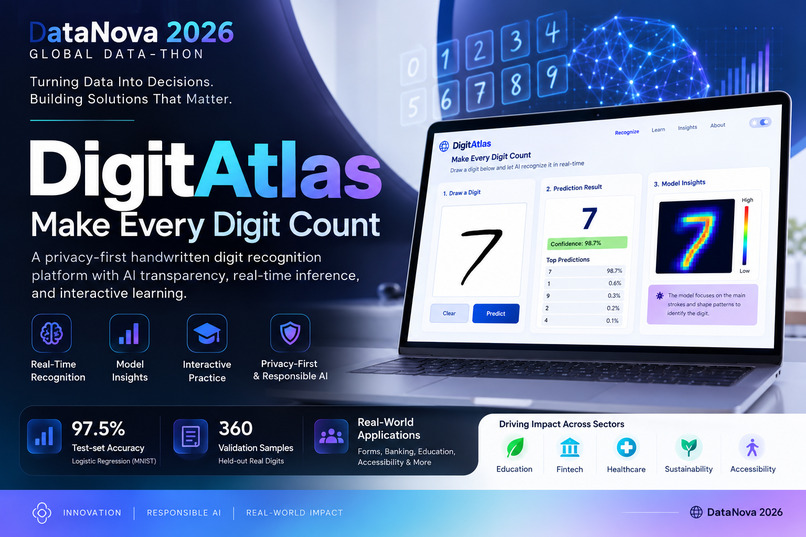
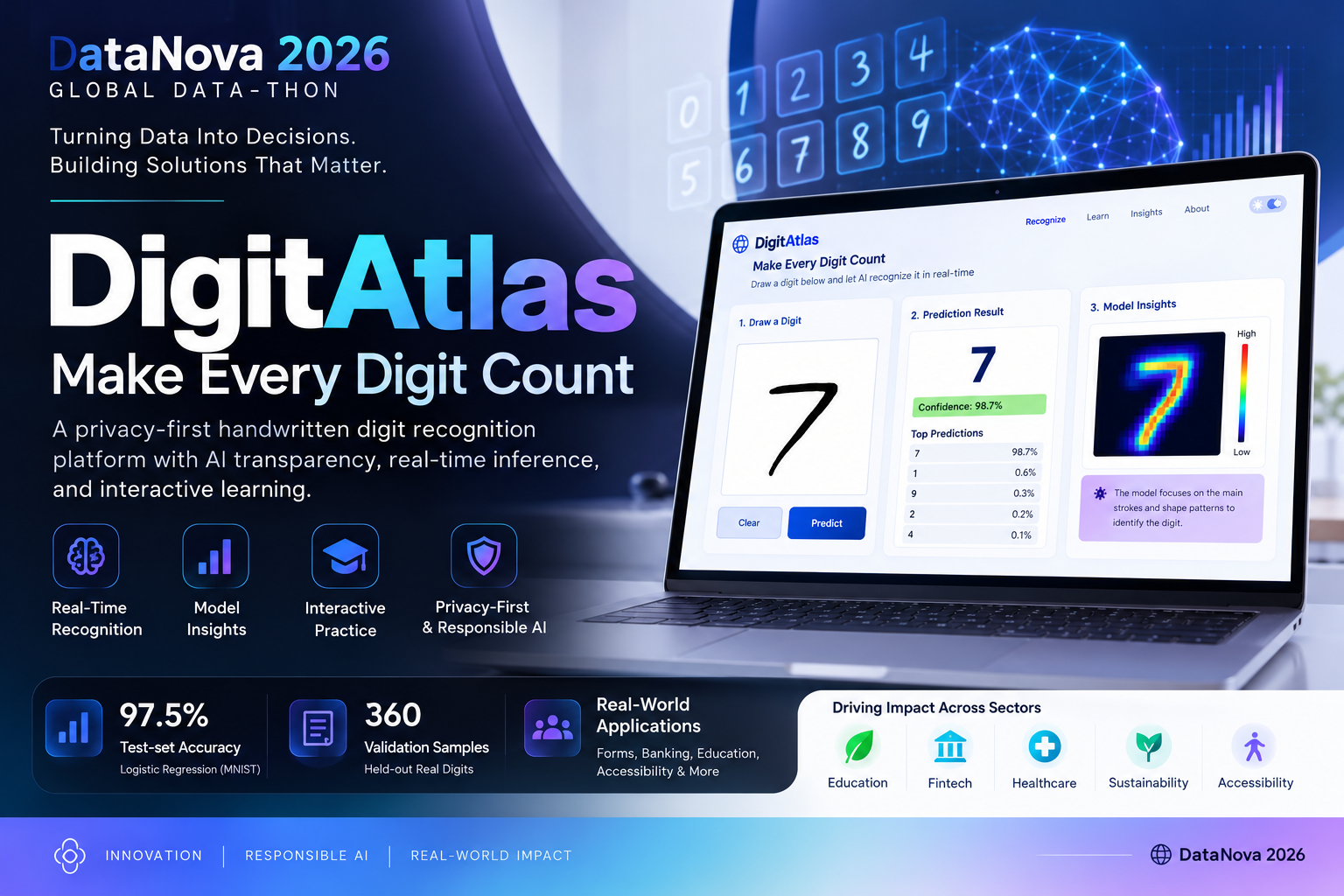
DigitAtlas is an interactive, privacy-first AI lab that lets users draw handwritten digits, see model predictions and probabilities, inspect confusion patterns, and practice with held-out digit samples. It also explains when AI recognition should not be used for automated assessment.
How it was built
The project trains a logistic regression classifier on the scikit-learn digits benchmark (1,797 samples, 64 features, ten digits). A stratified 80/20 train-test split with random seed 42 produces 360 held-out examples. The trained preprocessing and classifier weights are exported as JSON; browser JavaScript implements inference locally with no personal information sent to an AI server. A random forest and majority-class baseline provide comparison points.
Tested results
- Logistic regression: 97.5% accuracy on 360 held-out benchmark images.
- Random forest comparator: 96.67%.
- Majority-class baseline: 10%.
- These values describe one historical benchmark and should not be interpreted as accuracy on contemporary children's handwriting or real classroom deployments.
Responsible AI and impact
The application discloses dataset limitations, surfaces confidence and errors, minimizes personal data collection, and emphasizes human review. Practical impact is a hypothesis: teaching model literacy and helping educators identify risks before applying computer vision to learning settings. Further work requires consent-based, representative evaluation and educator co-design.
Try it
Working demo: https://digitatlas-datanova-2026.vercel.app/
Public PowerPoint: https://digitatlas-datanova-2026.vercel.app/DigitAtlas_DataNova_2026.pptx
Technologies
Python, scikit-learn, logistic regression, random forest, NumPy, JSON, JavaScript, HTML, CSS, Vercel.
Development disclosure
AI-assisted development and presentation preparation were used. Performance claims are limited to the supplied benchmark validation. No third-party video or field results are represented as personally collected research.
Team
Team roster and individual contributions need confirmation from eligible participants before final submission.

Log in or sign up for Devpost to join the conversation.