Inspiration
AI vibe-coding platforms like Bolt, v0, and Cursor are changing how software is built, but they suffer from a major bottleneck:
"Garbage In, Garbage Out." A single vague prompt often produces incomplete database schemas, missing edge cases, and brittle code.
Digitano Builder was created to act as an AI Systems Architect—an autonomous virtual software engineering team that compiles raw, unstructured ideas into enterprise-grade PRDs, single-table DynamoDB schemas, serverless API contracts, and structured Vibe-Coder prompts in under 120 seconds.
Special Inspiration: To prove that world-class software engineering can be accessible to anyone, Digitano Builder was designed, coded, and deployed entirely on a budget Samsung Galaxy A05 smartphone using cloud development environments on a $0 infrastructure budget.
What it does
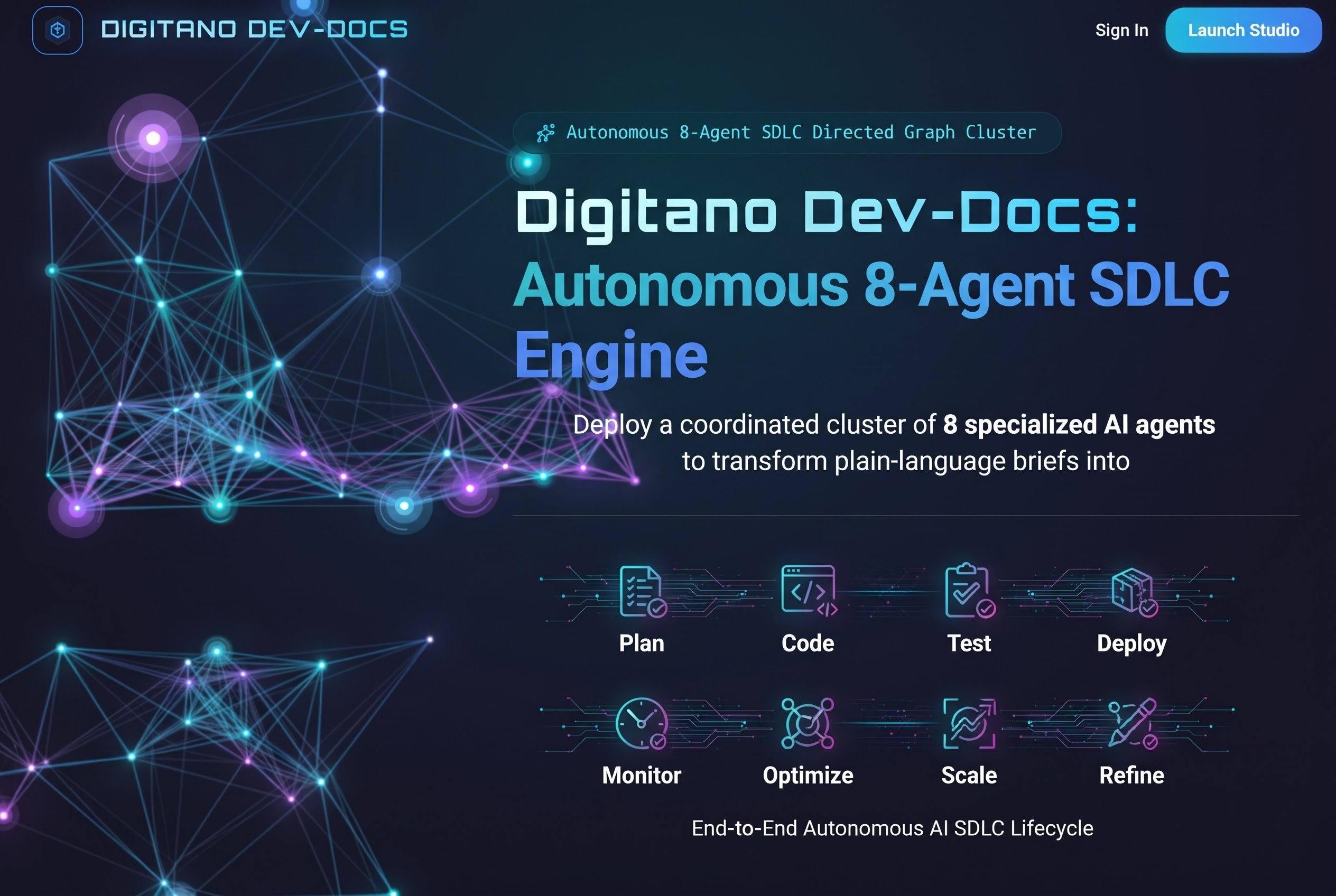
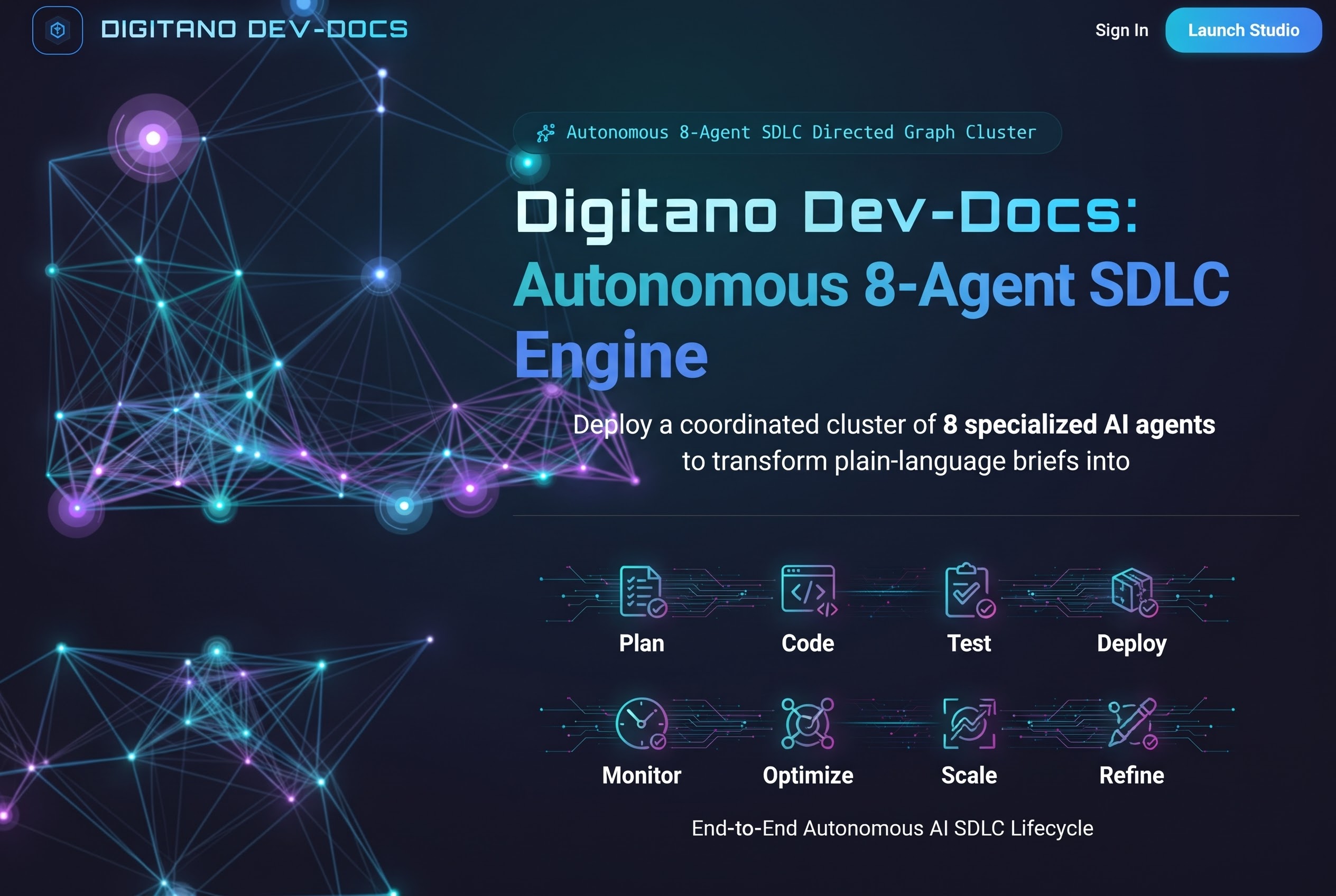
Digitano Builder orchestrates an autonomous 8-agent AI team that mirrors a real-world Agile SDLC workflow:
Product Owner: Defines high-level scope, personas, and success metrics.
Software Analyst: Generates prioritized user stories and edge-case failure matrices.
UI Lead: Maps out component hierarchies and ShadCN/Tailwind specifications.
Backend Lead: Architects serverless FastAPI routes and single-table DynamoDB access patterns.
Full Stack Lead: Defines client-server state flow and API integration contracts.
Infrastructure Architect: Configures serverless AWS services (App Runner, Amplify, DynamoDB).
Technical Researcher: Researches the inputs from the user and uses that to build a questionaire tobrefine and structure the foundation for the artifacts built by the app.
Orchestrator: Audits output against Pydantic schemas and generates copy-pasteable Vibe-Coder system prompts.
How I built it
Frontend: Vite, Tailwind CSS, ShadCN UI, Framer Motion, and tsParticles for a cybernetic dark-mode UI.
Backend Engine: Python FastAPI microservice deployed on AWS App Runner with Server-Sent Events (SSE) streaming real-time agent execution logs.
Dual AI Orchestration: Powered natively by AWS Bedrock (Claude 4.6 Sonnet & Claude Haiku 4.5) as the primary reasoning engine, with automatic fallback to
Google Gemini Flash for high-speed document processing and throttling failover.
- Database & Persistence: Amazon DynamoDB using single-table design (
projectId/sk) for $0-budget state management.
Challenges I ran into
Mobile Development Constraints: Building a dual-service Vite.js + Python architecture entirely on a budget smartphone required strict reliance on cloud IDEs (GitHub Codespaces and Replit) and mobile-optimized terminal workflows.
Context Overhead & Token Limits: Parallel 8-agent chaining can quickly bloat API payloads. We engineered a custom Payload Trimmer module that extracts only essential JSON keys before handing off execution to the next agent, reducing token overhead by over 60%.
Resilient Model Fallbacks: To eliminate HTTP 429 rate limits, we built a dual-provider routing layer that seamlessly transfers execution to Gemini Flash if AWS Bedrock experiences throttling.
Accomplishments that I am proud of
Constructed a fully autonomous, 8-agent software engineering engine operating completely on AWS Free Tier infrastructure ($0 cost).
Reduced the pre-build software scoping phase from 4 hours down to under 90 seconds.
Proved that high-grade full-stack AI development can be executed end-to-end on a budget mobile phone.
What I learned
How to enforce deterministic JSON outputs across multi-agent chains using Pydantic models.
How to optimize token efficiency through payload trimming in sequential LLM pipelines.
Single-table DynamoDB design patterns for multi-stage workflow persistence.
What's next for Digitano Builder
- Automated Repo Provisioning: Direct GitHub API integration to auto-commit generated PRDs and OpenAPI contracts into new user repositories.
Built With
- amazon-dynamodb
- amazon-web-services
- amplify
- bedrock
- cognito
- python
- react
- s3
- vite

Log in or sign up for Devpost to join the conversation.