-
-
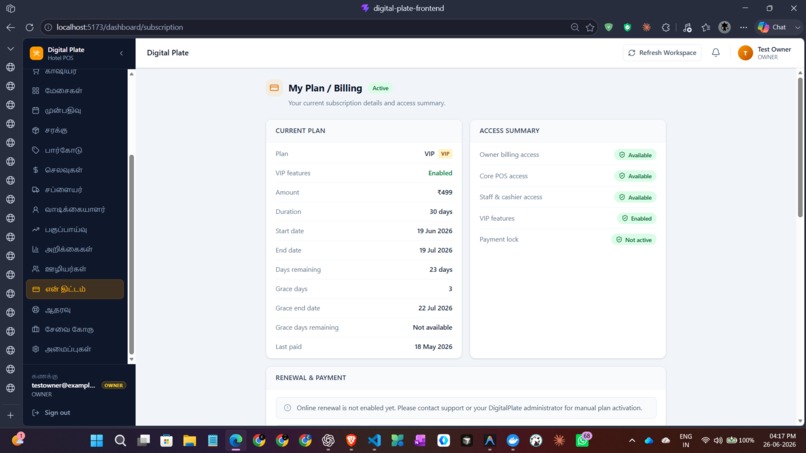
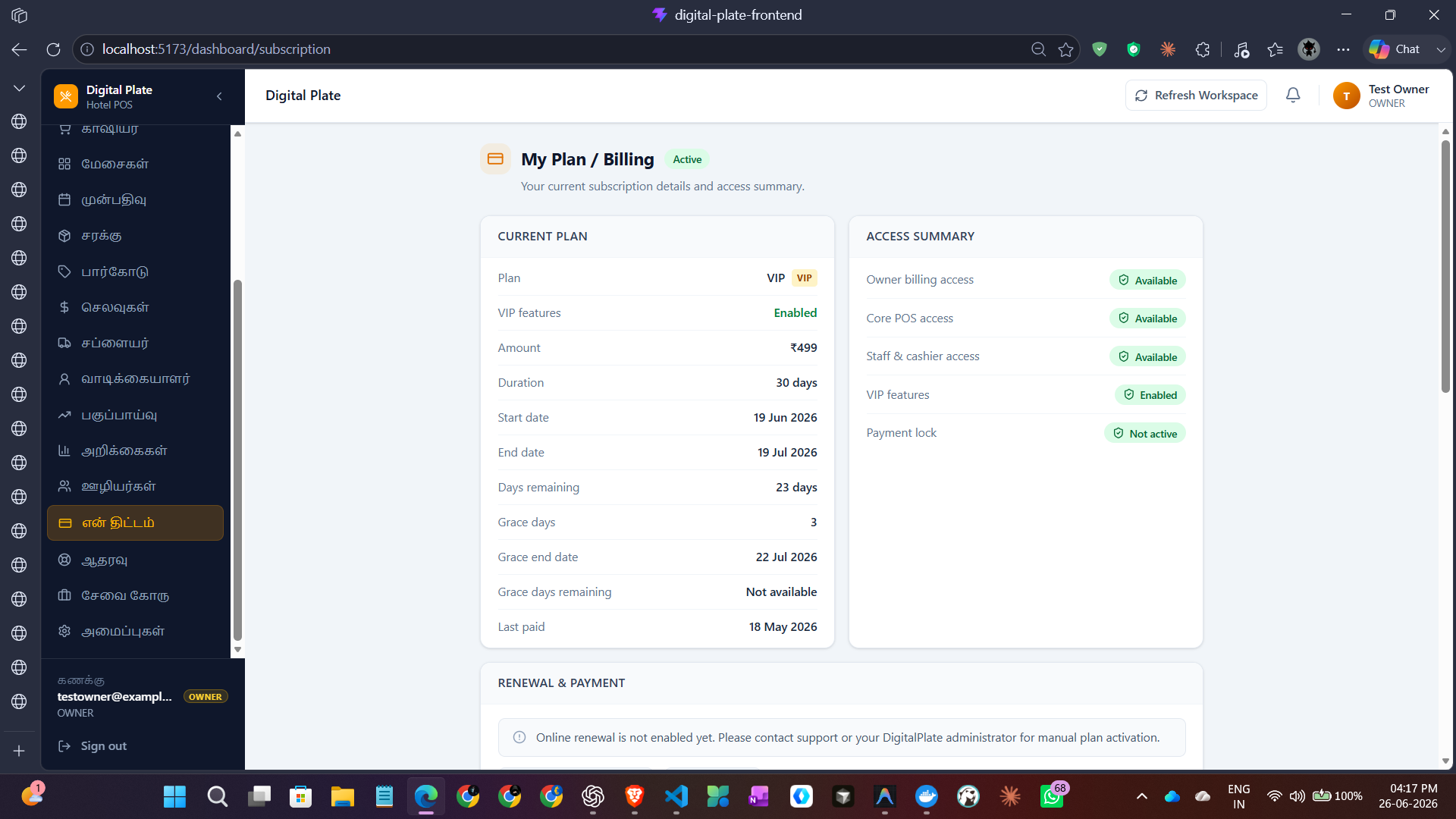
My Plan / Billing overview
-
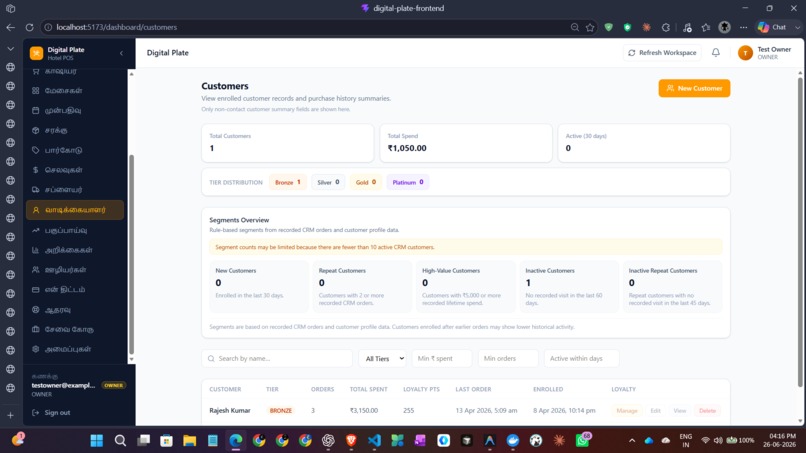
overview
-
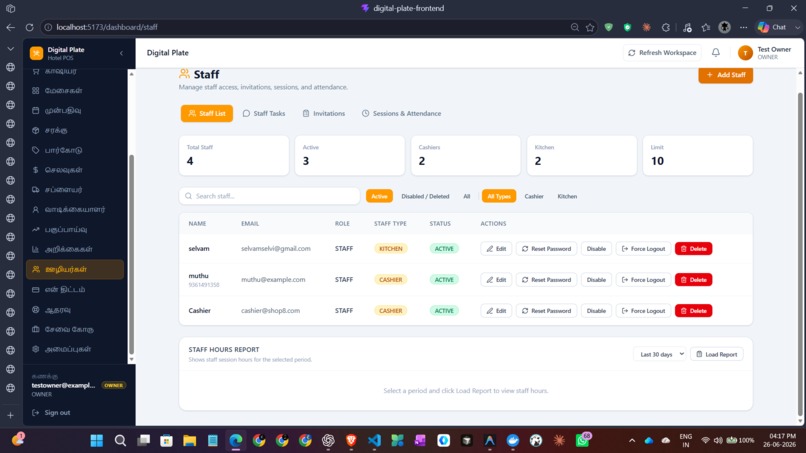
Staff ManagementOrders
-
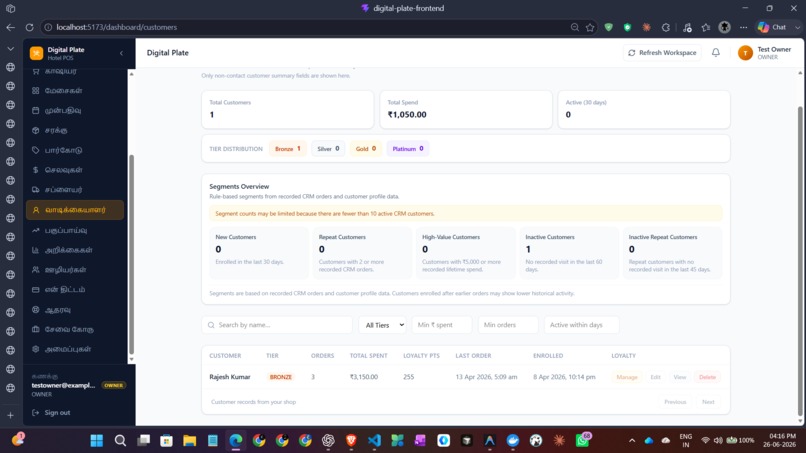
overview
-
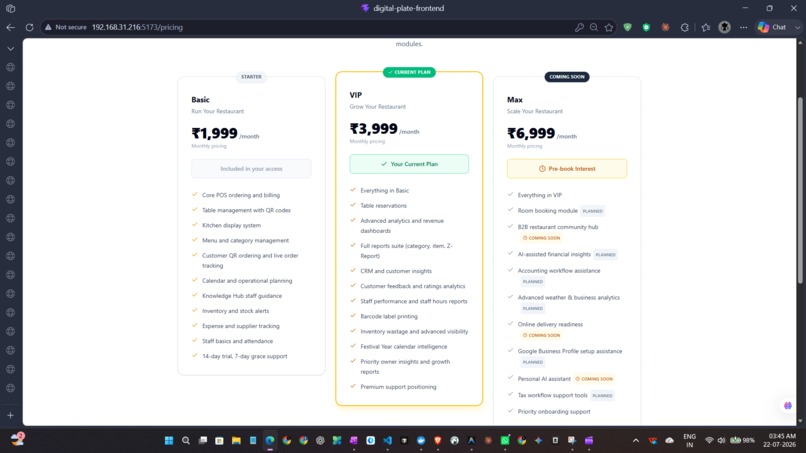
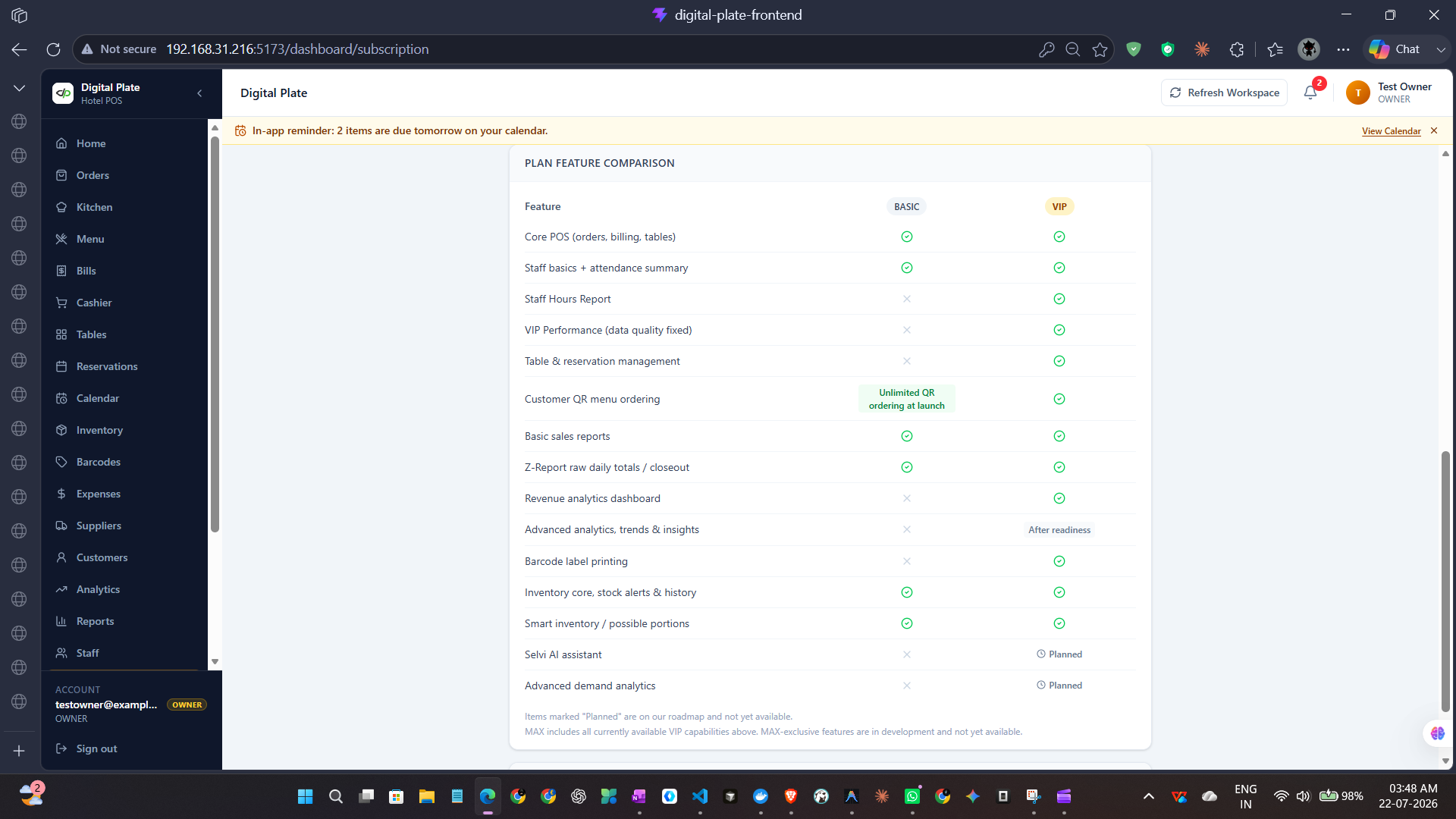
Subscription pricing
-
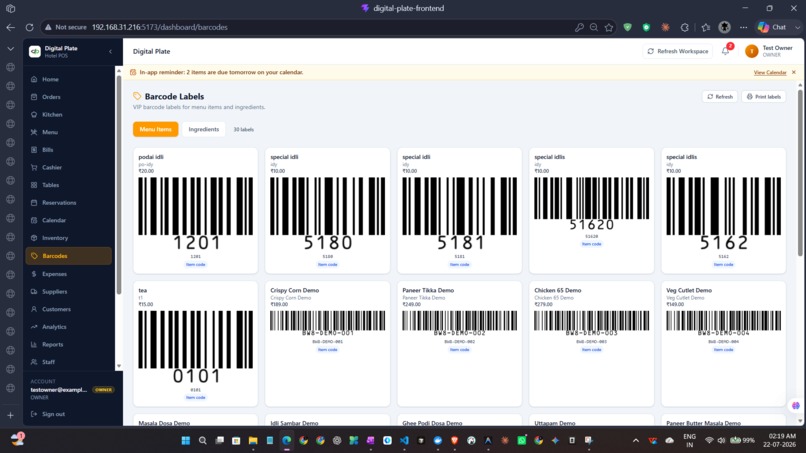
Barcode Labels
-
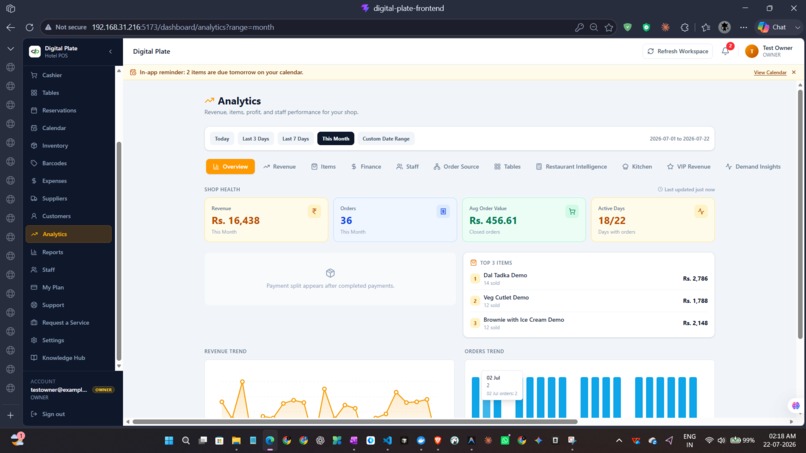
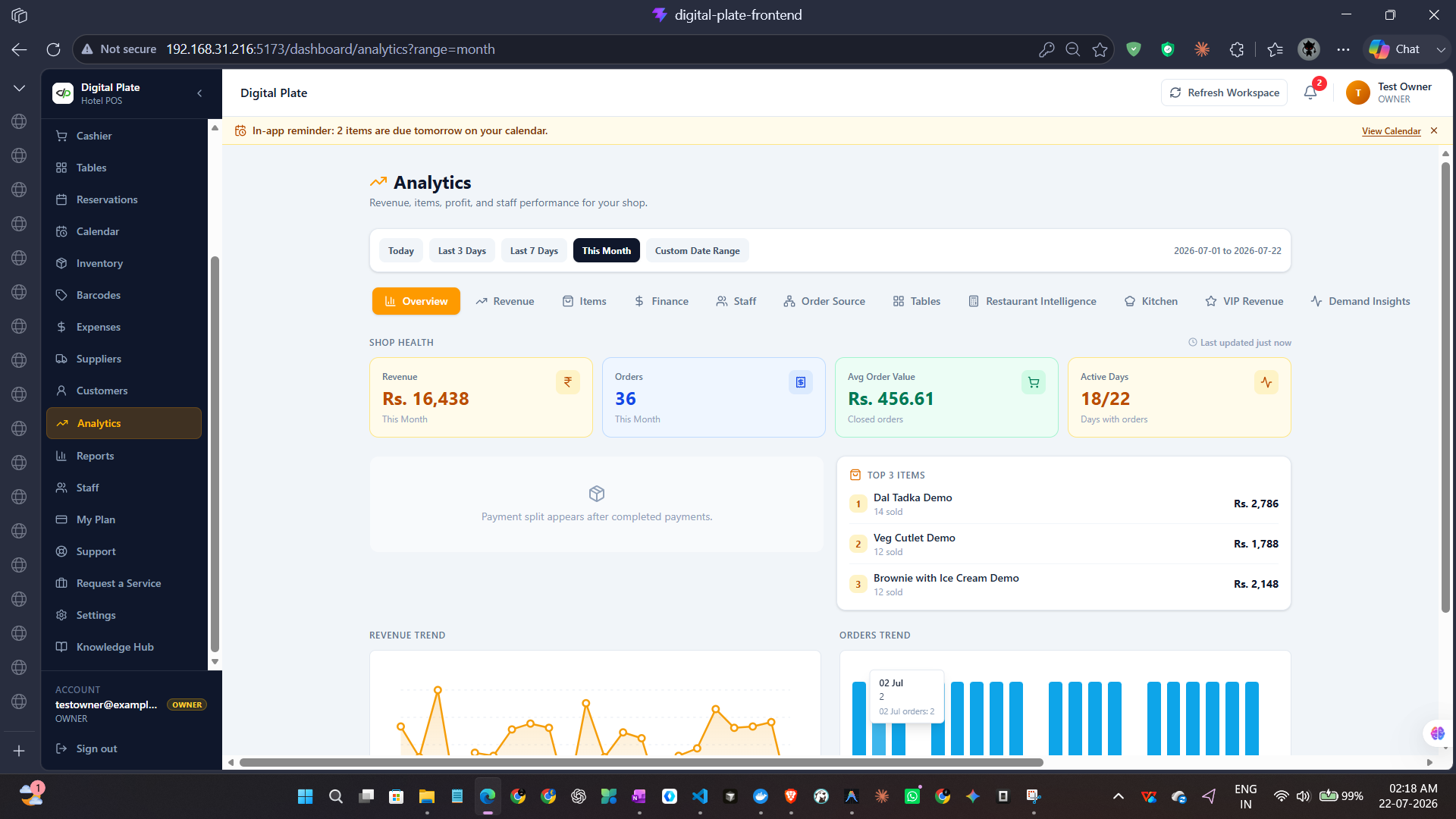
Advanced Analytics
-
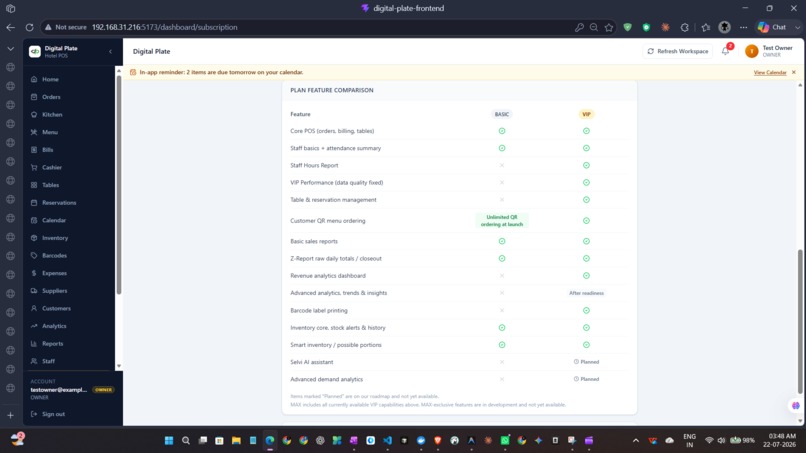
Plan Feature Comparison
-
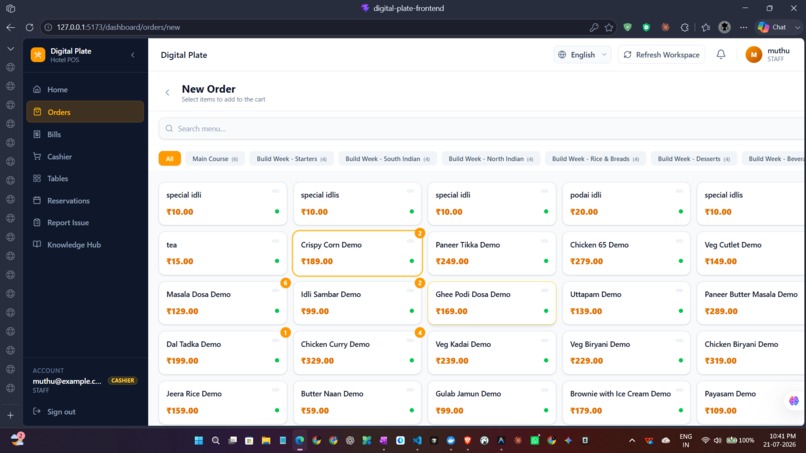
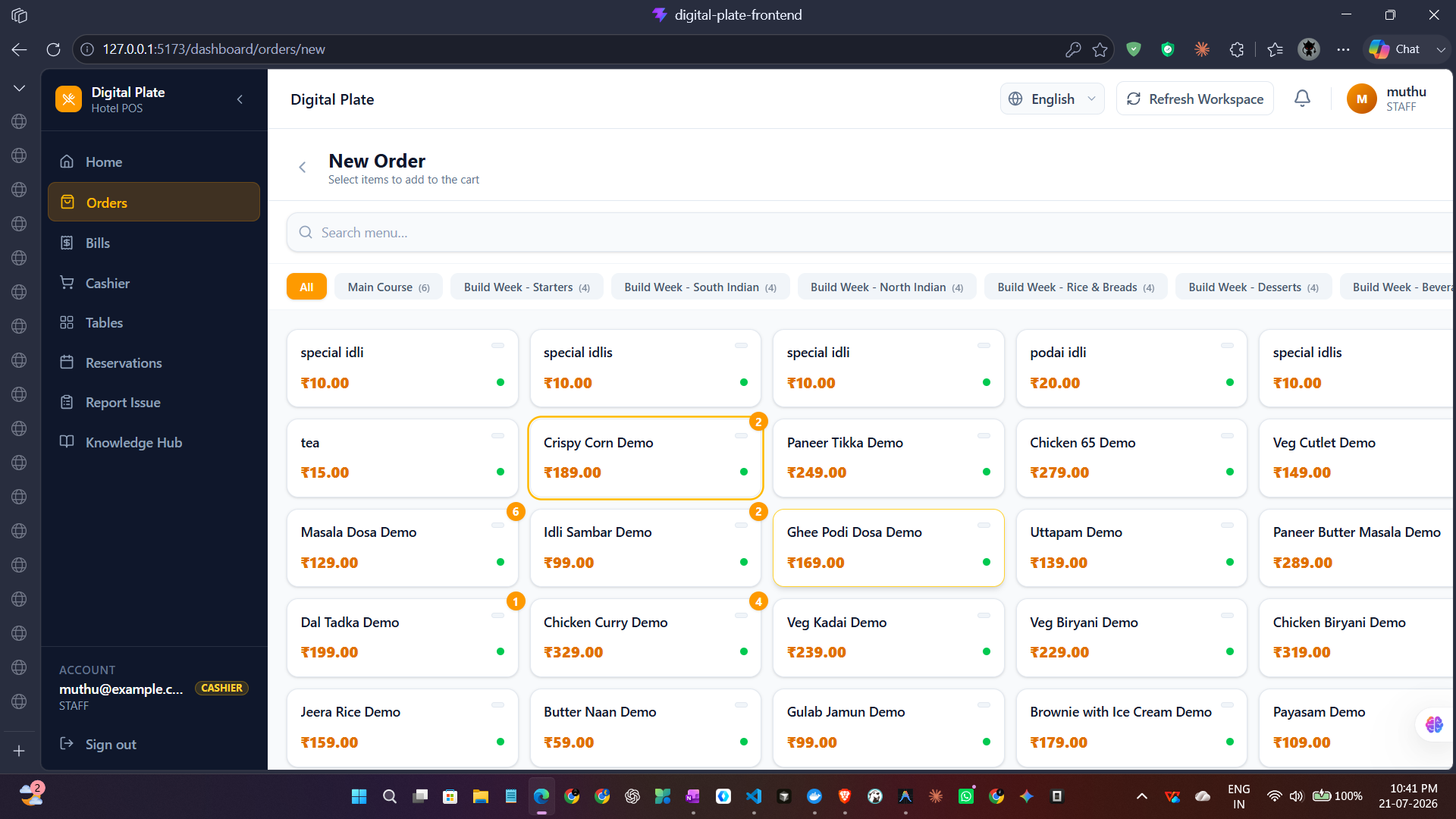
Orders / Cashier dashboard
-
Digital plate logo
-

Brand name

Inspiration
I am Sathish J, the solo founder and developer of DigitalPlate.
After completing my studies, I faced repeated early-career job rejections during a difficult hiring market. I did not always understand why I was being rejected, and the experience was frustrating. Instead of continuing to wait for someone to give me an opportunity, I decided to create one for myself.
I channelled that frustration into building a real product.
For approximately six to seven months, I independently worked on DigitalPlate without a development team, external funding, or dedicated business resources. I had to operate as the founder, product designer, frontend developer, backend developer, database engineer, tester, security reviewer, and future product operator.
DigitalPlate became more than a portfolio project. It became proof that I could understand a complex industry, identify real operational problems, design connected workflows, and take responsibility for building a substantial software platform.
My goal is not only to sell software. I want to help restaurant and food-business owners who may not have access to advanced technology, operational knowledge, analytics, staff-management systems, food-safety awareness, or expensive enterprise tools.
The Problem
Restaurant operations are rarely limited to billing.
A restaurant must coordinate:
- Customer and Cashier orders
- Kitchen preparation
- Tables and reservations
- Bills and payment records
- Menu items and ingredients
- Inventory and wastage
- Suppliers and purchase orders
- Staff attendance and tasks
- Customer relationships and feedback
- Expenses and reporting
- Safety awareness
- Daily planning and business decisions
Many small and medium restaurants still handle these areas through disconnected POS tools, handwritten notes, spreadsheets, messaging applications, verbal communication, and the owner’s memory.
This can create delayed Kitchen handoffs, missed items, poor stock visibility, disconnected financial information, informal staff coordination, weak customer follow-up, and limited understanding of business performance.
What DigitalPlate Does
DigitalPlate is a role-aware, multilingual restaurant operations platform that connects five major product surfaces in one system.
1. Cashier Workspace
The Cashier workspace supports daily service operations, including:
- Dine-in and takeaway order creation
- Searchable menu and category navigation
- Cart quantity controls
- Per-item Kitchen notes
- Live-order visibility
- Table operations
- Reservations and waitlist
- Billing and payment recording
- Pending bills and completed-order visibility
- Customer-service workflows
- Role-specific Quick Calculators
The objective is to reduce manual steps while keeping orders, bills, and payment records connected.
2. Kitchen Display System
The Kitchen workspace provides a focused preparation queue with:
- Live Kitchen tickets
- Full item names and quantities
- Cashier and Kitchen notes
- Waiting-time and urgency indicators
- Pending, in-progress, and completed item states
- KOT printing and reprinting
- VIP and pinned-order visibility
- Ingredient Peek
- Issue reporting
- Item-availability controls
- Deterministic recent-demand preparation guidance
This helps the Cashier and Kitchen coordinate without relying only on verbal communication or handwritten tickets.
3. Customer and Public QR Experience
Customers can scan a secure table QR code and access a mobile-friendly restaurant experience that includes:
- Public menu browsing
- Category and food-type filters
- Cart and ordering
- Table-aware QR access
- Existing-order tracking
- Staff-service requests
- Customer feedback
- Verified anonymous food reviews
- Ratings
- Frequently Bought Together suggestions
- Restaurant-scoped loyalty foundations
- English, Tamil, and Hindi support
- Light and dark interface behaviour
Customers receive access only to the appropriate public experience, without exposure to internal restaurant tools.
4. Owner Operations and Intelligence
The Owner workspace brings together operational oversight across:
- Orders and bills
- Revenue summaries
- Collection and payment-method visibility
- Tables and reservations
- Menu and category management
- Ingredients and inventory
- Low-stock visibility and wastage
- Suppliers and purchase orders
- Expenses
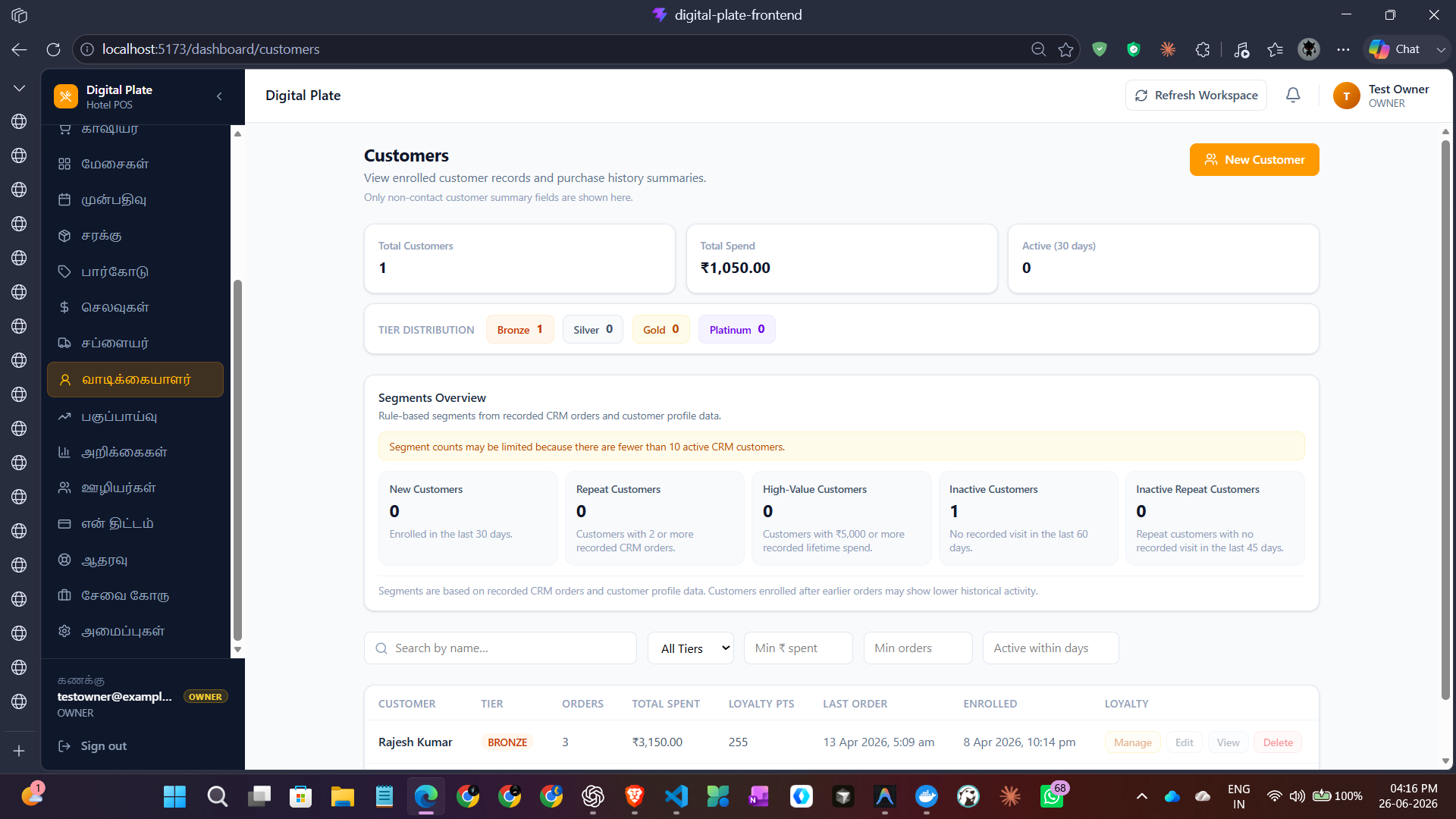
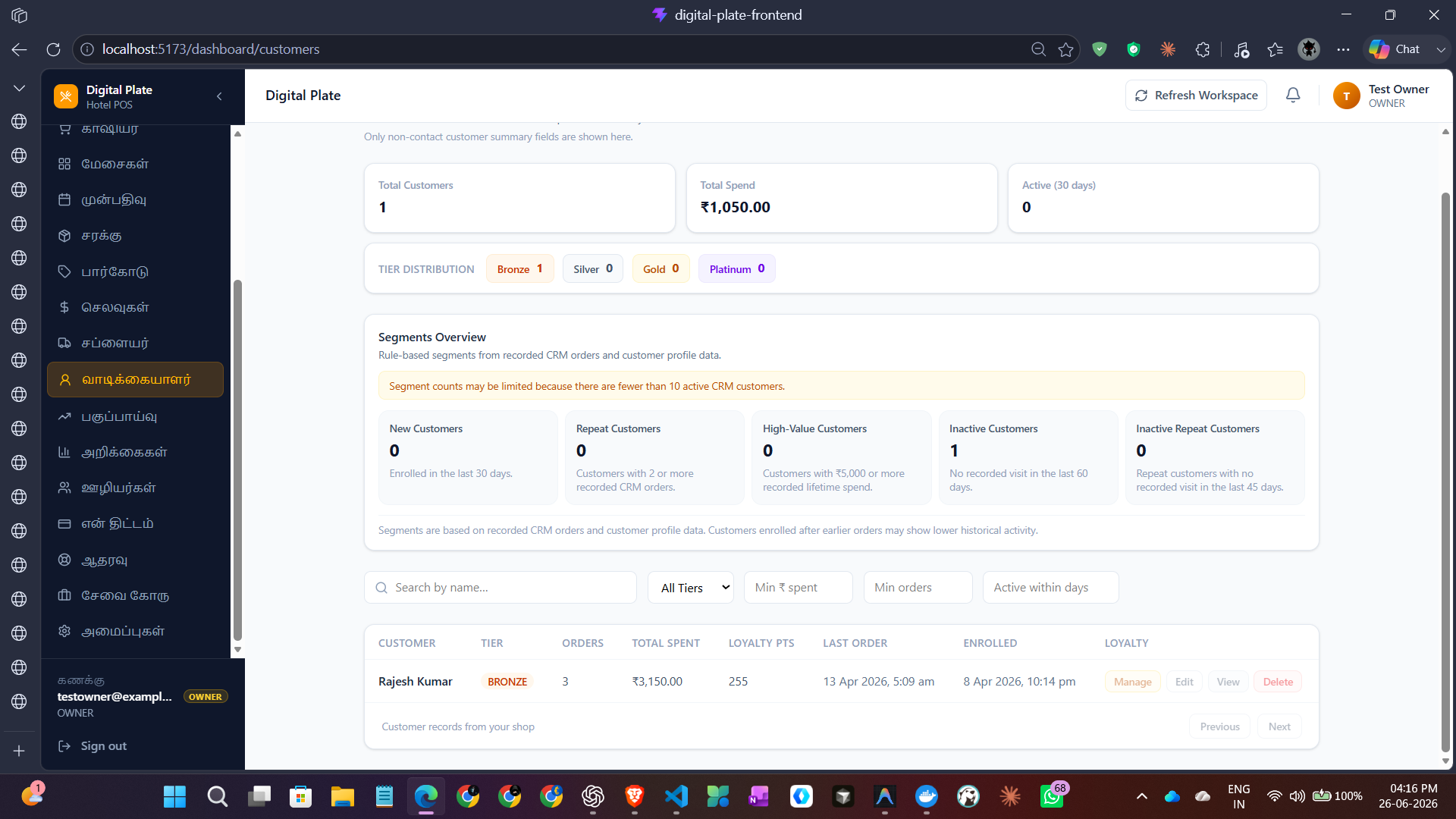
- Customers and customer growth
- Birthdays and anniversaries
- Feedback and ratings
- Loyalty management
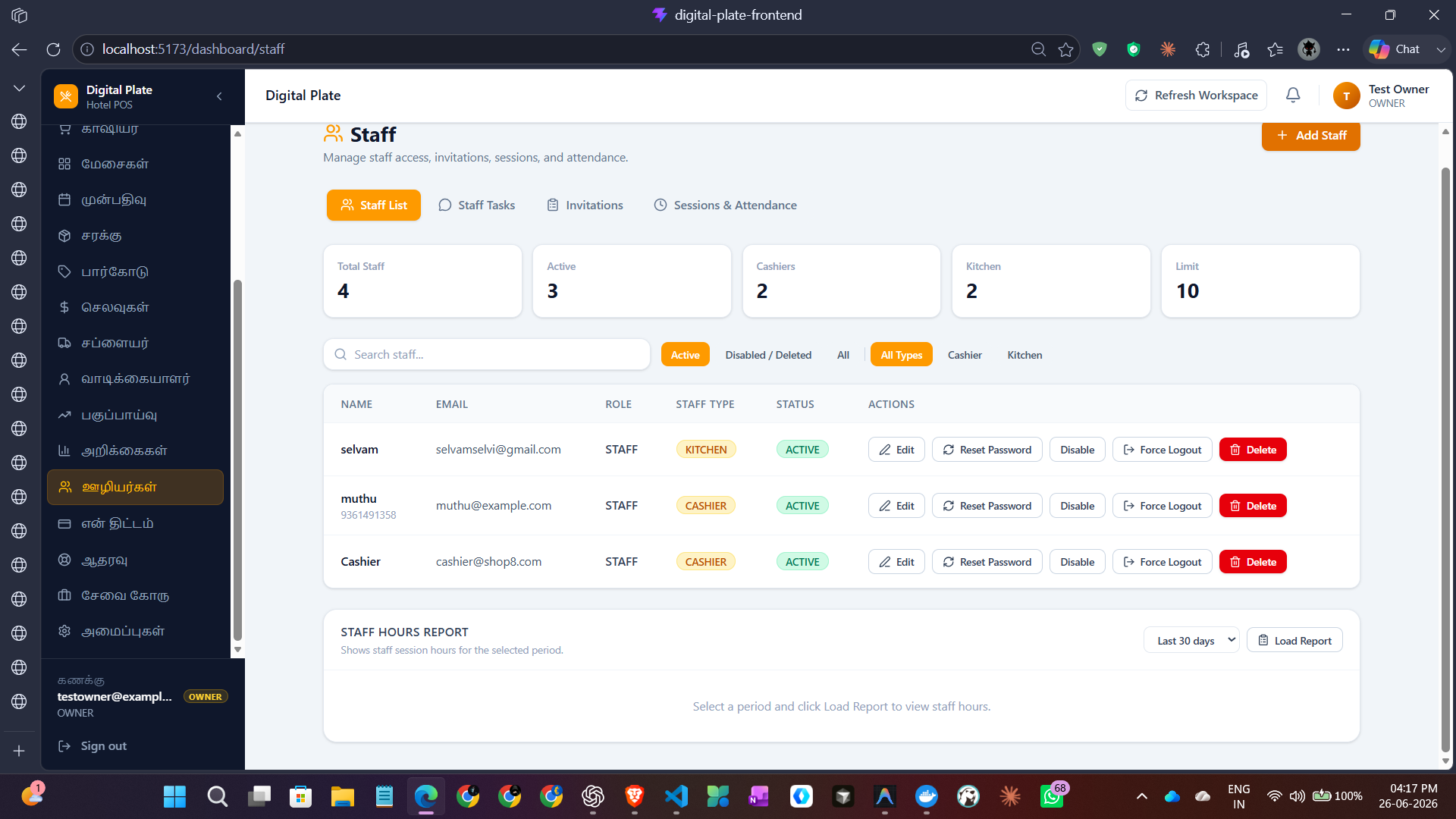
- Staff accounts and permissions
- Attendance and working hours
- Staff sessions and tasks
- Operational-risk signals
- Reports and CSV/PDF exports
- Restaurant Intelligence
- Menu Performance and Menu Engineering
- Business and profit-estimation calculators
- A role-aware Knowledge Hub
The Restaurant Intelligence tools include Average Order Value, daypart revenue mix, channel analysis, table-turnover visibility, workforce summaries, food-cost coverage, menu-performance analysis, and other source-derived operational metrics.
DigitalPlate also includes a Knowledge Hub with role-aware operational guidance, checklists, business awareness, hygiene information, and food-safety education. This content is designed for awareness and learning; it is not presented as legal advice, professional certification, or inspection approval.
5. Platform Admin Governance
The Platform Admin surface supports controlled platform-level operations such as:
- Shop oversight
- Subscription and feature governance
- Support operations
- Lead management
- Festival evidence staging
- Review, approval, rejection, and publishing
- Year-level festival release management
- Rollback controls
- Controlled cross-shop administration
Restaurant users remain isolated from platform-level governance tools.
OpenAI Build Week Contribution
DigitalPlate existed before OpenAI Build Week as a substantial multi-role restaurant operations platform.
The specific dated contribution completed during the 13–21 July 2026 Build Week period was the Premium VIP Calendar Workspace.
The Calendar provides restaurant owners with:
- Month view
- Week view
- Daily Details
- Authoritative daily revenue context
- A 24-hour operational timeline
- Manual events and reminders
- Maintenance and deep-cleaning planning
- Gas-refill and closure reminders
- Approved regional-festival visibility
- In-app Due Soon reminders
- English, Tamil, and Hindi parity
- Responsive layouts
- Keyboard and accessibility improvements
Platform Admin can review and publish supported festival information, while approved festivals become visible in the Owner Calendar.
The submission does not claim that the entire DigitalPlate platform was created during Build Week. The broader product was developed before the event, while the Premium Calendar Workspace and its supporting integration work represent the dated Build Week contribution.
How I Built It
DigitalPlate uses:
- React
- TypeScript
- Vite
- Tailwind CSS
- Node.js
- Express
- PostgreSQL
- React Query
- Zustand
- Socket.IO
The system follows role-aware and shop-scoped access boundaries. Financial and lifecycle-sensitive information remains backend-authoritative. Public QR users, restaurant staff, restaurant owners, and Platform Admin users are separated according to their responsibilities.
The private judging repository is a sanitized submission copy. Secrets, private environment values, internal development history, and real customer information are excluded. Demonstration data is synthetic.
How I Used GPT-5.6, Codex, and Claude Code
I used GPT-5.6 for:
- Product architecture and scope reasoning
- Security and data-authority boundaries
- Feature prioritisation
- Phased implementation planning
- Validation strategy
- Repository and submission planning
- Final review and professional presentation
I used Codex for:
- Independent sanitized-repository review
- Credential and privacy verification
- Private GitHub repository preparation
- Safe staged-file verification
- Continuous-integration workflow implementation
- Frontend and backend CI validation
- Judge-facing documentation review
- Private repository publication and remote verification
I used Claude Code for implementation support, source exploration, targeted debugging, and automated validation.
All final product, scope, safety, inclusion, exclusion, and founder decisions remained under my control.
Challenges
The largest challenge was not implementing one isolated feature. It was maintaining consistency across a connected operational system.
An order can affect the Cashier, Kitchen, customer tracking, table status, bill generation, payment records, analytics, and Owner reporting. A change that looks small on one screen can create lifecycle or data-integrity problems elsewhere.
Working alone also meant I had to carefully manage:
- Role and shop isolation
- Order, Kitchen, bill, and payment lifecycles
- Responsive behaviour
- Multilingual parity
- Public and internal security boundaries
- Database constraints
- Backward compatibility
- Demo-data safety
- Private-repository protection
- Honest separation between implemented and future capabilities
I learned to avoid fake functionality, unsupported analytics, and unsafe shortcuts. When a feature depends on data or infrastructure that is not yet trustworthy, I prefer to label it honestly as future work instead of presenting it as complete.
Current Status and Parked Work
DigitalPlate is currently a substantial pre-launch product. Its core role-aware workflows and Build Week contribution are implemented and validated for demonstration, but I am not claiming that it is already a fully launched commercial production service.
Some remaining capabilities are intentionally parked because they depend on resources beyond internal product code, including:
- Live payment-gateway activation
- Paid SMS and WhatsApp provider integrations
- External provider credentials
- Production hosting and deployment
- Final legal and compliance execution
- Advanced AI-provider integrations
- Broader production-scale testing and infrastructure
As a solo founder without external funding, I cannot responsibly activate every paid third-party service immediately. Rather than simulate providers or create fake payment flows, I have preserved those capabilities as controlled future tracks until the required budget, contracts, credentials, legal controls, and production governance are available.
Future directions also include a Community Staffing Hub, richer restaurant automation, advanced operational intelligence, additional safety education, broader integrations, and further production hardening.
What I Learned
Building DigitalPlate taught me that creating a serious product requires much more than writing code.
I learned to:
- Understand user roles and operational responsibilities
- Challenge assumptions before implementing features
- Treat security and data boundaries as product requirements
- Design connected business lifecycles
- Separate estimates from authoritative financial information
- Validate changes across Cashier, Kitchen, Customer, Owner, and Admin surfaces
- Protect private source code and credentials
- Clearly distinguish implemented functionality from future vision
- Continue building even without a team, funding, or guaranteed outcome
Most importantly, I learned that rejection does not have to be the end of an opportunity. It can become the beginning of something larger.
Vision
My vision is to develop DigitalPlate into a comprehensive restaurant operations companion—not merely another billing application.
I want it to help restaurant owners:
- Operate more efficiently
- Understand their business more clearly
- Coordinate staff more effectively
- Reduce operational mistakes
- Improve customer experiences
- Build better safety awareness
- Make decisions using trustworthy information
DigitalPlate represents nearly seven months of persistence, learning, engineering, and founder responsibility. It is the product I chose to build when no company had yet given me the opportunity I was looking for.
Built With
- actions
- api
- claude
- codex
- css
- css3
- express.js
- github
- gpt-5.6
- html5
- jwt
- node.js
- openai
- postgresql
- query
- react
- rest
- socket.io
- tailwind
- tanstack
- typescript
- vite
- zustand

Log in or sign up for Devpost to join the conversation.