-
-
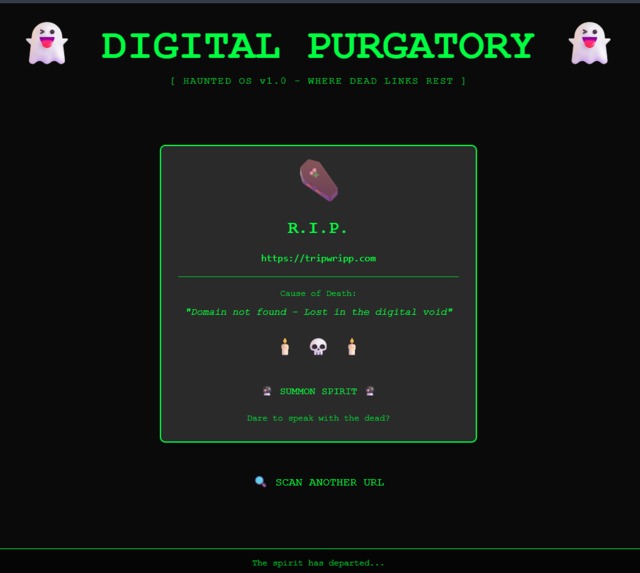
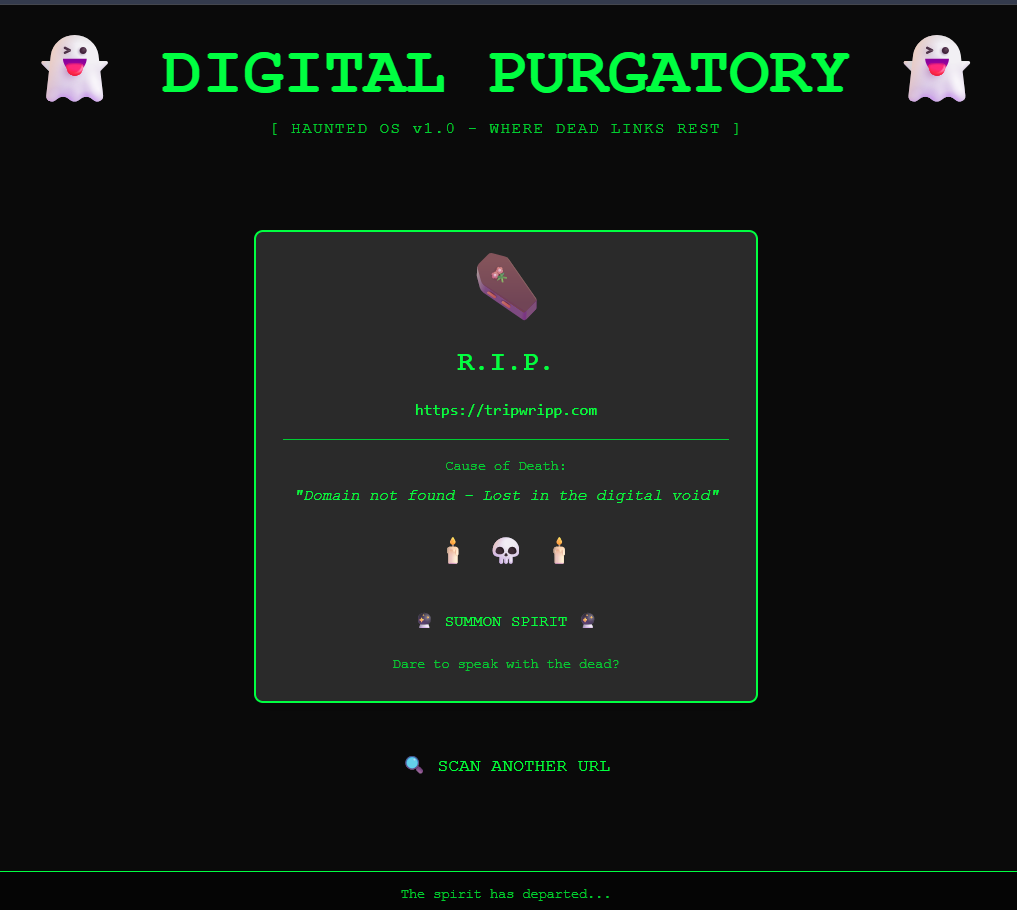
Interface of dead website.
Inspiration
The concept of "Digital Purgatory" was born from a question: What happens to our digital footprints when we are gone? In an era where our online personas outlive our physical bodies, we wanted to explore the boundary between memory and data. We were inspired by the idea of "Digital Immortality"—using technology not just to store files, but to simulate the presence of those who aren't online anymore. We wanted to build a bridge, a "terminal to the other side," where users can find closure or simply converse with an echo of the past.
What it does
Digital Purgatory is a web-based interface that simulates conversations with "offline" entities. It uses AI to generate responses based on the persona of a deceased individual (or fictional character). The user enters a "seance" room, initiates a connection, and communicates in real-time with the digital ghost. The UI is designed to feel like a limbo state—glitchy, ethereal, and disconnected from the normal web.
How we built it
We built the entire project using Kiro IDE, which allowed us to rapidly prototype our frontend and backend in a unified environment.
The Brains: We utilized AI Seance engine to power the conversation engine. We spent time prompt-engineering the system to ensure the "ghosts" spoke in a way that felt distant yet personal.
The Interface: The frontend was built with React, Tailwaind CSS, featuring custom CSS animations to create the "glitch" and "static" effects that give the site its purgatory vibe. And the Bakend was built using Mongodb, Next Js. Basically, this is a MERN stack application that scans for dead link.
The Workflow: Kiro IDE was instrumental in helping me out in many areas, which helped us iterate quickly during the hackathon crunch time.
Challenges we ran into
Tone Balancing: Making the AI sound "dead" or "ethereal" without just being gibberish was difficult. We had to fine-tune the system prompts to maintain a spooky but coherent atmosphere Atmosphere: We struggled initially to make the UI feel immersive. We had to experiment with CRT monitor effects and typography to get the "retro-terminal" look just right.
Accomplishments that we're proud of
We are proud that we managed to turn a high-concept, philosophical idea into a working prototype in such a short time. Successfully integrating the AI response stream into our custom UI without lag was a big win. We're also really happy with how the visual aesthetic turned out—it genuinely feels like a forbidden piece of software.
What we learned
Voice Synthesis: Adding audio so you can "hear" the static-filled voices of the entities. Memory Upload: allowing users to upload text logs to train a specific "ghost" for more accurate personalization.
What's next for Digital Purgatory
Memory Ingestion: We plan to implement RAG (Retrieval-Augmented Generation) so users can upload past chat logs (e.g., from WhatsApp or Discord) to fine-tune the AI. This will make the "ghost" speak with the specific vocabulary and quirks of the deceased.
Audio Synthesis: Integrating text-to-speech to give the entities a voice, overlaid with audio filters to maintain the "static/purgatory" aesthetic.
Multi-User Sessions: Enabling a "Séance Mode" where multiple users can join a single room to communicate with a memory together in real-time.


Log in or sign up for Devpost to join the conversation.