-
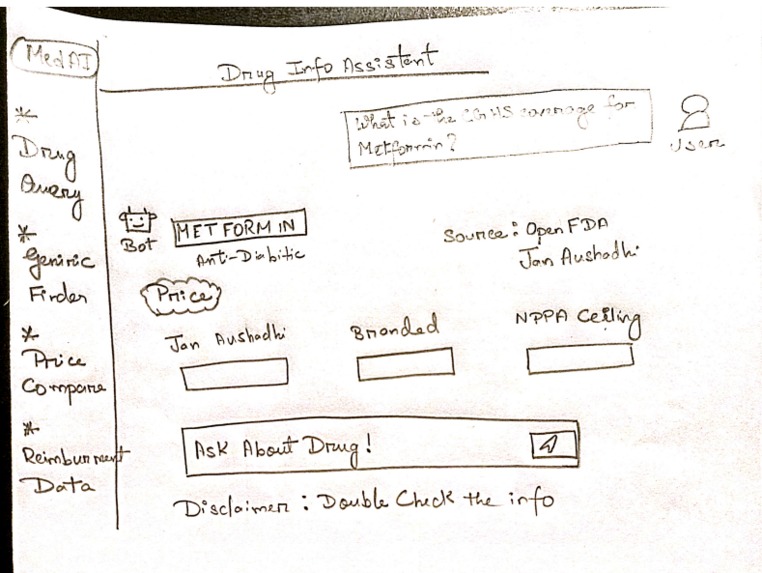
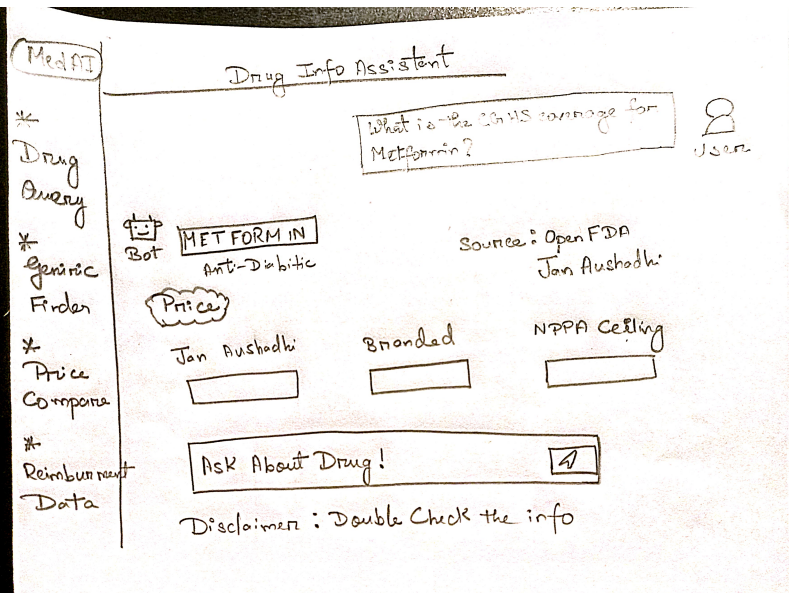
wireframe
-
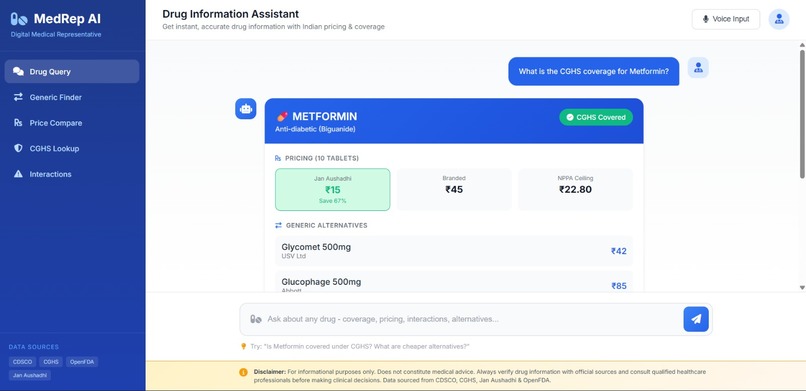
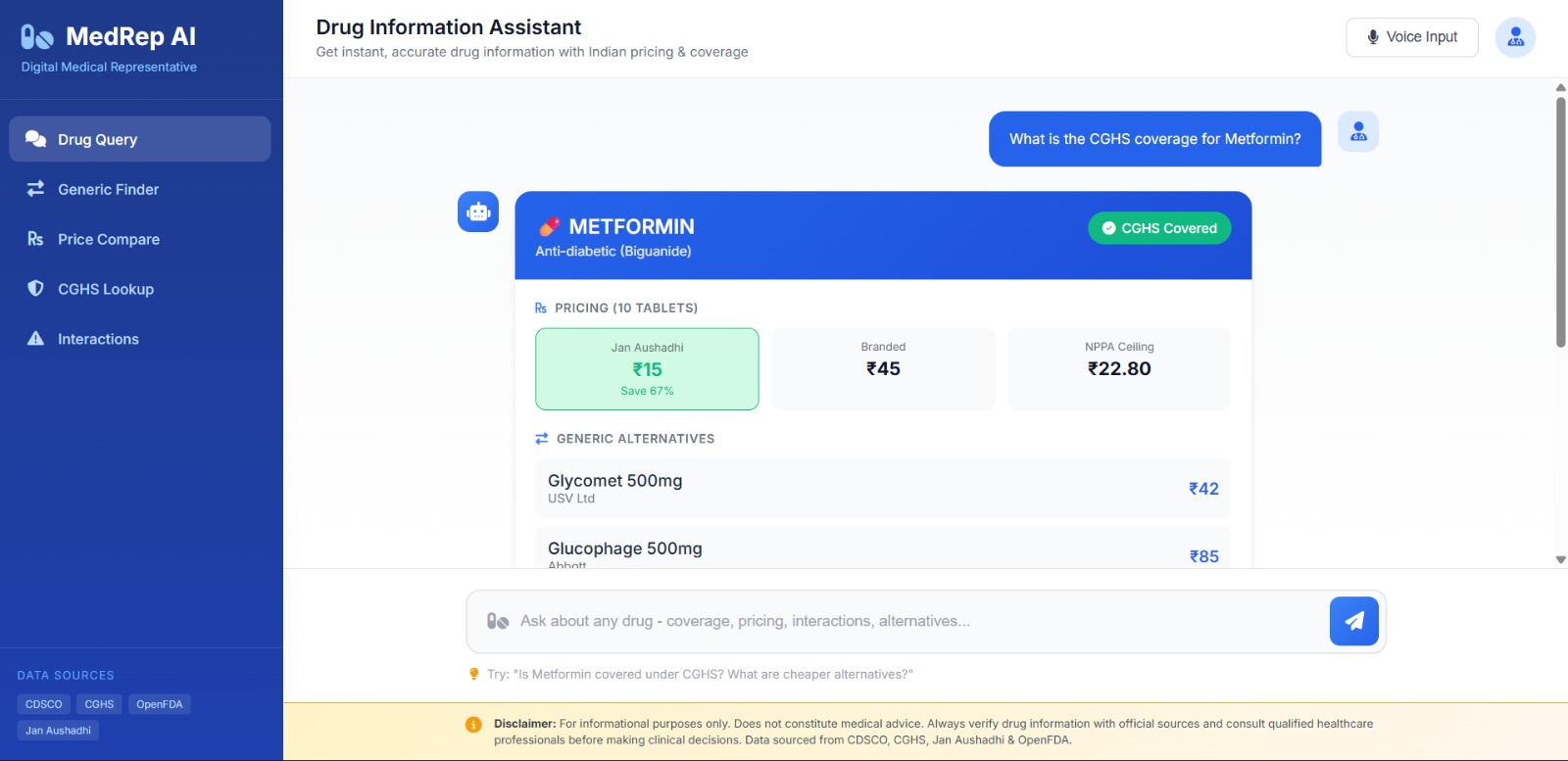
sample_screen
This is a text version of our About section. Below we have also uploaded a latex version.
text version
Inspiration
- Doctors in India face fragmented systems for clinical data, regulations, and reimbursement.
- Short consultations require manual checks for drug safety, eligibility, and affordability.
- Administrative overhead reduces time for patient care.
- There is a need for a single, verified, point-of-care decision support system.
What it does
- Provides verified drug information including indications, dosing, and contraindications.
- Checks reimbursement eligibility under CGHS, NLEM, and Ayushman Bharat (PM-JAY).
- Maps branded medicines to Jan Aushadhi generic alternatives.
- Shows transparent price comparisons for cost-aware decisions.
- Supports text and voice-based interaction for hands-free usage.
How we built
- Used a Retrieval-Augmented Generation (RAG) architecture to ensure accuracy.
- Backend developed using Python (FastAPI).
Integrated trusted data sources:
- OpenFDA for clinical drug data.
- Indexed Indian regulatory documents including CGHS, NLEM, and PM-JAY.
Used ChromaDB as a vector database for semantic document retrieval.
Built a professional Streamlit frontend with an evidence-first layout.
Enforced strict source grounding so responses are generated only from retrieved documents.
Challenges we ran into
- Preventing hallucinations in medical and policy-related answers.
- Normalizing unstructured Indian government PDFs.
- Mapping global drug names to India-specific generics and schemes.
- Designing a UI that balances speed with transparency.
Accomplishments that we’re proud of
- Built a source-verifiable AI system suitable for clinical environments.
- Unified clinical, regulatory, and financial insights in one interface.
- Enabled doctors to see the exact source text behind each answer.
- Designed a scalable architecture applicable across medical specialties.
What we learned
- Verified data is more valuable than large volumes of data.
- Trust and transparency are critical for healthcare AI adoption.
- Financial eligibility is as important as clinical correctness in India.
- AI must fit into existing clinical workflows, not disrupt them.
What’s next for Digital Medical Representative
- Prescription OCR for automated drug and interaction checks.
- Integration with hospital EHR systems.
- Multilingual patient education content.
- Expansion beyond drugs to diagnostics and treatment protocols.
\documentclass[12pt]{article} \usepackage[margin=1in]{geometry} \usepackage{enumitem}
\begin{document}
\section*{Inspiration} \begin{itemize}[leftmargin=*] \item Doctors in India face fragmented systems for clinical data, regulations, and reimbursement. \item Short consultations require manual checks for drug safety, eligibility, and affordability. \item Administrative overhead reduces time for patient care. \item Need for a single, verified, point-of-care decision support system. \end{itemize}
\section*{What it does} \begin{itemize}[leftmargin=*] \item Provides verified drug information (indications, dosing, contraindications). \item Checks reimbursement eligibility under \textbf{CGHS}, \textbf{NLEM}, and \textbf{Ayushman Bharat (PM-JAY)}. \item Maps branded medicines to \textbf{Jan Aushadhi} generic alternatives. \item Shows transparent price comparisons for cost-aware decisions. \item Supports text and voice-based interaction for hands-free usage. \end{itemize}
\section*{How we built it} \begin{itemize}[leftmargin=*] \item Used a \textbf{Retrieval-Augmented Generation (RAG)} architecture to ensure accuracy. \item Backend developed using \textbf{Python (FastAPI)}. \item Integrated trusted data sources: \begin{itemize} \item \textbf{OpenFDA} for clinical drug data. \item Indexed Indian regulatory documents (CGHS, NLEM, PM-JAY). \end{itemize} \item Used \textbf{ChromaDB} as a vector database for semantic document retrieval. \item Built a professional \textbf{Streamlit} frontend with an evidence-first layout. \item Forced strict source grounding so responses are generated only from retrieved documents. \end{itemize}
\section*{Challenges we ran into} \begin{itemize}[leftmargin=*] \item Preventing hallucinations in medical and policy-related answers. \item Normalizing unstructured Indian government PDFs. \item Mapping global drug names to India-specific generics and schemes. \item Designing a UI that balances speed with transparency. \end{itemize}
\section*{Accomplishments that we're proud of} \begin{itemize}[leftmargin=*] \item Built a source-verifiable AI system suitable for clinical environments. \item Unified clinical, regulatory, and financial insights in one interface. \item Enabled doctors to see exact source text behind each answer. \item Designed a scalable architecture applicable across medical specialties. \end{itemize}
\section*{What we learned} \begin{itemize}[leftmargin=*] \item Verified data is more valuable than large volumes of data. \item Trust and transparency are critical for healthcare AI adoption. \item Financial eligibility is as important as clinical correctness in India. \item AI must fit into existing clinical workflows, not disrupt them. \end{itemize}
\section*{What's next for Digital Medical Representative} \begin{itemize}[leftmargin=*] \item Prescription OCR for automated drug and interaction checks. \item Integration with hospital EHR systems. \item Multilingual patient education content. \item Expansion beyond drugs to diagnostics and treatment protocols. \end{itemize}
\end{document}
Built With
- api
- css3
- fastapi
- generative-ai
- html5
- javascript
- langchain
- python
- rag
- react
- restapi

Log in or sign up for Devpost to join the conversation.