-
-
Poster
Title
Forward and Inverse Problem of the Michelson interferometer
Who
Siyuan Song (cslogin: ssong26)
Introduction
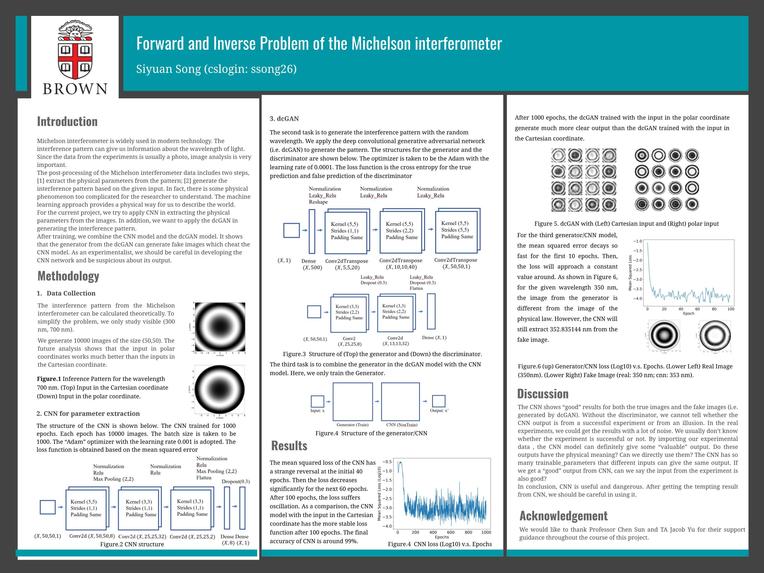
Michelson interferometer is widely used in modern technology. The interference pattern can give us information about the wavelength of light. Since the data from the experiments is usually a photo, image analysis is very important.
The post-processing of the Michelson interferometer data includes two steps, [1] extract the physical parameters from the pattern; [2] generate the interference pattern based on the given input. In fact, there is some physical phenomenon too complicated for the researcher to understand. The machine learning approach provides a physical way for us to describe the world.
For the current project, we try to apply CNN in extracting the physical parameters from the images. In addition, we want to apply the dcGAN in generating the interference pattern.
Related Work
Conditional Deep Convolutional Generative Adversarial Network is an algorithm to generate images from continuous label. Both the generator and discriminator will read the continuous label and train for the labeled images [1].
Some people has already used the LSSVM to extract the phase information from the interference pattern [2].
[1] Ding, X., Wang, Y., Xu, Z., Welch, W.J. and Wang, Z.J., 2020, September. CcGAN: Continuous Conditional Generative Adversarial Networks for Image Generation. In International Conference on Learning Representations.
(https://openreview.net/forum?id=PrzjugOsDeE)
[2] Zhong, C., Gao, Z., Wang, X., Gao, C., Yang, S., Sun, X., Wen, X., Feng, Z. and Wang, S., 2018. The machine learning method of phase extraction in interferometry. Optics and Lasers in Engineering, 110, pp.384-391.
(https://www.sciencedirect.com/science/article/pii/S0143816618303038?casa_token=rcvsxfW6phMAAAAA:FhNsX5yhXzDHigQ5r1GXCYleIAHfY75bqiAKfArKND57YNpXFmGroYQKu52gc_zwRyzqDsS3qEs)
Data
I use the interference formula to generate thousands of datasets. Each image is 50*50*1. The number of images is over 10 thousand.
Methodology
At first, I used the interference pattern formula to generate thousands of datasets. Due to the circular symmetry of the problem, I will transform the image into the polar coordinate.
Then, I build a CNN network to extract the physical parameters.
For the image generating part, I will try dcGAN in generating the image from both the noise and labels.
To give the labeled output, I will use the CNN to train the generator in dcGAN.
Metrics
The loss function for CNN is the relative error between the predictions and the real parameters.
The loss function for the generating model is the classification accuracy.
I will assess my model's success by applying it to the experimental data in the real world.
Ethics
- Why is Deep Learning an excellent approach to this problem?
The physical system is complicated. In the old days, people have to simplify the system in understanding the phenomenon. However, there are always some systems that can not be simplified. Machine learning is a promising approach for next-generation physics development.
It took a huge amount of effort to generate images and experimental data. The deep learning approach is much faster in generating images based on the given information. - Who are the major “stakeholders” in this problem, and what are the consequences of mistakes made by your algorithm?
The experimentalists are the stakeholders in this problem. They can use the general CNN method and dcGAN method to understand their results. The consequences of the mistakes are that they misunderstand their data. They may waste their time in the experimental development.
## Division of labor I do all the work myself.
Link to the one page reflection and final report.
One Page Reflection (2nd checkin)
(https://drive.google.com/file/d/1-c_sw0faP9cIXoFWL_ezNXjCxemfXneK/view?usp=sharing)
Final Report
(https://drive.google.com/file/d/1Ur_dvWSvQVwmtCB61jSQn4aX3ldj4Qae/view?usp=sharing)
Built With
- python
- tensorflow


Log in or sign up for Devpost to join the conversation.