-
-
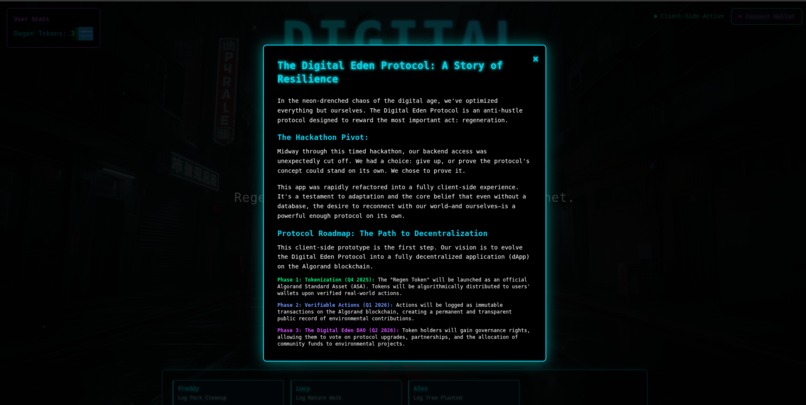
the protocol
-
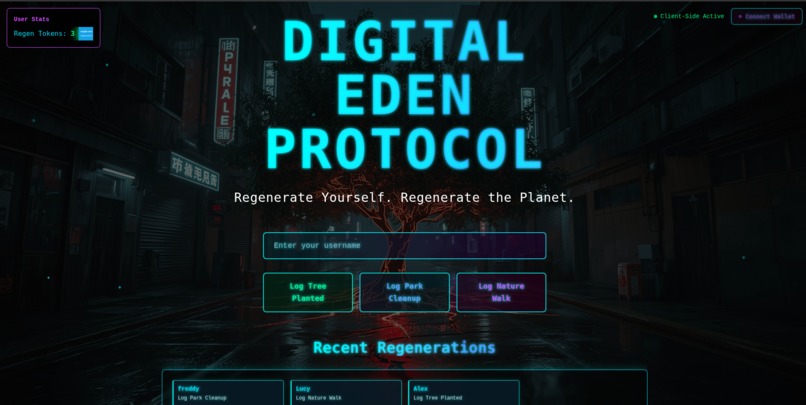
home page
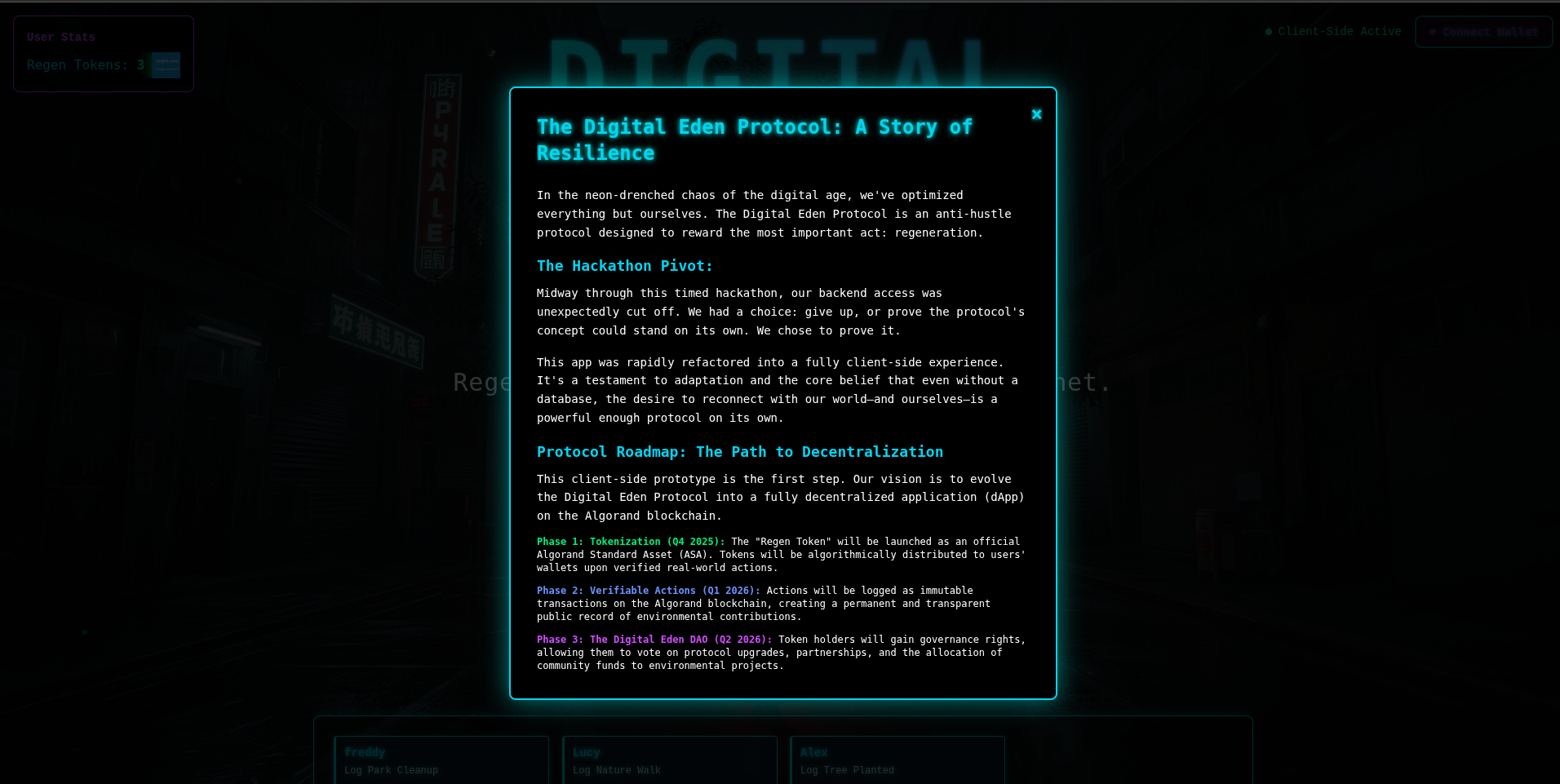
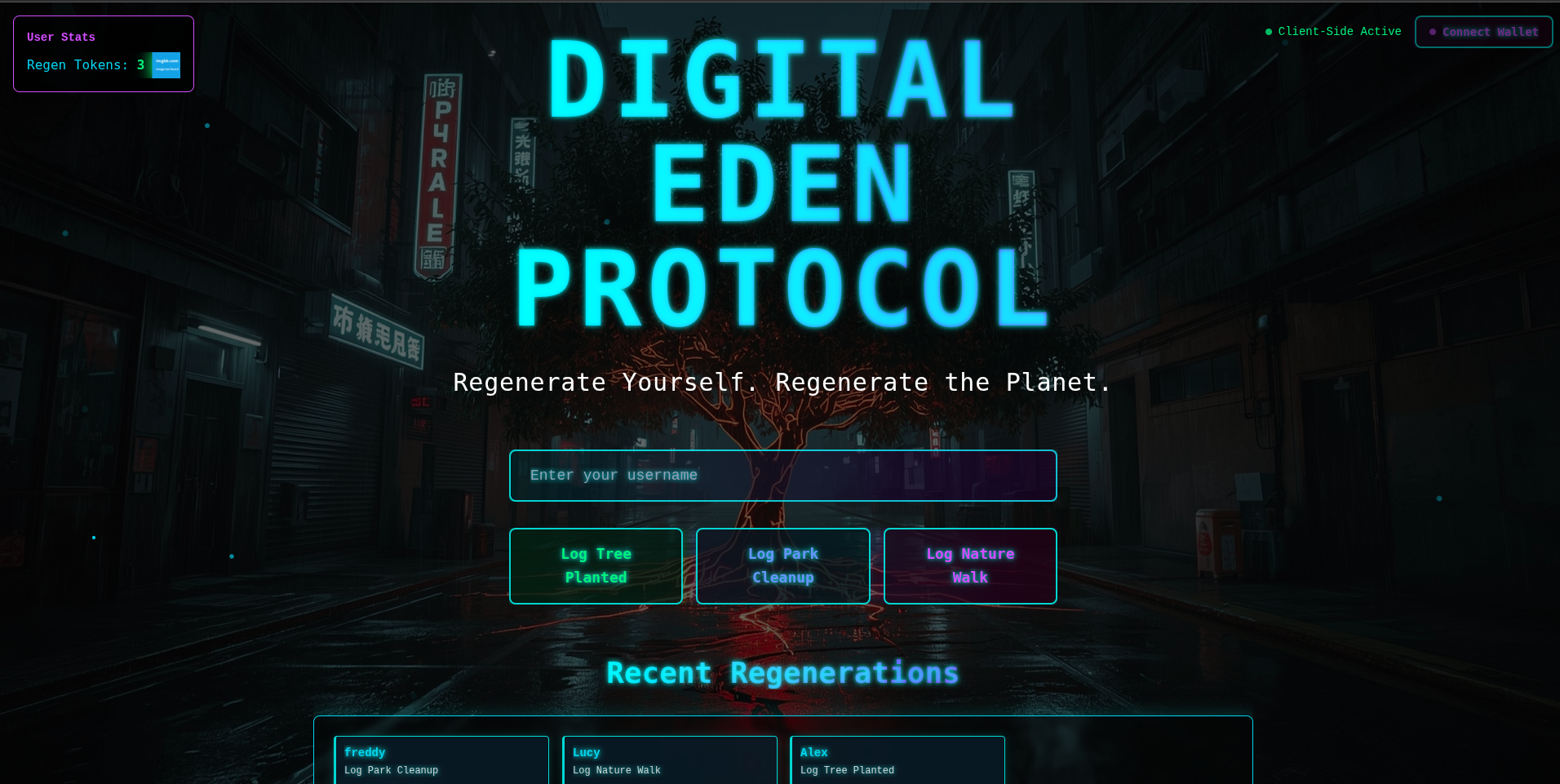
A Protocol for Regeneration, Built Through Resilience Inspiration: Fighting the Digital Burnout In our hyper-connected, neon-lit world, it's easy to optimize everything except ourselves. We get lost in the digital noise and forget to reconnect with the real world and our own well-being. The Digital Eden Protocol was born from this idea: what if we could use the aesthetics of the future to encourage the timeless practice of self-care and environmentalism? I was inspired to create a system—a protocol—that gamifies nature-positive actions, turning them into a rewarding experience for a generation immersed in technology. The theme of "cyberpunk meets nature" felt like the perfect, ironic-yet-sincere way to capture this mission.
How I Built It: A Story of a Mid-Hackathon Pivot The project began with an ambitious plan involving a full-stack architecture with a Supabase backend to manage user data and ElevenLabs for voice AI. The initial foundation and UI were built rapidly using Bolt.new, establishing the core cyberpunk aesthetic.
However, the true story of this project began halfway through the incredibly tight deadline. A critical, unexpected subscription failure cut off all backend access, rendering the initial plan impossible. At that moment, I faced a choice: give up, or adapt.
I chose to adapt.
The project was immediately downloaded to my local system. Using my code editor's AI (Zed), I began a rapid, high-pressure pivot. The entire application was re-architected from the ground up to be a 100% client-side experience. The Supabase backend was replaced with the browser's localStorage, ensuring user progress felt permanent within their own system. The core logic was rebuilt in React, focusing on state management with useState and useEffect hooks to create a seamless, responsive application. The final, polished version was deployed globally using Netlify's drag-and-drop interface.
Challenges Faced: The Crisis is the Feature The greatest challenge was undoubtedly the unexpected loss of my backend capabilities mid-sprint. It wasn't just a technical problem; it was a complete conceptual crisis that forced me to rethink the entire project's architecture under immense time pressure. Transforming this potential failure into the project's core narrative—a story of resilience and agility—became the new goal. The challenge was no longer just to build an app, but to prove that the idea was strong enough to survive even when the technology supporting it was pulled away.
What I Learned This hackathon was an intense lesson in agility and strategic problem-solving.
Embrace Constraints: I learned that a sudden, critical limitation can be a catalyst for creativity. The pivot forced a simpler, more robust client-side solution that, in many ways, is more powerful for a proof-of-concept.
The Power of the Front-End: I gained a deeper appreciation for the capabilities of modern front-end development. Using localStorage and React hooks, I was able to build a feature-rich, persistent-feeling application without a single server-side call.
Narrative is Key: The most important lesson was that the story behind the project is as important as the code itself. The ability to frame a challenge as a strength is a critical skill.
Built With
- bolt
- css3
- html5
- javascript
- netlify
- react
- supabase
- typescript

Log in or sign up for Devpost to join the conversation.