-
-
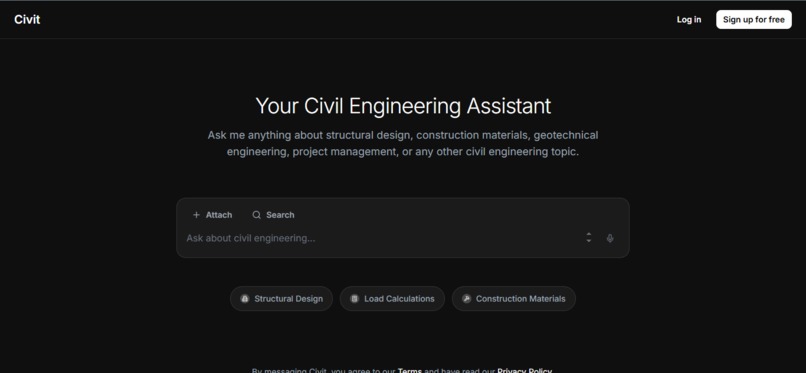
public landing page
-
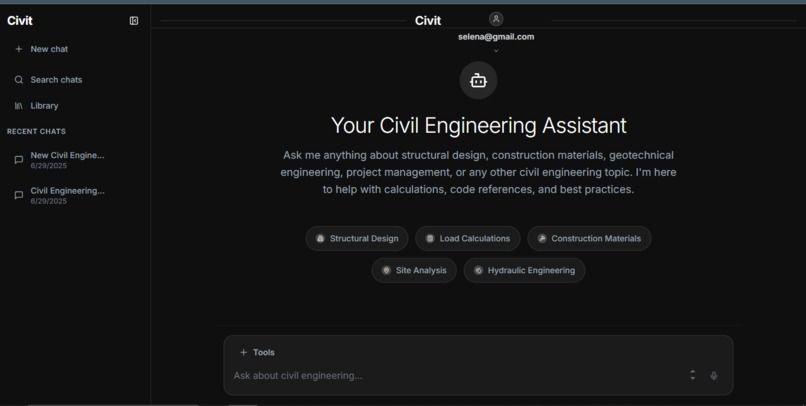
login home page
-
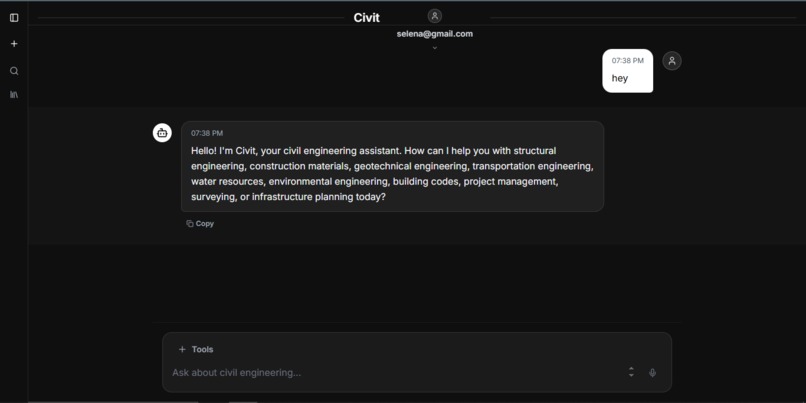
chat UI with civit
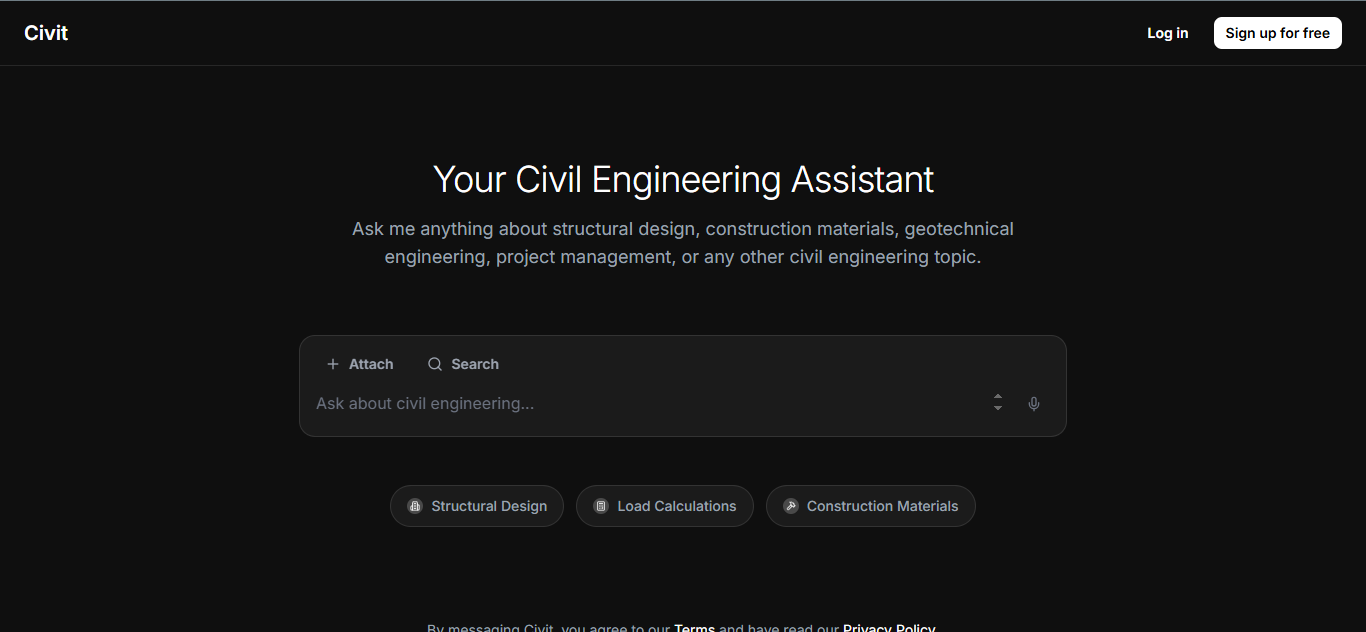
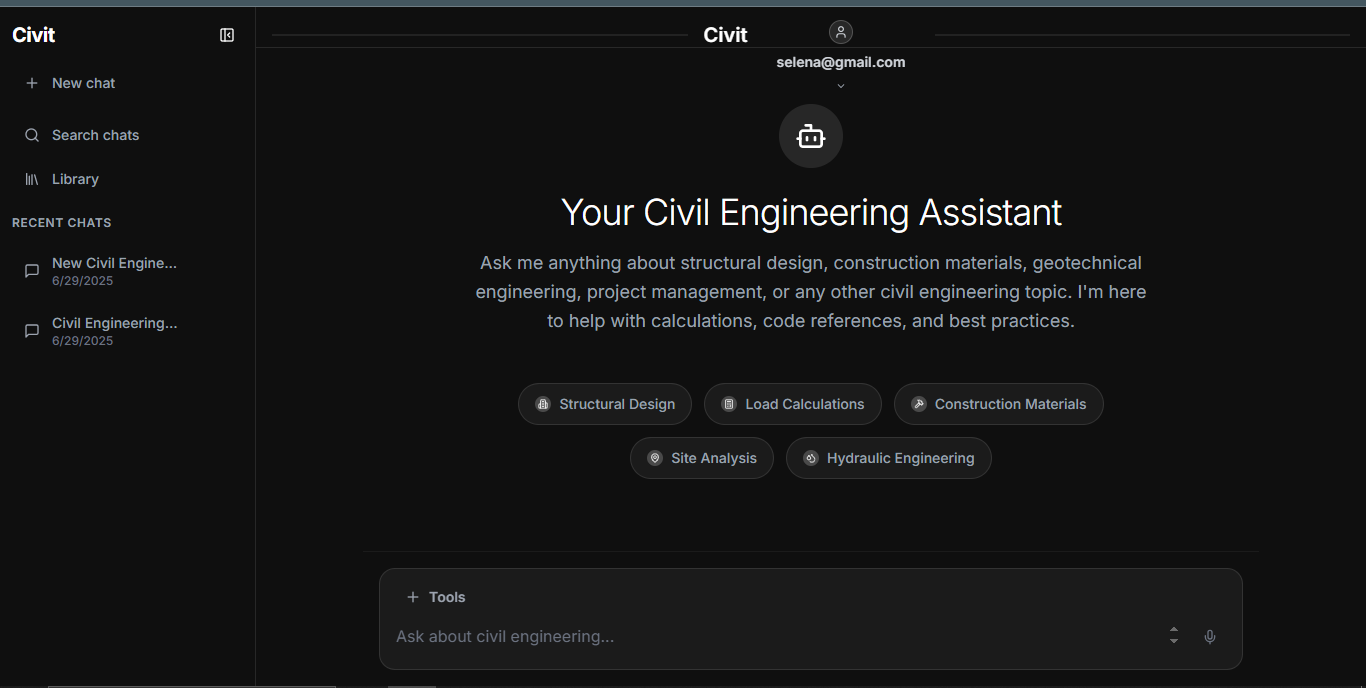
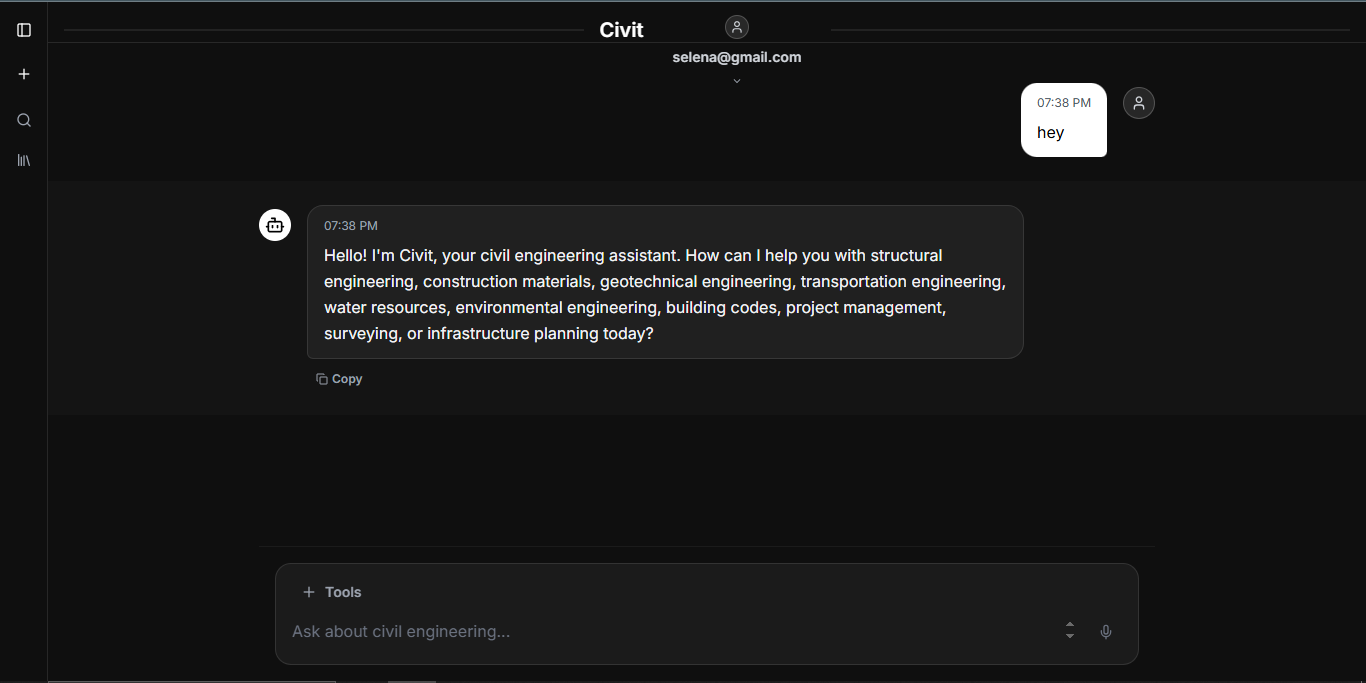
Civit – Your Civil Engineering AI Assistant
Inspiration
As a civil engineering student who’s also passionate about AI and full-stack development, I constantly found myself needing instant guidance on technical topics like structural analysis, concrete design, hydraulic flow, and AutoCAD scripting. Traditional resources are either scattered, outdated, or too rigid. Inspired by ChatGPT, I envisioned an AI assistant specifically tailored for civil engineers, capable of understanding context, solving engineering problems, and providing real-time assistance—whether for study, design, or field work. That vision became Civit.
What it does
Civit is an AI-powered assistant that functions like ChatGPT, but with prompt desing specific for civil engineering. It allows users to:
- Ask civil engineering questions in natural language (e.g., "What’s the formula for critical depth in open channels?")
- Get design guidance on concrete structures, slabs, columns, beams, and more
- Solve hydraulic problems like pipe sizing, flow estimation, or Manning’s equation
- Receive AutoCAD Lisp code or suggestions for structural drafting
- Access summarized code clauses, formulas, and fieldwork best practices
It’s built to support students, professionals, and field engineers who need quick, reliable, and intelligent help.
How we built it
- Frontend: Next.js + TailwindCSS + DaisyUI for a clean, ChatGPT-inspired interface
- AI Agent: Integrated OpenRouter.
- Prompt Engineering: Carefully crafted system prompts to steer GPT toward civil-related reasoning
- Auth: JWT authentication using
jose(Edge Runtime compatible) - Deployment: Developed inside Bolt IDE, exported to GitHub, deployed to Netlify
The project is modular and easily scalable to add new AI tools like unit converters, live drawing interpreters, or engineering calculators.
Challenges we ran into
- Edge Runtime limits: Packages like
bcryptjsfailed under Edge runtime. I had to refactor logic and switch to Edge-compatible libraries or move code to Node runtime. - Bolt deployment issues: Misconfigured base and publish directories caused Netlify and Bolt IDE to throw "no such file" errors.
- Token signing: Needed to switch from
jsonwebtokentojosefor Edge compatibility, and rework JWT handling logic - Narrowing AI focus: Prompt engineering was tricky—GPT had to stay on-topic for engineering and not drift into general-purpose answers
Accomplishments that we're proud of
- Created a working full-stack AI assistant in a limited hackathon window
- Designed a specialized AI UX for engineering rather than general chat
- Solved Edge Runtime problems and successfully deployed with authentication
- Built an assistant that understands the field I study and can help others like me
What we learned
- How to use AI as a domain-specific assistant with prompt steering
- Managing Edge Runtime constraints in Next.js and Bolt
- Full-stack authentication under serverless/Edge conditions
- Design and UI strategies for high-context interfaces like AI chatbots
- Crafting AI agents that simulate technical expertise in niche fields
What's next for Civit
- Launch as a free tool for civil engineering students worldwide
- Add modules for load calculations, material estimates, and safety codes
- Train a custom GPT model fine-tuned on engineering textbooks and codebooks
- Add file upload and markup support (drawings, site reports, etc.)
- Build a mobile version or PWA for field accessibility
Civit isn't just a chatbot. It's an AI companion for the next generation of civil engineers.
Built With
- mongodb
- nextjs


Log in or sign up for Devpost to join the conversation.