-
-
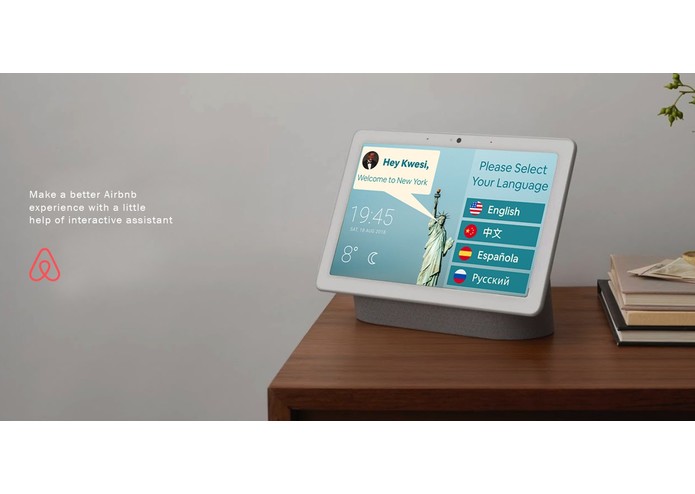
Make a better Airbnb experience with a little help of interactive assistant
-

Inspiration
I have a friend who is an Airbnb Host with three years of experience. He knows me as a creative individual, and he asked me to help him to improve his hospitality rate. He has hosted more than 2000 guests, and most of them have had generally the same questions and needs. This project will focus on guest problems and experiences after booking, and specifically those things that occur after their check-in experience. We put our Hackathon spirit hat on and ventured into the wild to see if we could come up with new creative solutions to help my friend and other hosts improve the hospitality rate.
Goal
Improve a host’s hospitality rate and make a guest’s stay experience stress-free.
Problems
We decided to tackle the four problems that were both important to guests and hosts. We redefined the pain points below Problem 1. Miscommunication issue between guests and host when a host is not at home Many hosts have full-time jobs and most of the time when the guests are checking in and out the hosts are not at home, and they are not able to meet guests in person and walk them through amenities and house rules. Moreover, hosts can’t deliver their smiles to guests, and it leads to losing that personal touch with the guests. Sometimes even during their stay, hosts don’t see them at all.
Problem 2. Guests don’t understand house rules or how to use the amenities Even though the host may have many signs and instructions on the walls very often it doesn’t help. Some guests don’t mention it, some don’t understand because of a language barrier, and sometimes they intentionally ignore what’s posted.
Problem 3. Hosts need to answer the same questions over and over again Most of the quests have the same question, which takes so much time for hosts to answer over and over again. And sometimes it’s not possible to answer promptly if the host is busy at work.
Problem 4. Guests don’t read listing descriptions and house rules very carefully, and sometimes they don’t even open an Airbnb app during their stay
There are multiple reasons why this happens. Sometimes the people who live in the house are not the same individuals who booked the place so they don’t have any access to the booking information. Sometimes people are not familiar with an Airbnb app and find it difficult to use, so they struggle every time when they need to open it. And of course, a language barrier doesn’t allow guests to consume all the information properly from the outset.
Solution
We spent quite a long time brainstorming to find the best solution that tackles all the problems mentioned above. Here are the options that we decided to stay away from:
• We didn’t want to create just another mobile app for guests so they have to connect to wifi first, then go to Play Store, download it, etc. This would actually make the process even more difficult for guests. • We also stepped away from the idea of creating a website and just sending a link to the guest. It seems like a reasonable solution but it has some downsides, like for example when people initially check-in they don’t have a wifi connection. This then meant that there is a big chance we would lose them. Of course, we can send them a link via the Airbnb app a few days before they arrive, but this makes no sense. Unless the guests are inside the house at the time of receiving instructions, the content will not make any sense. • We could increase the number of paper wall signs but when it’s too much it seems like guests are not welcome here and also they just don’t generally pay attention to it.
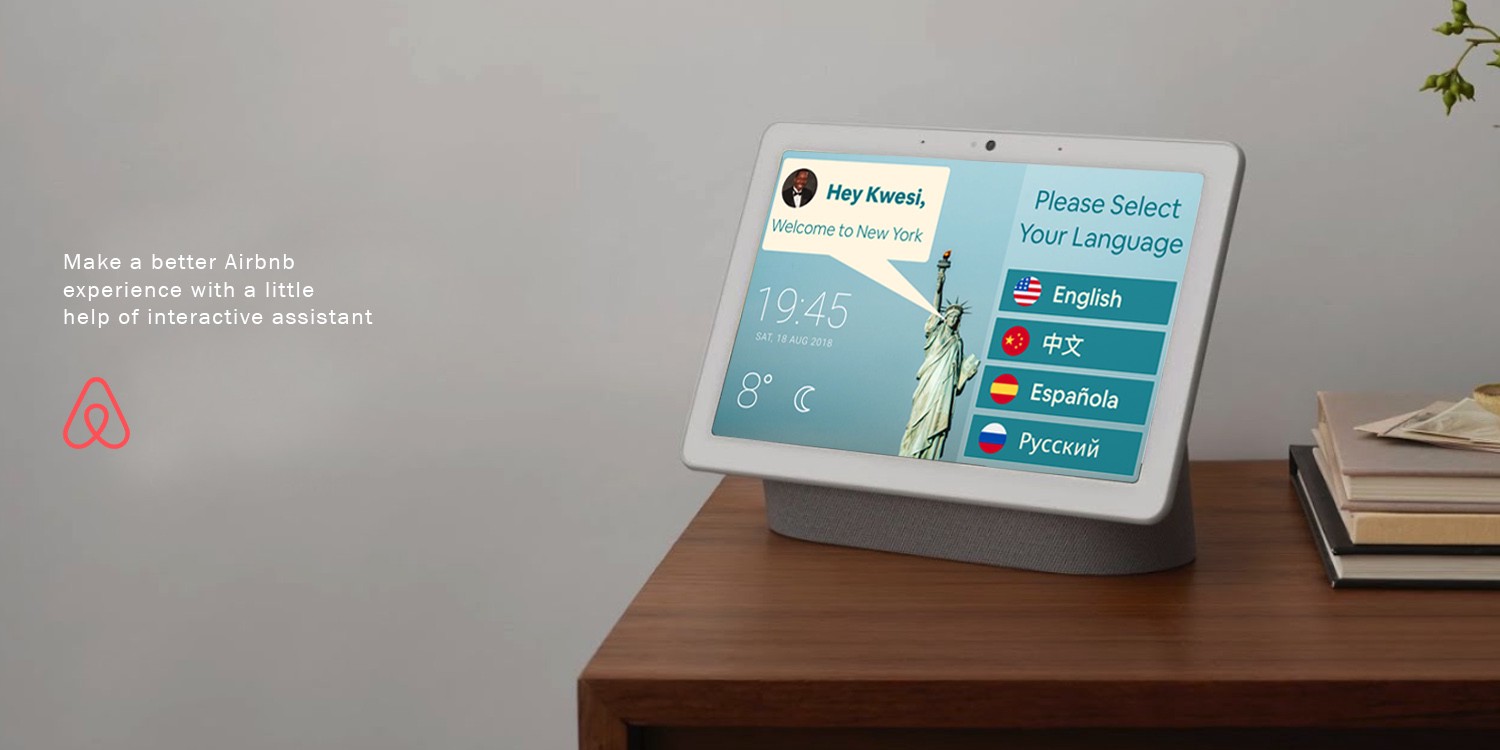
After a few weeks of brainstorming, we decided to use a tablet as a digital interactive assistant. This is a very flexible solution because it can be installed on the most visible place in the room and it will always be on so guests have almost no chance of avoiding it. The home screen will be personalized with the guest’s photo and name in their own language so it will evoke curiosity and desire to make the first click. Also, it doesn’t require any installation or technical skills.
Instruments:
Python, Adobe XD, ReactJS, Google API, Illustrator, Photoshop
Challenges we ran into
Luck of time
Accomplishments that we're proud of
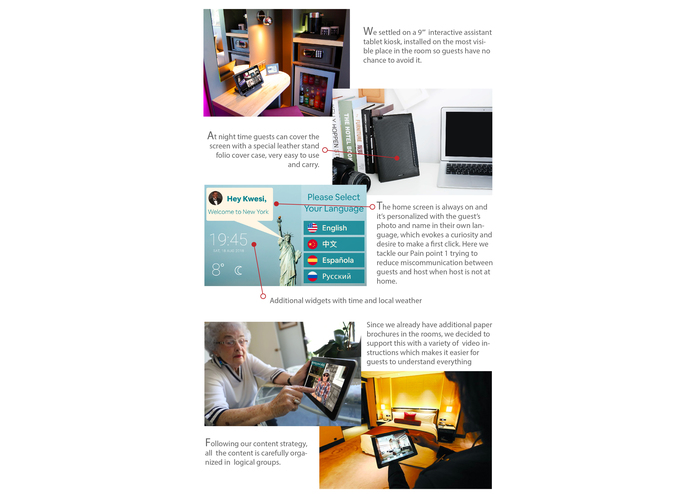
• We settled on a 9’” interactive assistant tablet kiosk, installed on the most visible place in the room so guests have no chance to avoid it. • At night time guests can cover the screen with a special leather stand folio cover case, very easy to use and carry. • The home screen is always on and it’s personalized with the guest’s photo and name in their own language, which evokes a curiosity and desire to make a first click. Here we tackle our Pain point 1 trying to reduce miscommunication between guests and host when host is not at home. • Additional widgets with time and local weather • Since we already have additional paper brochures in the rooms, we decided to support this with a variety of video instructions which makes it easier for guests to understand everything • Following our content strategy, all the content is carefully organized in logical groups.
What we learned
I personally learned about React Routes and Json array integration to the front end. My Teammates were exploring Google Map Api and functions
What's next for Digital Concierge
We have to finish our MVP and launch in a real-world environment. My friend who is an Airbnb Host already waiting to use it for his guests


Log in or sign up for Devpost to join the conversation.