-
-
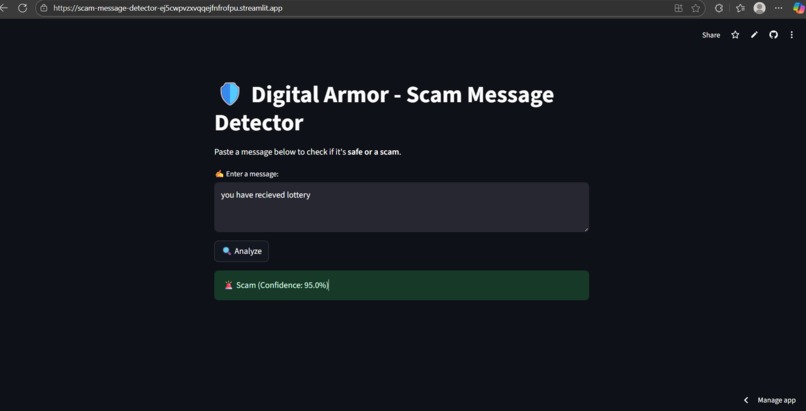
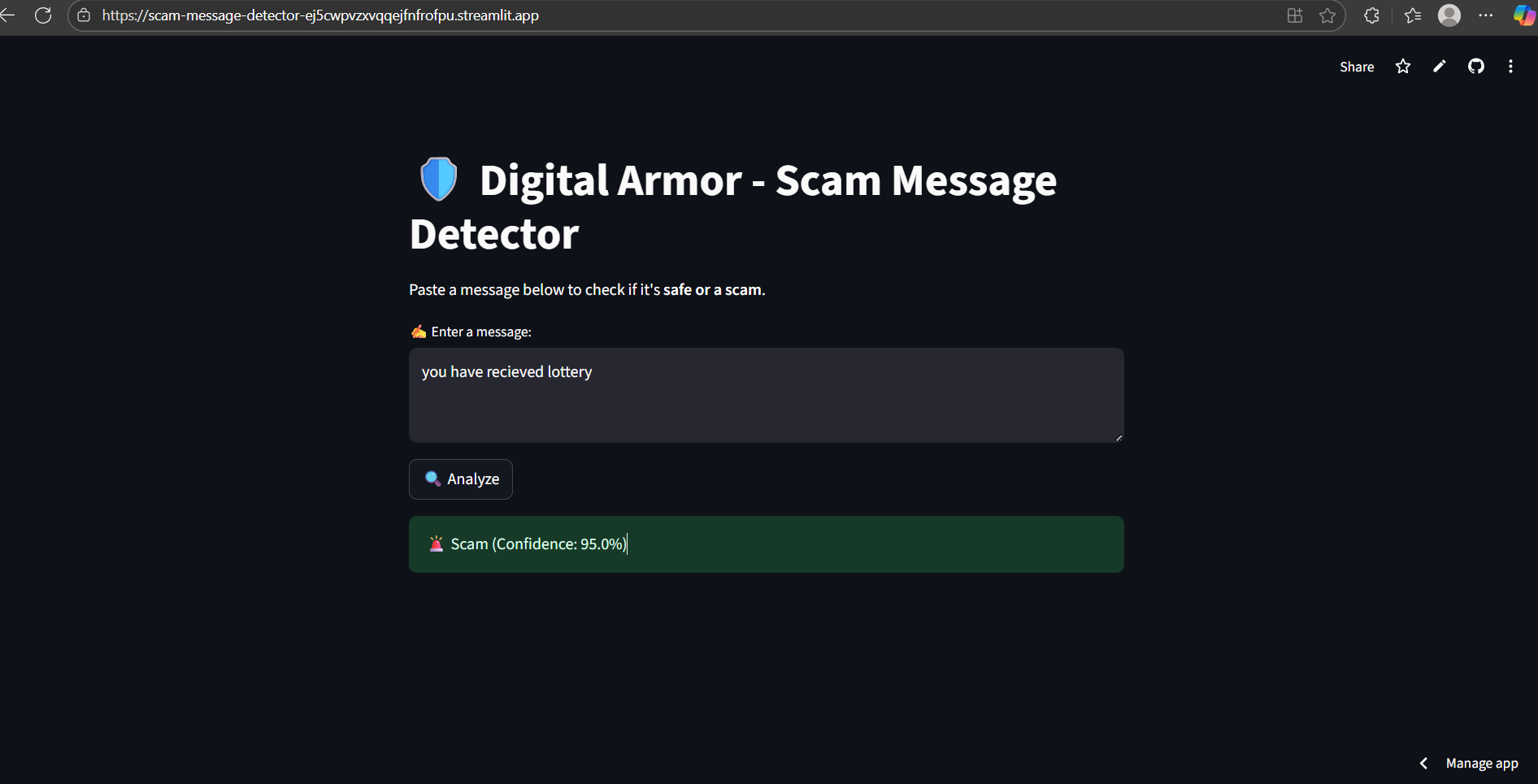
interface of the project
Inspiration
Every day, thousands of people fall victim to online scams — fake job offers, phishing emails, and fraudulent messages. I wanted to create a tool that helps ordinary users detect scams instantly and build trust in digital platforms.
What it does
Digital Armor — AI Scam Detector uses OpenAI’s gpt-oss-20b model to analyze text from emails, job postings, or SMS messages. It returns:
A label: SCAM or SAFE
A confidence score
Reasons why it flagged the message (keywords, suspicious links, personal info requests)
How we built it
Frontend: Streamlit (simple, clean UI for pasting messages)
Backend AI: OpenAI’s gpt-oss-20b model via Hugging Face Inference API
Fallback checks: keyword & URL detection using Python regex
Deployment: Hugging Face Spaces (public demo)
Code repo: GitHub with README & setup instructions
Challenges we ran into
Ensuring JSON-only output from the model (sometimes it returns extra text).
Managing inference latency for large models.
Designing a safe UX that doesn’t give false confidence to users.
Accomplishments that we're proud of
Built a working prototype that detects scams in seconds.
Created a live demo accessible worldwide.
Designed a human-centered explanation system so users understand risks.
What we learned
How to integrate gpt-oss open-weight models into a web app.
The importance of combining AI + rule-based heuristics for safety.
How to package a project for hackathon submission (demo, repo, video).
What's next for Digital Armor — AI Scam Detector
Fine-tune gpt-oss on a larger scam dataset for higher accuracy.
Add multilingual support (detect scams in Hindi, Spanish, etc.).
Develop a browser plugin to scan phishing links in real time.


Log in or sign up for Devpost to join the conversation.