Inspiration
What it does
How we built it
Challenges we ran into
Accomplishments that we're proud of
What we learned
What's next for Digital-_Necromancer
Inspiration We were inspired by the silent struggle every developer faces: legacy code. It's the cryptic, outdated code that slows down innovation, costs companies billions in maintenance, and is a nightmare to understand. We wanted to build a bridge between the past and the future of software development. What if you could converse with old code? What if you could have Alan Turing himself explain a complex algorithm? This vision led us to create the Digital Necromancer—a tool to resurrect digital artifacts and give them a modern voice.
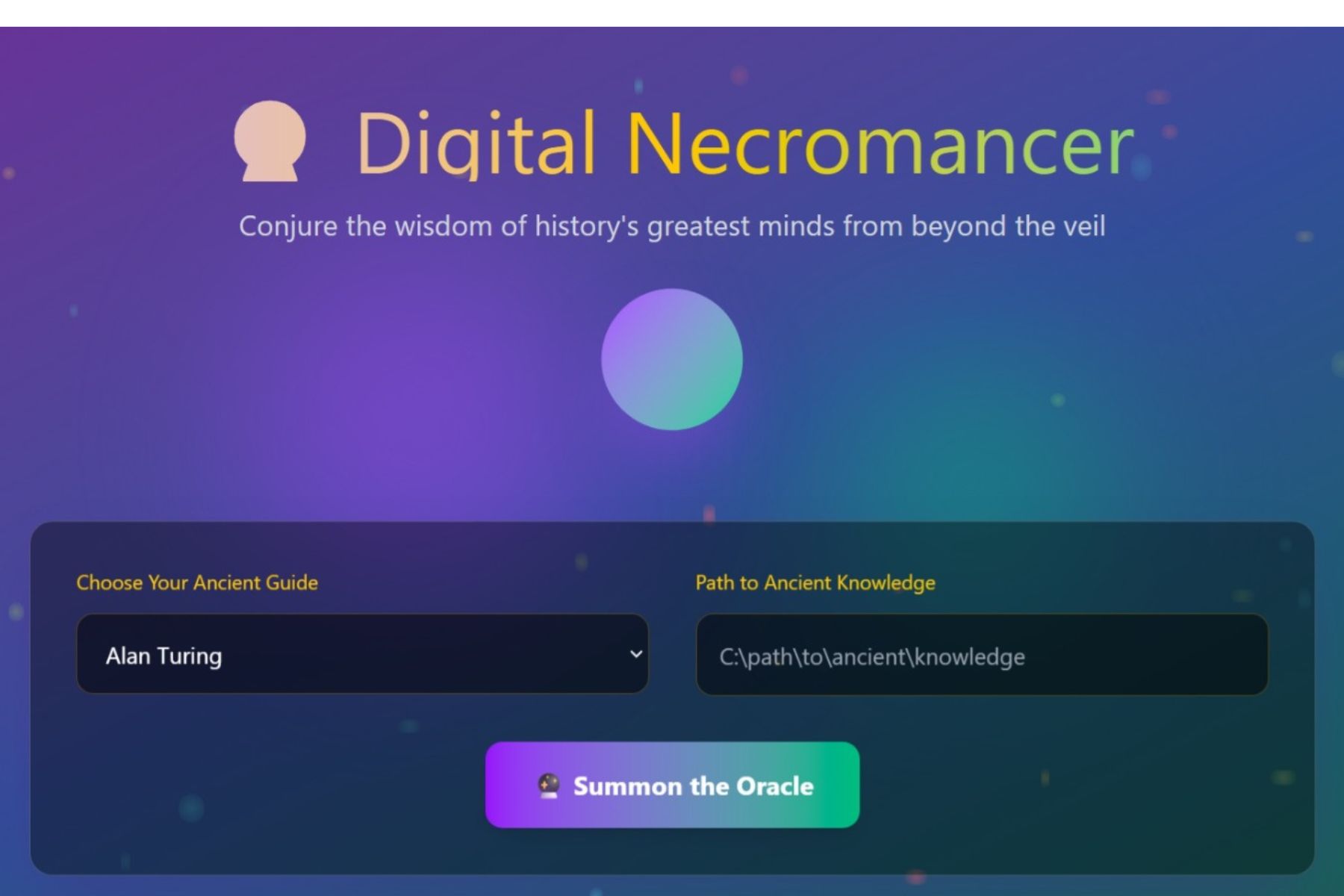
What it does Digital Necromancer is an AI-powered full-stack application that analyzes and modernizes legacy code. A user simply pastes a code snippet or selects a project directory. Our application then:
Analyzes: It processes the code, breaking down its structure and purpose.
Explains: It generates a clear, concise, plain-English explanation of what the code does, phrased in the style of a chosen historical tech figure like Alan Turing or Grace Hopper.
Modernizes: It provides a new, clean, best-practice version of the code, ready to be integrated into a modern codebase.
It turns a task that typically takes hours of frustrating debugging into an intuitive, seconds-long conversation.
How we built it We built a robust and modern full-stack architecture:
Frontend: A responsive and sleek UI built with React, TypeScript, and Vite, styled with Tailwind CSS and Shadcn/UI.
Backend: A high-performance Python API built with FastAPI, handling file processing and business logic.
AI Engine: The core intelligence, leveraging the Hugging Face Inference API with powerful large language models like Mistral-7B to perform the code analysis and generation.
Development: Entirely built in VS Code, with version control on GitHub, and deployed on Vercel.
Challenges we ran into Our biggest challenge was the "moving target" of AI API access. Our initial model, available during the hackathon, became unavailable by the submission deadline, forcing us to quickly pivot and re-architect our AI integration to a new provider and model. This taught us invaluable lessons in building resilient systems with fallbacks.
Other challenges included efficiently processing large project directories without hitting context limits and designing prompts that consistently generate useful, accurate, and character-driven explanations from the AI.
Accomplishments that we're proud of We are incredibly proud of building a complete, functional, and visually appealing full-stack application under time pressure. Successfully integrating a complex AI pipeline into a seamless user experience is a major accomplishment. We're also proud of our creative approach—the "historical figure" persona isn't just a gimmick; it creates a more engaging and memorable way to learn from legacy systems, a concept that truly resonates with users.
What we learned This project was a deep dive into practical AI integration. We learned how to handle API inconsistencies, manage context windows for code, and craft effective prompts for complex technical tasks. Beyond AI, we strengthened our skills in building a decoupled frontend-backend architecture and handling real-world problems like file I/O and error handling in a production-like environment.
What's next for Digital Necromancer The future is bright for the Necromancer! Our roadmap includes:
Advanced AI Models: Integrating more powerful and code-specific models like CodeLlama or StarCoder for even better analysis.
Batch Processing: Allowing users to modernize entire repositories and projects at once.
IDE Integration: Developing plugins for VSCode and JetBrains to bring the Necromancer directly into the developer's workflow.
Collaborative Features: Adding features for teams to share and discuss code analyses, turning it into a collaborative learning tool.
Our goal is to make Digital Necromancer an indispensable tool in every developer's toolkit, finally solving the legacy code problem.
Built With
- face
- fastapi
- hugging
- javascript
- node.js
- python
- tailwind


Log in or sign up for Devpost to join the conversation.