-
-
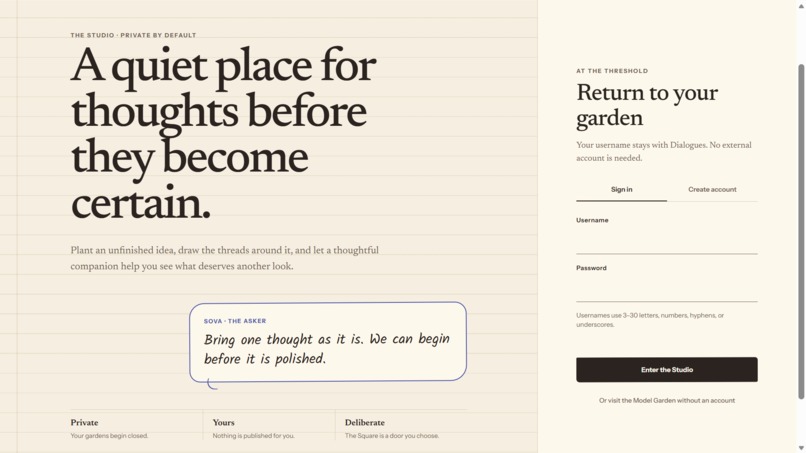
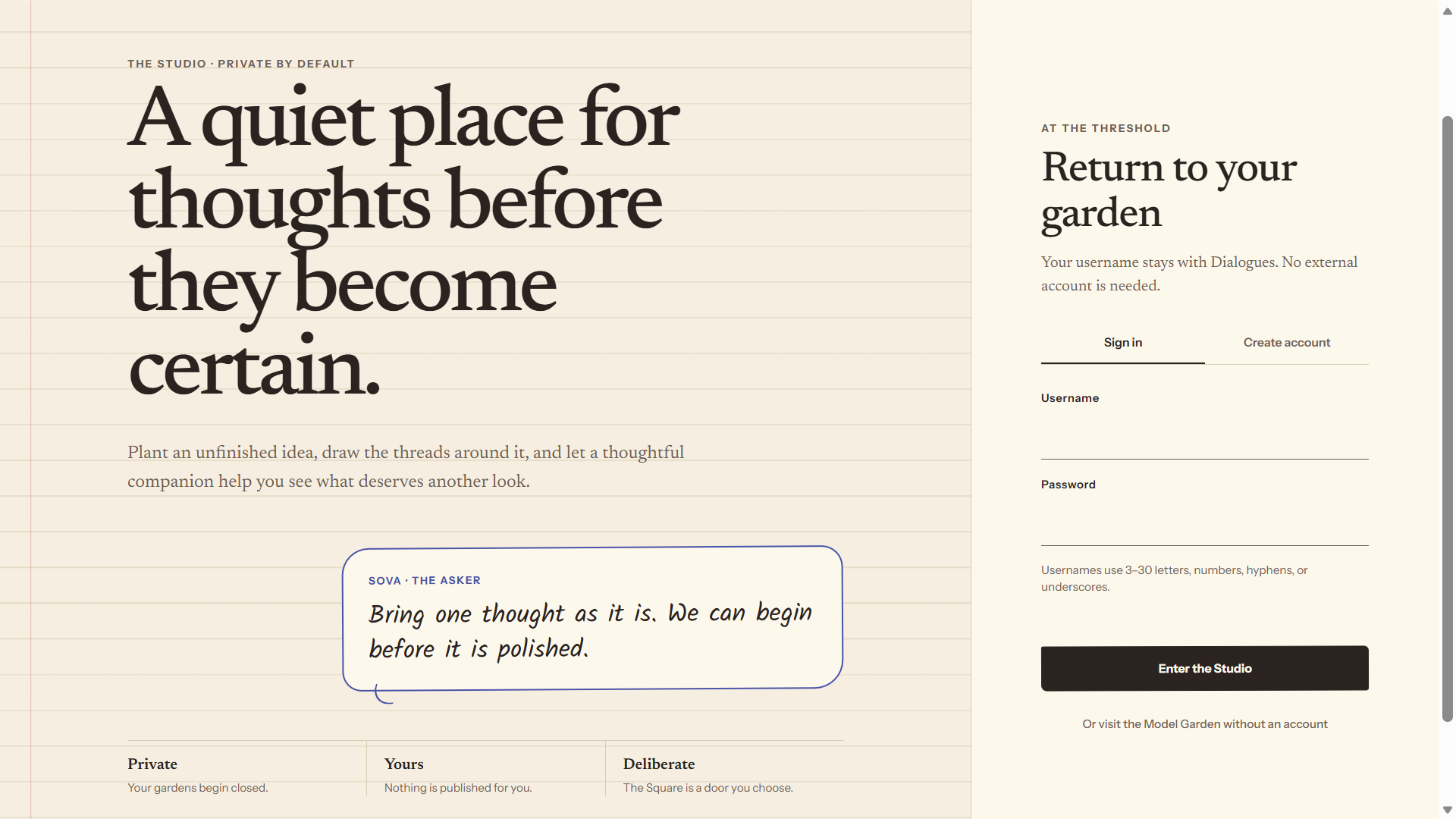
The entrance: Login page
-
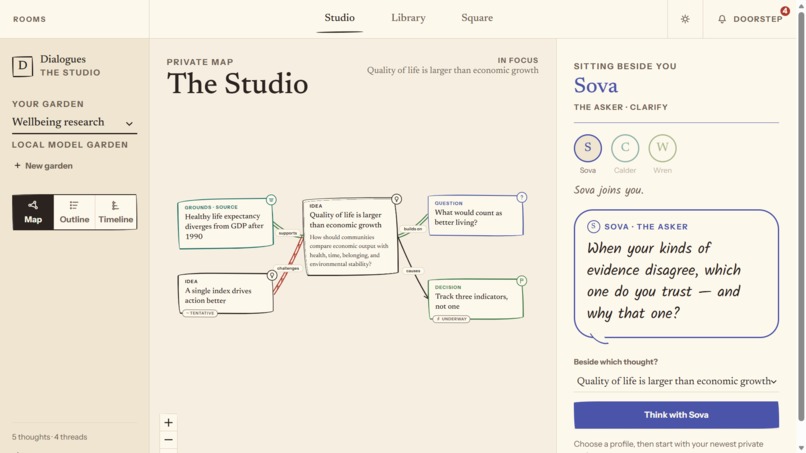
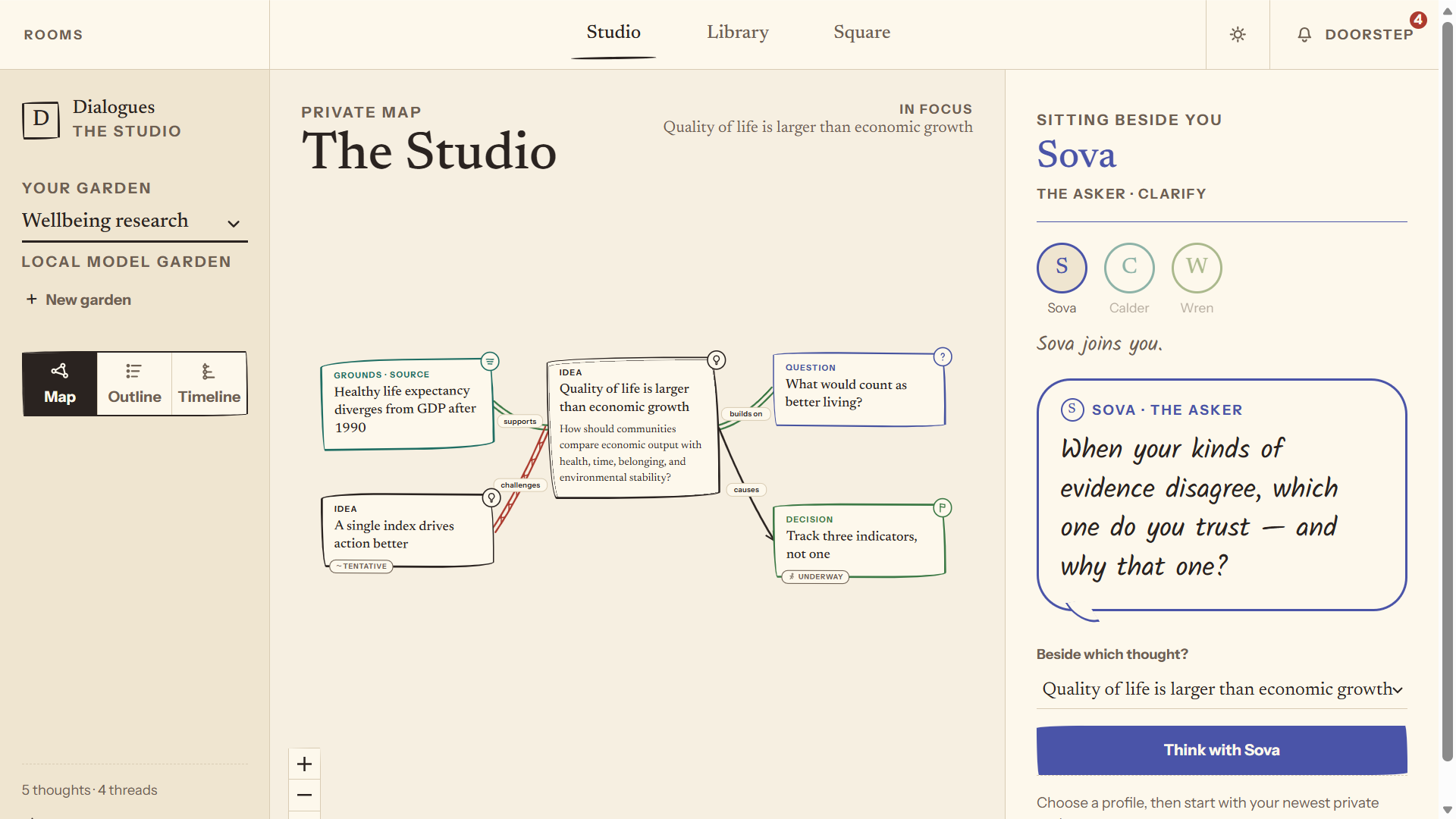
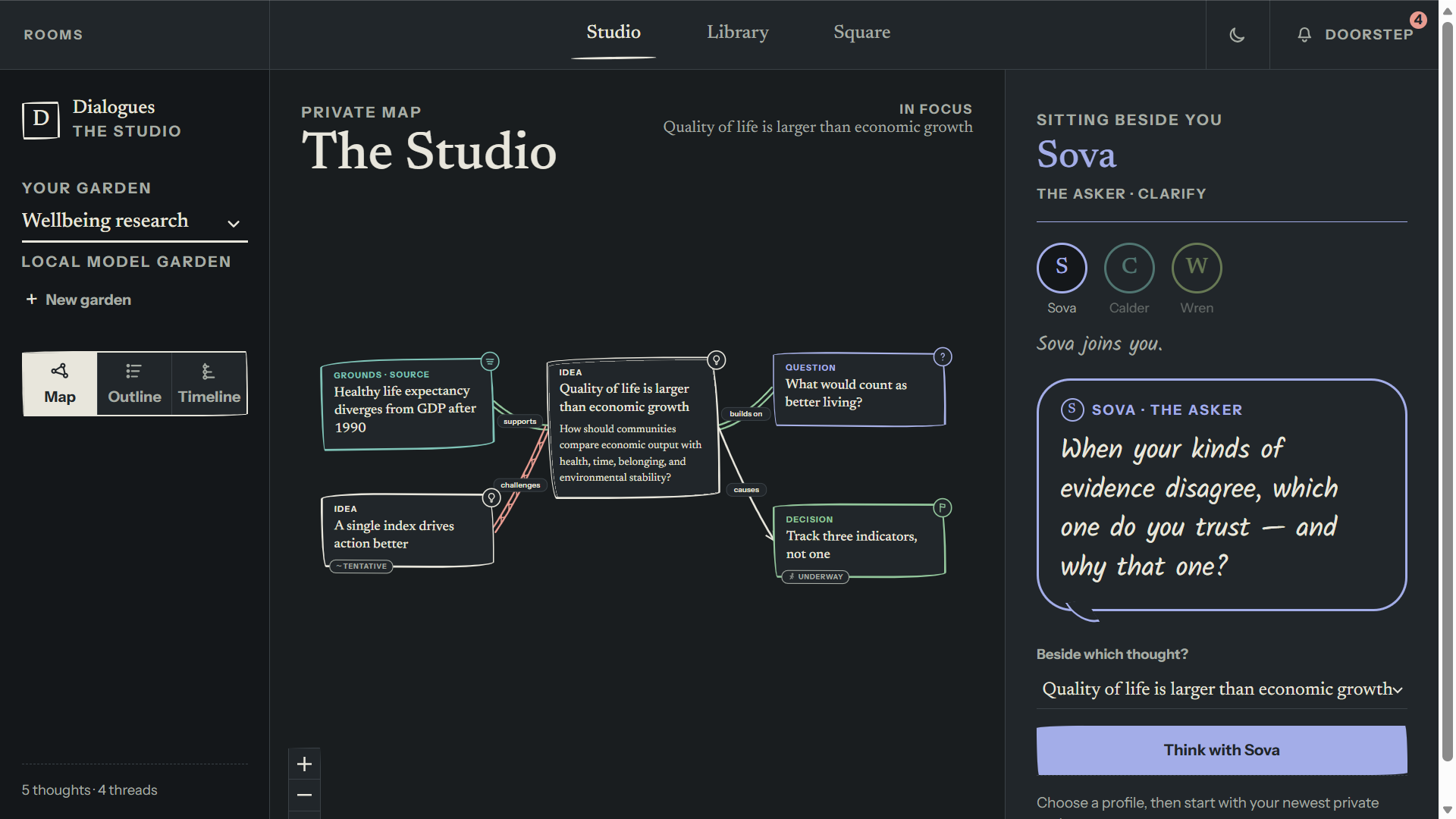
The Studio - Map
-
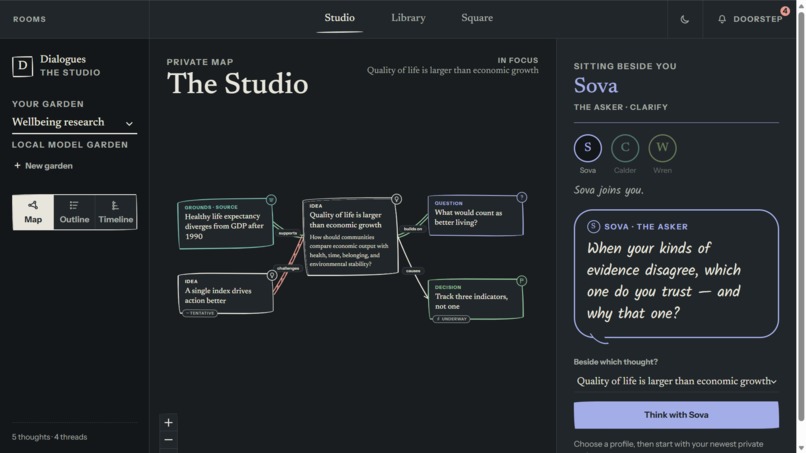
Dark mode
-
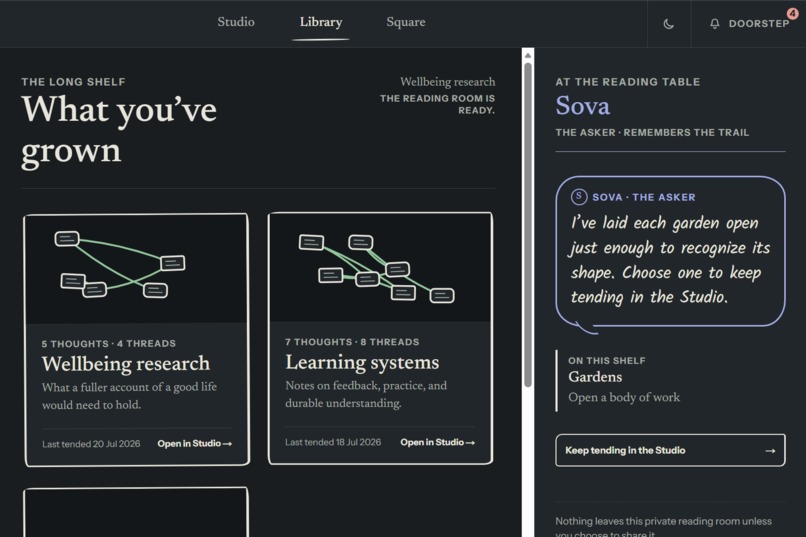
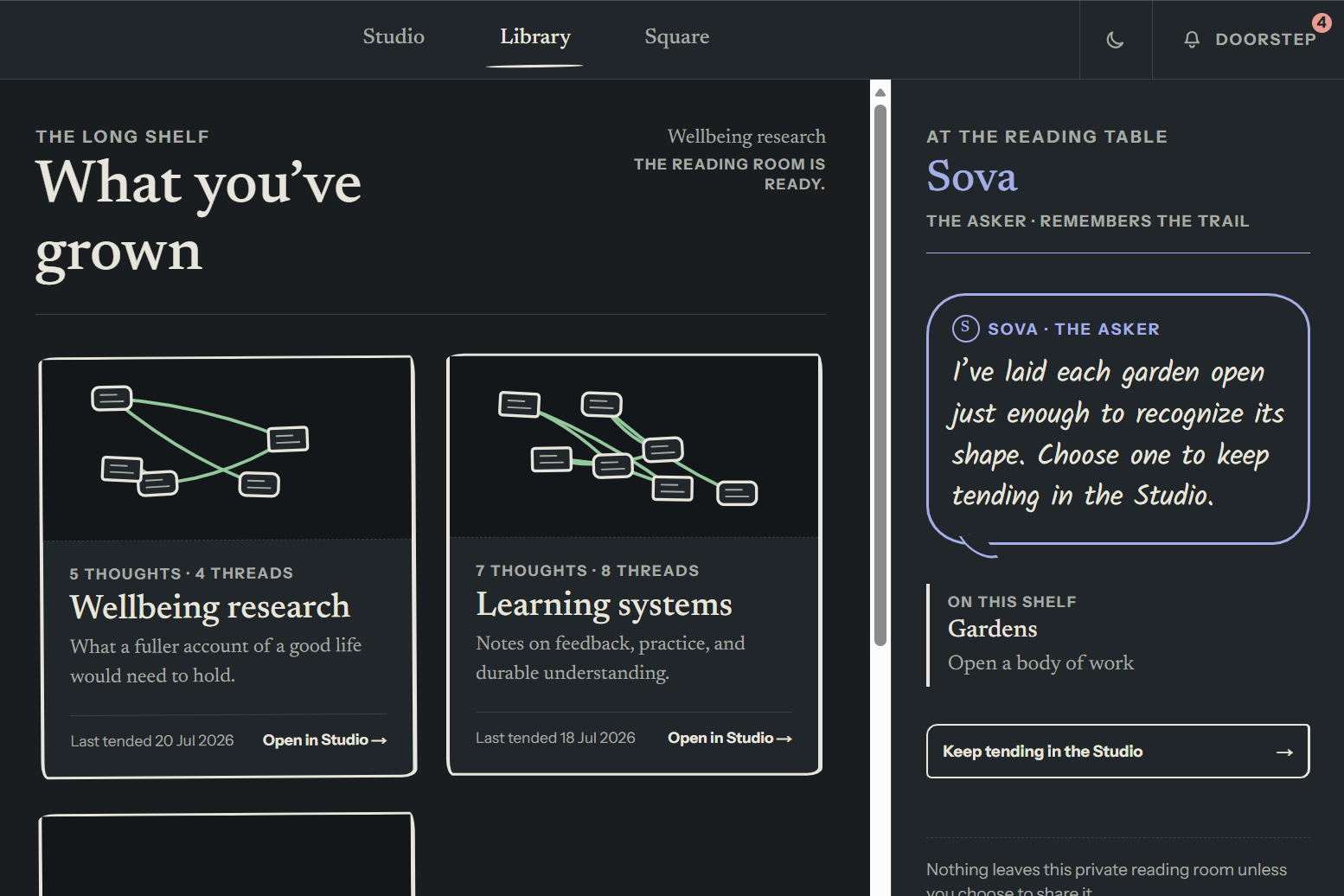
Library - Gardens
-
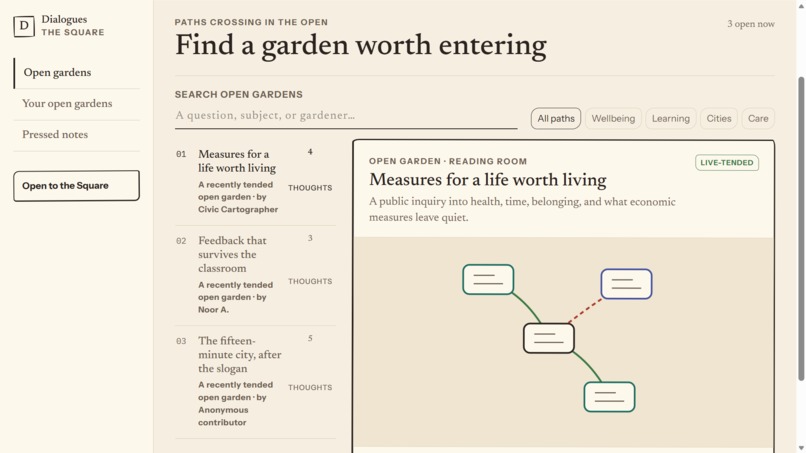
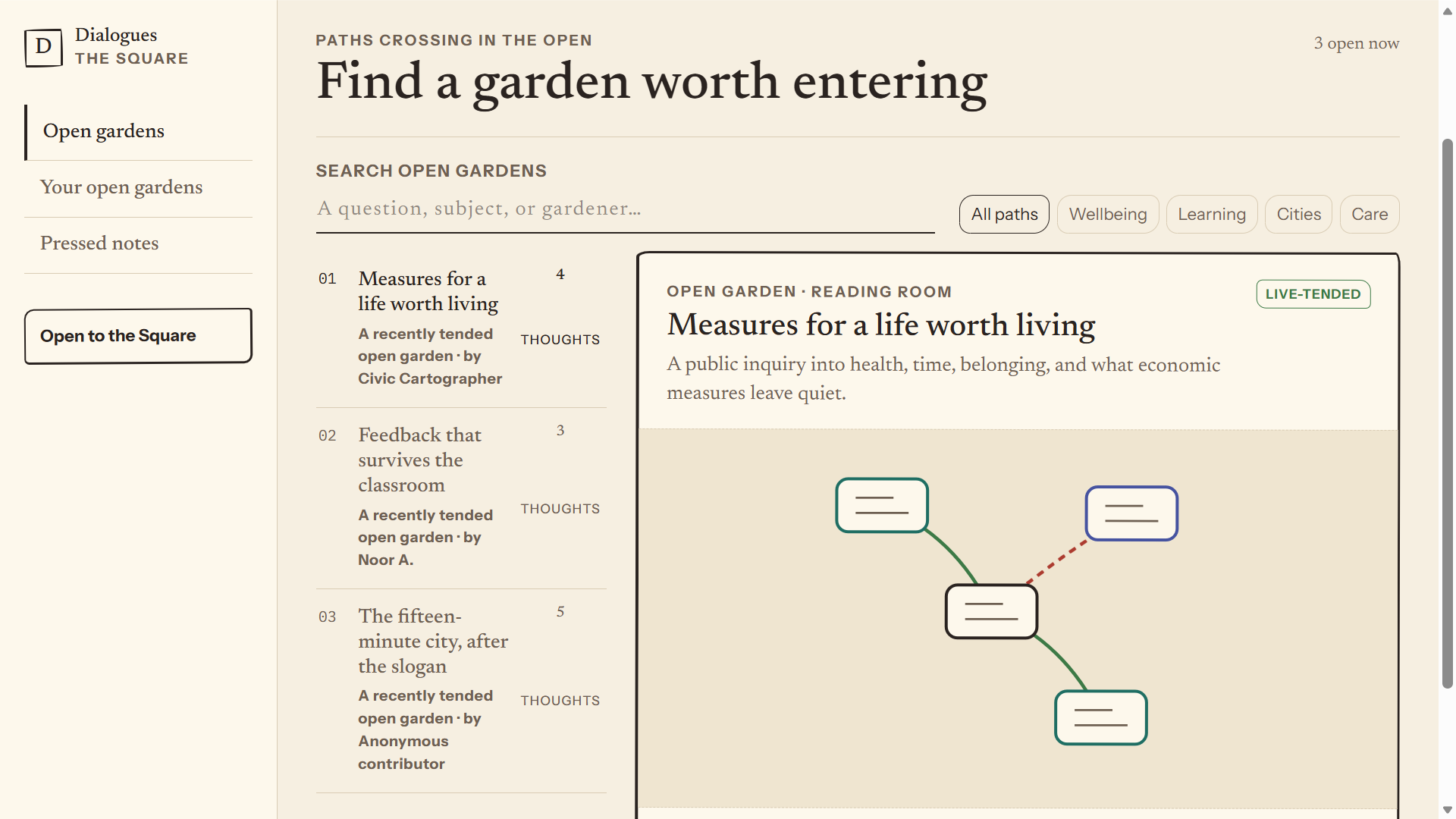
Square - Open gardens
-
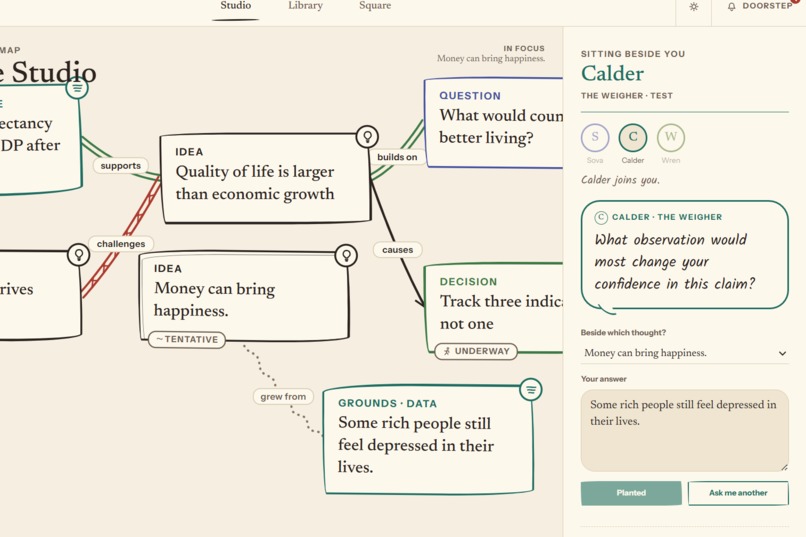
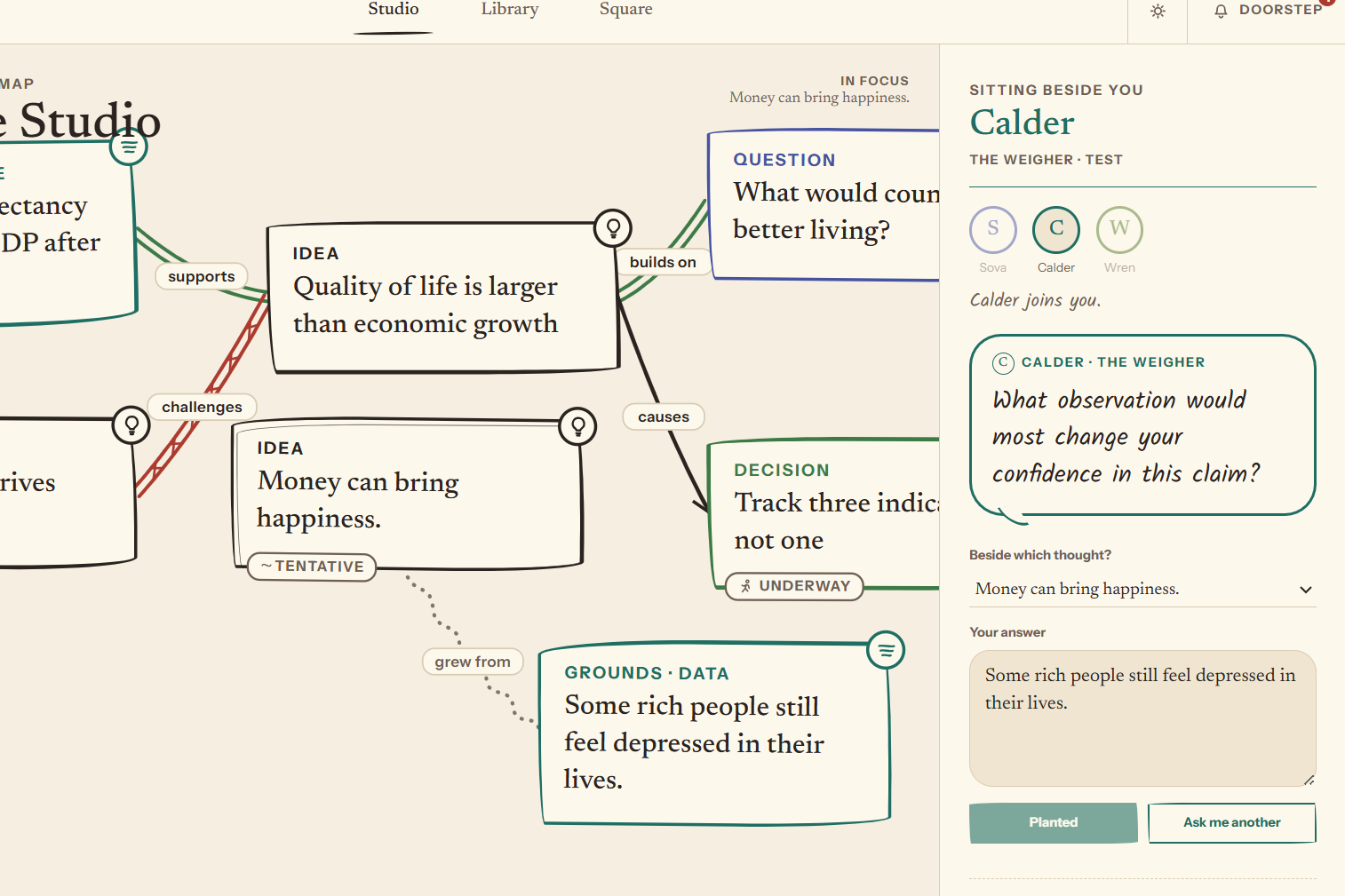
Think with AI Philosopher, Calder and plant the thought
Inspiration
In today's era of information overload, people are constantly consuming ideas, yet rarely have the opportunity to actively develop them. Most note-taking applications organize information, while AI assistants often provide answers immediately. However, genuine understanding comes from questioning assumptions, connecting evidence, and refining ideas over time.
We believe thinking itself should be collaborative, iterative, and transparent.
That inspired us to build Dialogues—a graph-native thinking environment where ideas evolve from private brainstorming into collaborative public knowledge. Instead of replacing human reasoning, AI acts as a Digital Philosopher, asking thoughtful questions, challenging assumptions, and encouraging users to explore different perspectives. Combined with graph-based knowledge mapping, Dialogues helps users organize their thinking while preserving authorship, provenance, and version history.
What it does
Dialogues is a graph-native thinking environment built around the lifecycle of an idea:
Private Thought → Guided Inquiry → Knowledge Map → Publication → Branching → Collaborative Evolution
Users begin by brainstorming in a private graph, where AI-powered Digital Philosophers encourage deeper thinking through different reasoning styles, such as Socratic questioning, scientific skepticism, and systems thinking.
Ideas are organized into interconnected knowledge graphs consisting of claims, evidence, questions, decisions, and relationships. Users can explore their knowledge in editable 2D views.
When ready, selected subgraphs can be published to a public knowledge space, where others can discover, branch, and contribute without overwriting the original work. Every contribution preserves authorship, provenance, and immutable version history.
How we built it
We built Dialogues with ChatGPT and Codex acting as teammates throughout the entire software development lifecycle.
On Day 1, ChatGPT helped us transform an abstract vision into a well-defined product through brainstorm. We used it to refine our product positioning, design the knowledge graph model, define user workflows, challenge architectural decisions, and iterate on the overall user experience.
As development began, Codex became our pair programmer. We used it to rapidly implement features, generate boilerplate code, refactor components, write TypeScript APIs, debug complex issues, explain unfamiliar code, review pull requests, and improve code quality. Instead of replacing developers, Codex allowed us to focus on solving product and design problems while significantly accelerating implementation.
Our MVP is built with:
- React + TypeScript for the frontend
- Neo4j as the graph database
- GitHub Authentication for user identity
- AI-powered Digital Philosophers that guide users through structured reasoning
- Zod for validating structured AI outputs
- Interactive graph visualization and editing
- Semantic relationship suggestions with explicit user acceptance
- Versioned publication, branching, and selective incorporation workflows
Throughout the project, OpenAI tools were involved in far more than coding. We cooperate with ChatGPT for brainstorming, UX design, architecture reviews, documentation, and technical decision-making, while Codex accelerated implementation, debugging, testing, and refactoring. Together, they helped us transform an ambitious idea into a working MVP in just seven days.
Challenges we ran into
Our biggest challenge was turning an ambitious vision into a working MVP within just seven days. Dialogues combines AI-guided reasoning, graph databases, collaborative knowledge management, version history, publication workflows, and multi-graph architecture—features that could easily become standalone projects. We had to continuously prioritize, iterate, and make difficult trade-offs to deliver a polished and coherent product within the hackathon timeframe.
Another major challenge was implementing secure multi-graph isolation. Each private graph serves as an authorization boundary, ensuring that ideas, AI context, publications, and relationships remain isolated unless users explicitly merge them. Designing this architecture while keeping the system scalable and intuitive required careful planning.
Finally, we wanted AI to encourage thinking rather than replace it. Instead of allowing AI to automatically modify users' knowledge, we designed an explicit review workflow where every AI-generated relationship or suggestion requires user approval before becoming part of the graph. This ensures that users remain the authors of their own reasoning while AI serves as a thoughtful collaborator.
Accomplishments that we're proud of
Within just seven days, we successfully built a functional MVP featuring:
- Multiple isolated private knowledge graphs
- AI-powered Digital Philosophers with different reasoning styles
- Interactive and meaningful 2D graph visualization
- Graph-specific authorization and ownership
- Semantic relationship suggestions with explicit acceptance
- Snapshot and live publication workflows
- Exact-version branching and selective incorporation
- Immutable provenance and version history
- Community-ready public knowledge projections
We're especially proud that Dialogues doesn't simply generate content—it helps users develop better thinking while preserving the evolution of every idea.
What we learned
This project taught us that building AI-powered software is not simply about integrating a language model—it is about designing meaningful human-AI collaboration.
We learned how graph databases naturally represent knowledge, how structured AI outputs improve reliability, and how explicit human review builds trust into AI-assisted workflows.
Most importantly, we experienced how ChatGPT and Codex can accelerate every stage of software development. ChatGPT became our product strategist and architectural sounding board, while Codex acted as our software engineer, reviewer, debugger, and pair programmer. Together, they significantly shortened our development cycle and allowed us to turn an ambitious vision into a working MVP within seven days.
What's next for Dialogues
We're excited to continue expanding Dialogues beyond the MVP.
Our roadmap includes:
- Cross-graph discovery with explicit merge workflows
- 3D graphic layouts
- Rich version history visualization
- Full public graph exploration interface
- Collaborative moderation and community curation
- Additional Digital Philosopher personas
- Source verification and citation assistance
- Real-time collaborative editing
- Smarter graph analytics and personalized learning insights
Ultimately, we envision Dialogues becoming a platform where knowledge is not just stored, but continuously questioned, refined, and collaboratively evolved—with AI acting as a thoughtful partner rather than simply an answer engine.

Log in or sign up for Devpost to join the conversation.