Diagnostify: Your personal Doctor
Inspiration
The exponential increase in the Covid-19 cases along with the plight of doctors and medical institutions across the country inspired us to do something for the people, for the doctors and for the nation. Therefore, we came up with an app which has features such as early and regular monitoring of critical covid-related health parameters of the user. This will in turn help to track down the number of cases and will also ease the burden on the medical staff of our country.
What it does
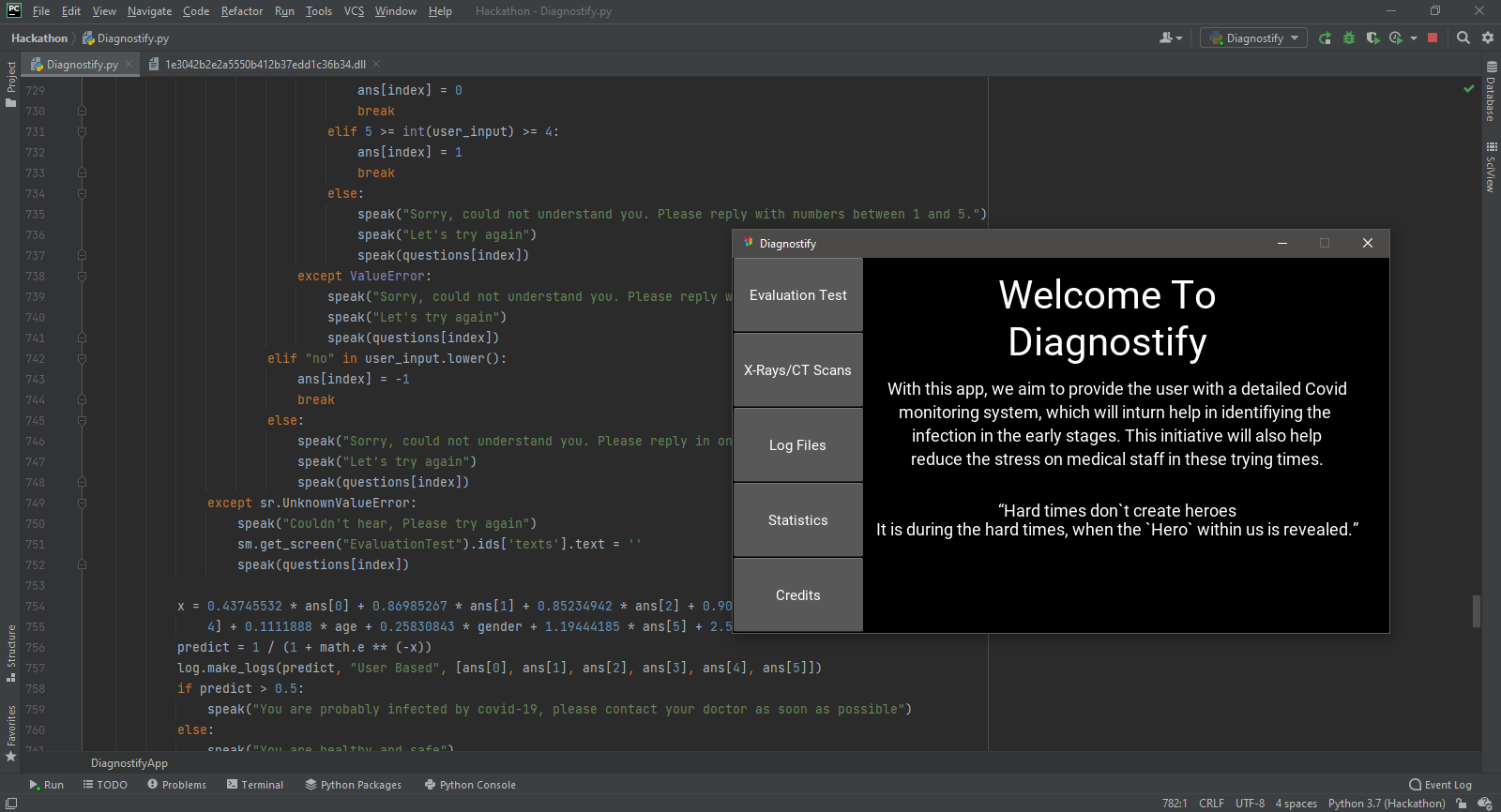
Covid-19 cases have been rising exponentially in our country, with about 4,00,000 cases being reported daily. To help us monitor these large number of cases, right since the early stages, we made an app called Diagnostify, which tells the user whether he is infected by Covid-19 or not. We do this by analysing a dataset, training it using machine learning and then predicting the probability of a person being infected by Covid-19. The user can also attach his/her CT scans and X-rays, which can again be used by our app to check whether the person is infected by the virus or not. To do this we used deep learning algorithms on a data frame of confirmed scan images. This in turn formed a mathematical model which is then finally used. Using our app, the user can monitor his health easily in day-to-day life. The simple yet efficient user interface enables the person to analyse various health-based parameters, related to Covid-19, through informative graphs, and the log file, that are updated every time the user uses our app.
How we built it
We take the input from the user in the form of speech, and we then form an array on the basis of the input given. This is finally followed by the application of our machine learning model to predict whether a patient is Covid-19 positive or not. First, we took a dataset that had 8 health-based parameters. Our app checks each of these parameters and tells us whether a person is infected by Covid-19 or not. Each parameter takes 3 values, we consider it as a 1 if a parameter is a yes for the user, 0 if the user is not sure and -1 if it holds negative for the user. This process is automated and done by our app, at the end of which we get an array of 0’s, 1’s and -1’s. With the help of this array, we get a probability as an output. If the output is greater than 0.5, it means that the user is Covid-19 positive, while if the output is less than 0.5, it means that he/she is Covid-19 negative. Now let us see how our app gets to this output. First, we did have to carry out data binning for each parameter. Then, as in this case we wanted a probability as the result, we applied logistic regression. For that we split our dataset in ratio of 3:1, which are the training and testing parts respectively. Then using the training dataset, we form our mathematical model. To test the accuracy of our mathematical model, we ran it on the test dataset. We found out its accuracy to be 96.2 % and its precision to be 96 %. After getting our logistic regression equation, we then made a health assistant so that the value of each parameter is fetched easily and efficiently. Finally, our app runs the logistic regression equation on the input array, and we get our output probability. If the probability is greater than 0.5, it means that the user is probably Covid-19 positive. This result is then displayed to the user. The statistics such as the output value, and the input for each parameter are added to a log file, for further reference of the user. Our app also has a feature to detect whether a person is Covid-19 positive or negative through his CT scans/X-rays. We trained a model based on images of CT scans and X-rays and then used it to predict whether a person is Covid-19 positive or not. The accuracy of the model was 88 % while the precision was 90 %.
Challenges we ran into
- Making an accurate prediction model
- Processing and Understanding the speech input ## Accomplishments that we're proud of
- High accuracy and well-functioning machine learning model
- Smooth speech recognition
- Efficient Graphical User Interface ## What we learned We learned many new things such as:
- Team co-ordination and Spirit
- Artificial Intelligence and Deep Learning


Log in or sign up for Devpost to join the conversation.