-
-

Logo
-
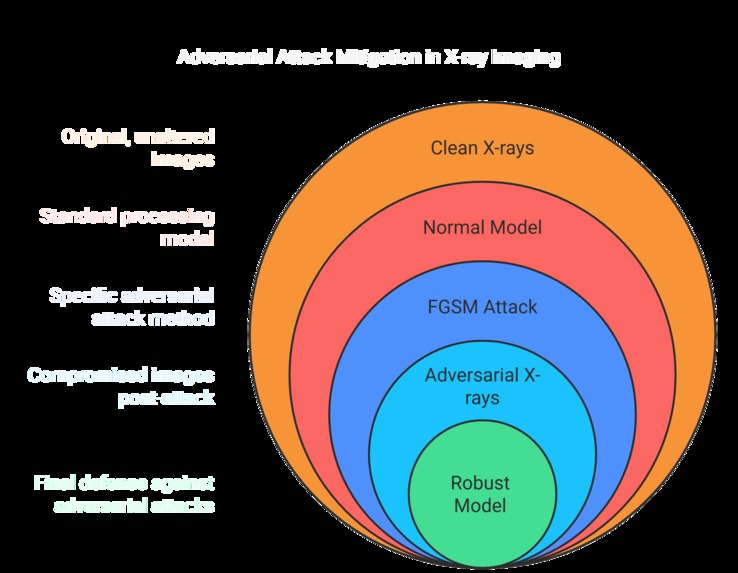
Model
-
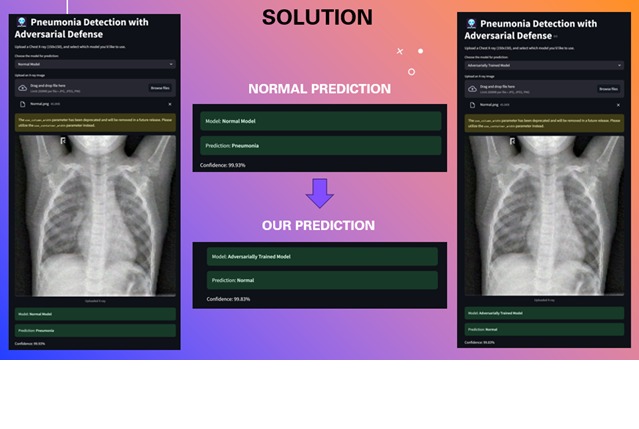
Solution

🚀 Diagnoa – Adversarially Robust AI for Inclusive Healthcare
UN SDG 10: Reduced Inequalities
🌟 Inspiration
Access to timely and accurate healthcare remains a luxury for many. Especially in rural and low-income regions, diagnostic errors and delays lead to life-threatening consequences. While AI has the potential to bridge this gap, it often fails when exposed to real-world distortions like low-quality images or noise.
We were inspired by this digital health divide and motivated to build a system that could offer equal healthcare opportunities—regardless of the environment or input quality.
🩺 What It Does
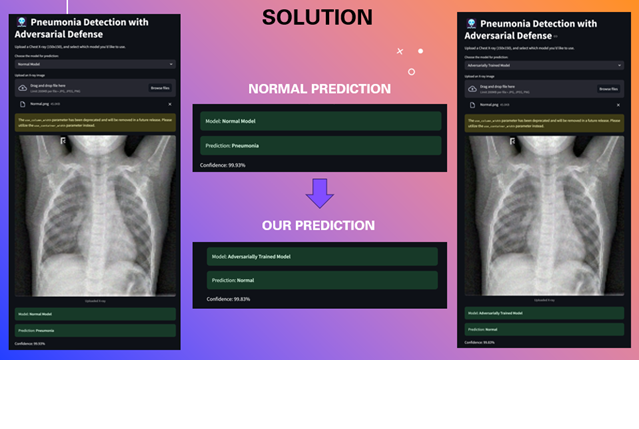
Diagnoa is a dual-model AI diagnostic system designed to detect pneumonia from chest X-ray images and remain reliable under adversarial attacks. Here's what it delivers:
- Accepts user-uploaded X-ray images
- Predicts disease using:
- A standard AI model
- An adversarially-trained robust model
- Visualizes how adversarial noise affects predictions
- Compares both models’ outputs with confidence scores
- Ensures fairness by resisting adversarial manipulations that could otherwise lead to misdiagnosis
🛠️ How We Built It
We built Diagnoa using:
- TensorFlow/Keras: To train two convolutional neural networks—one standard, one robust
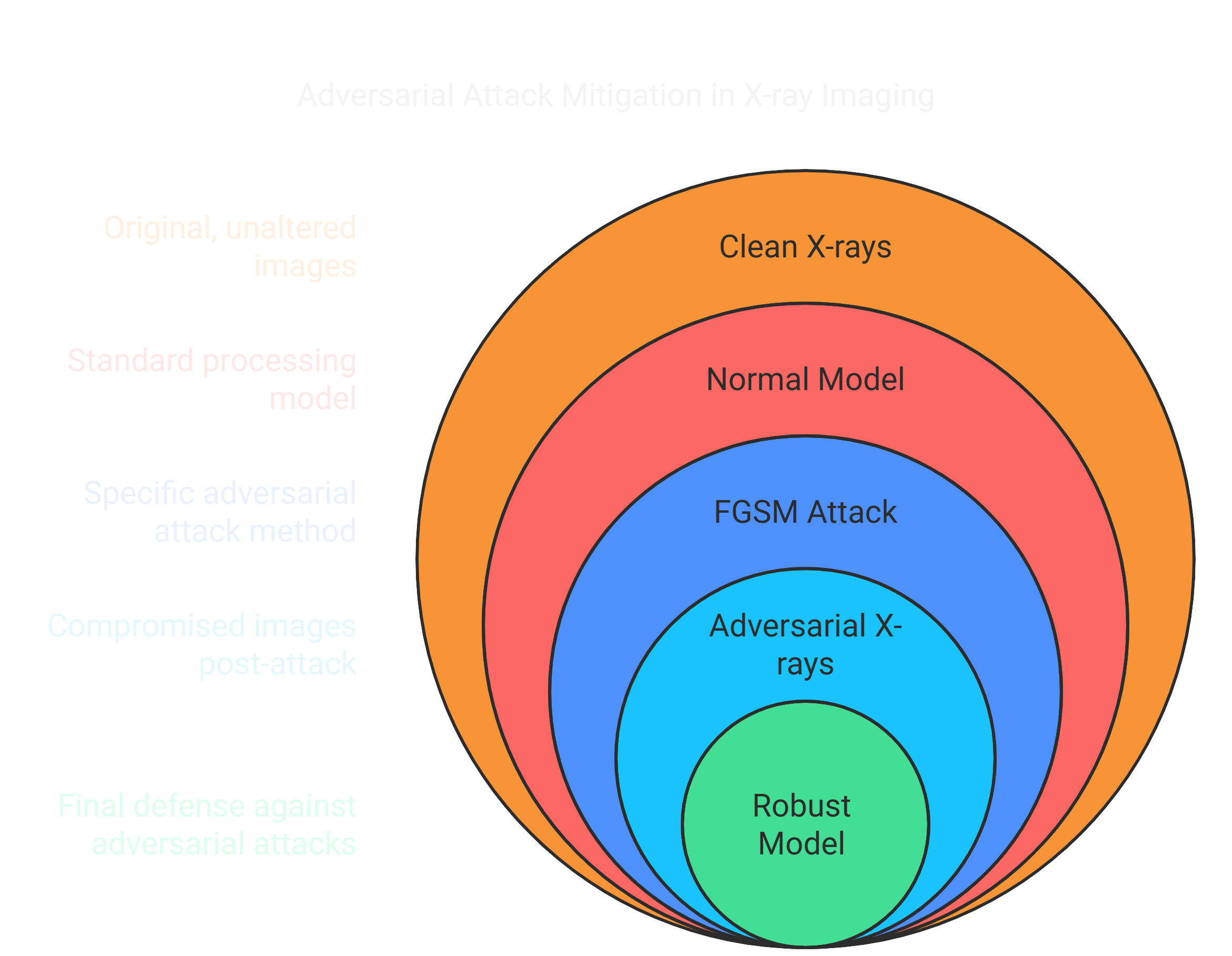
- FGSM (Fast Gradient Sign Method): To generate adversarial examples for robust training
- Streamlit: For an intuitive, browser-based interface
- Matplotlib & Seaborn: For data visualizations and confusion matrix plots
- Google Drive Integration: For dynamic model downloads during app runtime
The architecture includes:
.png?Expires=1838920185&Key-Pair-Id=K2ZIVPTIP2VGHC&Signature=mTKjrEAp0CbI5mtX8xOKn1fiYOggnkrKGEtNl1yhJ8R7D-fZr7nYo2ObiK%7EOYw9xiQ0F1Wc5aDKMxWPNorU42iaJRkZUCSM81Da4aJoa2T-HgTDX9ZOA2oBhNC1AQOgt9Y5NhB48N0-o2gsBiiuTHNj4PakEPwPoDywbmOfmwVJx-6giqq64QvTA8mxZiH63nrom2fmD4IdeXTmwKBBkRBGsvWx3Sb6JdBoMB4kbQOj0US1EBFngACQ%7EJFKJYL9tekgQfB1%7ECLWi3tkxPcVGHPuWl1REA-7vq6swp2PFFSud1D%7EaOUxGyw9ylIitM-inruhOCfgfdniv14BMoRHlUA__)
⚠️ Challenges We Ran Into
- Balancing Accuracy and Robustness: Adversarial training often compromises clean image accuracy. Tuning this trade-off was key.
- Model Size & Deployment: Compressing models for seamless Streamlit integration without losing performance.
- Generating Meaningful Adversarial Samples: Ensuring the added noise simulates real-world image degradation.
- UX Design: Designing a layout that clearly communicates both model results to a non-technical audience.
🏆 Accomplishments We're Proud Of
- Successfully created two models: one that performs well on clean images and one that maintains accuracy even on adversarial images.
- Built an interactive platform where users can visually compare how AI robustness affects prediction reliability.
- Aligned our work directly with SDG 10 by focusing on reducing healthcare inequality through inclusive technology.
📚 What We Learned
- AI systems must be evaluated not just by accuracy, but also by fairness, robustness, and resilience.
- Adversarial machine learning isn't just academic—it has powerful implications for real-world safety and access.
- A good solution is not just technical—it’s also user-friendly, scalable, and empathetic to diverse user needs.
🔮 What’s Next for Diagnoa
- Disease Expansion: Train models on other conditions like COVID-19, tuberculosis, or lung cancer.
- Mobile & Offline Compatibility: Optimize for low-resource deployment in remote clinics and villages.
- Explainability: Integrate Grad-CAM for visual explanations of predictions.
- Local Partnerships: Collaborate with public health organizations to pilot Diagnoa in underserved areas.
- Open Source Release: Share datasets, models, and the Streamlit app to invite global contributions.


Log in or sign up for Devpost to join the conversation.