Inspiration
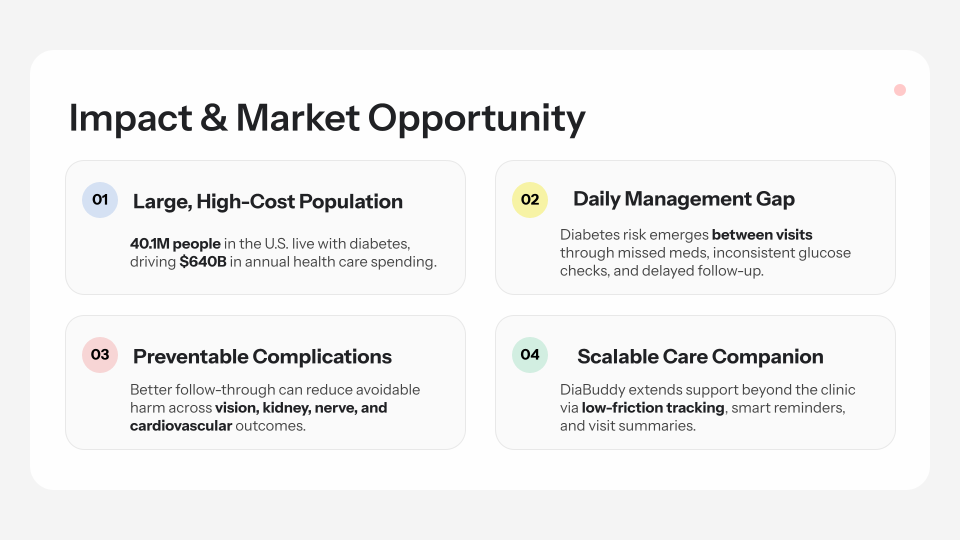
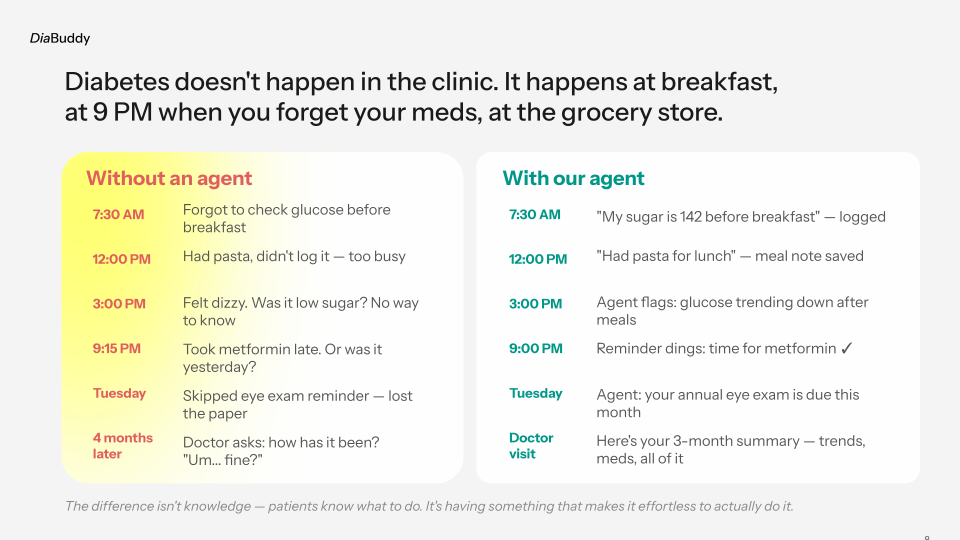
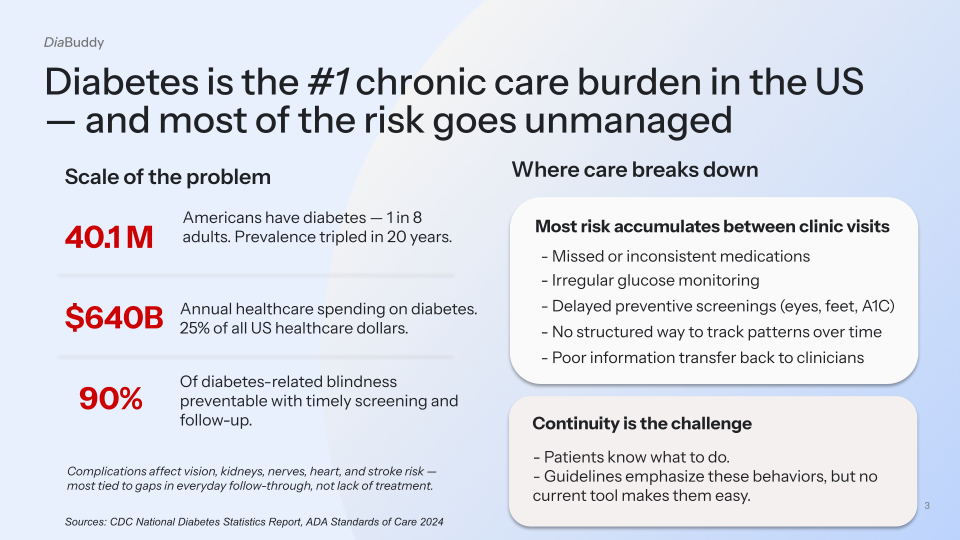
Diabetes is one of the largest everyday care problems in medicine because the burden does not stop when the visit ends. In the United States, 40.1 million people, about 1 in 8, live with diabetes, and the disease accounted for $640 billion in health care spending in 2021, or 25% of total health care spending. A large share of the real risk comes from what happens between appointments, when people miss medications, skip glucose checks, delay follow-up, or lose track of patterns over time. Diabetes also drives preventable complications across vision, kidneys, nerves, heart, and stroke risk, which makes daily follow-through clinically important, not just administratively helpful. That is what inspired DiaBuddy. We wanted to build something that supports the part of care most tools ignore: the repeated small actions that determine whether patients stay on track in real life.
What it does
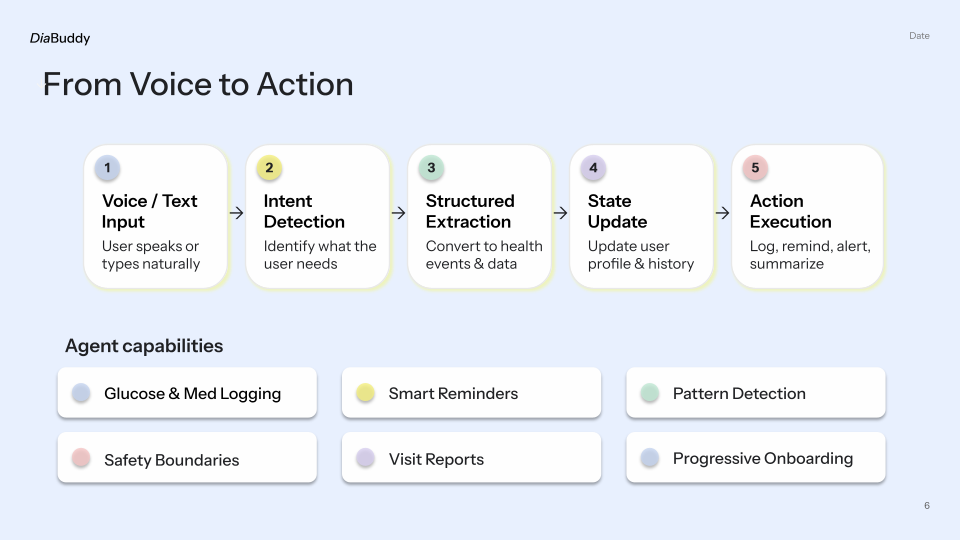
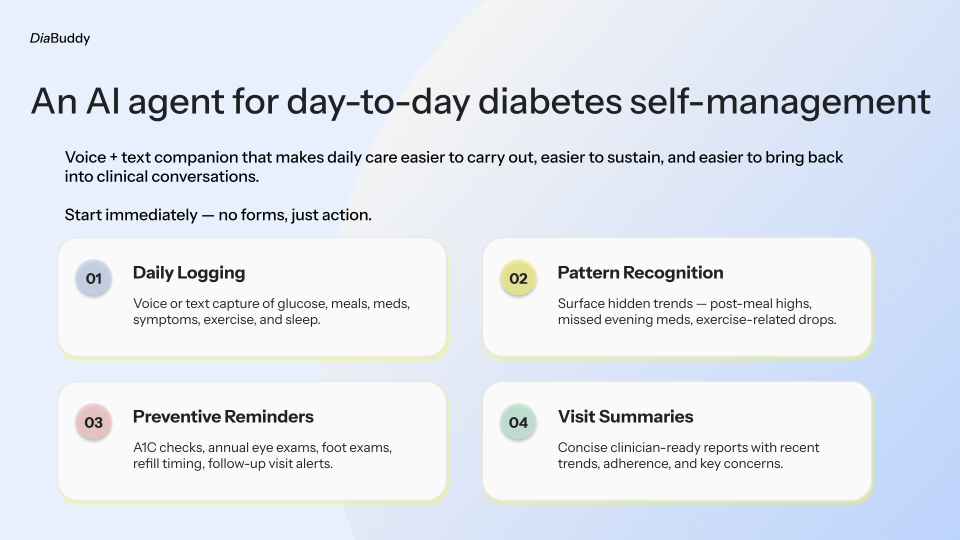
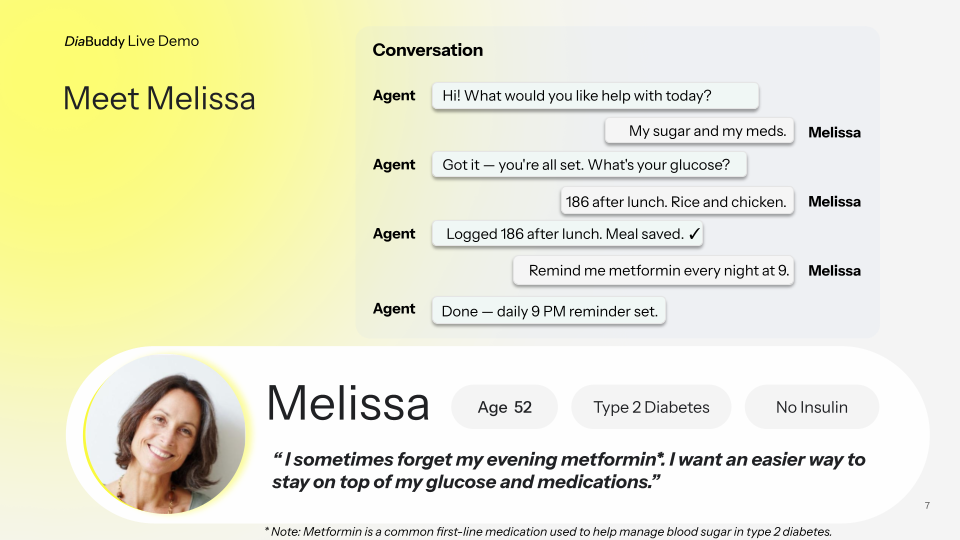
DiaBuddy is an AI diabetes care agent built for daily self-management and continuity between visits. It helps users log glucose, meals, medications, exercise, sleep, symptoms, and notes through short voice or text interactions, then turns those inputs into structured support that is actually useful. It can set reminders, surface simple patterns such as repeated post-meal highs or missed evening medications, generate concise daily reviews, and prepare visit-ready summaries that help clinicians quickly understand what has been happening outside the clinic. The core idea is straightforward: DiaBuddy does not just answer questions about diabetes, it helps users carry out the daily behaviors that protect long-term outcomes and make care more consistent.
How we built it
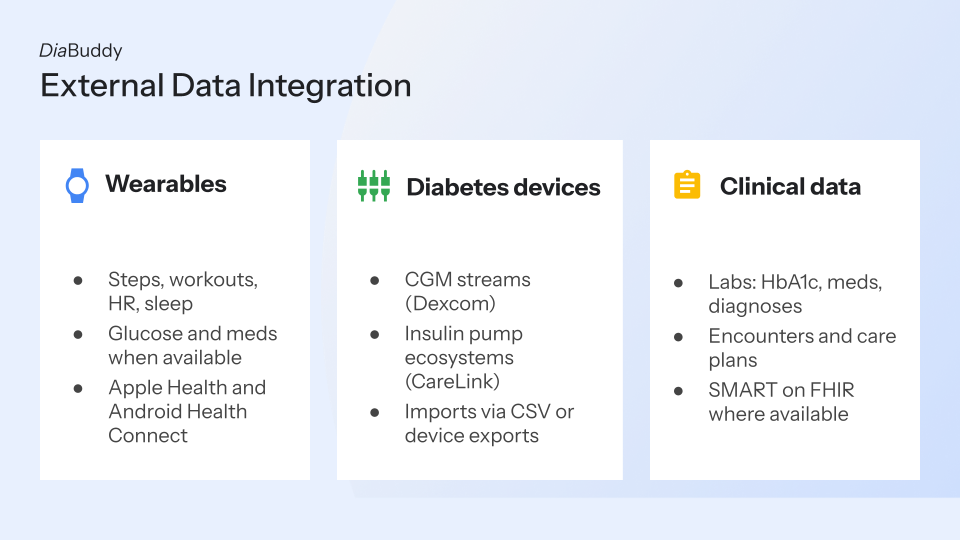
We built DiaBuddy as an action-oriented agent rather than a passive chatbot. The system takes natural user input, identifies intent, extracts structured health events such as glucose values, medication adherence, meal context, symptoms, or reminder requests, updates the user’s running state, and triggers the next useful action inside the workflow. That action might be logging a reading, creating a reminder, summarizing the day, or preparing a cleaner report for a future visit. We designed onboarding to be progressive so users can start immediately with one useful task instead of getting blocked by a long intake form, and we kept the architecture modular so it can connect over time with wearables, CGMs, and clinical records through platforms such as HealthKit, Dexcom, and SMART on FHIR.
Challenges we ran into
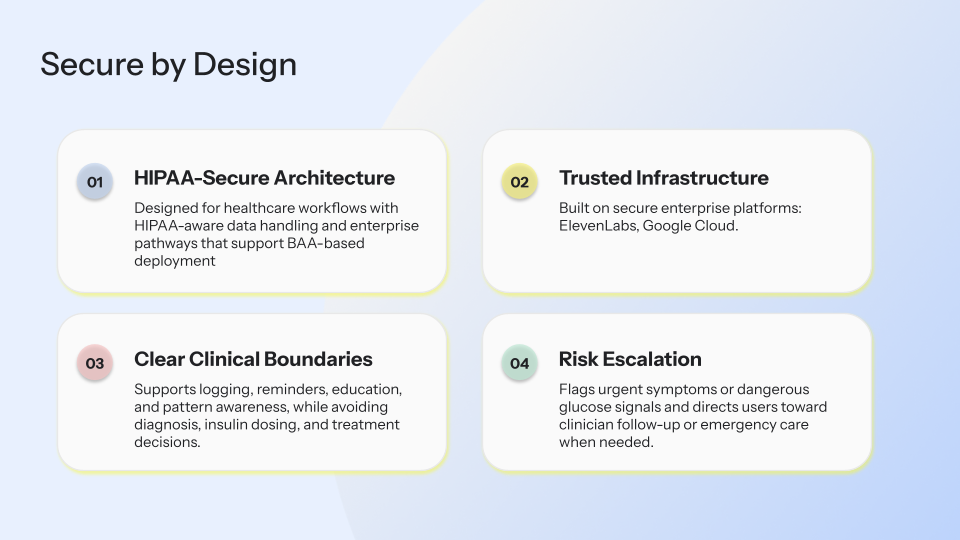
The hardest part was building something clinically credible, practically useful, and still simple enough to feel light for the user. Diabetes care spans many domains at once, including glucose, medications, meals, exercise, sleep, preventive screening, and specialist follow-up, so there was a constant risk of building something too broad and too shallow. We had to stay disciplined and focus on the clearest value proposition, which is follow-through. Another challenge was defining the safety boundary. In healthcare, it is easy for an AI system to sound confident beyond its role, so we had to be explicit that DiaBuddy can support tracking, reminders, summaries, and education, but cannot diagnose conditions or make medication dosing decisions. We also had to think carefully about interoperability because manual logs, wearables, CGMs, and clinical systems all represent health information differently.
Accomplishments that we're proud of
We are proud that DiaBuddy is not just another health chatbot with generic advice. It is a workflow system that turns conversation into structured action, preserves continuity over time, and focuses on one of the most important operational gaps in chronic care: helping people actually follow through. We are also proud of the product design because it starts fast, asks for only what is needed, and gives the user immediate value instead of burdening them with setup. The system combines low-friction interaction, longitudinal memory, safety-aware logic, and integration-ready architecture in a way that feels practical rather than theoretical. For a hackathon project, that level of product clarity and clinical grounding is something we see as a real strength.
What we learned
We learned that the most valuable healthcare AI is often the one that reduces friction around actions people already know they should take. In diabetes, the challenge is often not awareness but consistency, which means a good system has to make daily care easier to do, easier to remember, and easier to review over time. We also learned that memory is central to chronic disease support because isolated conversations have limited value unless the system can connect them into trends, routines, and unresolved issues. On the product side, we learned that restraint matters. Short prompts, one clear next step, and progressive onboarding create a much better experience than trying to collect everything upfront. On the technical side, separating conversation, structured extraction, persistent state, and downstream actions made the system much stronger and much more realistic.
What's next for DiaBuddy
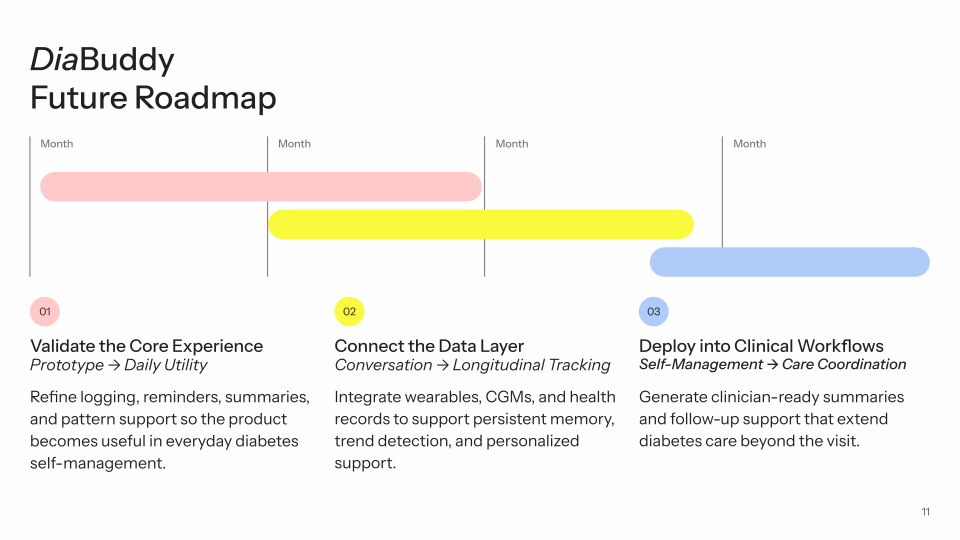
The next step for DiaBuddy is to move from a strong prototype into a connected daily care platform with deeper memory, richer pattern detection, and tighter data integration. We want to strengthen the longitudinal layer so the agent can track recurring patterns across glucose, meals, medications, exercise, and sleep, and generate more clinically useful summaries for primary care, endocrinology, and eye care visits. We also want to connect directly with platforms such as Apple Health, Dexcom, and SMART on FHIR so the system can combine patient-reported information, device data, and clinical context in one workflow. Longer term, we see DiaBuddy as a scalable care companion for chronic disease management that starts with diabetes and expands toward broader support for everyday follow-through, preventive care, and better continuity between patients and clinicians.
Built With
- agent
- apis
- claude
- dexcom
- elevenlabs
- emr
- fhir
- fitbit
- gradio
- healthkit
- huggingface
- ispeech-text-to-speech
- liveperson-agent
- llm
- multimodal
- oura
- python
- speech-to-text


Log in or sign up for Devpost to join the conversation.