-
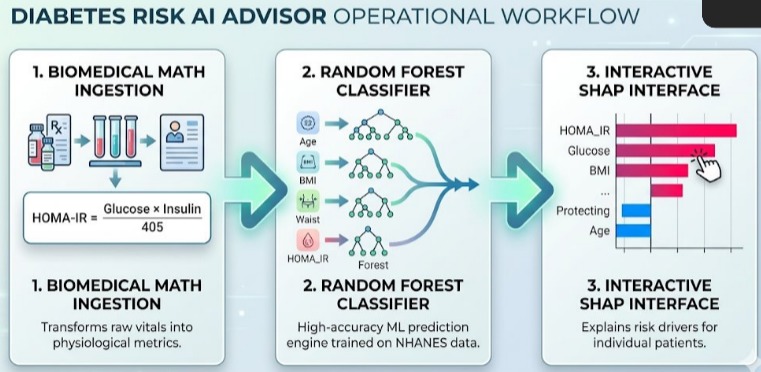
Workflow
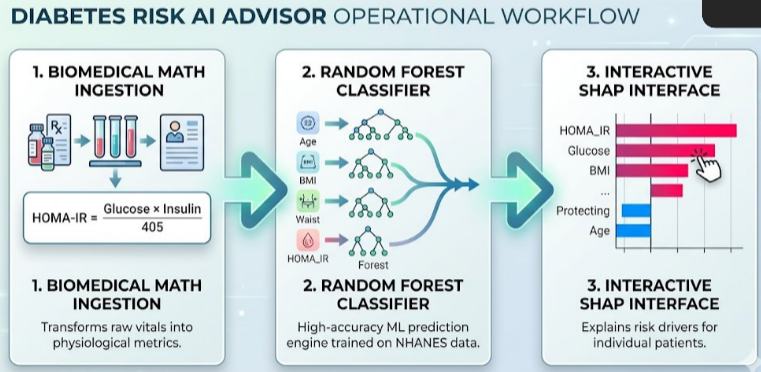
Inspiration
The Problem: Diabetes is a growing global health crisis, often diagnosed too late after complications have already developed.
The Gap: Healthcare providers and individuals lack accessible, proactive, and intelligent early-warning tools to evaluate individual risk factors before clinical onset.
Our Goal: To build a next-generation Clinical Decision Support System (CDSS) that leverages artificial intelligence to predict diabetes risk accurately, offer actionable insights, and assist clinicians in early intervention.
What it does
Predictive Risk Assessment: Analyzes clinical data, demographic factors, and health metrics to estimate an individual's risk of developing diabetes.
Interactive AI Advisor: Provides clinical decision support by highlighting key risk factors and recommending proactive measures or diagnostic tests.
Streamlined Workflow Integration: Features an intuitive interface designed for seamless use by medical professionals and patient-facing workflows.
How we built it
Data Ingestion & Preprocessing: Cleaned, normalized, and structured health datasets to prepare features such as glucose levels, BMI, age, and family history.
Machine Learning Pipeline: Trained predictive algorithms (classification models) to identify risk patterns with high sensitivity and specificity.
System & UI Architecture: Developed a user-friendly frontend interface for inputting patient data and integrated backend ML models to return real-time risk scores and visual analytics.
Challenges we ran into
Data Imbalance & Quality: Handling missing medical parameters and balancing datasets to avoid prediction bias toward certain demographic groups.
Interpretability vs. Accuracy: Balancing complex, high-accuracy machine learning algorithms with the need for clear, explainable AI (XAI) feature importance for clinicians.
Workflow Integration: Designing a clean user interface that fits into real-world clinical decision-making without adding complexity for healthcare users.
Accomplishments that we're proud of
Successfully building an end-to-end working prototype with interactive visual insights and clear risk breakdowns.
Translating complex clinical indicators into an actionable, user-friendly Clinical Decision Support System dashboard.
Demonstrating high model accuracy while prioritizing explainability for risk drivers.
What we learned
Explainability is Essential in Healthcare AI: High accuracy alone is not enough; clinicians must understand why the AI generated a specific risk evaluation.
Feature Engineering Matters: Proper normalization and selection of critical clinical parameters significantly improve model reliability over raw data alone.
User-Centric Design for Health Tech: Designing simple, intuitive UI workflows is critical for seamless adoption by healthcare providers.
What's next for Diabetes Risk AI Advisor
EHR/EMR Integration: Connect with standard Electronic Health Record systems (such as Epic or Cerner) via FHIR APIs for real-time patient data sync.
Longitudinal Tracking: Add patient progress tracking over time to monitor how lifestyle changes or preventative treatments affect risk scores.
Multi-Condition Risk Expansion: Expand the AI model to assess related metabolic and cardiovascular co-morbidities (e.g., hypertension, metabolic syndrome)
Built With
- python
- shap
- streamlit

Log in or sign up for Devpost to join the conversation.