-
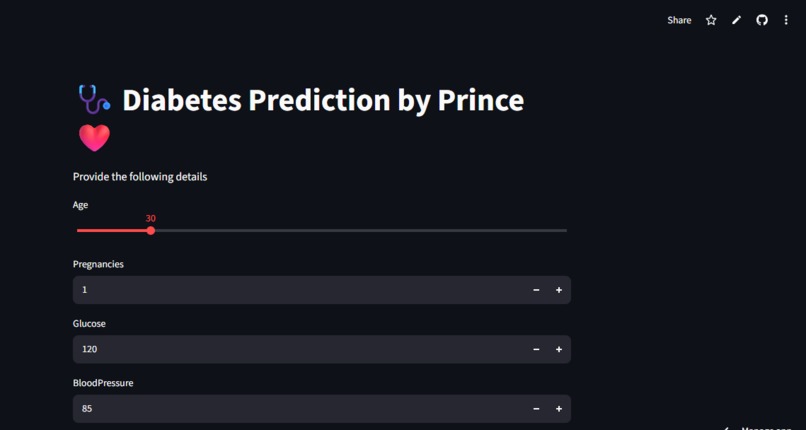
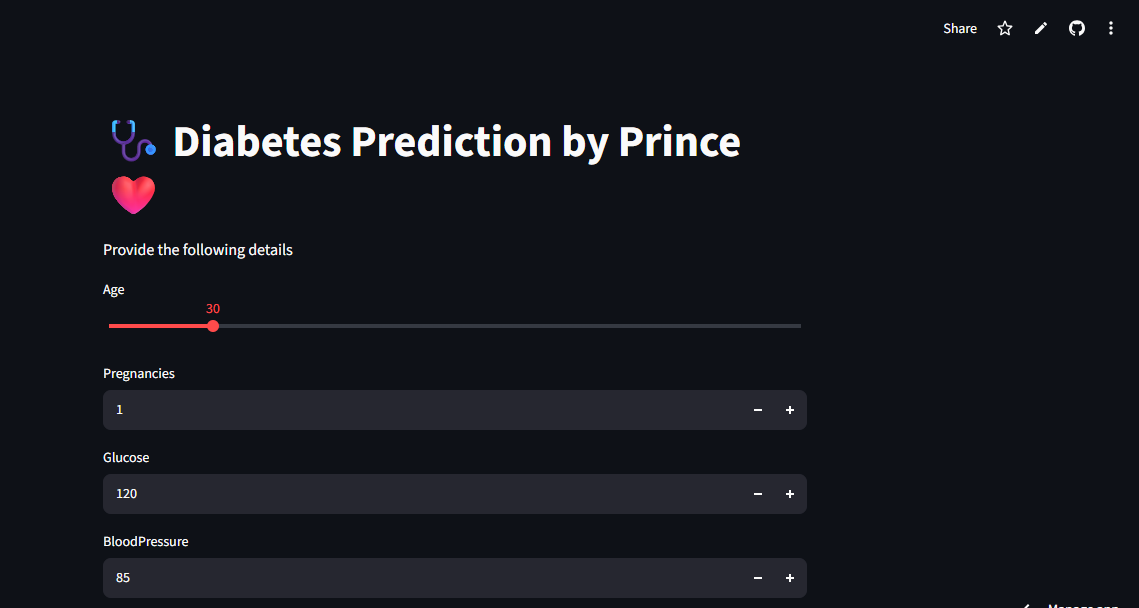
Diabetes Prediction by Prince
Inspiration
Diabetes often goes undiagnosed for years because early symptoms are easy to miss, and many people don't get regular screening. We wanted to build something simple that lets anyone check their risk in under a minute using a few common health measurements, so they know when to see a doctor. [Add one personal line here if you have one, e.g. a family member or a statistic that motivated you.]
What it does
Diabetes Prediction is a web app that takes a few health inputs (such as [glucose level, BMI, age, blood pressure, insulin]) and uses a machine learning model to estimate whether the person is at risk of diabetes. The result appears instantly with [a probability score / risk label]. It is a screening aid, not a medical diagnosis.
Live demo: https://diabetes-prediction-app-ncxesbdnsv2niokyt5boow.streamlit.app/
How we built it
- Data: [dataset name, e.g. the Pima Indians Diabetes dataset], cleaned by [handling missing or zero values, scaling, etc.]
- Model: We compared [Logistic Regression, Random Forest, etc.] and chose [final model] based on [metric].
- Evaluation: The final model reached [accuracy / recall / ROC-AUC], measured on a held-out test set. For example:
$$\text{Recall} = \frac{TP}{TP + FN}$$
We focused on recall because missing a person who is at risk costs more than a false alarm.
- App: Built with Python, scikit-learn, pandas and Streamlit, and deployed on Streamlit Community Cloud.
Challenges we ran into
- Dealing with [missing or unrealistic values, e.g. zeros in glucose or BMI] in the data
- Handling [class imbalance] so the model didn't just predict the majority class
- Balancing accuracy against simplicity, so the app stays fast and easy to use
- [Deployment issue you hit, e.g. dependency versions or model loading on Streamlit Cloud]
Accomplishments that we're proud of
- A working, publicly accessible app, not just a notebook
- [Your best metric] on unseen data
- A clean interface that a non-technical person can use without instructions
- Taking the project end to end: data, model, and deployment
What we learned
- How the full ML workflow fits together, from preprocessing and model selection to deployment
- Why the metric matters: accuracy alone can be misleading in medical screening
- How to turn a model into a usable product with Streamlit
- [Anything else, e.g. feature importance, cross-validation, working in a team]
What's next for Diabetes Prediction Project
- Train on larger, more diverse datasets to improve generalisation
- Add explainability (e.g. SHAP) so users see which factors drove their result
- Add personalised lifestyle and diet suggestions based on the result
- Support more languages and mobile-friendly design to reach more people
- Validate with medical professionals before any real-world use
Built With
- datacleaning
- machine-learning
- numpy
- pnadas
- python
- pythonlibraries
- scikit-learn
- strealit


Log in or sign up for Devpost to join the conversation.