-
-
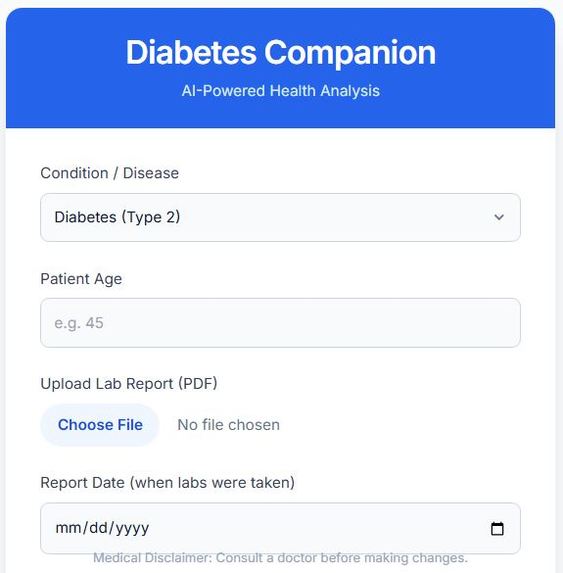
Landing Page
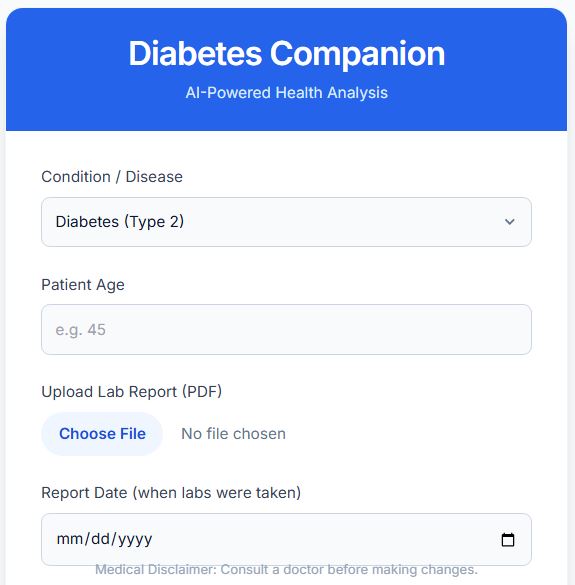
Inspiration
The inspiration for Diabetes Companion is deeply personal. Growing up, I watched my mother navigate the complexities of chronic illness. While the physical symptoms were difficult, the administrative and cognitive burden was often just as overwhelming.
Our kitchen table was frequently covered in stacks of medical papers—lab reports, prescriptions, and discharge summaries. I vividly remember her anxiety when she couldn't find a specific past report to compare with a new one, or her confusion when trying to decipher medical jargon and numerical reference ranges.
I realized that my mother wasn't alone. According to the CDC, nearly 9 out of 10 adults struggle with health literacy. I built Diabetes Companion to bridge that gap, acting as the intelligent, organized, and empathetic assistant I wish my mother had from the start.
What it does
Diabetes Companion is a Human-Centered AI tool that makes health data understandable and actionable.
PDF Analysis: Users upload complex medical lab reports (PDFs).
AI Translation: The app uses Claude AI to read the report and generate a plain-language summary, explaining what the numbers actually mean in simple terms.
Trend Tracking: It automatically extracts critical metrics like HbA1c and plots them on an interactive chart, helping users visualize how their health changes over time.
Q&A Chat: Users can ask the AI follow-up questions about their report (e.g., "Why is my glucose high?" or "What foods should I avoid?") in a safe, judgment-free zone.
How we built it
We built a full-stack web application centered around accessibility and data privacy:
Frontend: We used HTML5 and Tailwind CSS for a clean, responsive interface, and Chart.js to render the health trend visualizations.
Backend: The server is built on Node.js and Express, handling file uploads and API orchestration.
AI Engine: We integrated the Anthropic Claude API. We chose Claude for its strong reasoning capabilities and ability to handle large context windows (vital for reading dense medical reports).
Data Processing: We used
pdf-parseto extract raw text from uploaded documents before sending it to the AI for analysis.Database: Supabase (PostgreSQL) is used to securely store user profiles, parsed reports, and chat history.
Challenges we ran into
The biggest challenge was the shift in mindset required for the build. I am a Mechanical Engineer by training, not a software developer. I am accustomed to physical systems, thermodynamics, and CAD—where constraints are physical and immutable.
Transitioning to the fluid logic of software development was a steep learning curve. Concepts like asynchronous programming, handling API states, and managing database schemas were completely new to me. I spent hours debugging CORS errors and figuring out how to properly pass data from the backend to the frontend charts. However, approaching the code with an engineer's problem-solving framework helped me break down these complex software problems into manageable components.
Accomplishments that we're proud of
Bridging the Skill Gap: Successfully building a functioning full-stack application despite having limited coding experience.
The "Translation" Quality: Seeing Claude successfully take a dense, confusing medical paragraph and turn it into a sentence my mom could understand was a huge win.
Visualizing the Invisible: Getting the Chart.js visualization to work dynamically with uploaded data felt like a breakthrough—turning abstract numbers into a tangible trend line.
What we learned
The Power of API Integrations: I learned how powerful tools like Claude and Supabase can be; they allow a single developer to build complex, intelligent systems that would have previously required a large team.
Empathy in Design: I learned that "Human-Centered" isn't just a buzzword; it means designing for the user's worst day. The UI had to be simple enough for someone who is sick, tired, or anxious to use easily.
Full-Stack Basics: I gained a foundational understanding of how web servers, databases, and frontends communicate.
What's next for Diabetes Companion
Wearable Integration: Syncing with Apple Health or Fitbit to correlate activity data with lab results.
Multi-Language Support: Adding Spanish and Mandarin support, as non-native speakers often face the highest barriers to health literacy.
Doctor Portal: Creating a secure view for physicians to see the trends their patients are tracking, facilitating better conversations during visits.
Built With
- anthropic
- chart.js
- claude
- express.js
- html5
- node.js
- postgresql
- supabase
- tailwind


Log in or sign up for Devpost to join the conversation.