-
-
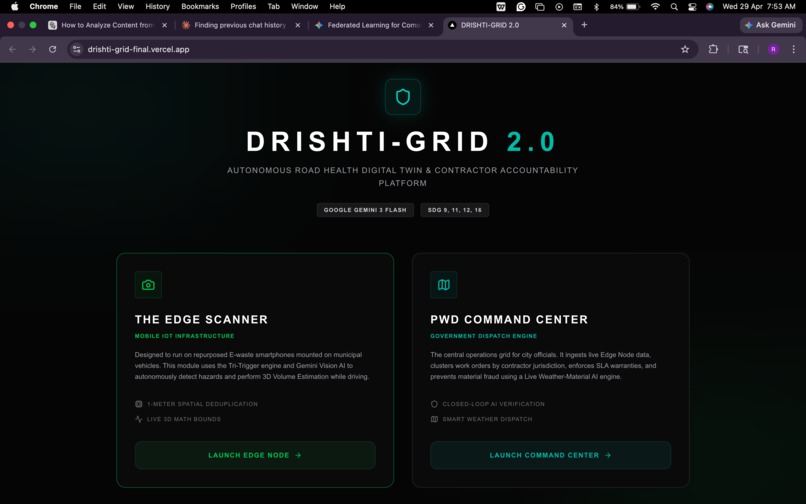
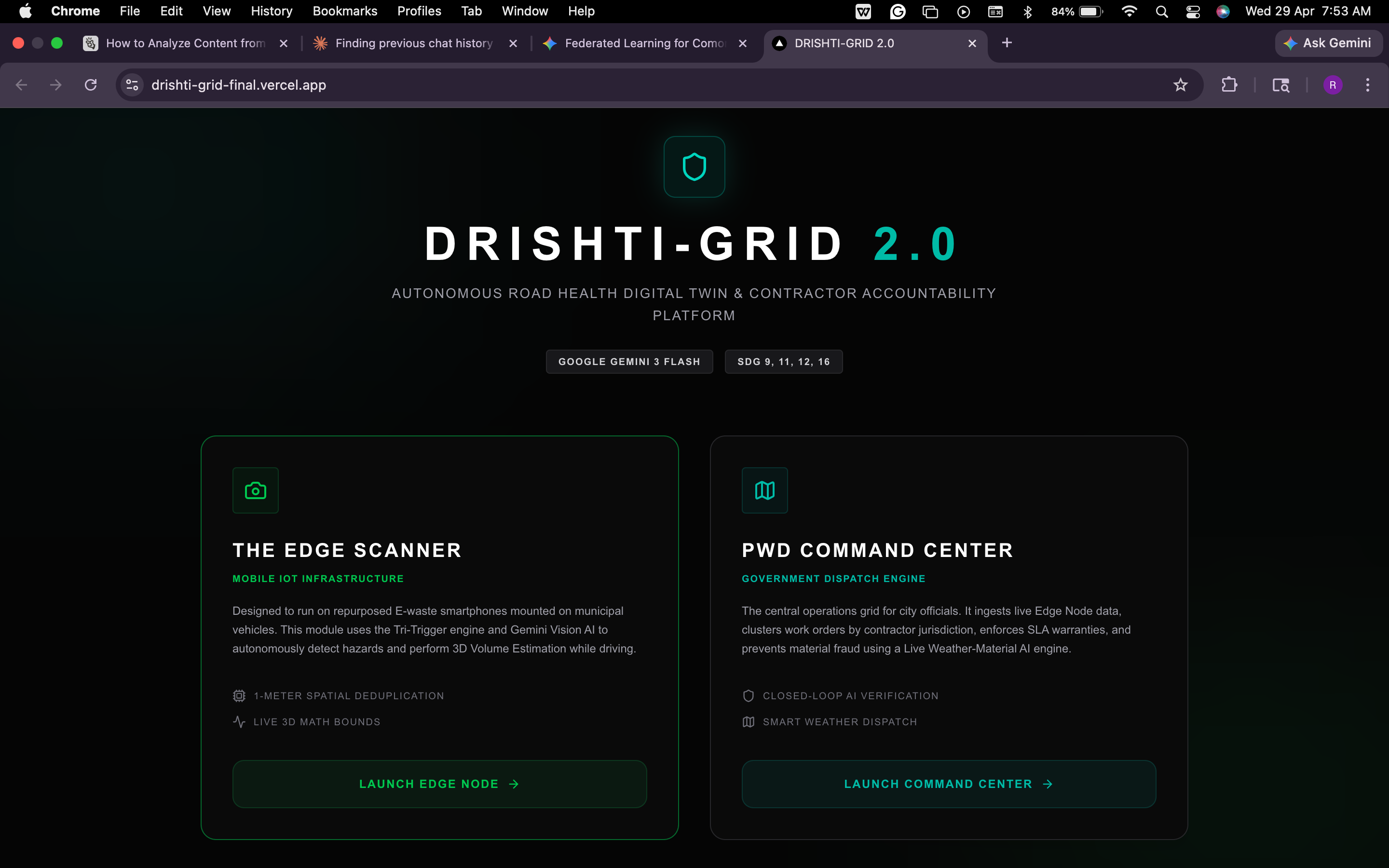
Unified Portal: Role-based access for the Mobile Edge Scanner and PWD Command Center.
-
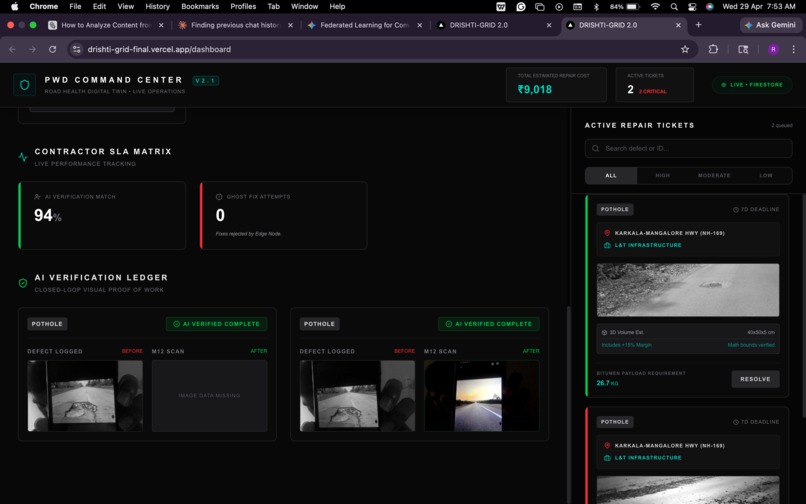
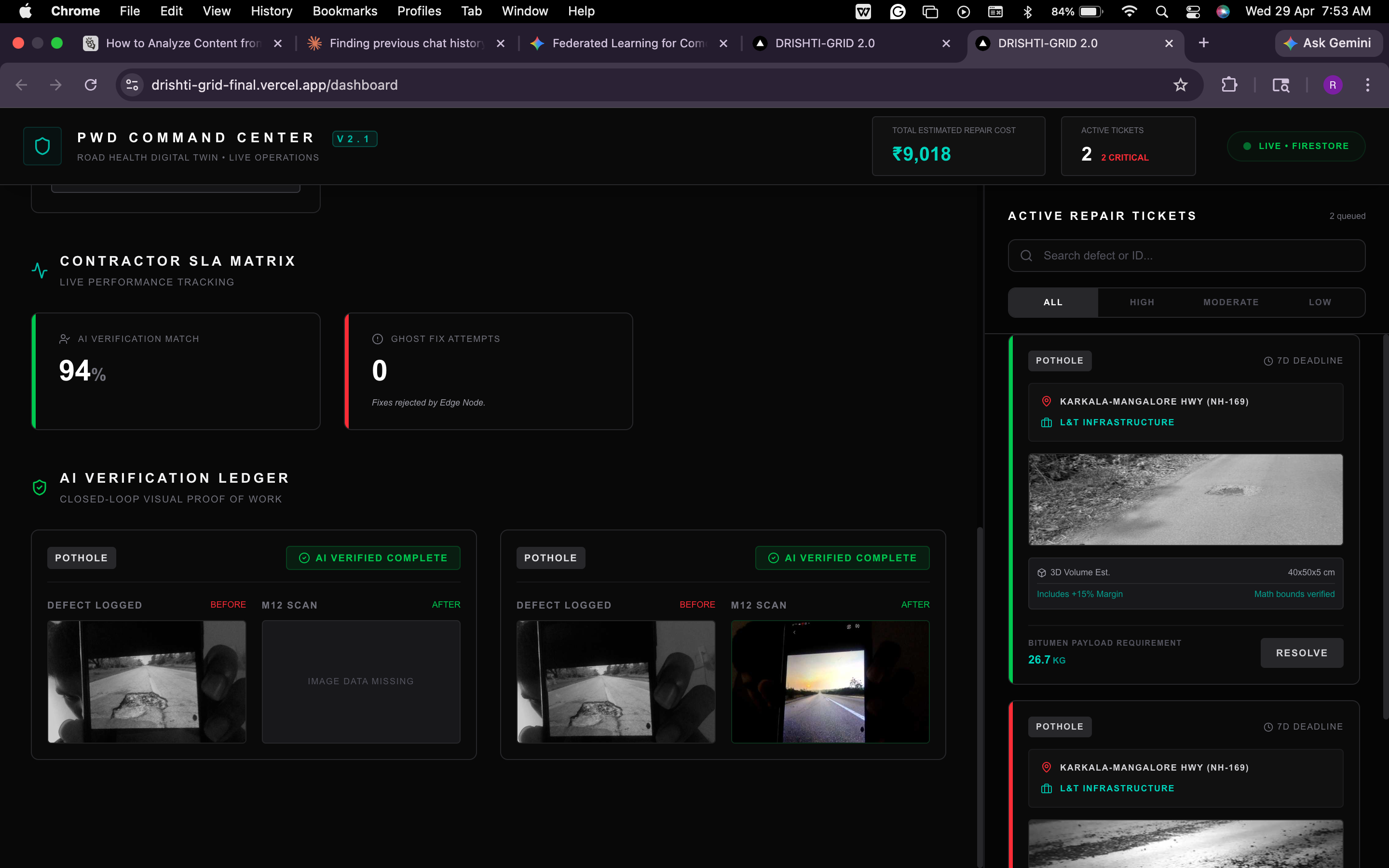
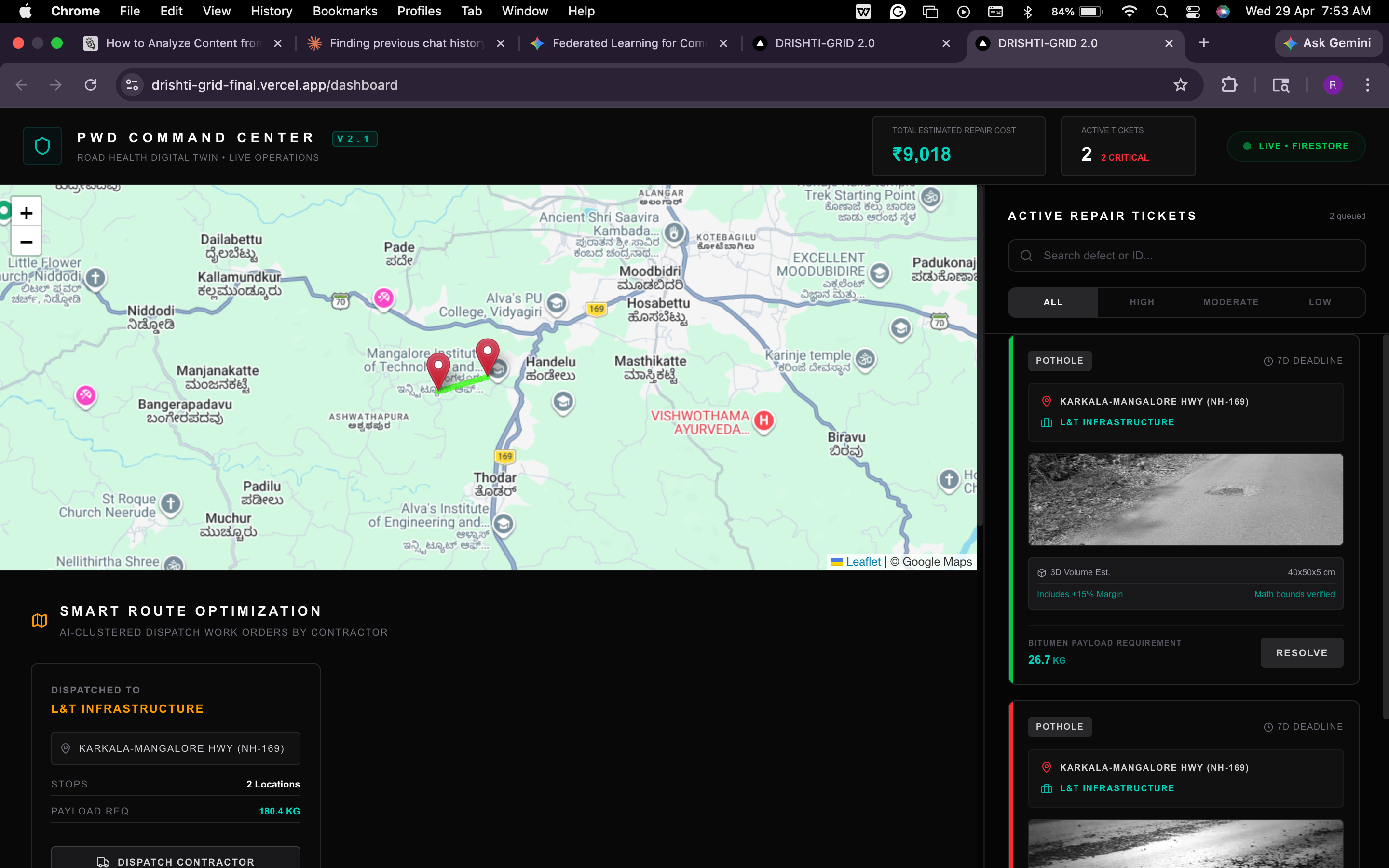
Command Center: Contractor SLA tracking, active tickets, and the AI Verification Ledger.
-
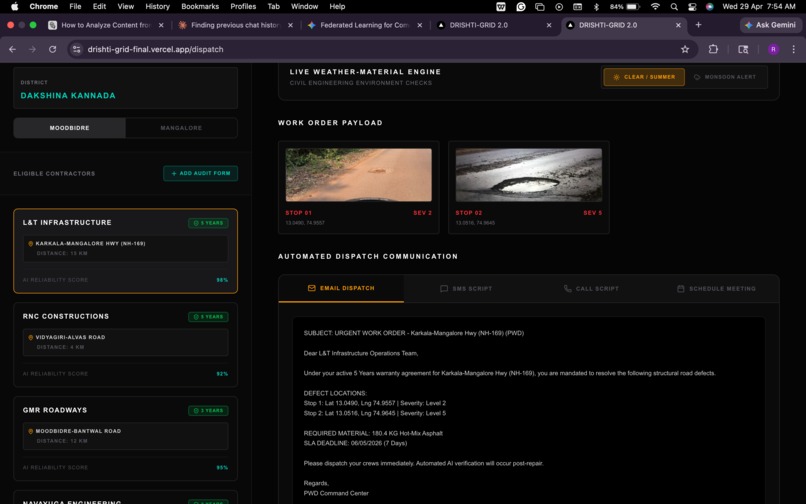
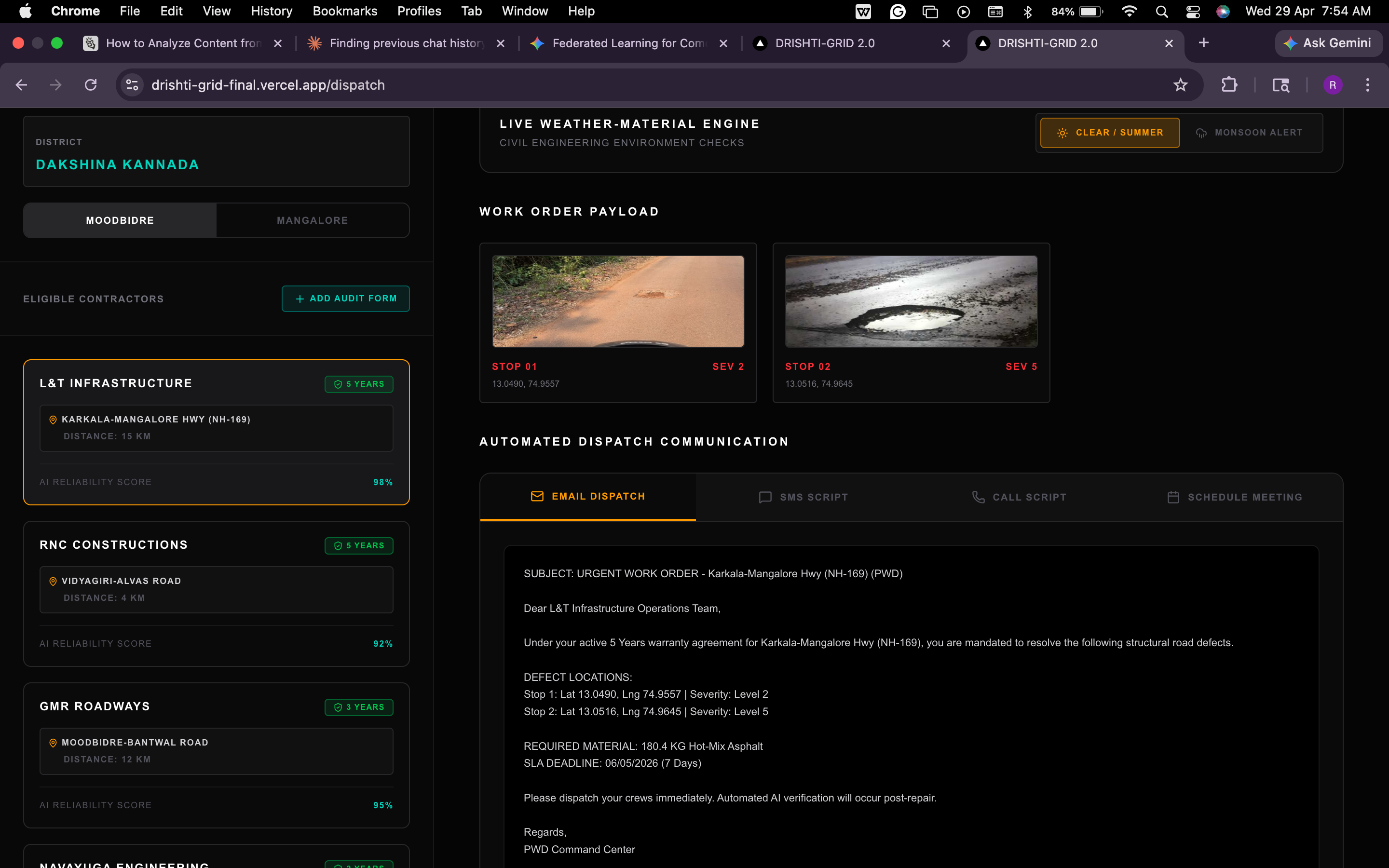
Dispatch Engine: Live weather routing, contractor mapping, and automated work order scripts.
-
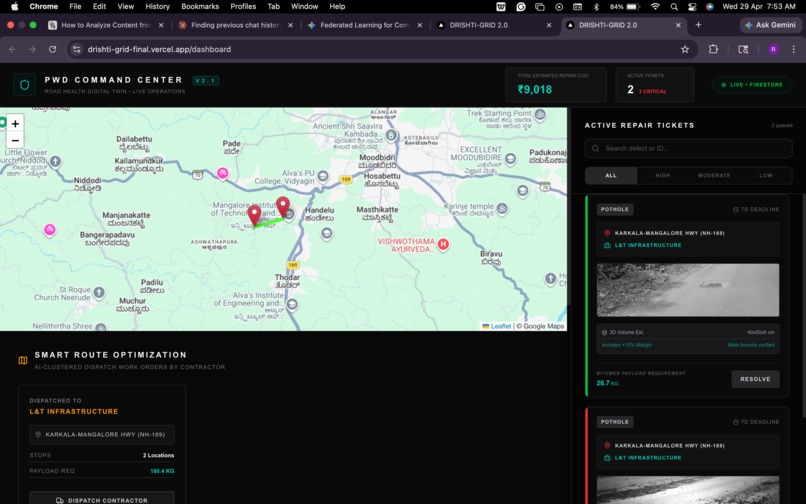
Spatial Digital Twin: Real-time geospatial mapping and AI-clustered contractor route optimization.
-
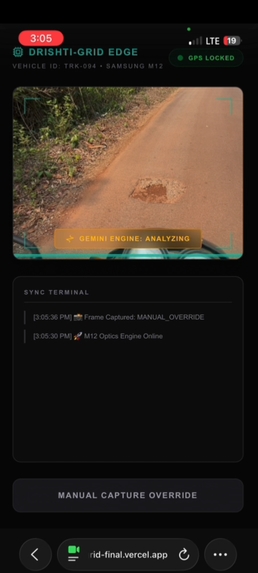
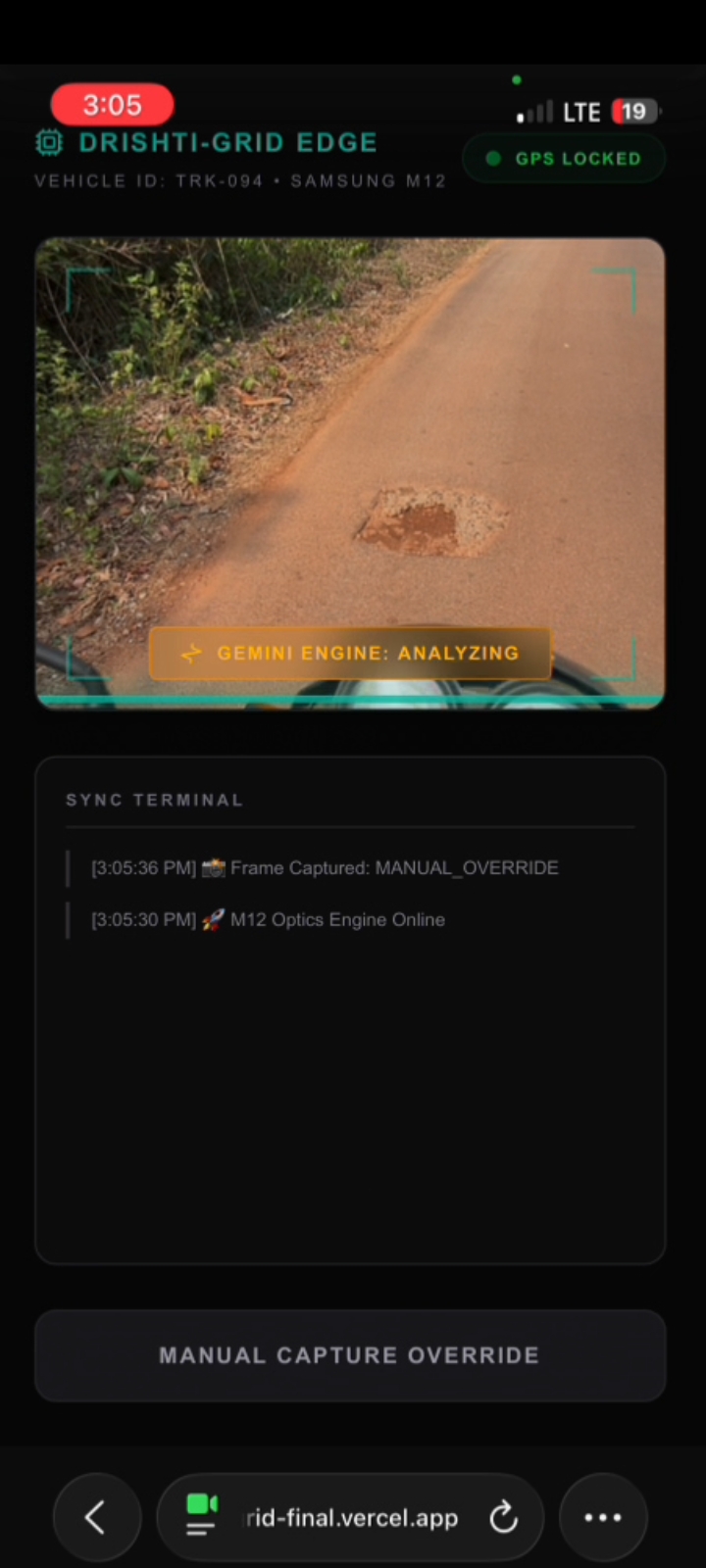
Mobile Edge Scanner: Real-time road hazard detection, GPS locking, and Gemini AI analysis HUD.
Inspiration
Modern cities face a three-front crisis. First, reactive road maintenance leads to thousands of lethal accidents every year (SDG 11.2). Second, municipal governments lose millions to "ghost fixes" and contractor material over-billing (SDG 16). Third, the world discards millions of highly capable smartphones annually, fueling an E-waste crisis (SDG 12.5).
We realized that discarded smartphones contain advanced accelerometers, GPS modules, and high-res cameras. What if we could upcycle this E-waste into a zero-cost, autonomous AI grid that holds infrastructure contractors accountable? That vision became DRISHTI-GRID 2.0.
What it does
DRISHTI-GRID 2.0 is an autonomous GovTech platform that manages the entire lifecycle of road maintenance:
- Zero-Cost Edge Sensors: Discarded smartphones (e.g., Samsung M12) are mounted on municipal garbage trucks running our Next.js PWA. They autonomously scan roads using a Tri-Trigger engine (Heartbeat & DeviceMotion jerks).
- AI Fraud Prevention: Gemini 3 Flash performs Monocular Depth Estimation on 2D images to calculate the 3D volume of the hazard, mathematically capping the raw materials a contractor can bill for.
- Smart Dispatch: The Command Center clusters work orders by contractor jurisdiction and enforces SLAs. A Live Weather Engine blocks "Hot-Mix" asphalt dispatch during monsoons, forcing temporary gravel fixes.
- Closed-Loop AI Verification: Contractors are only paid when our Edge Node re-drives the exact coordinate and the AI visually verifies the road is smooth, committing the proof to an immutable ledger.
The Math Behind the Magic (Anti-Fraud Engine)
To prevent material over-billing, we engineered Gemini to output spatial dimensions. We then apply strict civil engineering physics to calculate the maximum allowable Bitumen payload:
Standard asphalt density is roughly $2.32 \, \text{g/cm}^3$. The allowed billing payload includes a 15% safety/wastage margin:
$$ Payload (kg) = \left( \frac{Width \times Length \times Depth \times 2.32}{1000} \right) \times 1.15 $$
How we built it
- The Edge Node: A Next.js Progressive Web App (PWA) utilizing HTML5
DeviceMotionandGeolocationAPIs. - The AI Brain: Google Gemini 3 Flash Preview via a direct REST API integration for ultra-low latency multimodal processing.
- The Command Center: A unified Next.js dashboard styled with Tailwind CSS and Leaflet Maps.
- The Cloud State: Google Firebase Firestore powers the real-time NoSQL spatial sync between the Edge trucks and the Command Center.
Challenges we ran into
API Spam from Moving Vehicles: If a garbage truck gets stuck in traffic over a pothole, it would spam the AI API and database. Solution: We implemented an offline cache using the Haversine Formula to calculate Earth-sphere distances. If the new GPS coordinate is $< 1$ meter from a cached scan, the request is suppressed: $$ d = 2r \arcsin\left(\sqrt{\sin^2\left(\frac{\Delta\phi}{2}\right) + \cos\phi_1\cos\phi_2\sin^2\left(\frac{\Delta\lambda}{2}\right)}\right) $$
AI JSON Hallucinations: Large language models occasionally wrap JSON responses in markdown backticks, crashing standard parsers.
Solution: We built a surgical regex extractor rawText.match(/\{[\s\S]*\}/) inside our REST call to guarantee crash-free parsing in the mobile environment.
Accomplishments that we're proud of
- Achieving a $0.00 Hardware Deployment Cost by proving that discarded E-waste can run enterprise-grade IoT edge computing.
- Successfully engineering an AI prompt capable of reliable Monocular Depth Estimation for financial bounding.
- Building a beautiful, device-aware Unified Dashboard with strict Role-Based Access Control (RBAC).
What we learned
- Advanced prompt engineering for spatial reasoning and structured JSON output.
- Managing real-time web-socket streams via Firebase in a Next.js App Router environment.
- The civil engineering constraints of road repair (e.g., weather-dependent material selection).
What's next for DRISHTI-GRID
- OBD2 Telemetry Integration: Connecting the Edge Node directly to the truck's computer to dynamically adjust camera capture rates based on vehicle speed.
- Citizen WhatsApp Grid: Launching a crowdsourced pipeline where citizen photos enter an AI Verification Quarantine before hitting the PWD dashboard.
- Smart Contracts: Migrating the Verification Ledger to the blockchain for automated, tamper-proof contractor payouts.
Built With
- firebase
- firestore
- google-gemini
- html5-apis
- leaflet.js
- next.js
- react
- tailwind-css
- typescript


Log in or sign up for Devpost to join the conversation.