-
-
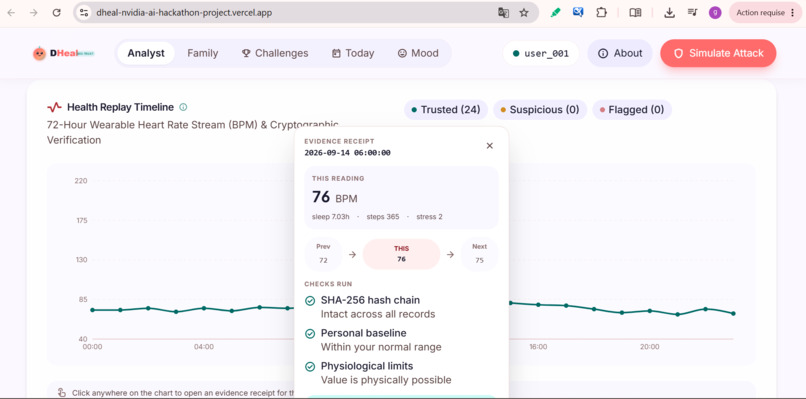
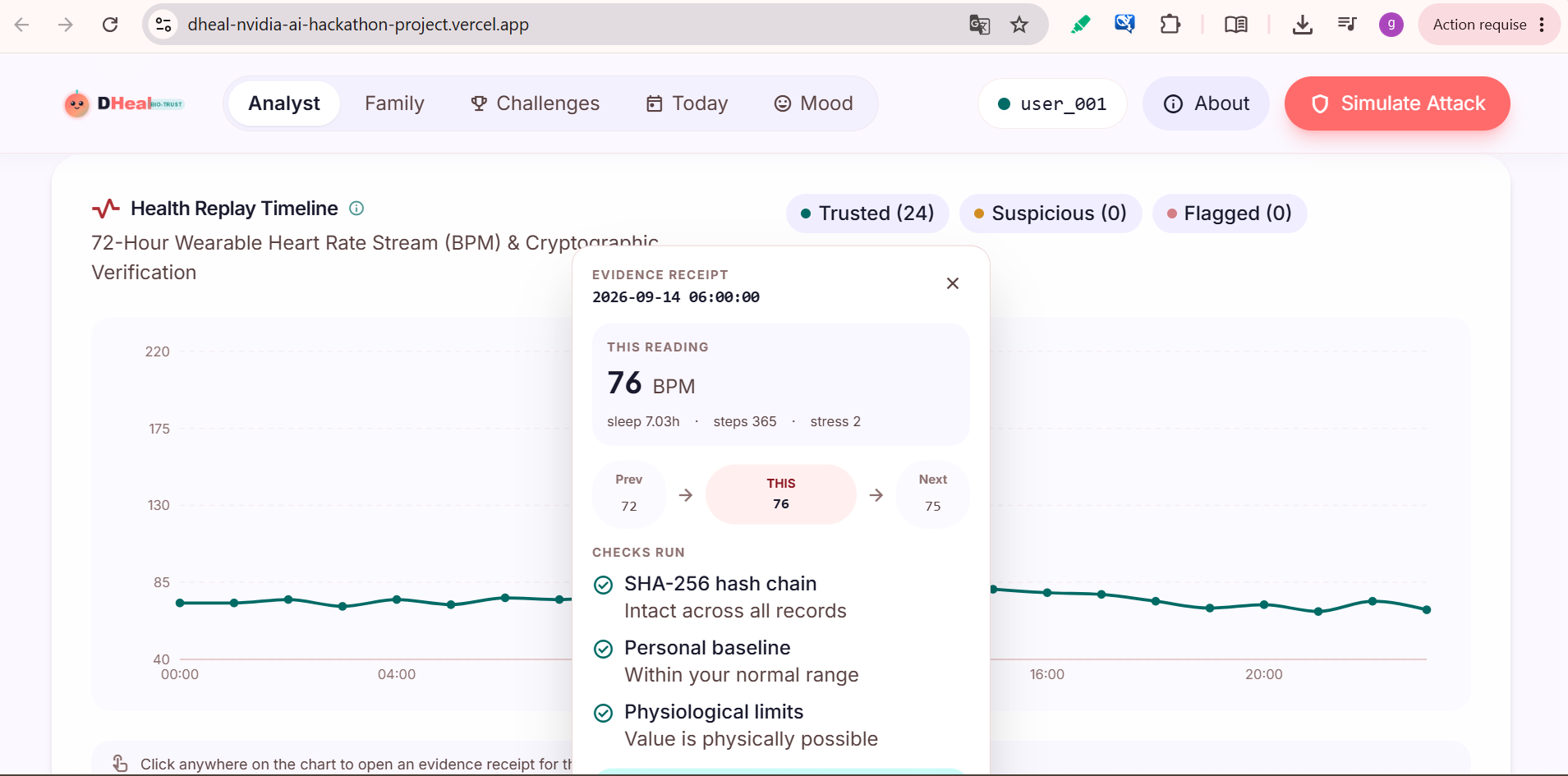
Evidence receipt: SHA-256 hash chain, baseline check, and trust verdict for every reading.
-
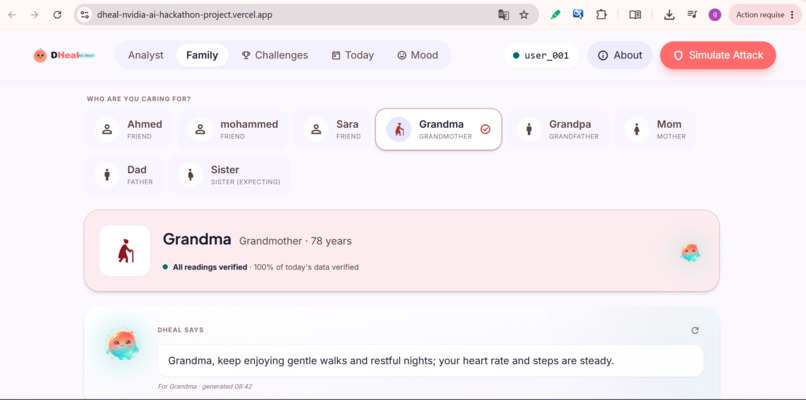
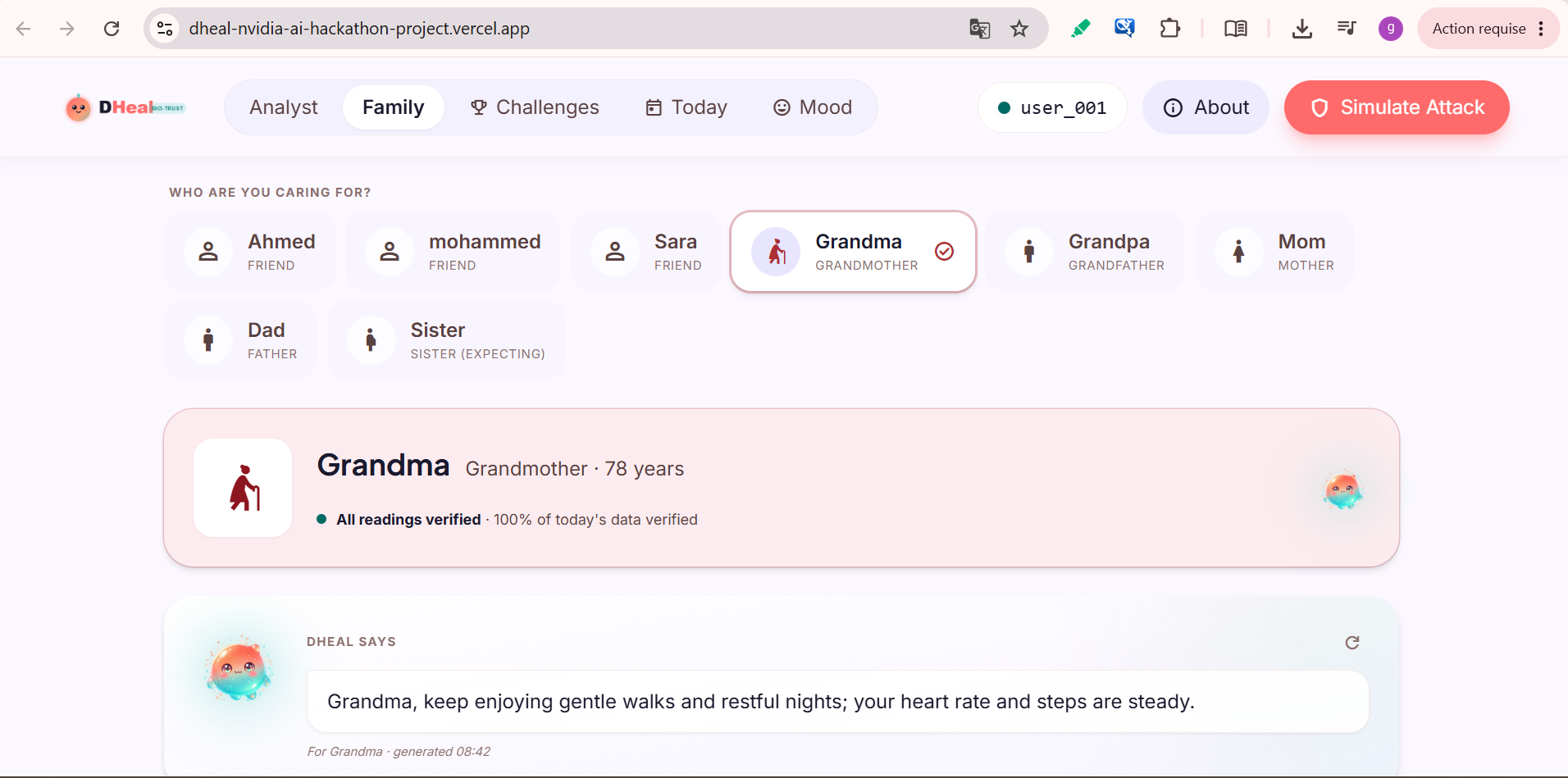
Five family members, one dashboard. Each with their own conditions and data.
-
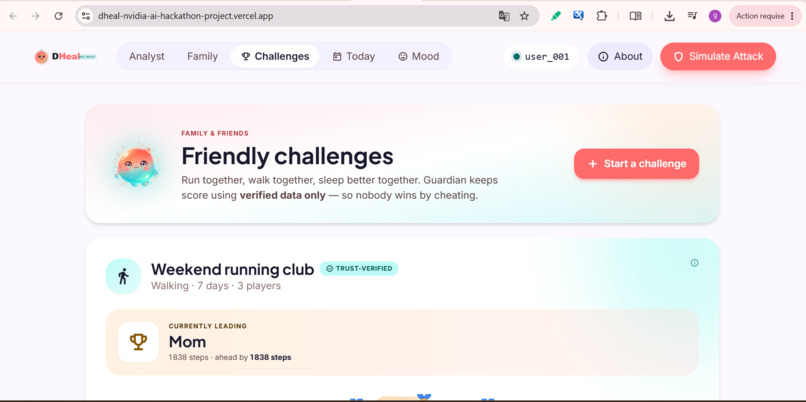
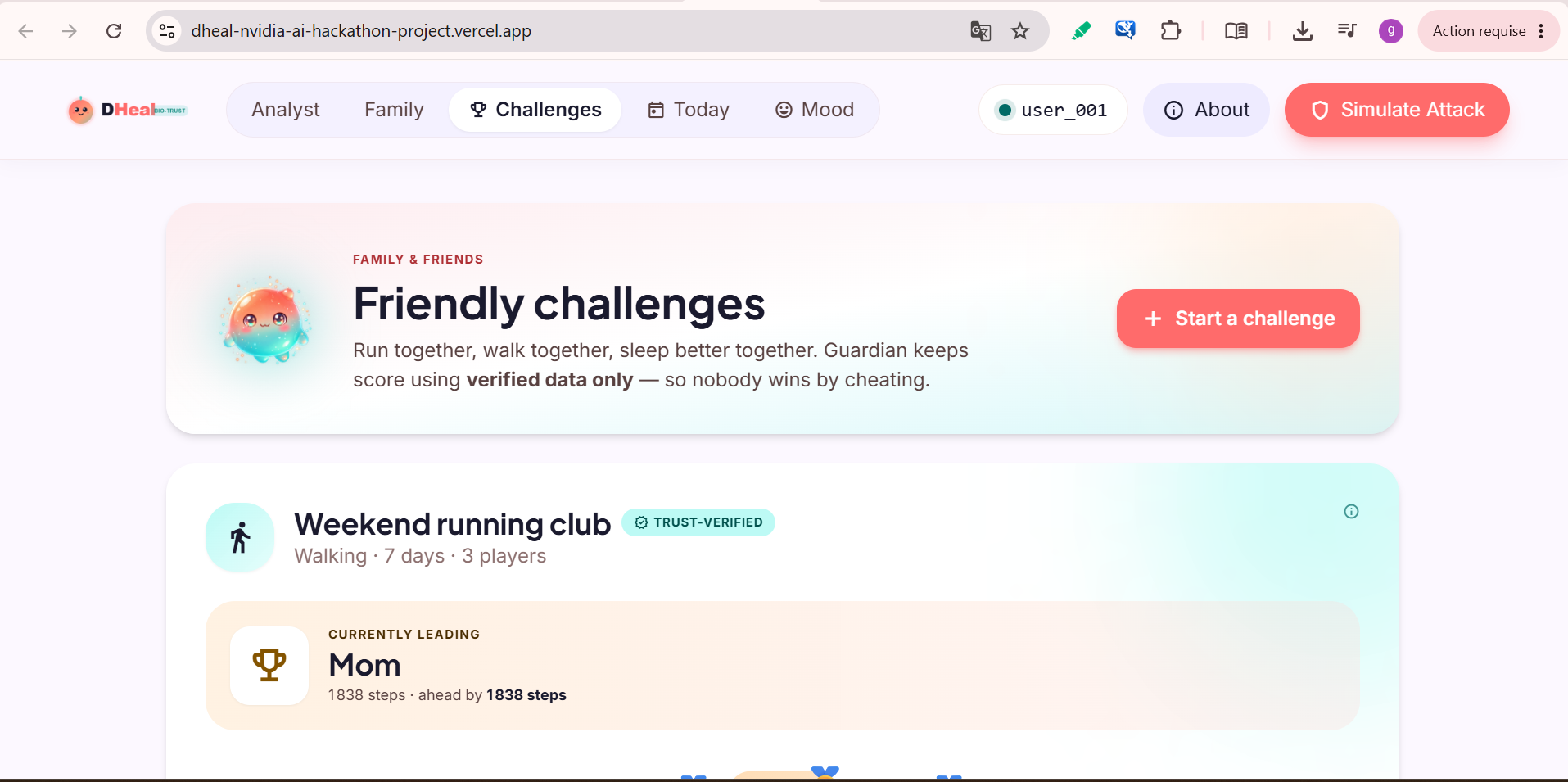
Trust-verified leaderboard. Cheating is detected and excluded automatically.
-
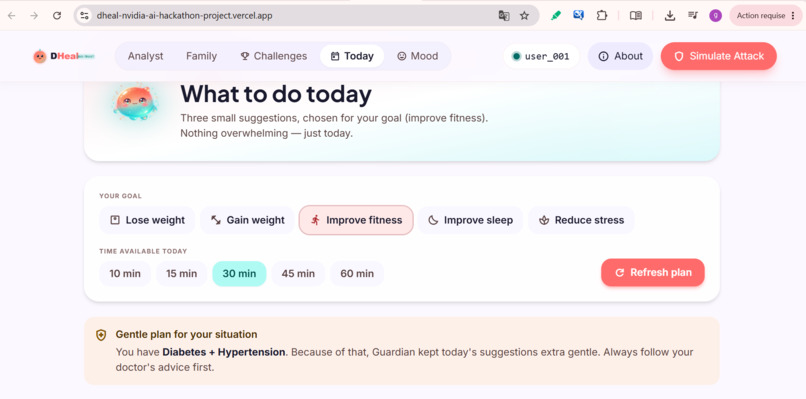
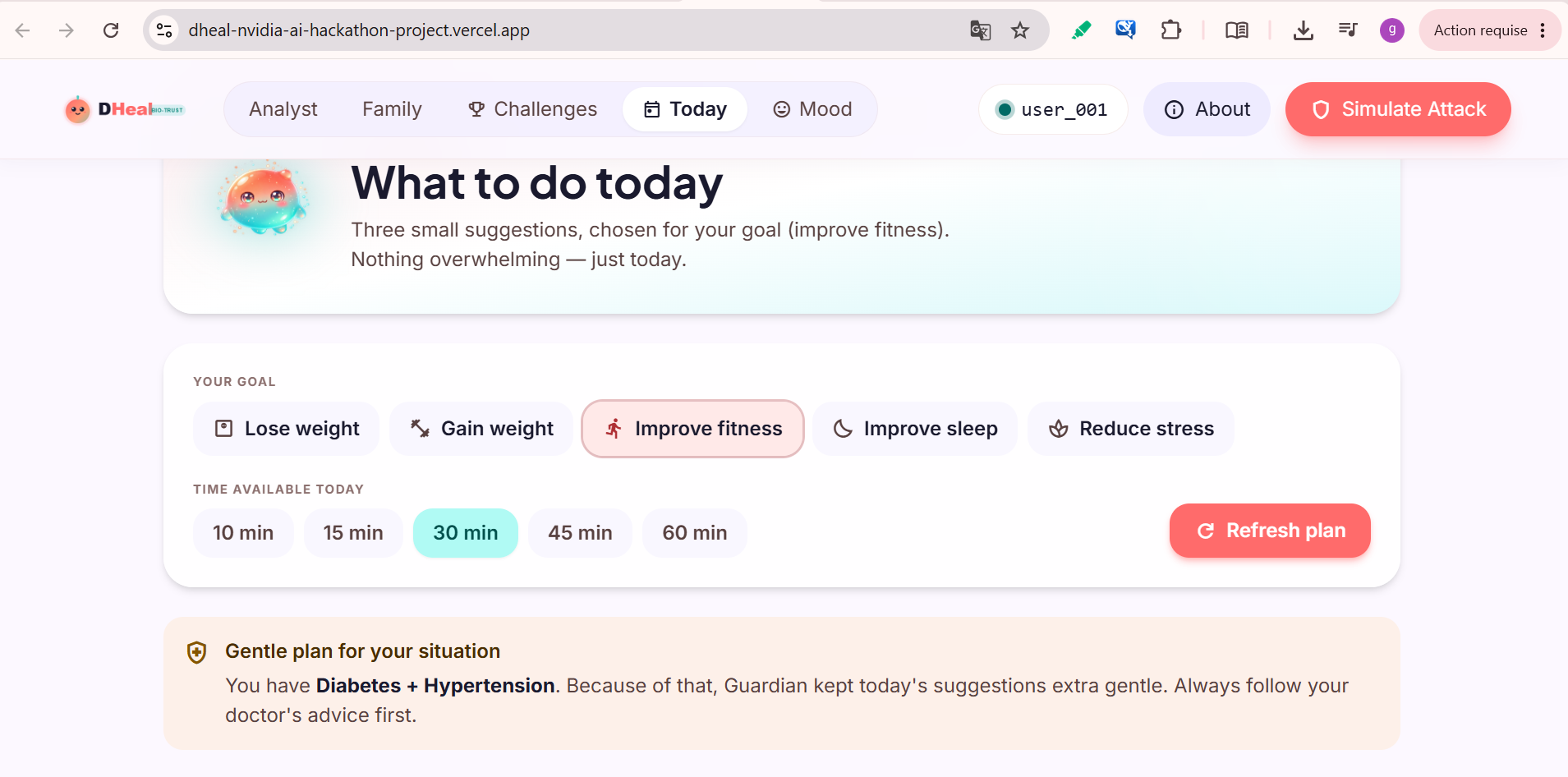
Nemotron generates a personalized daily plan. Condition-aware and gentle.
-
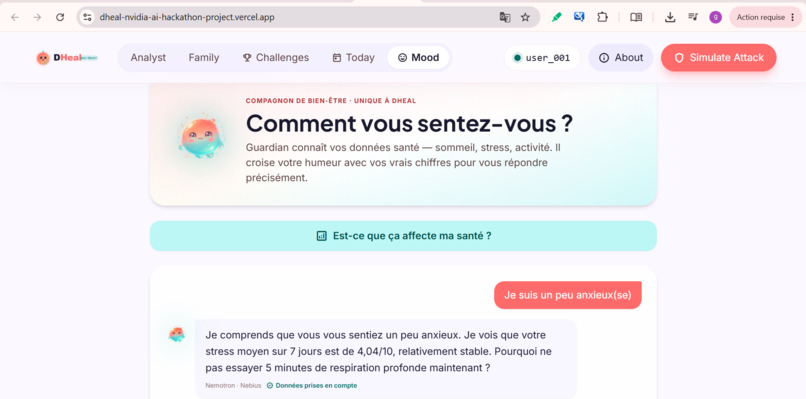
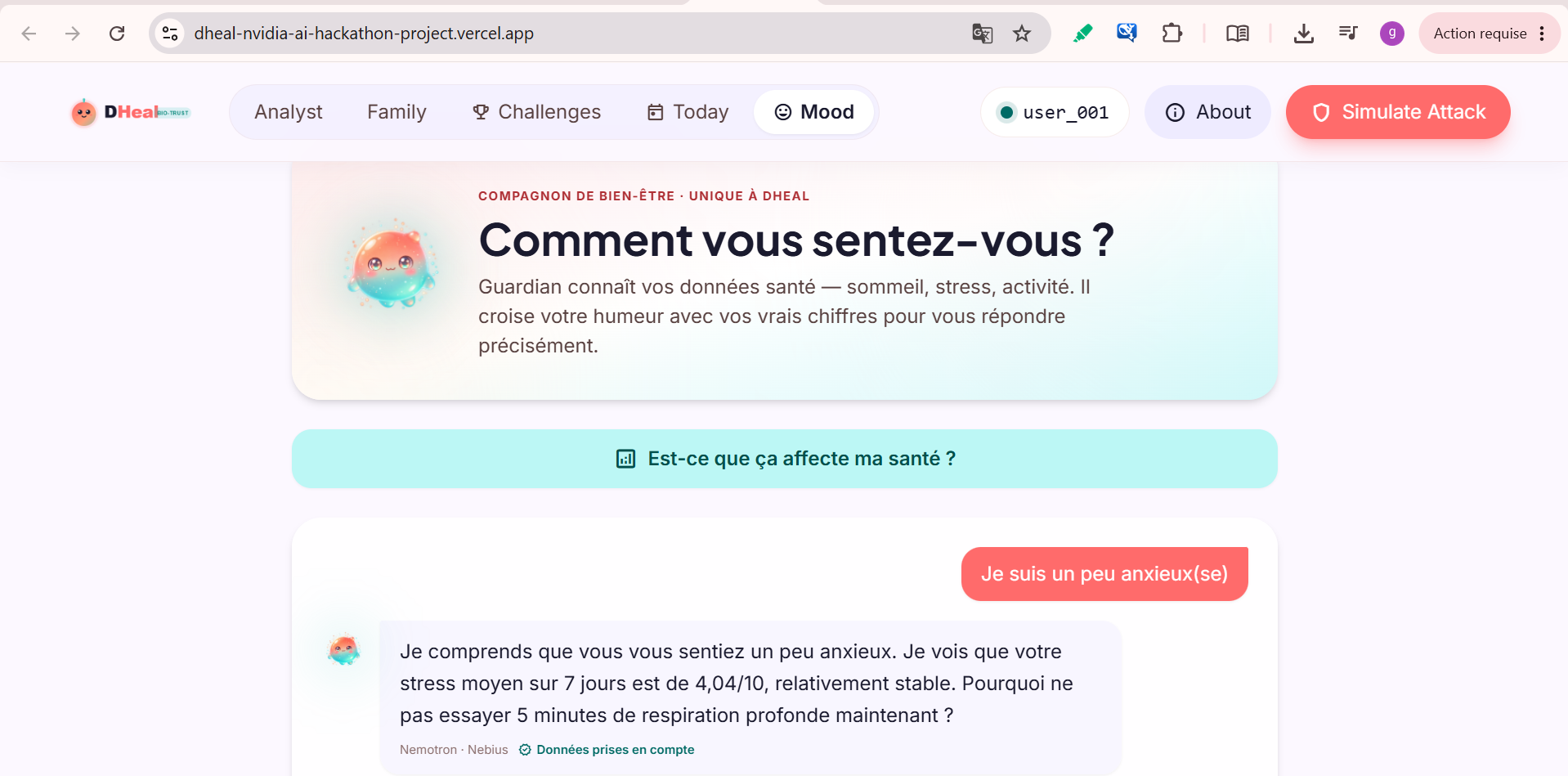
Bilingual mood chat that cross-references emotions with real health data.
Inspiration
Health AI has a fundamental problem: it assumes the data it receives is accurate. Every major product — Whoop, Oura, Apple Health, Google Health AI — reasons over sensor data without asking whether that data can be trusted. A loose watch strap, a low battery, a deliberate sensor injection, or a device sync error can produce readings that look real but are clinically meaningless, and yet LLMs happily reason over them and produce confident-sounding conclusions. The idea behind DHeal is simple: before an AI is allowed to draw any conclusion from health data, that data has to prove it deserves to be trusted. We started from a personal problem — family members caring for elderly relatives can't tell the difference between "Mom's watch is acting up" and "Mom actually needs attention." A dashboard that shows raw numbers doesn't help. A dashboard that verifies first, then reasons — that helps.
What it does
DHeal is a family health platform that verifies every health reading before letting AI reason over it. Every reading is hashed with SHA-256 to detect tampering, compared against a personal baseline learned per user, and flagged as SUSPICIOUS (more than 5σ from baseline) or FLAGGED (physiologically impossible) if it doesn't pass. Only TRUSTED readings are passed to NVIDIA Nemotron, which is explicitly instructed to refuse conclusions based on unreliable data — when the key evidence is flagged, the AI's confidence drops to LIMITED and it says "I won't draw conclusions from this evidence." The platform serves five family members (Grandma, Grandpa, Mom, Dad, Sister), each with their own watch data, baseline, and health conditions, and runs six condition-specific analyzers (diabetes, hypertension, arthritis, post-surgery recovery, menopause, pregnancy) that produce cross-signal insights like "glucose spiked on low-activity days." Beyond the dashboard, DHeal includes trust-verified challenges between family and friends (fake data is automatically detected and excluded from the leaderboard), a bilingual mood support chat that cross-references emotions with real health data, personalized daily recommendations with matched workout and meal media, and a one-page doctor-visit PDF export. The single most important feature is "Simulate Attack" — with one click, a tampered heart-rate reading (198 BPM) is injected into the data, the trust layer flags it, Nemotron refuses to reason over it, and the trust score visibly falls from 100 to 82.
How we built it
DHeal is a full-stack application split into three layers. The frontend is React 19 with TypeScript, Vite, and Tailwind, featuring five distinct views (Analyst, Family, Challenges, Today, Mood), custom animations, and Recharts for all visualizations, deployed on Vercel. The backend is FastAPI on Python 3.11 with 15 route modules (AI, mood, challenges, recommendations, profiles, tracking, family, and more) and modular services for baseline computation, anomaly detection, trust scoring, condition analyzers, and challenge scoring, deployed on Render. Every reading passes through a SHA-256 hash chain and a per-user baseline check before being passed to the AI. The AI layer uses NVIDIA Nemotron (Nemotron 3 Nano for most calls, Nemotron 3.5 Lightning as a fallback for complex prompts) via the Nebius Token Factory, with strict JSON-only system prompts, defensive parsing that repairs truncated JSON, and telemetry logged for every call (latency, tokens, cost). Six condition analyzers are pure Python — no LLM involved — so their insights are deterministic and inspectable. The data model uses per-user CSV files for watch readings, per-user JSON baselines, per-user profiles with conditions and accents, and separate tracking files for self-logged data like glucose, blood pressure, pain, kicks, and weight.
Challenges we ran into
The biggest technical challenge was LLM JSON reliability. Reasoning models leak their chain-of-thought as prose before the JSON, and Nano returns empty strings on complex prompts. We solved it with a three-tier strategy: try Nano first with a strict "no prose" system prompt, retry with Lightning and a higher token limit if empty, and fall back to a rule-based curated library if both fail — the user never sees an error. The second challenge was the trust layer itself. Without real watches connected, we had to generate five distinct synthetic datasets with different baselines (Grandma at 74 BPM, Sister at 84 BPM) and simulate the full pipeline including SHA-256 hash chains, so the trust layer works identically on synthetic and real data. Multi-user personalization was harder than expected — "show 5 profiles in one dashboard" sounds easy, but every profile needs its own baseline, conditions, insights, and AI context, which pushed us toward a per-user file architecture that scales to any number of users without code changes. Crisis safety in mood support required special care: when a user says "I don't want to live anymore," the system must respond with emergency escalation language regardless of what the AI produces, so we built a keyword and pattern detector in Python that runs before the AI call and unconditionally prepends the escalation line. Finally, preventing cheating in challenges was a design problem — friends could inject fake step counts to win — and we solved it by running the trust layer's anomaly detection on every participant's data before scoring, excluding fake readings and visibly flagging the user in the leaderboard.
Accomplishments that we're proud of
The "Simulate Attack" moment is what we're most proud of: a judge clicks one button, a tampered reading is injected, and the AI visibly refuses to use it — the whole thesis of DHeal demonstrated in a single interaction. We're also proud of the trust layer working end-to-end: SHA-256 chain, per-user baseline, z-score anomaly detection, and physiological plausibility checks all combine to give every reading a TRUSTED, SUSPICIOUS, or FLAGGED verdict before the AI sees it. The six condition-specific analyzers produce real cross-signal insights, not generic warnings — "glucose 165 followed a 2,100-step day," "morning blood pressure averages 5 mmHg higher than evening," "day 8 of post-surgery tracking, 4 of 5 milestones reached," "resting HR drifted up 3 bpm this week, normal in trimester 2." The bilingual mood support works in French and English with crisis detection firing on 20+ keyword patterns in both languages, and the multi-user architecture scales from 5 profiles to any number without code changes. Most importantly, DHeal is not a demo that runs on localhost — it's a deployed product that anyone can visit at the live URL.
What we learned
Building the trust layer taught us that "verifying the data" is a fundamentally different product from "analyzing the data" — it changes every downstream design decision, from how prompts are structured to how the AI is allowed to phrase its conclusions. We learned that LLMs need explicit constraints, not implicit trust: the best AI outputs came from the strictest prompts, and freedom is the enemy of reliability in a structured-output system. Cross-signal insights turned out to be far more valuable than raw metrics — telling a user "your glucose is 165" is useless, but telling them "your glucose was 165 after a 2,100-step day, a short walk may help" is actionable, and that requires combining data sources that most apps keep separate. We learned that the demo moment matters more than the feature list: "Simulate Attack" is one button, not the most complex thing we built, but it's the one judges remember because it makes the entire product legible in 5 seconds. Multiple LLM models need multiple fallbacks — Nano is fast but fails silently, Lightning reasons more but leaks chain-of-thought, and rule-based fallbacks never fail, so the right architecture uses all three in a tiered pattern. Finally, building bilingual from day one forced us to design keyword detection, fallback libraries, and prompts with language-awareness from the start, which we now consider non-negotiable.
What's next for DHeal Bio-Trust
In the short term (2–4 weeks), we'll build an iOS and Android app that reads from HealthKit and Health Connect, integrate with Terra as an aggregator for Apple Watch, Fitbit, Garmin, Whoop, Oura, Withings, and Dexcom, migrate the backend to PostgreSQL with encryption at rest and HIPAA-grade auth, and run a real pilot with 5–10 families. In the medium term (2–3 months), we'll add a clinician dashboard where doctors see trust-verified summaries instead of raw data, build deeper condition analyzers for COPD, asthma, thyroid, and chronic pain, add parent-controlled sharing so the parent chooses what family sees, and ship an elder-friendly mode with large text, read-aloud, and a simplified UI. In the long term (6–12 months), we'll navigate the regulatory path carefully by staying out of diagnosis and keeping DHeal positioned as a trust layer and wellness companion, add multi-language support beyond French and English (Arabic, Spanish, Portuguese), expose an API for third-party health apps that want trust verification, and integrate with hospital EMR systems for post-discharge monitoring. Every health AI product today assumes the data it receives is accurate. DHeal is the first platform that verifies data integrity before allowing AI reasoning — in five years, this will be standard, and we're building it now.
Built With
- 3.5
- ai
- css
- factory
- fastapi
- lightning
- matplotlib
- nano
- nebius
- nemotron
- numpy
- nvidia
- pandas
- python
- react
- recharts
- render
- reportlab
- scikit-learn
- sha-256
- tailwind
- token
- typescript
- vercel
- vite


Log in or sign up for Devpost to join the conversation.