Dextra: Your AI can hear everyone. It should only take orders from you.
Inspiration
Vexo has 200+ connectors, but every time you ask it to do something, you still need to confirm on your phone.
That defeats the point of ambient AI.
The problem is identity. An always-on microphone hears everyone but doesn't know who's speaking. If someone next to you says "send me your investor emails," how does your AI know it wasn't you?
We built Dextra to solve this. An AI that knows who's speaking, when you're talking to it, and who is allowed to give it instructions. All with privacy and security built in.
What it does
Dextra is an on-device, speaker-aware security and interaction layer for Vexo.
- Knows who's talking. Live diarization and speaker identification with ~40 seconds of enrollment.
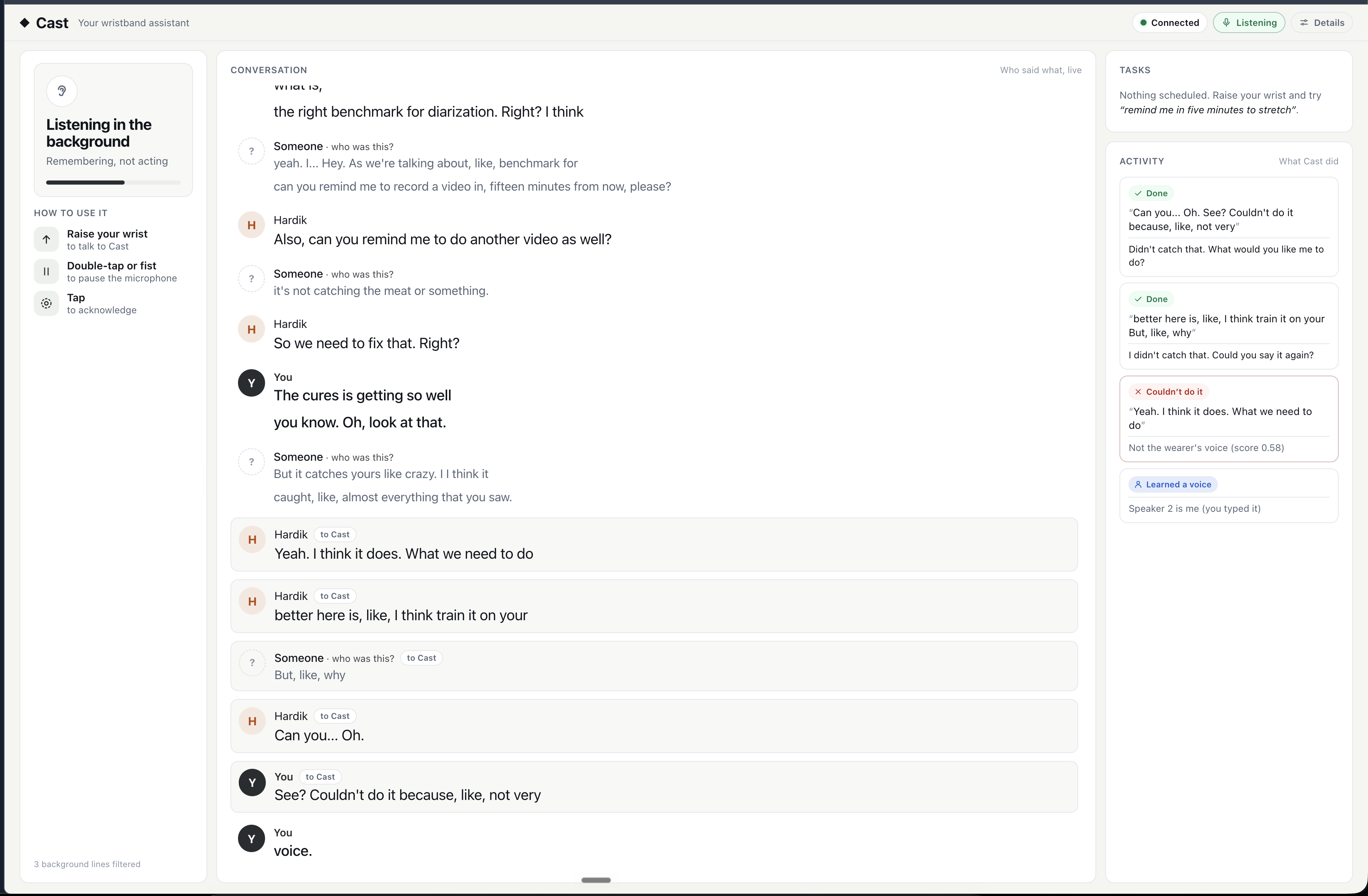
- Knows when you're talking to it. Raise your wrist to give a command. Arm down means conversation only. No wake words.
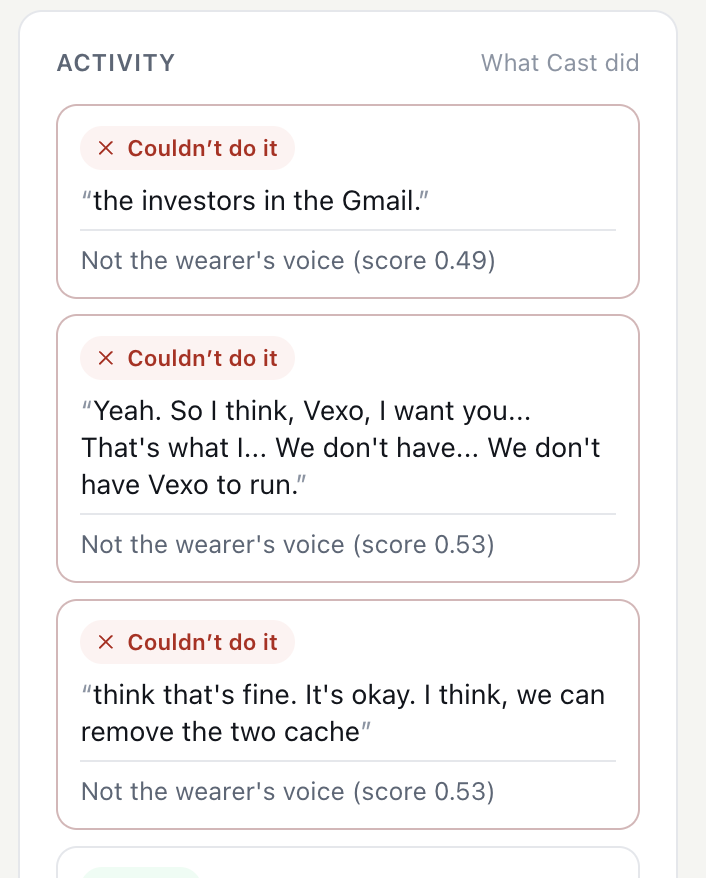
- Rejects unauthorized commands. Someone else can speak directly into the bracelet, but Dextra won't execute their instructions.
- Turns conversations into tasks. "Remind me before my parking expires" or "Every 20 minutes, tell me what I've promised people."
- Privacy by gesture. Close your wrist to turn the microphone off, and open it to turn it back on. No screen required.
How we built it
We stream audio and motion data from the Vexo Open band over Bluetooth.
- Deepgram Nova-3: Live transcription.
- NVIDIA Nemotron 3: Local streaming diarization with a session-long speaker cache.
- ECAPA-TDNN, TitaNet-Large, ERes2NetV2: Three voiceprint models that vote on speaker identity.
- Custom gesture models: Wrist orientation, fist detection, and motion-based microphone controls.
- Gemini: Command understanding, task management, and responses.
- React + TypeScript: Live transcript, speaker corrections, and tasks.
Speaker identification runs locally. We combine voice identity, wrist position, and microphone loudness to decide whether a command is authorized.
When Dextra isn't confident about someone's identity, it doesn't guess.
Challenges we ran into
Getting reliable diarization from a single wrist microphone was surprisingly difficult.
Off-the-shelf models merged our voices, and the same person sounded completely different depending on their wrist position.
We improved this with multi-position enrollment, streaming diarization, and identifying speakers across full turns.
We also dealt with short speech clips, gesture sensitivity, latency tradeoffs, and Bluetooth packet loss.
Accomplishments that we're proud of
On recordings from the actual bracelet:
- 96% accuracy identifying speakers on 1.5-second clips when confidently classified.
- 98% accuracy on 3-second clips under the same condition.
- 63% → 91% accuracy tracking the correct speaker across conversations.
We can demonstrate someone else picking up the bracelet and attempting to issue a command. Dextra refuses.
We also built speaker correction, so one correction updates earlier transcript lines and future recognition.
What we learned
Identity is the missing piece of ambient AI.
On a phone, you're authenticated. With an always-on microphone, everyone around you can potentially interact with your assistant.
We learned that real-world enrollment data matters as much as the models, and knowing when not to trust a prediction is critical.
Privacy also needs to be physical. A simple wrist gesture to turn the microphone on or off gives the wearer control without needing a screen.
What's next for Dextra
We want to integrate Dextra with Vexo's 200+ connectors, make enrollment automatic, support larger groups, and eventually move the entire pipeline onto the wearable.
We believe identity, intent, and privacy will become core infrastructure for wearables, smart glasses, and ambient AI.
Your AI should know it's you, without needing a screen.
Built With
- deepgram
- elevenlabs
- gemini
- vexo
