-
-
DevSweep AI: clean your workspace with confidence
-
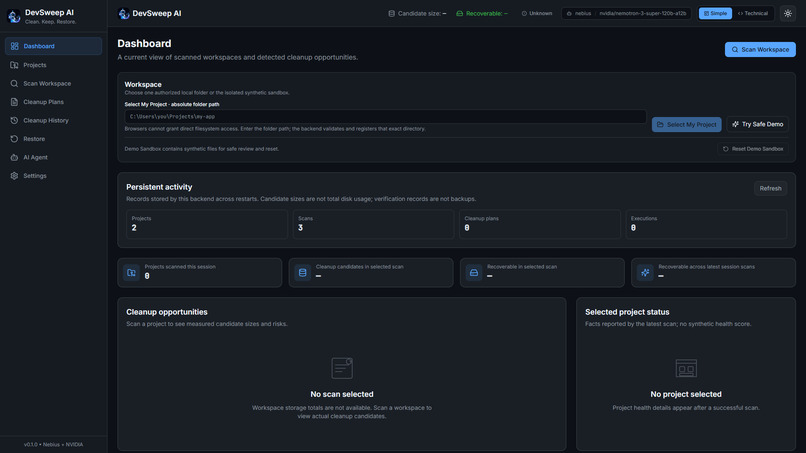
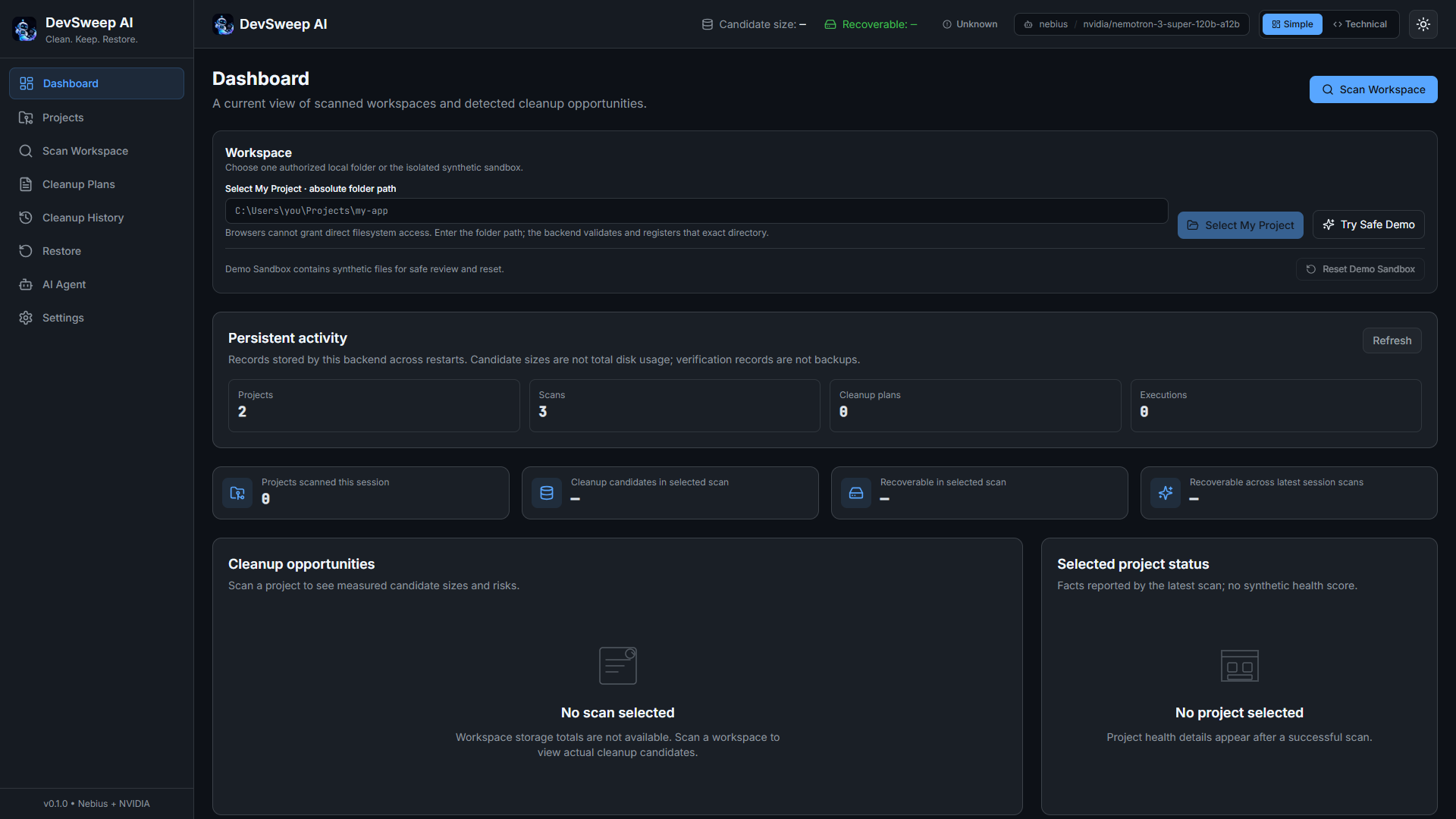
Live dashboard showing cleanup activity and workspace status.
-
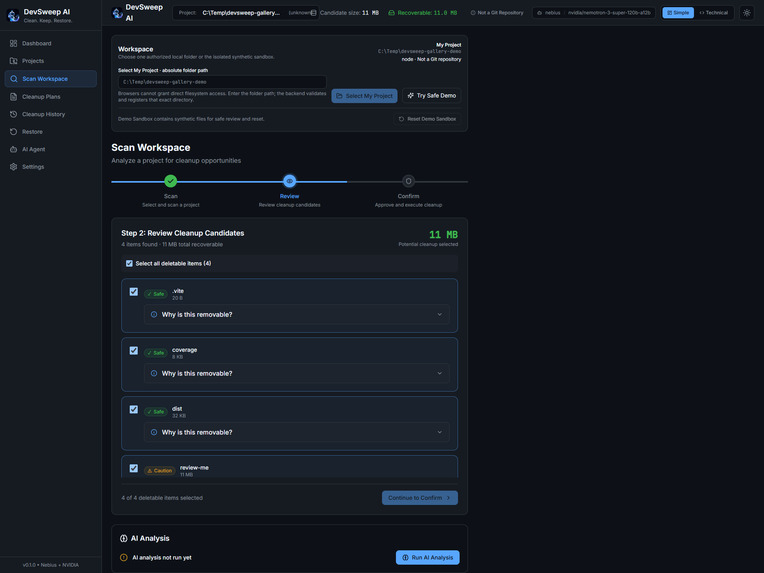
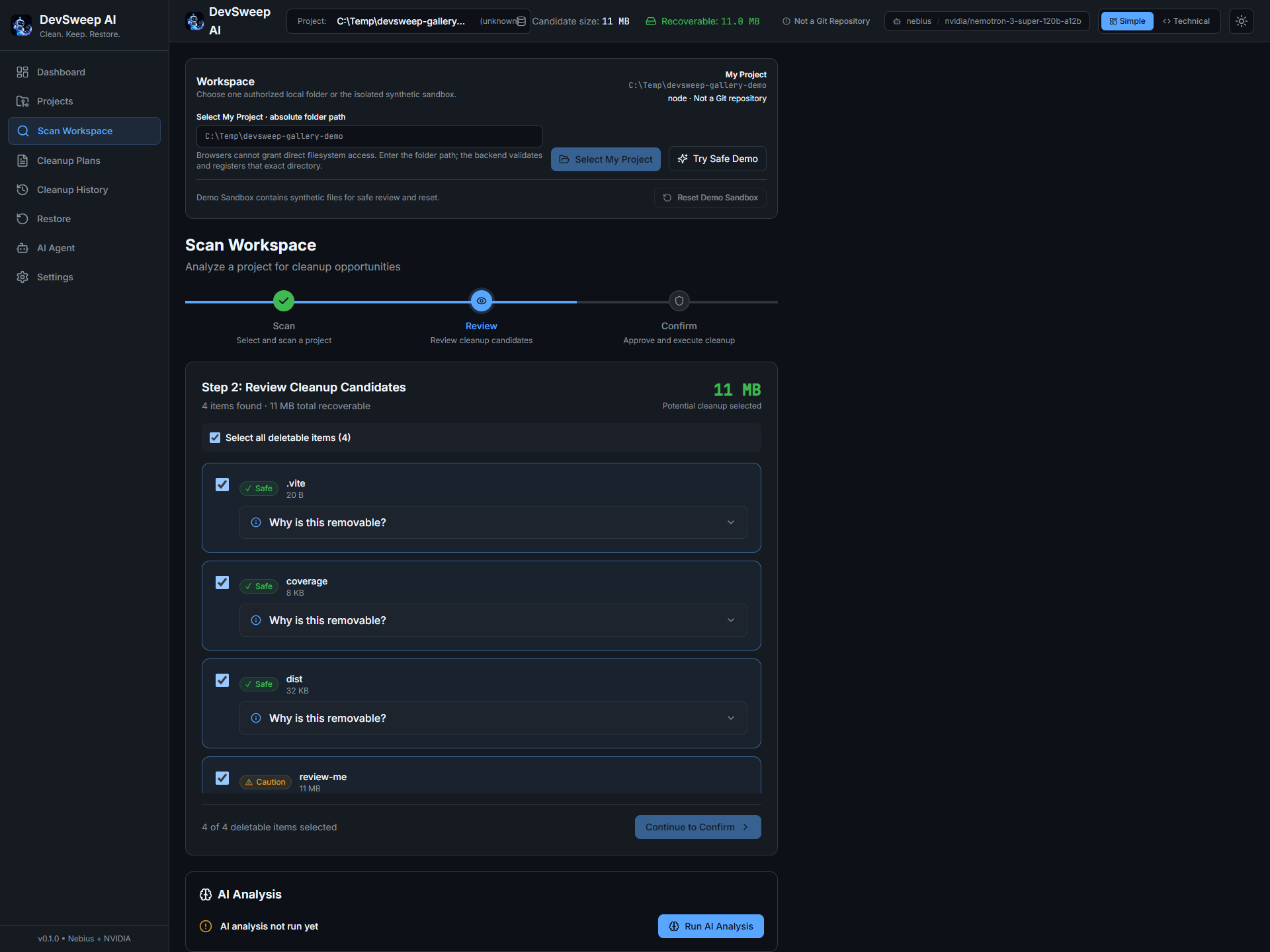
Synthetic workspace scan showing SAFE candidates and a CAUTION directory.
-
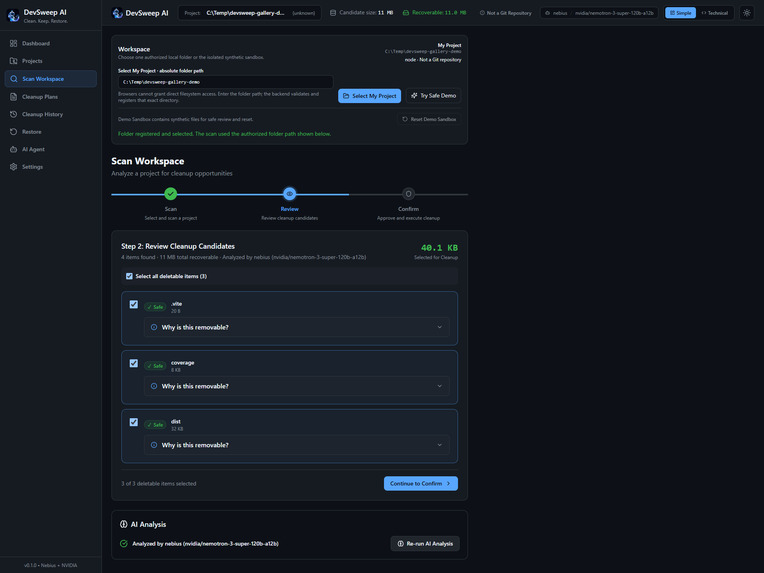
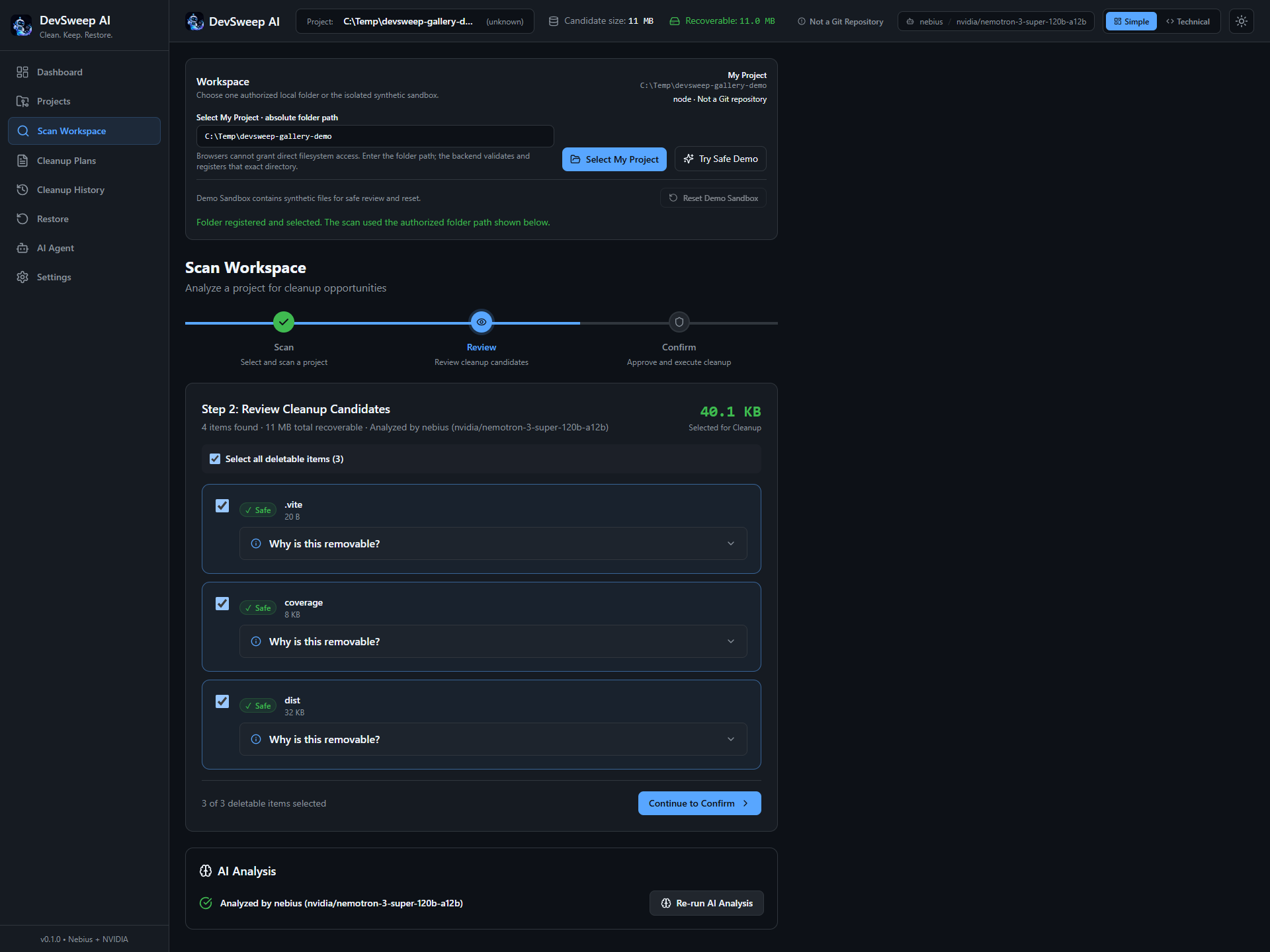
Live AI analysis selected three SAFE candidates and excluded the CAUTION directory.
-
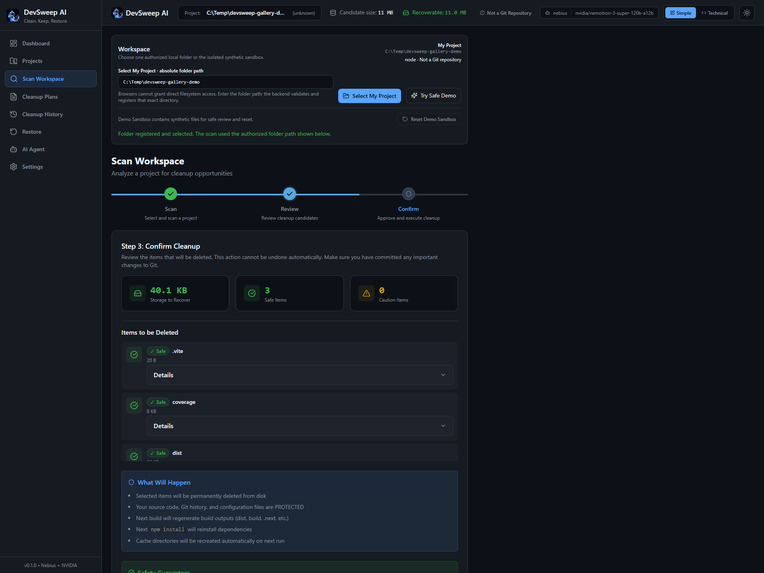
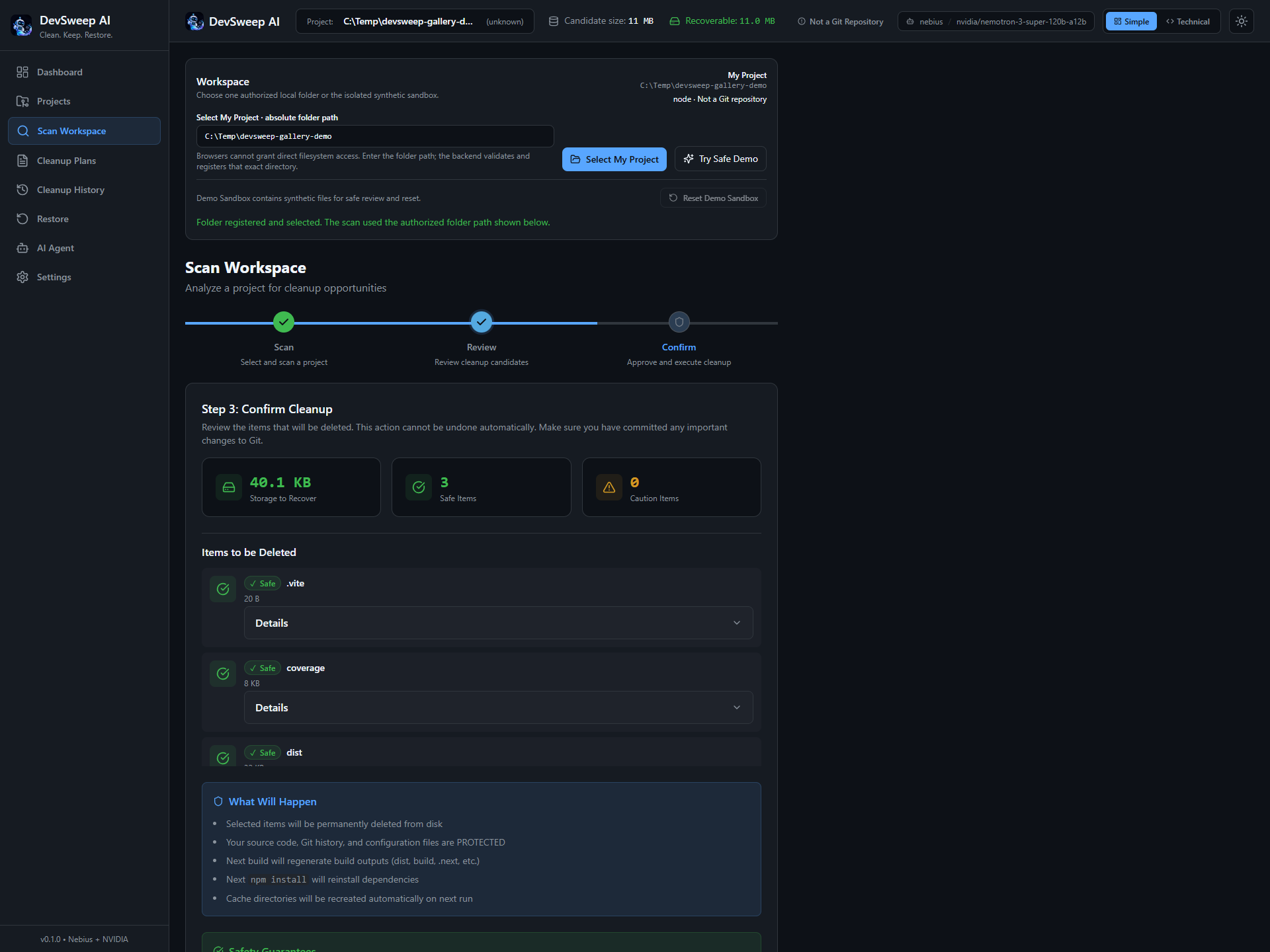
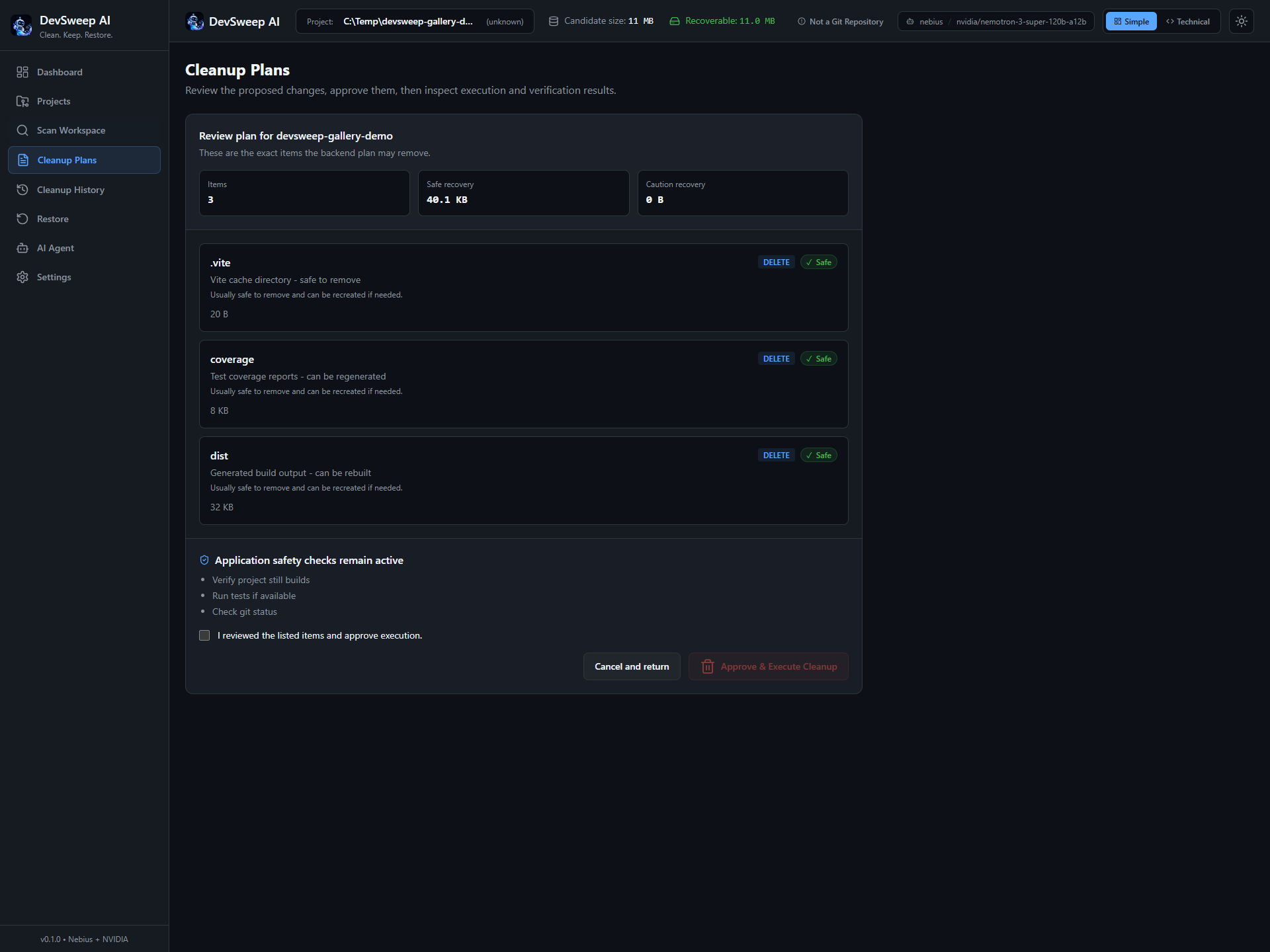
Cleanup review showing three SAFE items totaling 40.1 KB and no CAUTION items.
-
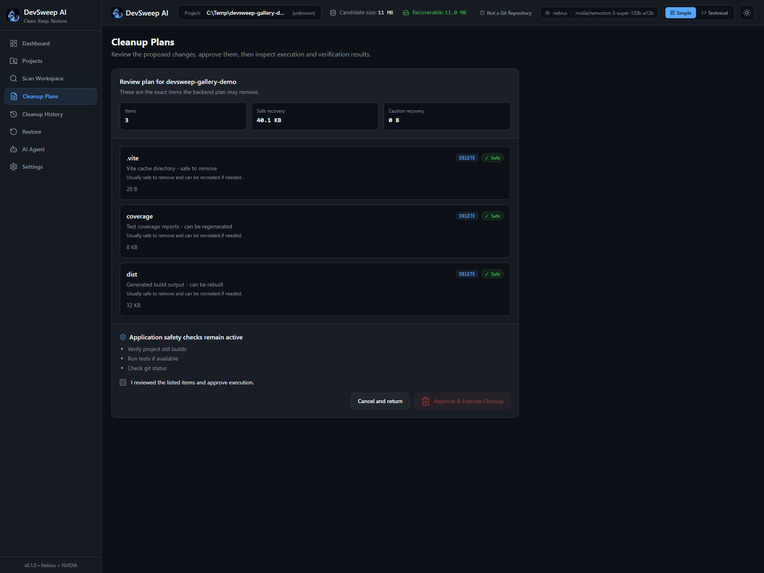
Execution stays disabled until the plan receives explicit approval.
-
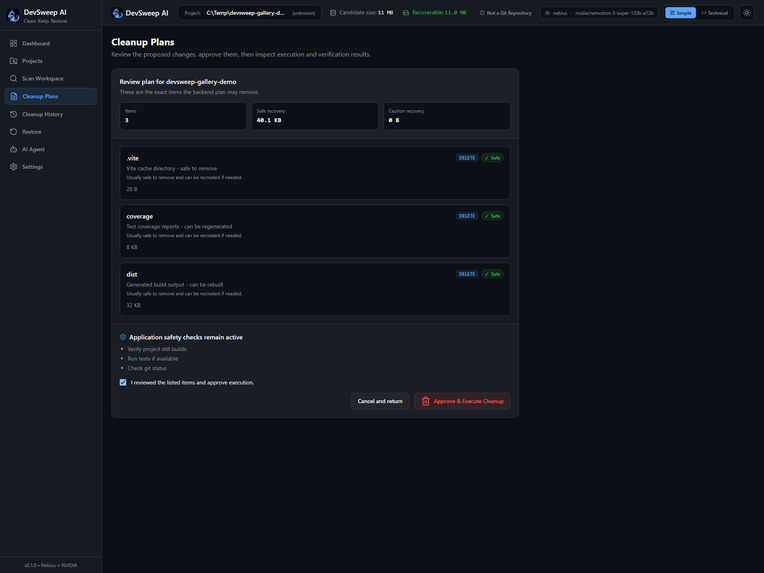
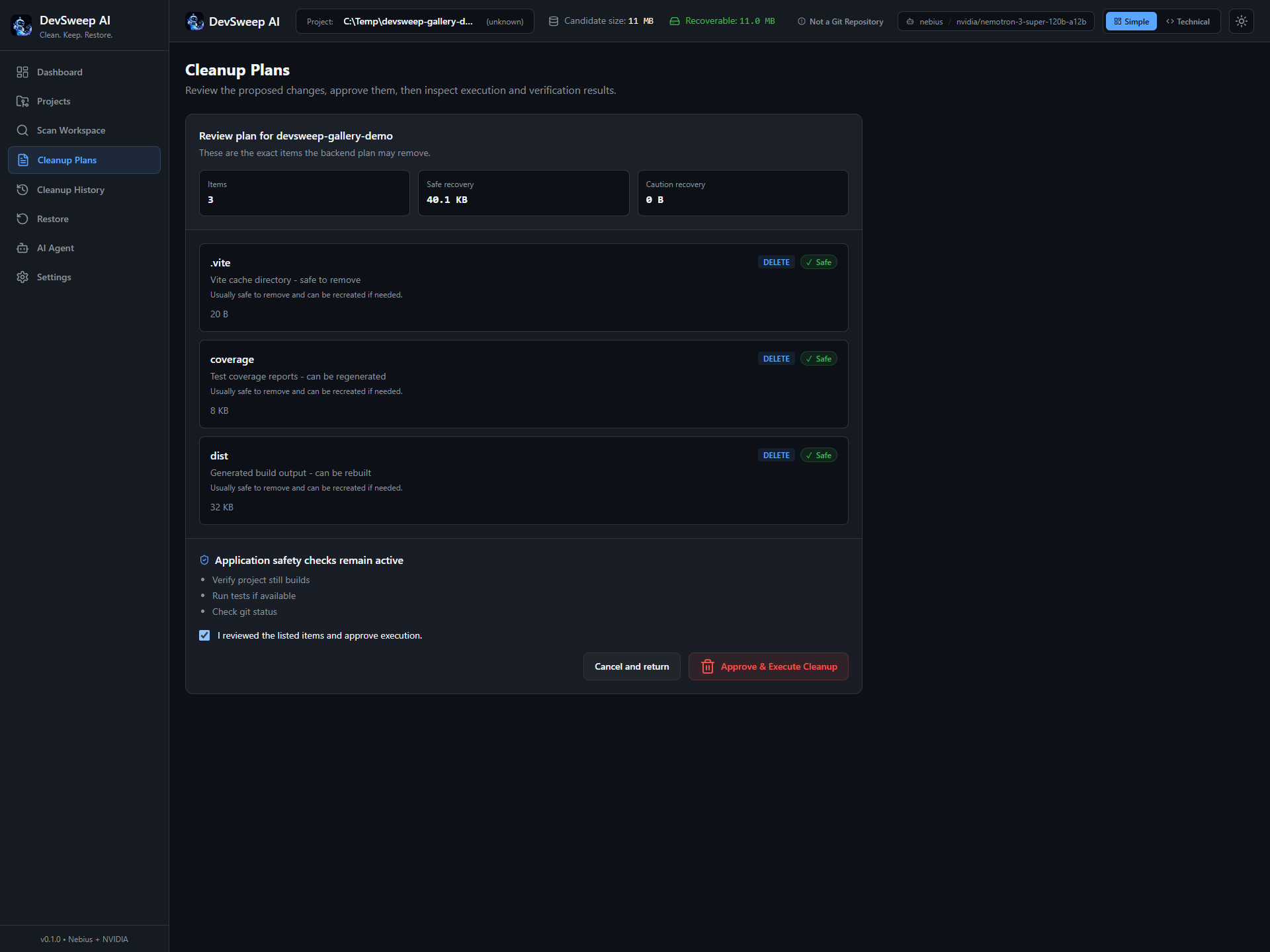
After approval, the reviewed cleanup plan is ready to execute.
-
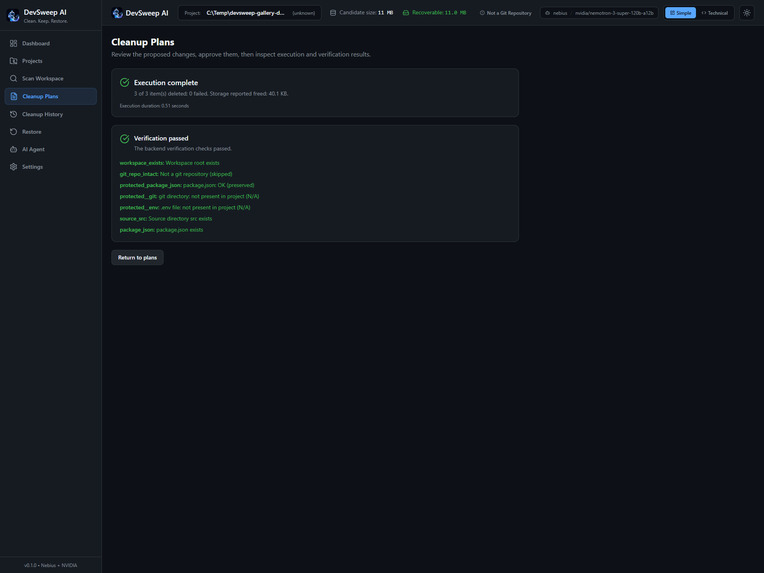
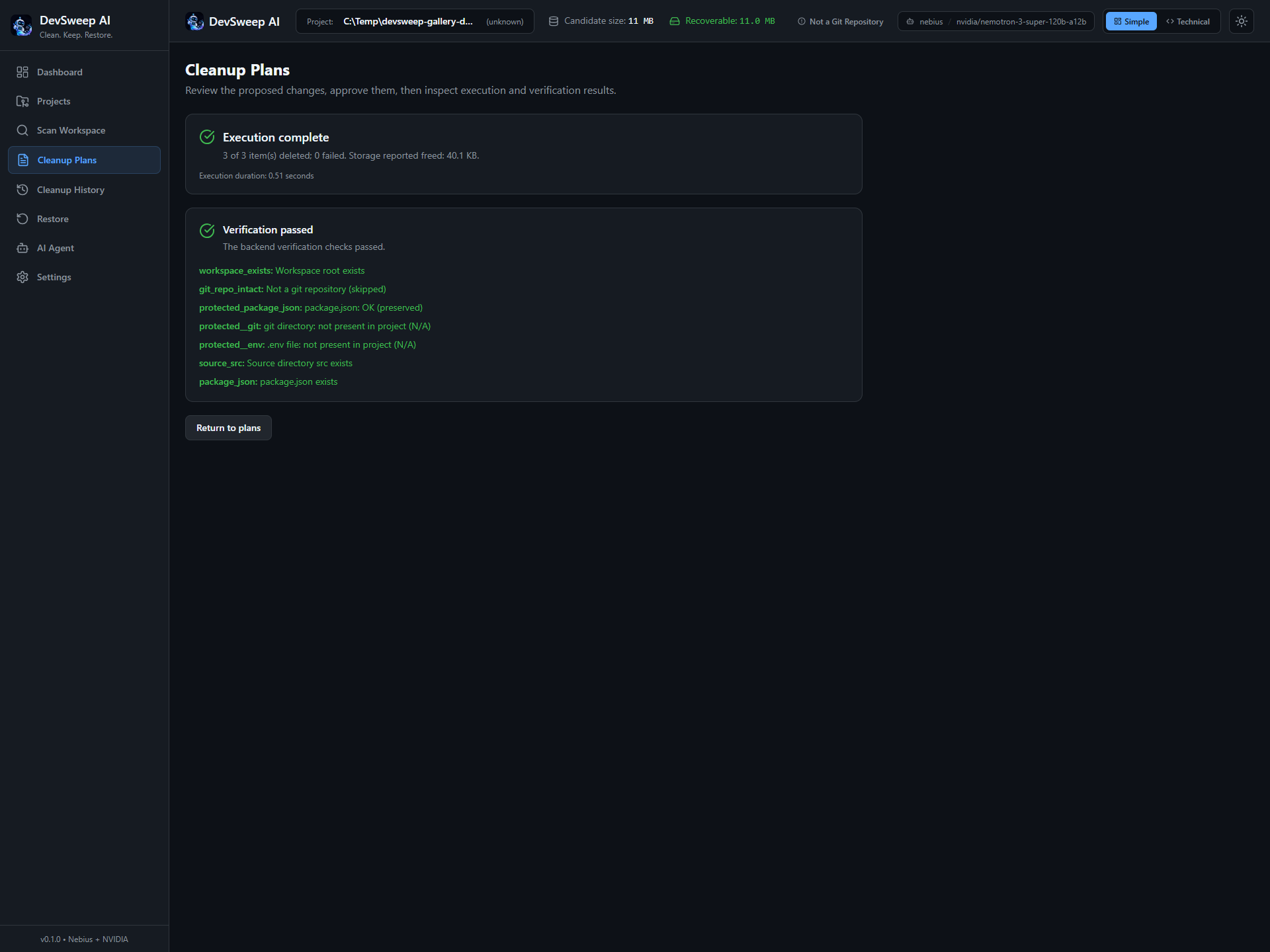
Verification passed: three items deleted, zero failures, and 40.1 KB freed.
-
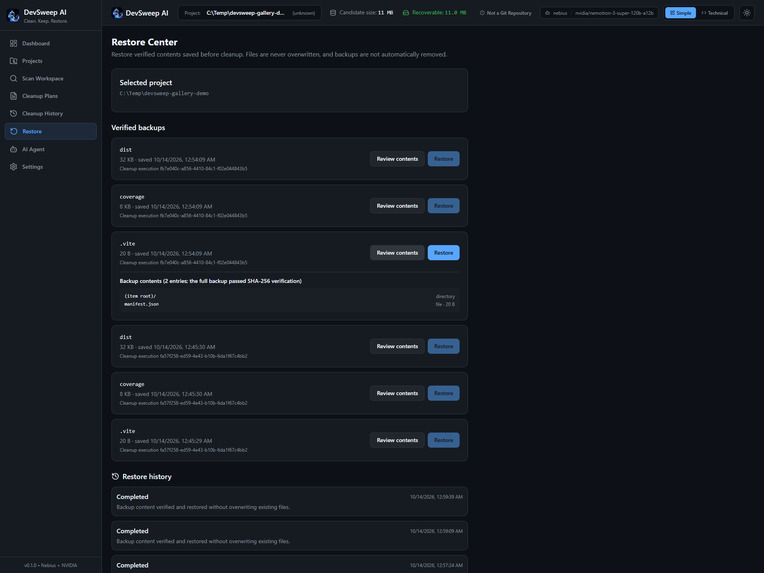
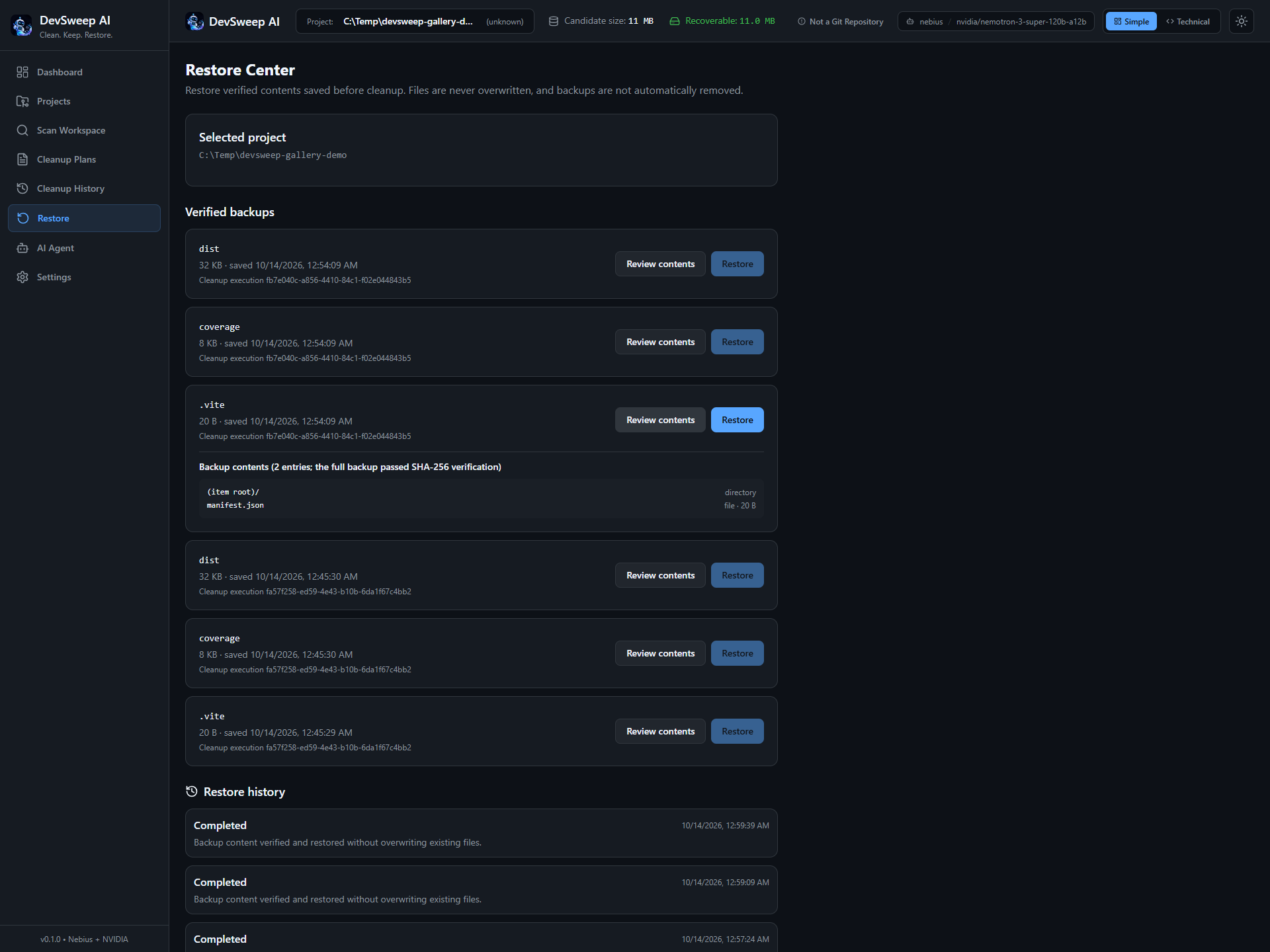
Restore Center showing SHA-256-verified backups and completed restore
-
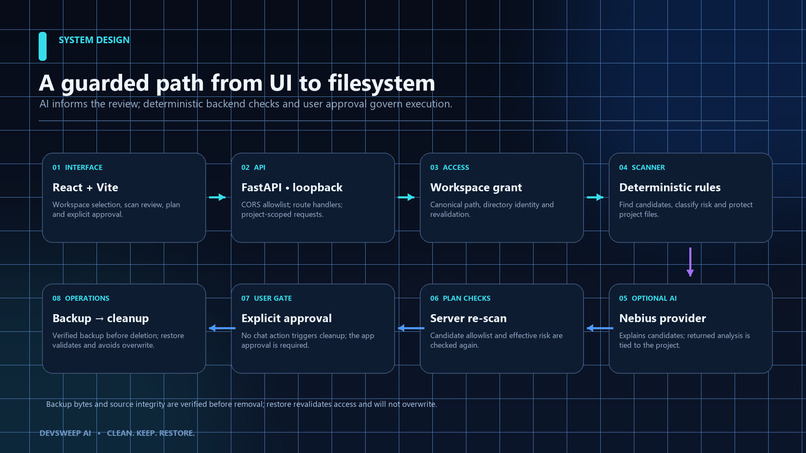
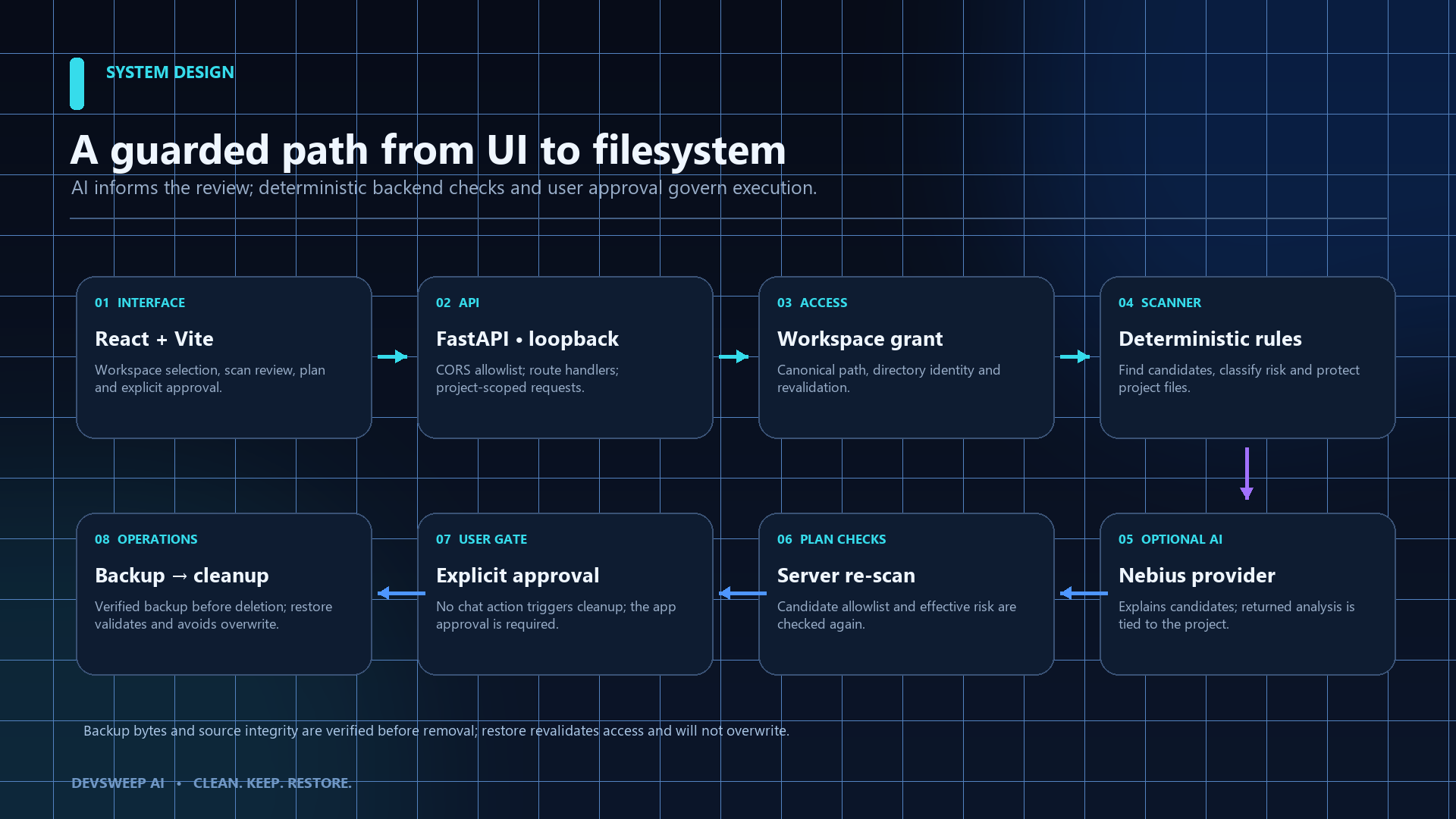
DevSweep AI system architecture and safeguards.
-
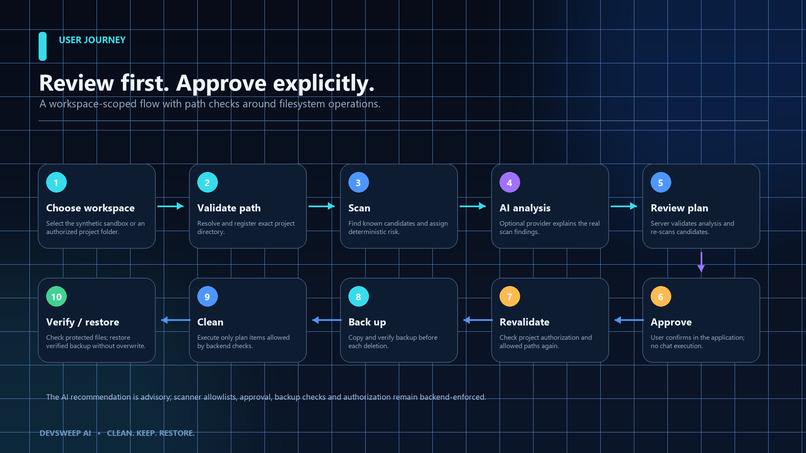
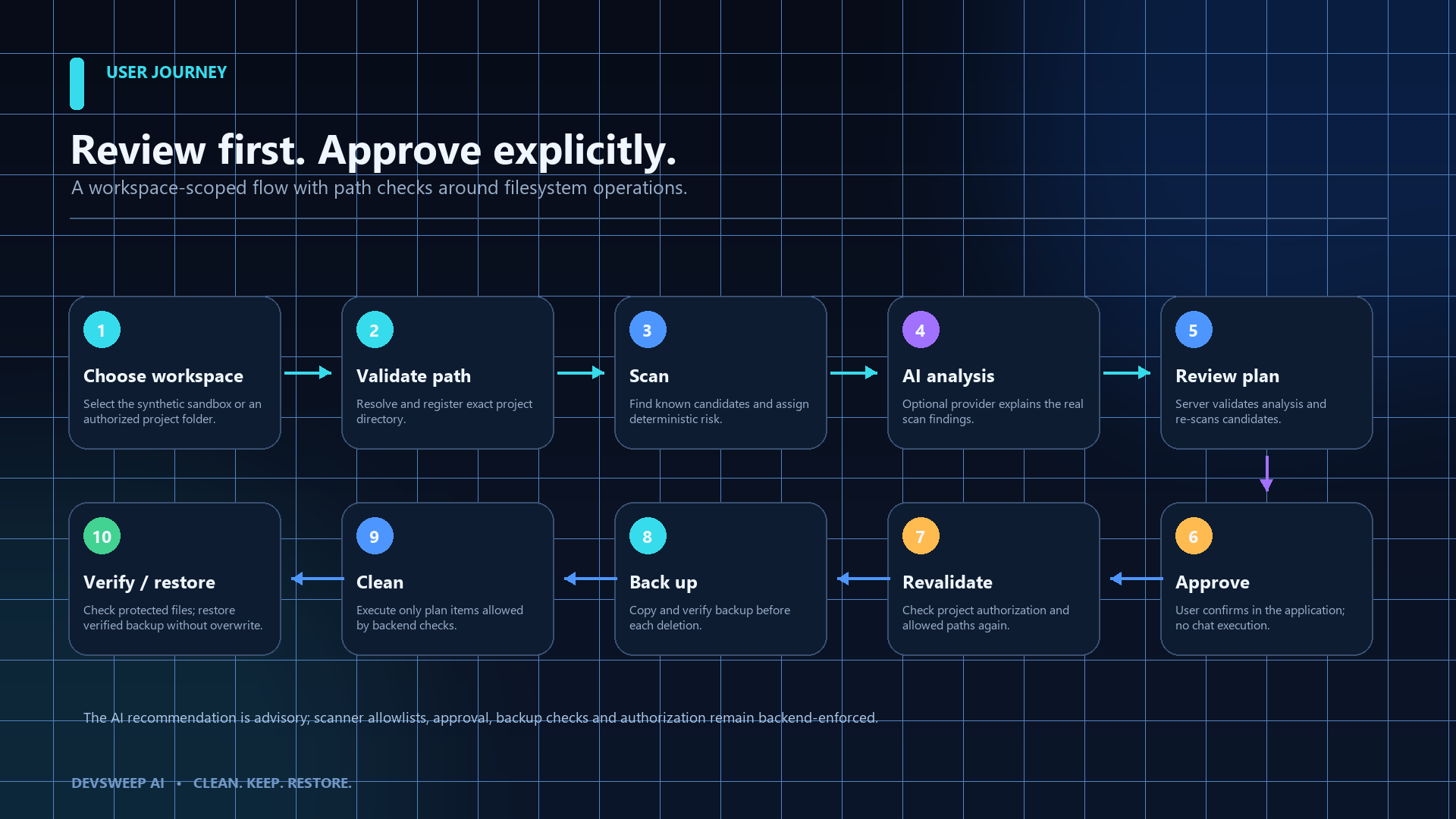
Workflow from workspace scan through cleanup, verification, and restore.
Inspiration
I built DevSweep AI for the NVIDIA × Nebius Global AI Hackathon around a problem I recognized in software development: workspaces accumulate generated files, caches, build outputs, and temporary artifacts. Cleaning them up manually is tedious, but deleting the wrong files can break a project.
I wanted to explore how NVIDIA Nemotron, accessed through Nebius Token Factory, could help developers understand cleanup candidates while keeping consequential filesystem actions under their control.
What it does
DevSweep AI scans a selected workspace and identifies potential cleanup candidates, such as regenerable development artifacts. It uses deterministic rules to classify findings and can optionally use NVIDIA Nemotron through Nebius Token Factory to provide AI-powered analysis.
The workflow is designed to be reviewable and safety-conscious:
- Select and authorize a workspace.
- Scan it for potential cleanup candidates.
- Review deterministic findings and, optionally, AI analysis.
- Inspect a proposed cleanup plan.
- Explicitly approve the plan before cleanup.
- Revalidate candidates through the backend.
- Back up eligible files and verify backup integrity before proceeding.
- Review the cleanup result and use the supported recovery workflow when needed.
AI analysis is advisory: it does not independently authorize filesystem deletion.
How I built it
I built DevSweep AI with a React and Vite frontend and a Python FastAPI backend. For the hackathon, I integrated NVIDIA Nemotron through Nebius Token Factory to analyze workspace scan findings and provide cleanup recommendations.
The frontend provides the workspace interface, scan results, cleanup-plan review, approval flow, and Restore Center. The backend handles workspace operations, deterministic scanning, validation, cleanup execution, and backup and recovery logic.
I kept the AI layer separate from safety-critical filesystem operations. The model helps analyze and explain findings, while backend validation and explicit user approval control cleanup.
Challenges I ran into
The biggest challenge was designing a useful cleanup workflow without giving an AI model unrestricted control over a developer’s files.
I had to account for the possibility that a suggested file might be important, that a workspace could change after a scan, or that an operation could fail partway through. This pushed me to focus on backend validation, explicit approval, backup integrity, and clear reporting instead of relying only on model recommendations.
I also worked through integration and configuration challenges while connecting the frontend, backend, and live Nebius inference. Making the application understandable and testable—not just functional—was another important part of the process.
Accomplishments that I'm proud of
I’m proud that DevSweep AI combines AI-assisted analysis with a guarded cleanup workflow rather than allowing model output to directly trigger deletion.
I built a user journey from workspace scanning and plan review to explicit approval, cleanup execution, and a Restore Center. I also integrated NVIDIA Nemotron through Nebius Token Factory and prepared a demonstration of the workflow.
Most importantly, I treated safety and transparency as core product requirements. The application is designed to show users what it proposes and what happened, while documenting limitations instead of promising perfect recovery.
What I learned
I learned that adding AI to a developer tool is not just about getting a model to produce useful recommendations. The surrounding system needs to validate those recommendations, handle failure, and keep users informed.
I also learned to distinguish model analysis from deterministic checks, and file-integrity verification from broader claims such as proving that a project still builds or that every aspect of its original state can be restored.
Building DevSweep AI helped me think more carefully about how AI agents should interact with real files and developer workflows.
What's next for DevSweep AI — Intelligent Workspace Cleanup Agent
I want to expand the range of development artifacts DevSweep AI can recognize, improve the first-run experience, and make it easier for developers to evaluate the application safely.
I also want to strengthen recovery and verification capabilities, improve the handling of workspace changes and failed operations, and continue refining the Nebius Token Factory and NVIDIA Nemotron integration.
The long-term goal is to make workspace cleanup easier while preserving a developer’s ability to understand, review, and control every consequential action.
Built With
- ai
- ai-agents
- automation
- developer-tools
- fastapi
- generative-ai
- nebius
- nvidia
- nvidia-nemotron
- python
- react
- typescript
- vite


Log in or sign up for Devpost to join the conversation.