-
-
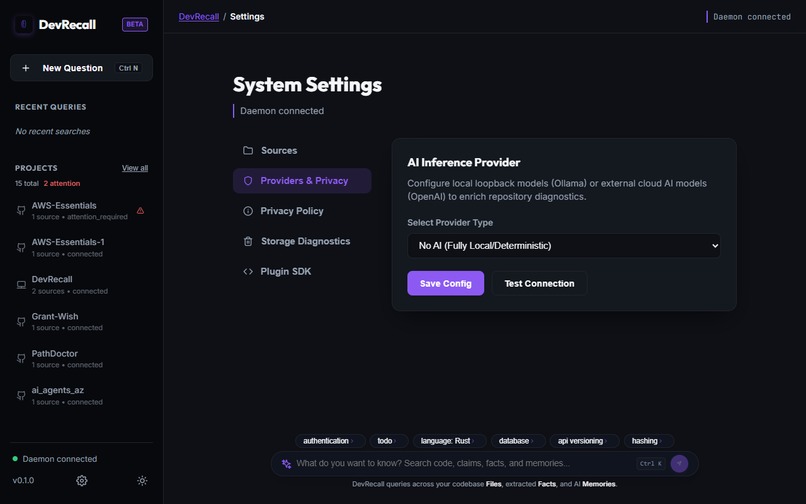
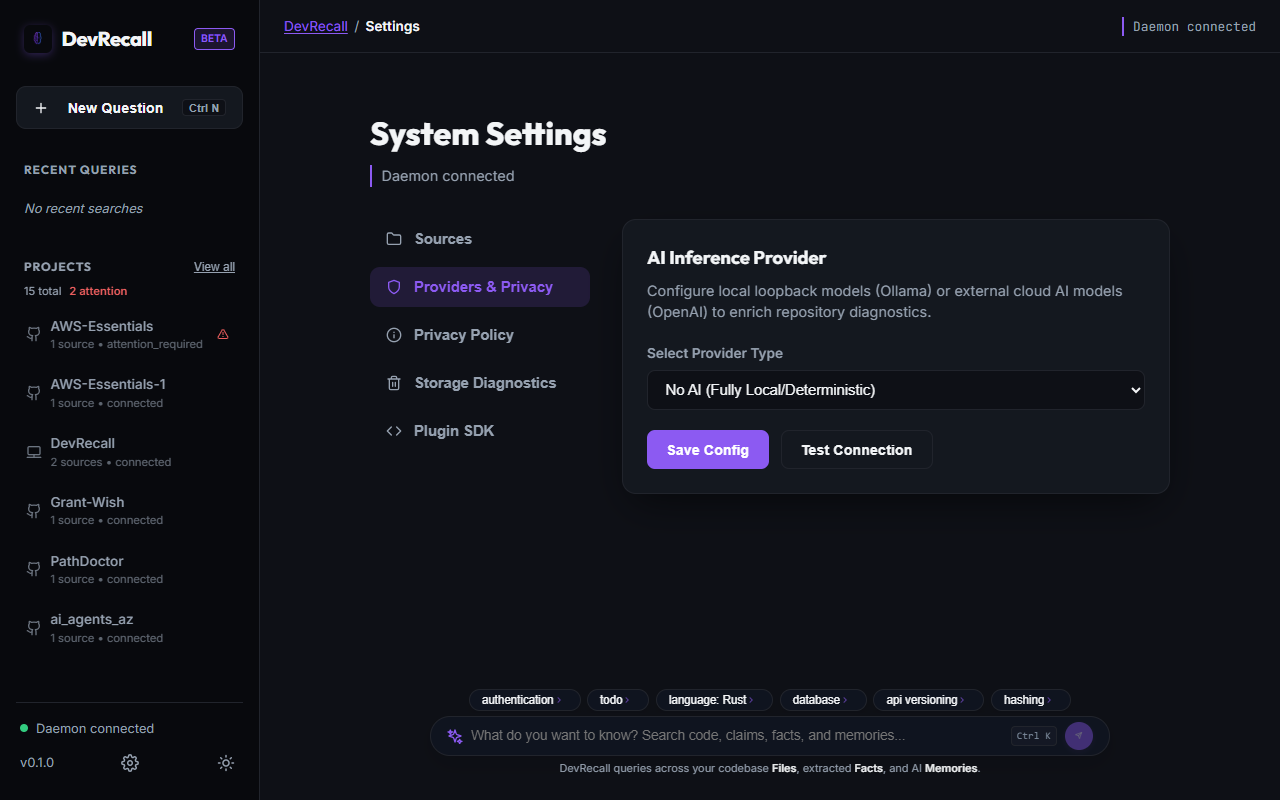
settings ai provider
-
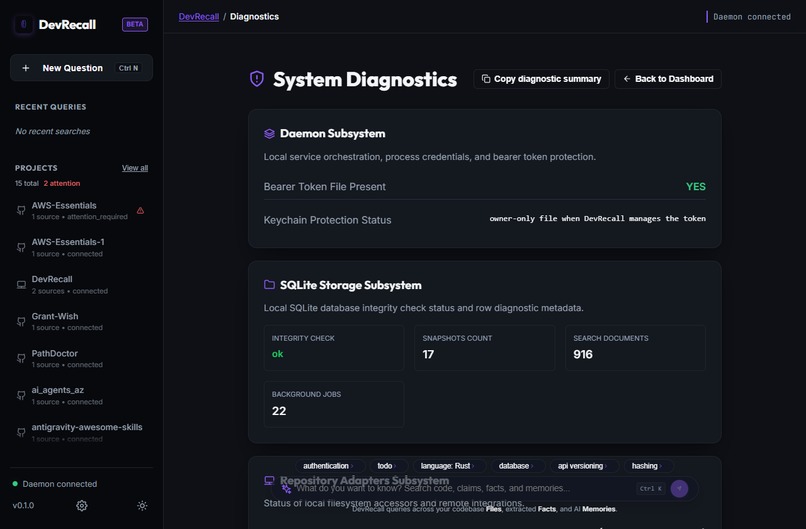
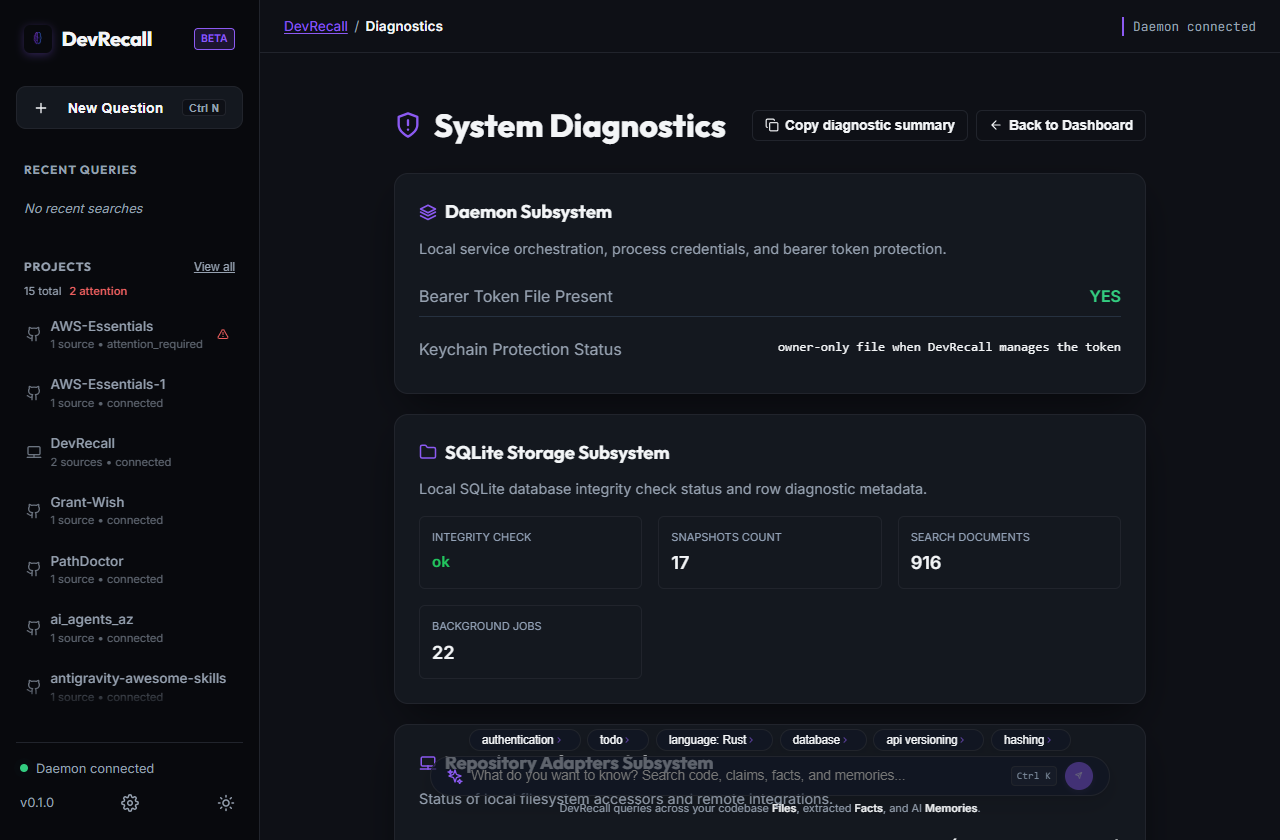
full memory system
-
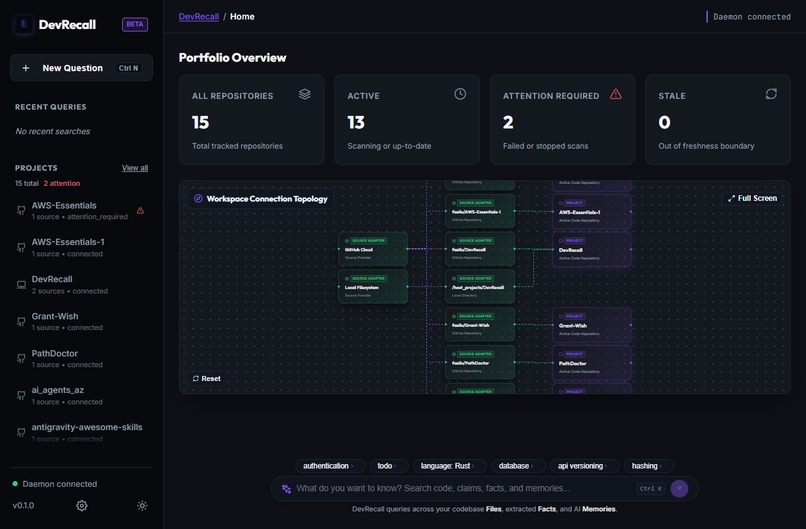
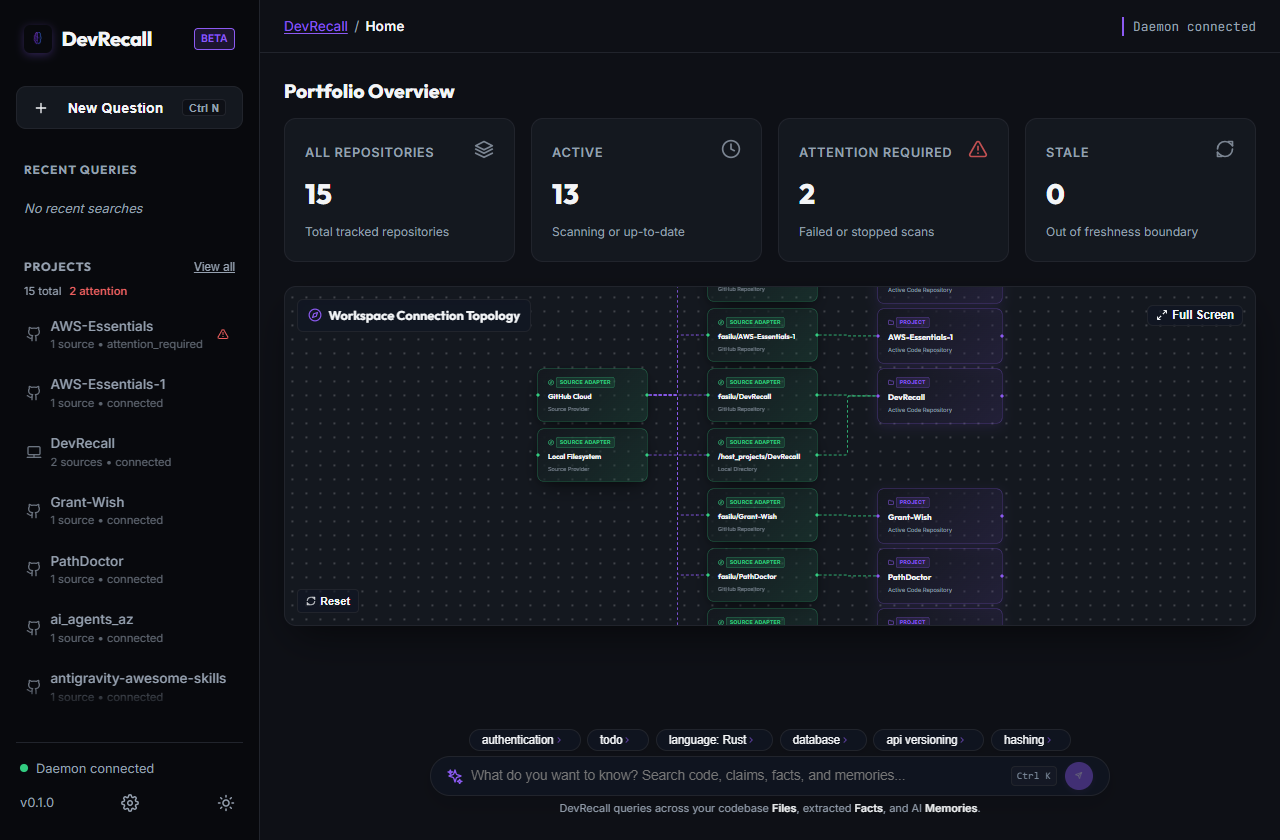
home
-
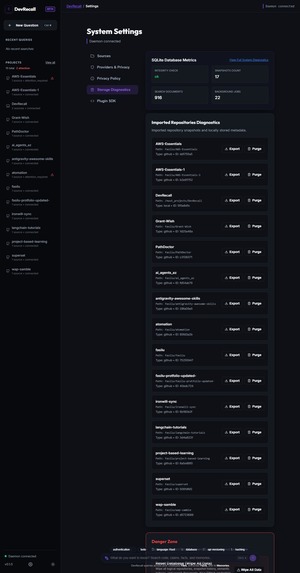
repo management
-
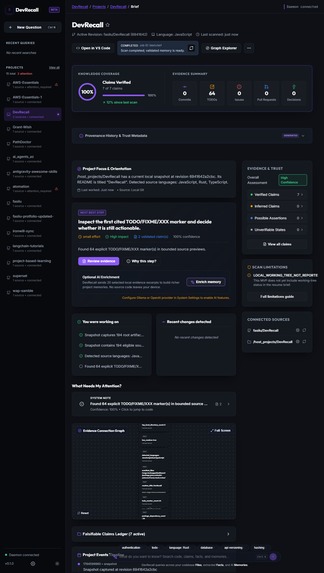
project resume and evidence
What it does
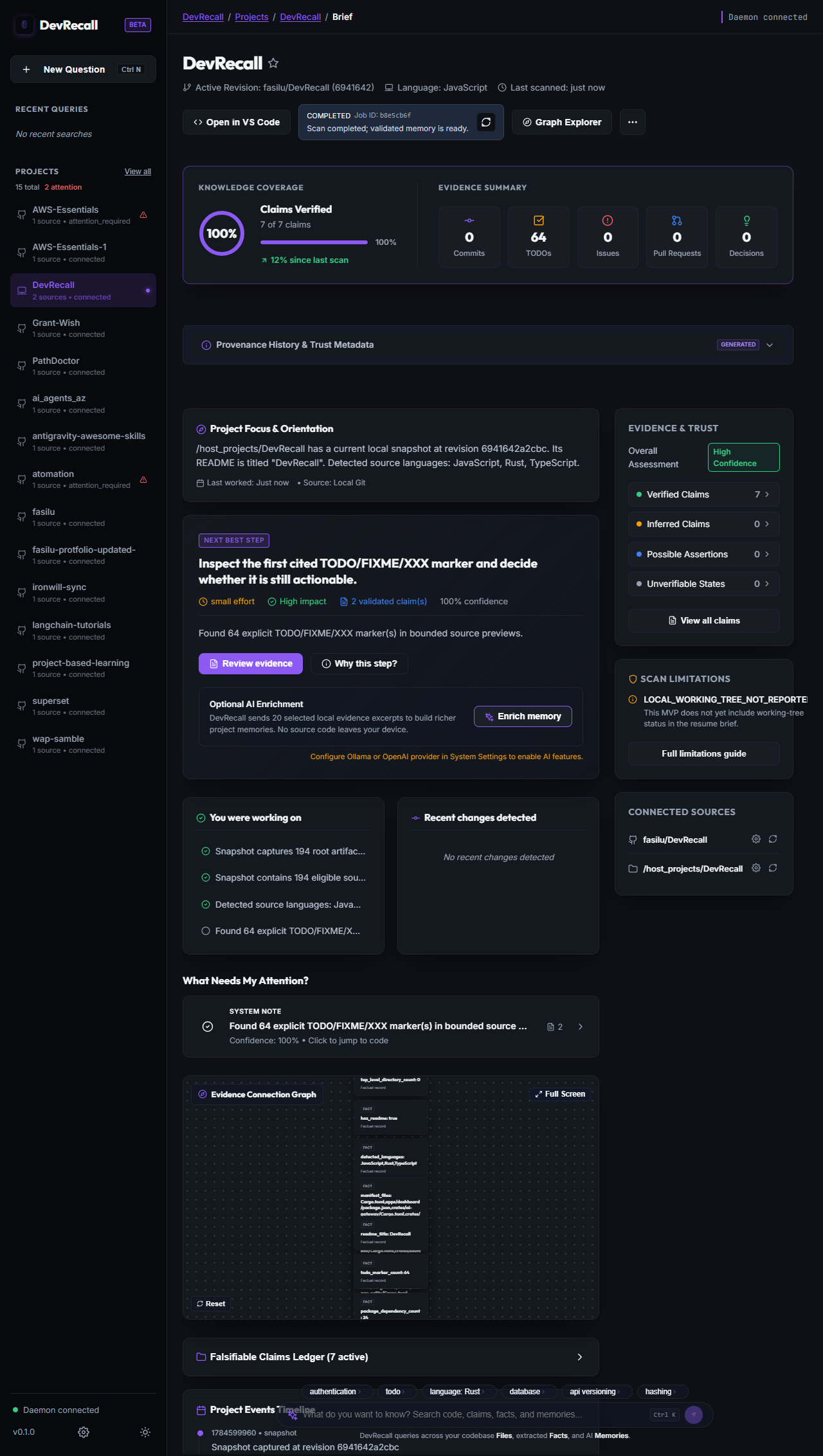
Developers often return to an old repository with the code intact but the context gone. DevRecall is a local-first developer-memory platform that turns selected GitHub repositories and local folders into immutable snapshots, deterministic facts, traceable evidence, validated claims, and a resume-ready project brief.
Instead of asking developers to keep a separate project journal, DevRecall reconstructs the context needed to make the next useful decision. It shows what a project is, what changed, which work may be unfinished, and the evidence behind every claim.
As a developer it is my own personal problem .. i am running some mobile apps every time i try to improve or add fetures in my weekend to get start to understand it take hours .
i mentined projects just in case
daymarker- link ironwill- link goalflow7030-link
i mean it is real pain xd
How it works
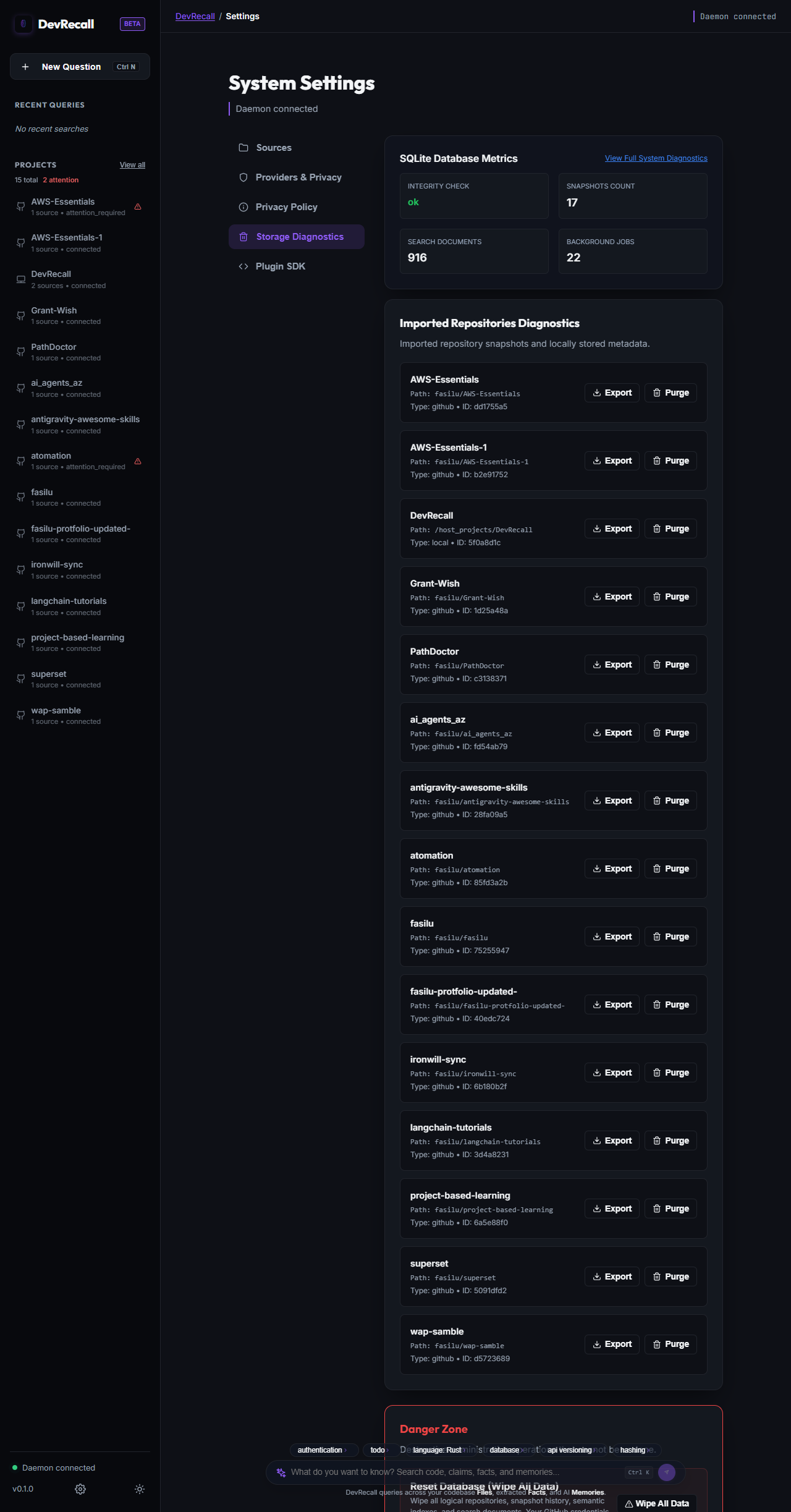
DevRecall connects to a GitHub repository or local Git working tree and creates a bounded snapshot. The Rust daemon scans repository structure, Git history, issues, pull requests, releases, README content, and actionable source markers. It persists structured facts and citations in SQLite, exposes REST and live status events, and powers a React dashboard.
Current capabilities
- Resume Brief: orientation, unfinished-work signals, recommended next actions, and limitations.
- Evidence-backed claims: inspect the source file, commit, issue, or pull request behind each conclusion.
- Search and evidence graph: rediscover relevant repository artifacts and follow their citations.
- Local-first controls: deterministic scanning and local evidence stay separate from optional AI-provider settings.
- *Github connect * same way of local reposetry one repo scanned based the git it will identify the local repo make it fast resum like open in vscode .
Why it matters
Side projects and long-lived codebases routinely lose momentum because re-entering them means rebuilding mental context from scratch. DevRecall makes the existing work legible again, so a developer can resume with a justified next action instead of starting over.
How we used Codex and GPT-5.6
We used Codex with GPT-5.6 Terra to plan DevRecall's foundations and page-by-page UI/UX: the system architecture, evidence-backed claim workflow, dashboard experience, and implementation plan.
After the core plan was established, we used GPT-5.6 Nano and GPT-5.4 for focused implementation tasks and test-oriented work. During credit constraints, Gemini was used for some UI polish. Codex and GPT-5.6 were used where they added the most leverage, while every feature was reviewed in the repository and the final dashboard build was verified.
How judges can run and test it
Documented environment: Docker Desktop (or another Docker engine) with Docker Compose v2.
- Copy
.env.exampleto.env. A GitHub App client ID is only needed for live GitHub Device Flow testing. - Build dependencies and the dashboard with the Docker Compose commands in the README.
- Run
docker compose -f compose.dev.yml run --rm dev cargo test --workspace. - Run the daemon using the documented compose command; it serves the dashboard locally at
http://127.0.0.1:8787. - For a no-credential evaluation, use a local Git working tree and the documented isolated smoke workflow. Do not use production code or secrets.
Future Scope
The following roadmap is planned work, not a claim about the current build.
- Native desktop app: a polished local-first experience for daily developer workflows.
- VS Code extension: repository memory, evidence, and next actions inside the editor.
- Repository-scoped MCP memory: give AI agents grounded project context with citations.
- Full memory visualization: navigate facts, evidence, decisions, and their relationships.
- SDK and integrations: let developer tools consume DevRecall's evidence-backed project memory.
- One-click resume: resume a project without local setup.
- Repository-scoped skill provider: deliver the right project context and capabilities to AI agents.
- Automation: continuously refresh analysis and surface proactive resume suggestions as repositories change.
- Deeper project analysis: connect architecture, implementation history, active work, and reusable lessons across repositories.
The direction is a graph-native developer memory system: not just a summary of a repository, but a durable and inspectable context layer that people and AI agents can use to continue work safely.
Technical stack
Rust, Axum, SQLite/FTS5, React, TypeScript, Vite, Docker, GitHub APIs, Server-Sent Events, and OpenAI Codex.

Log in or sign up for Devpost to join the conversation.