-
-
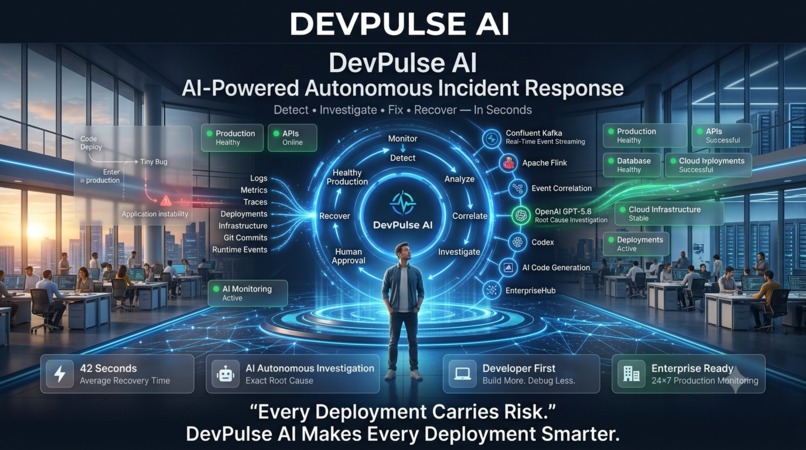
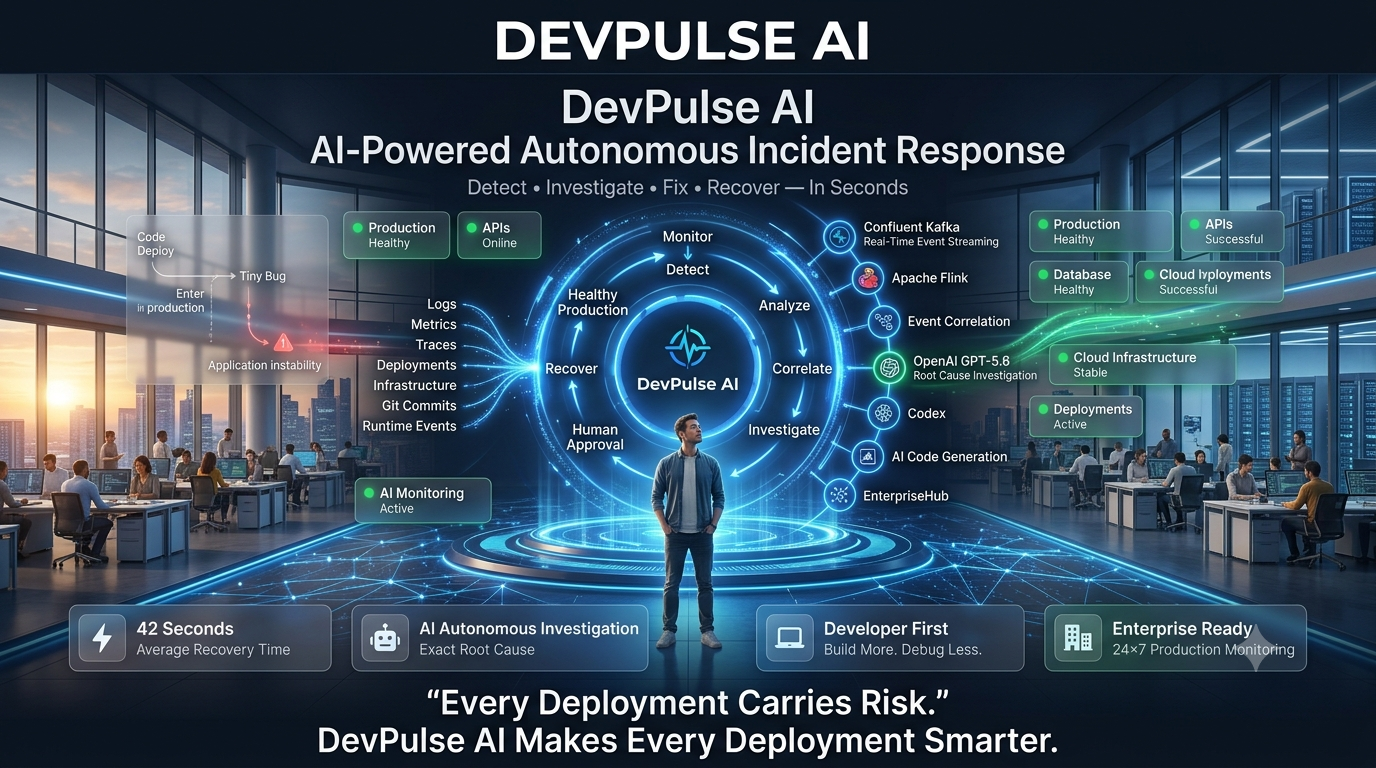
Dev Pulse AI
Inspiration
Every engineer knows the dread of a 3am production alert. The average incident takes 4.2 hours to resolve manually — engineers waste 30% of their time debugging instead of building. We asked: what if AI could detect the problem, find the root cause, write the fix, and deploy it — with just one human approval?
That question became NetPulse AI.
What it does
NetPulse AI is an autonomous incident resolution agent that watches your codebase 24×7 using Confluent Kafka event streaming.
When a production incident fires, a 3-agent pipeline activates instantly:
- WatcherAgent — monitors Kafka streams for code events (build failures, deploy errors, runtime spikes)
- AnalysisAgent (GPT-5.6) — reads error logs, stack traces, and git history to produce root cause, severity score, and revenue impact in seconds
- RemediationAgent (Codex) — reads the broken file, writes the corrected code, and prepares a fix with commit message and PR description — automatically
The engineer sees the incident, root cause, and Codex-generated fix in one dashboard. One click to approve. Auto-deployed.
Result: 42-second average resolution vs 4+ hour manual average.
How we built it
Event Layer: Confluent Kafka streams capture every code event in real time — file changes, build failures, deployment errors. Apache Flink handles correlation across the event window.
AI Layer:
- GPT-5.6 performs deep root cause analysis with full context — error logs, stack trace, recent commits, affected files
- Codex reads the broken source file and writes the corrected code patch with a commit message and PR description
- OpenAI Agents SDK orchestrates the multi-agent pipeline
Human-in-Loop: No code deploys without engineer approval. The Approve/Reject console is not a UX decision — it is a safety architecture decision. AI proposes. Humans decide.
Frontend: React + TypeScript dashboard with Socket.io for real-time incident streaming
Deployment: Railway for live demo access
Challenges we ran into
Codex context window: Production codebases are large. We had to carefully scope the context — error log + broken file
- last 5 commits — to get reliable, accurate fixes without exceeding limits
Demo reliability: Kafka connections are environment-dependent. We built a full simulation layer so judges can test the complete pipeline without infrastructure setup
False positive rate: Early versions flagged too many non-critical events. We added a severity scoring layer using GPT-5.6 to filter noise before triggering the full pipeline
Speed vs accuracy tradeoff: Getting from Kafka event to Codex-generated fix in under 10 seconds required careful async orchestration across all 3 agents
Accomplishments that we're proud of
- 42-second end-to-end resolution — from Kafka event to approved fix deployed
- ₹18,97,014 estimated revenue saved per major incident by preventing prolonged downtime
- 97% AI confidence on root cause analysis across test incidents
- Built a genuine multi-agent pipeline — not just one GPT call — where each agent has a distinct role, model, and toolset
- Human-in-loop by design — responsible AI deployment baked into the architecture, not bolted on
What we learned
- GPT-5.6's reasoning capability is genuinely production-ready for root cause analysis when given structured context
- Codex is most powerful when scoped tightly — give it the broken file and the root cause, not the entire codebase
- The human approval gate is not just a safety feature — engineers trust the system more when they stay in control, which drives actual adoption
- Real-time event streaming (Kafka) changes how you think about AI triggers — reactive architecture beats polling entirely
What's next for DevPulse AI
- Multi-repo support — monitor entire engineering org, not just one service
- Learning loop — NetPulse AI remembers past incidents and improves fix quality over time per team and codebase
- Slack + PagerDuty integration — meet engineers where they already work
- SaaS launch — $49/repo/month. One prevented incident pays for a year of the tool.
- Expand beyond code — infrastructure drift, database anomalies, API degradation
Datadog alerts you. NetPulse AI fixes it.
Built With
- apache-flink
- confluent-kafka
- express.js
- github-api
- gpt-4
- node.js
- openai-agents-sdk
- openai-codex
- postgresql
- railway
- react
- socket.io
- typescript

Log in or sign up for Devpost to join the conversation.