-
-
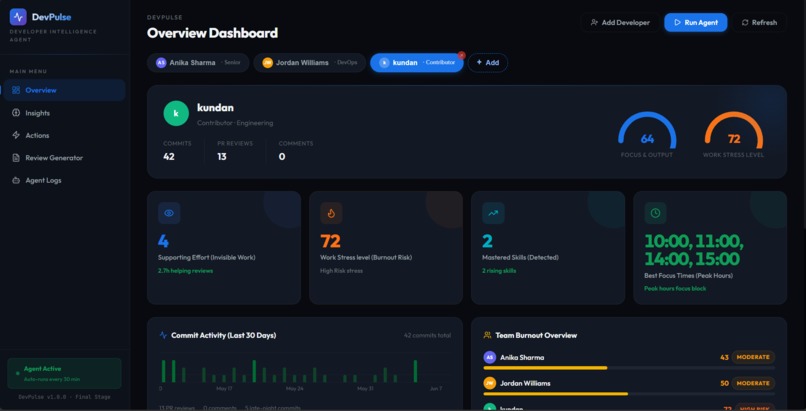
Overview Dashboard
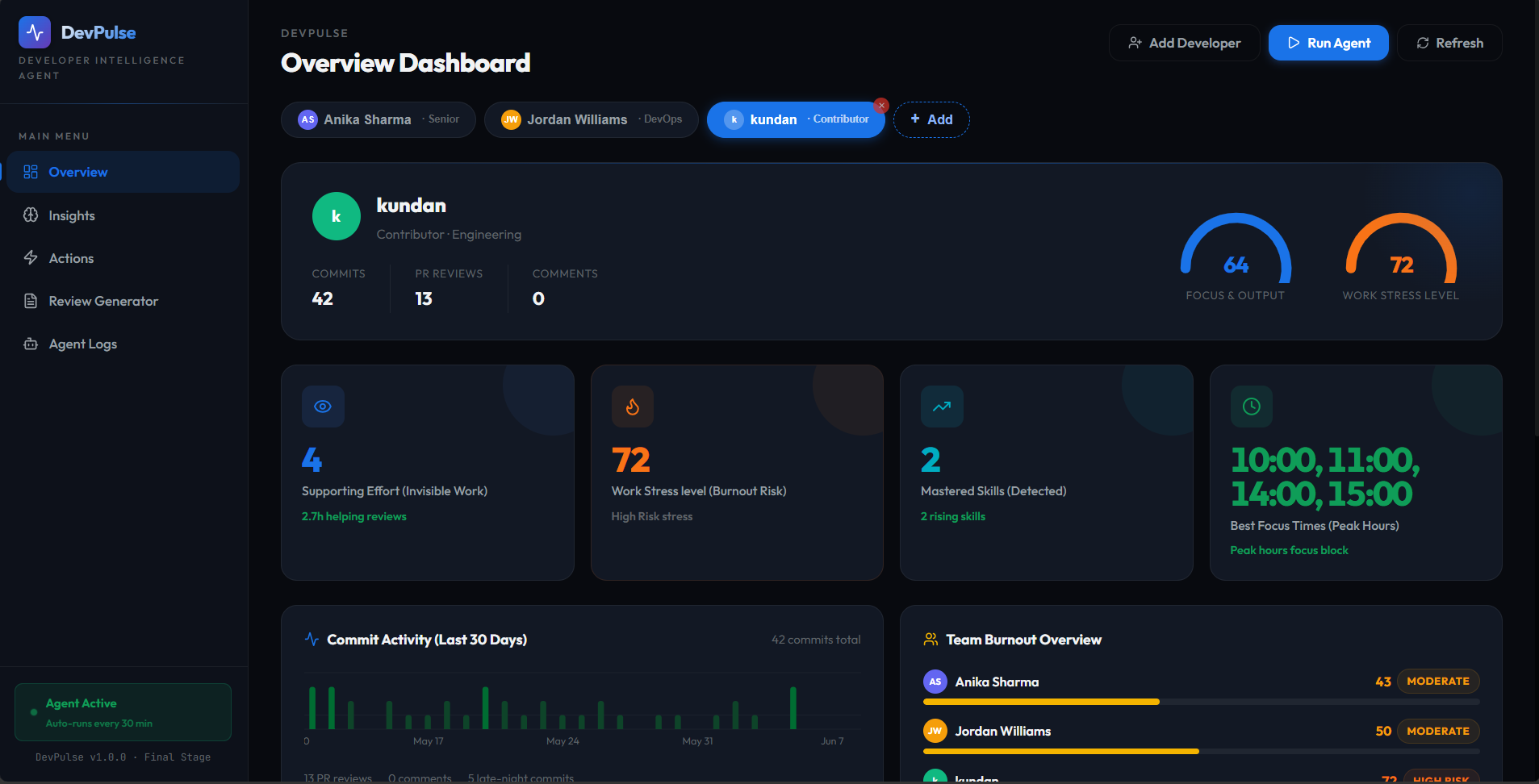
Inspiration
DevPulse was born out of a frustration with traditional engineering dashboards that focus strictly on raw metrics like commits and lines of code. This "metric trap" forces developers toward transactional output while completely ignoring their "Invisible Work"—peer code reviews, mentoring, documentation, and solving issue threads.
Compounding this, constant context-switching and meeting fatigue cause silent developer burnout. We asked a simple question: What if an AI-driven Developer Advocate worked directly for the engineer, instead of management? DevPulse is inspired by the need for an autonomous agent that highlights a developer's hidden value, monitors mental fatigue, and aggressively protects focus time by blocking schedules and declining unnecessary meetings.
What it does
DevPulse is an intelligent developer health dashboard and autonomous schedule defender:
- Invisible Work Quantification: Integrates with GitHub APIs to search for peer pull request reviews and issue comments, calculating hours spent on collaboration and mentoring that are ignored by typical dashboards.
- Dynamic Skill Velocity Tracking: Inspects commit payloads and language bytes to map a developer's real-time skill set onto a Radar chart, showing which skills are rising versus stabilizing.
- Workload & Burnout Diagnosis: Calculates a burnout risk score based on work patterns (flagging late-night and weekend commits).
- Autonomous Calendar Autopiloting: If a developer's peak productivity falls within a high-meeting window (like 2 PM - 5 PM), the agent autonomously interfaces with the Google Calendar API using Model Context Protocol (MCP) to set up daily recurring Deep Work blocks and automatically decline overlapping meeting invitations.
- AI Performance Appraisals: Instantly drafts professional engineering reviews that emphasize achievements and explicitly highlight invisible work, helping engineers get credit where it is due.
How we built it
DevPulse is constructed as a modern, decoupled web application:
- Frontend: Built with React and Vite, featuring a highly refined, premium glassmorphism dark-mode interface styled entirely with Vanilla CSS for granular aesthetic control.
- Backend: Powered by FastAPI (Python 3.13) hosting asynchronous endpoints for profile management, data analysis, and calendar actions.
- AI Engine: Powered by Gemini 2.0 Flash via the Google Generative AI SDK, parsing complex JSON prompts to generate structured insights, action plans, and complete performance appraisals.
- Agent Loop: An autonomous scheduler running in the background (
DevPulseAgent) that pulls fresh GitHub metrics, requests Gemini reasoning, determines calendar block needs, and executes actions. - Data Layer: Persisted in MongoDB Atlas to store developer profiles, action timelines, generated reviews, and Google OAuth tokens.
- Model Context Protocol (MCP): Utilizes a custom-built Calendar Block tool registry that aligns with MCP specifications, encapsulating Google Calendar interactions for agent consumption.
Challenges we ran into
- GitHub API Latency & Rate Limits: Querying detailed pull request reviews and comments across multiple repositories causes high latency and rate limits. Resolved by optimizing client sessions using
httpx.AsyncClientand utilizing GitHub's Search API to index PRs reviewed by the user in a single request. - OAuth Lifecycle in Autonomous Loops: Background agents cannot prompt users for login when creating events. We solved this by implementing a persistent OAuth credentials store in MongoDB, writing an auto-refresh handshake that checks and updates expired tokens before invoking Google Calendar API.
- LLM JSON Constraint Enforcement: In early iterations, the LLM returned markdown-wrapped JSON or invalid fields, breaking the backend parsers. We addressed this by designing strict system instruction schemas, implementing robust regex-based JSON extraction, and developing heuristic-based fallback methods to keep the UI running even under API errors.
- Out of Office (OOO) API Deviations: Google Calendar's standard
eventType"outOfOffice"has strict, undocumented constraints that vary between personal Google accounts and commercial Workspace domains. We resolved this by building safe API fallbacks within our MCP tool to try regular events with custom decline notices if the official OOO schema failed.
Accomplishments that we're proud of
- True Closed-Loop Autopilot: Successfully building an agent that doesn't just display data but acts on it—analyzing real GitHub commits and autonomously modifying real Google Calendars to decline meetings.
- Premium Visual Experience: Designing a dark-theme, responsive glassmorphism UI with customized timelines and radar charts that feels premium, fluid, and high-tech.
- Advocating for the Developer: Building a tool that flips the script on analytics—focusing on burnout prevention and highlight of hidden contributions rather than simple micromanagement.
What we learned
- Model Context Protocol (MCP): Standardizing tool execution schemas makes integrating LLMs with external APIs incredibly clean and structured.
- Hybrid Agent Design: Realized that combining rule-based heuristics (for safety and API reliability) with generative LLMs (for summarization and reasoning) creates a far more resilient product than relying on an LLM alone.
- OAuth Persistency: Gained deep experience in managing long-lived, secure API access in offline background worker processes.
What's next for DevPulse
- Slack & Microsoft Teams Notifications: Send real-time warnings to the developer when a focus block is scheduled, allowing them to snooze or adjust the block with a simple emoji reaction.
- Multi-Platform Activity Logs: Integrate Slack activity, Jira ticket status, and Figma comments to capture an even more complete map of "Invisible Work".
- Predictive Burnout Trends: Use time-series analysis to detect rising work velocity patterns early, proactively blocking calendar space before the developer hits critical stress levels.
- Manager/Developer Collaborative Appraisals: Enable interactive editing of generated self-appraisals, facilitating more collaborative, stress-free review conversations.
Built With
- api
- callender
- css
- fastapi
- gemini
- github
- github-rest-api
- google-api-client-library-*-**databases**:-mongodb-atlas-(cloud-database)-*-**apis**:-gemini-2.0-flash-api
- google-calendar-api-(v3)-*-**protocols**:-model-context-protocol-(mcp)-*-**deployment-platforms**:-vercel-(frontend)
- google-generative-ai-sdk
- html5
- httpx
- javascript
- javascript-(es6+)
- mcp
- mongodb
- motor-(async-mongodb-client)
- pydantic
- python
- react.js
- render
- vanilla-css-*-**frameworks-&-libraries**:-react.js
- vercel
- vite

Log in or sign up for Devpost to join the conversation.