-
Portable AI‑Powered Health Screening for Everyone.
Inspiration
Many underserved communities lack access to timely healthcare, leading to undetected vitamin and mineral deficiencies that affect long‑term well‑being. We were inspired to build a non‑invasive, affordable AI solution that enables early health screening and supports public health decision‑making.
What it does
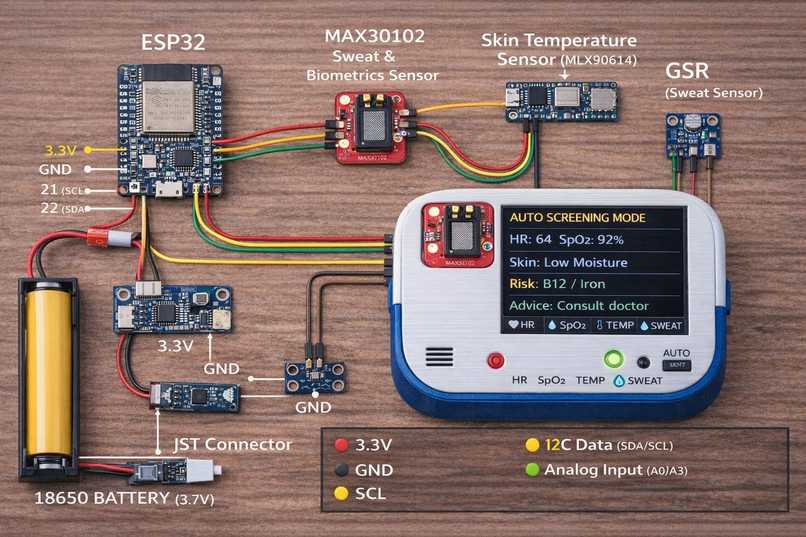
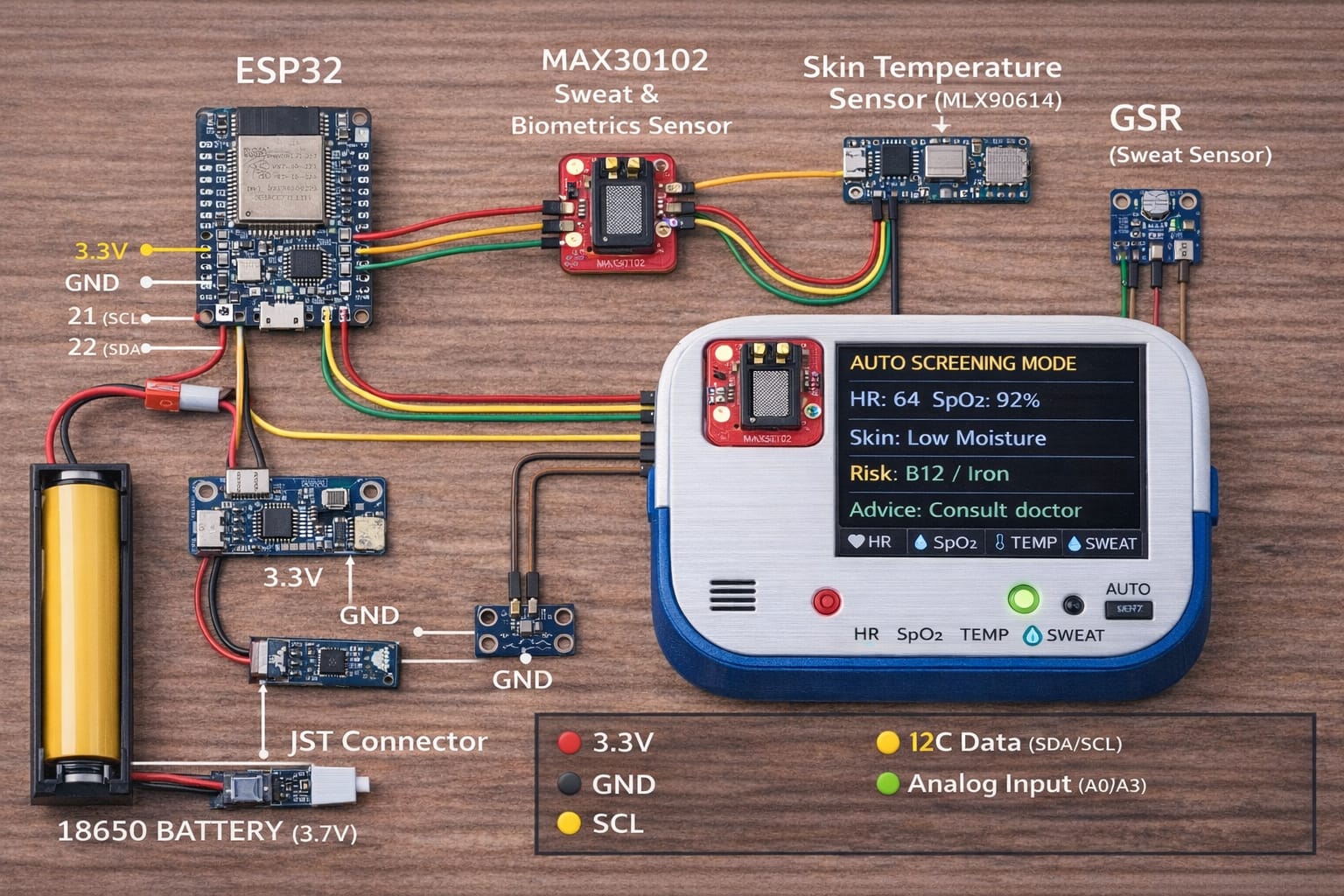
Our project uses AI and a low‑cost IoT health kit to analyze vital signs such as heart rate, SpO₂, skin temperature, and sweat levels to predict vitamin and mineral deficiency risks. It provides health insights, risk scores, and actionable advice through a dashboard for individuals and public health authorities.
How we built it
We developed a portable ESP32‑based sensor kit to collect real‑time physiological data. The data is processed using cloud computing and AI models to estimate health risks related to nutrition, immunity, and anemia. A web dashboard visualizes trends and supports data‑driven health interventions.
Challenges we ran into
- Limited access to real‑world medical sensor data
- Ensuring predictions remain non‑diagnostic and ethically responsible
- Building a system that is low‑cost, scalable, and reliable in resource‑limited environments
- Balancing medical accuracy with simplicity and usability
Accomplishments that we're proud of
- Successfully built a non‑invasive health screening prototype
- Developed a realistic synthetic dataset for AI training
- Created an AI‑powered risk prediction pipeline
- Designed a dashboard suitable for community and government use
What we learned
We learned how to integrate IoT hardware, AI analytics, cloud systems, and public health logic into a single impactful solution. This project strengthened our understanding of ethical AI, healthcare accessibility, and technology for social good.
What's next for Non‑Invasive Vitamin Deficiency Screening using AI
- Expanding to real clinical validation and field trials
- Adding more biomarkers and advanced AI models
- Scaling deployment across rural and underserved communities
- Partnering with government and NGOs to support national public health programs
Built With
- c/c++-(arduino-for-esp32)-hardware-platform:-esp32-microcontroller
- cloud-storage-apis-&-tools:-rest-apis
- css-data-&-storage:-csv-dataset
- github
- gsr-sensor
- jupyter-notebook-visualization:-matplotlib
- lambda)-/-firebase-dashboard-&-frontend:-streamlit-/-html
- ldr-ai-&-machine-learning:-scikit?learn
- max30102-(hr-&-spo?)
- numpy-cloud-&-backend:-aws-(iot-core
- pandas
- programming-languages:-python
- s3
- seaborn
- temperature-sensor

Log in or sign up for Devpost to join the conversation.