Inspiration
DevOps teams repeatedly face the same incident workflow: command fails, logs are copied manually, context is reconstructed, and fixes are retried under
pressure. We built DevOps Incident Commander to remove that repetitive loop and turn terminal failures into a fast, reusable remediation process.
## What it does
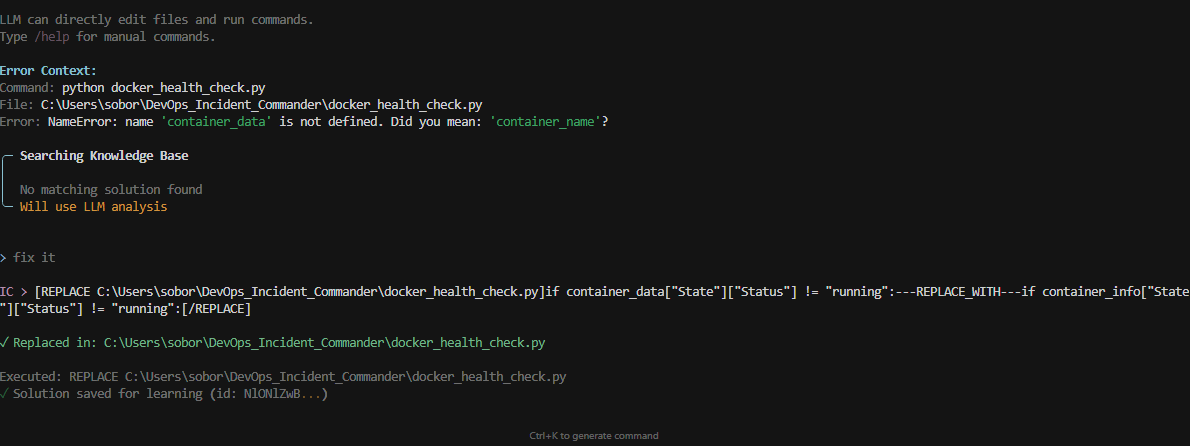
DevOps Incident Commander captures terminal errors automatically, extracts execution context (command, file, traceback), and launches an AI-assisted
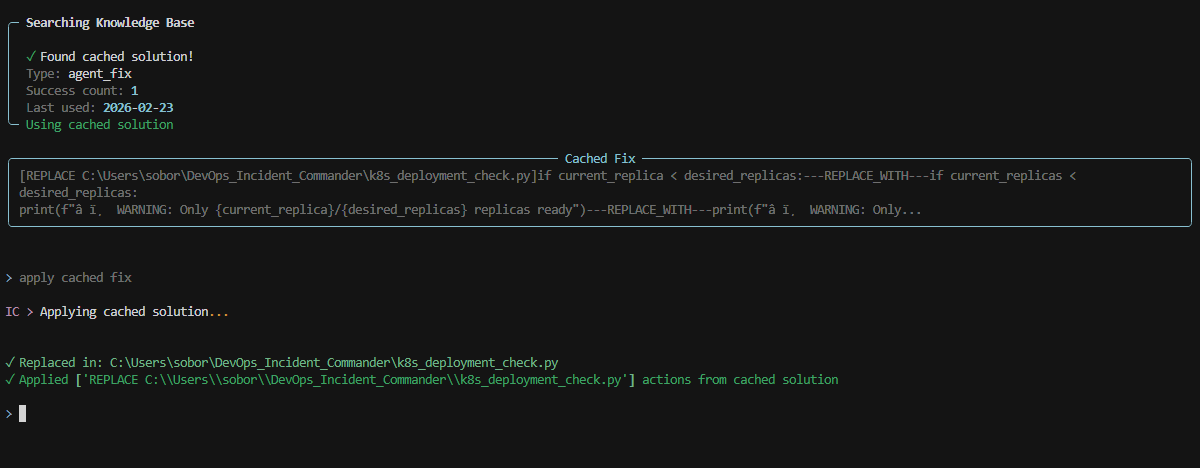
remediation flow. It first checks a knowledge base for previously successful fixes, then falls back to LLM analysis for new issues. Successful
remediations are stored, so similar incidents are resolved faster over time.
## How we built it
We built the project with Python, PowerShell/Bash terminal hooks, and a CLI-first workflow.
Core components:
- Terminal hook layer for runtime error capture
- Incident orchestration and CLI with Typer/FastAPI
- LLM analysis pipeline for novel errors
- Elasticsearch-backed learning loop for cached remediations
- CI pipelines for linting, tests, and security checks
## Challenges we ran into
- Reliable stderr capture for external commands in PowerShell
- Hook reloading conflicts in VSCode/terminal sessions
- Preventing recursive remediation loops when internal commands are proxied
- CI hardening issues (security checks, request timeouts, safe network defaults)
## Accomplishments that we’re proud of
- End-to-end terminal-to-fix workflow that runs in real environments
- Context-aware Agent Mode with actionable remediation output
- Working learning loop: first-time LLM fix, then cached fix reuse
- Stable hook behavior after resolving proxy/initialization edge cases
- Green lint/test/security pipelines after iterative hardening
## What we learned
- Reliability and context quality matter more than “smart” output alone
- Operational UX (predictable hooks, clear status, safe defaults) drives adoption
- Security and CI feedback should be treated as product inputs, not afterthoughts
- A memory-backed remediation system creates compounding value across incidents
## What’s next for DevOps Incident Commander
- Expand connectors (Kubernetes, cloud providers, alerting systems)
- Improve remediation ranking with richer incident similarity
- Add policy controls and approval workflows for higher-risk actions
- Build richer observability dashboards for remediation effectiveness
- Package a smoother onboarding experience for team-wide deployment
Built With
- bash
- dockerfile
- elasticsearch
- hcl
- powershell
- python
- shell
- terraform
- typescript

Log in or sign up for Devpost to join the conversation.