-
-
-
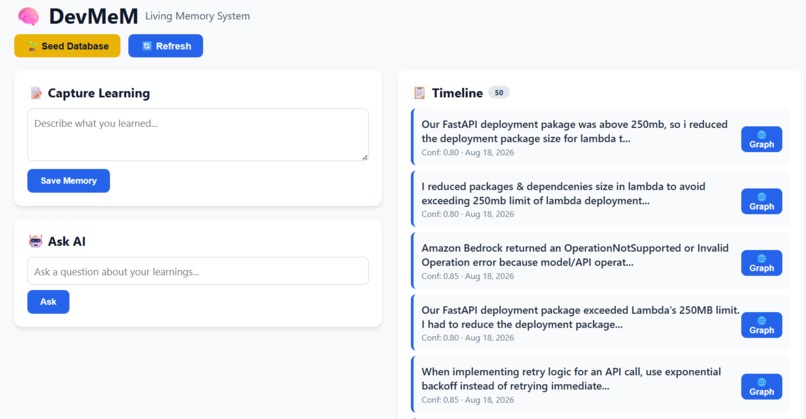
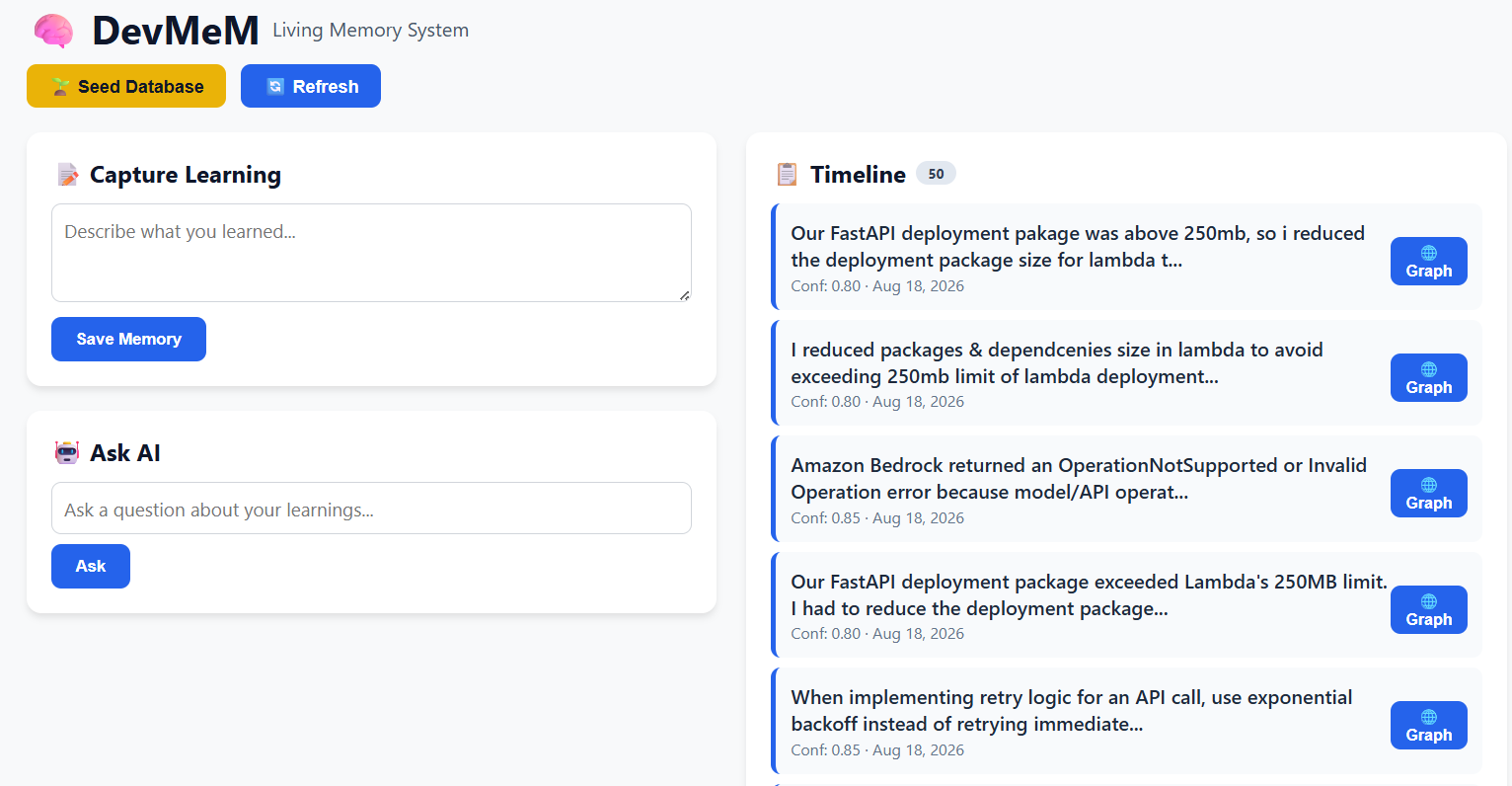
DevMeM - Persistent developer memories for capture, semantic retrieval, duplicate detection, and connected learnings.
-
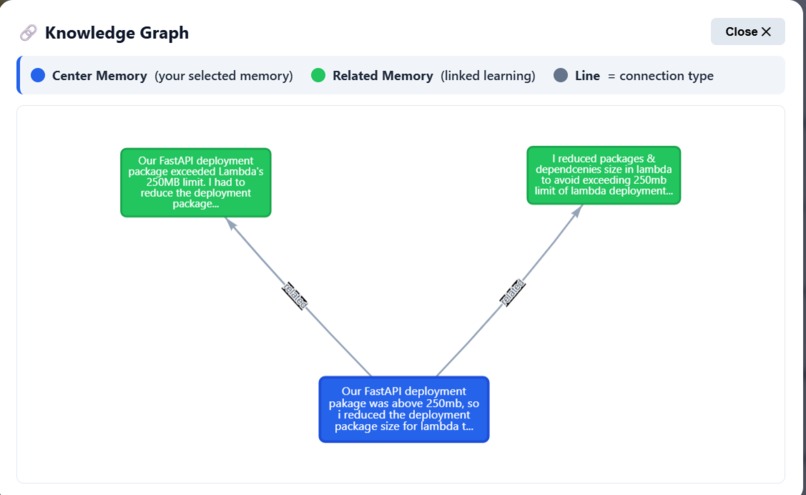
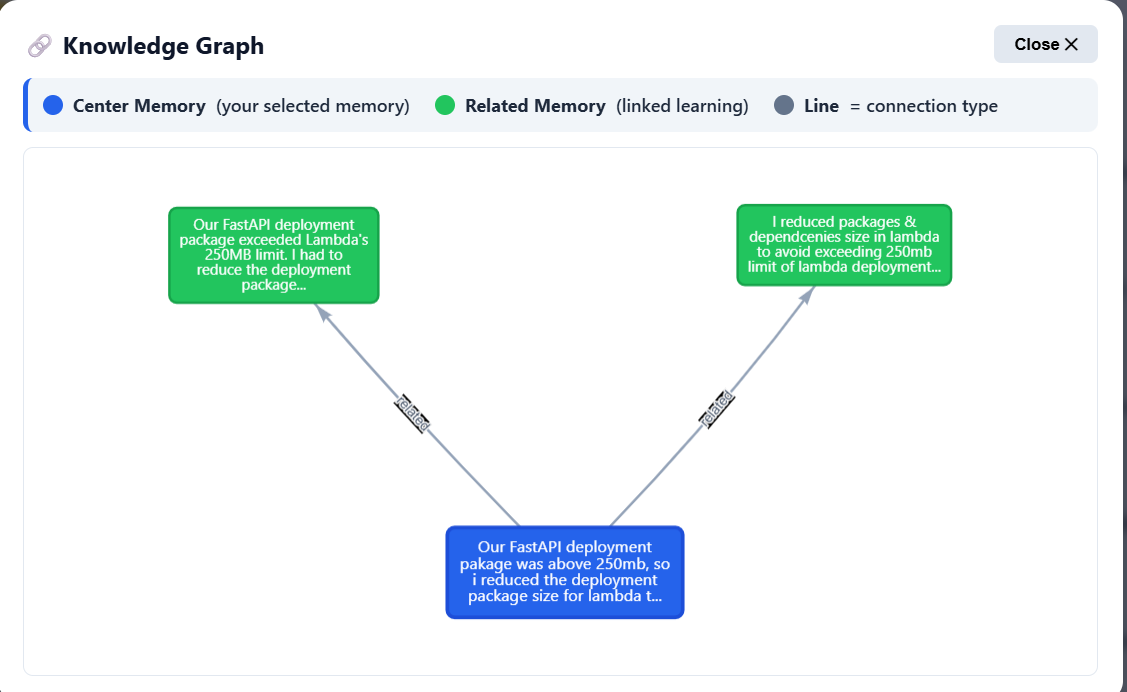
Graph Visualizing the related developer memories
-
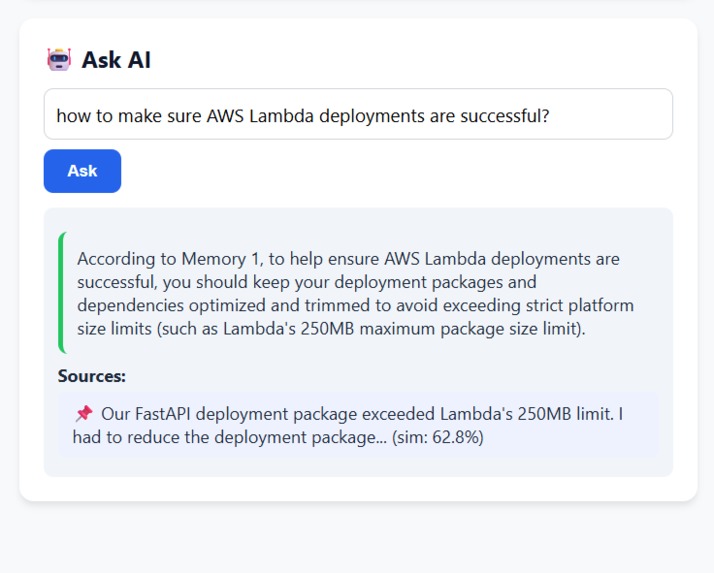
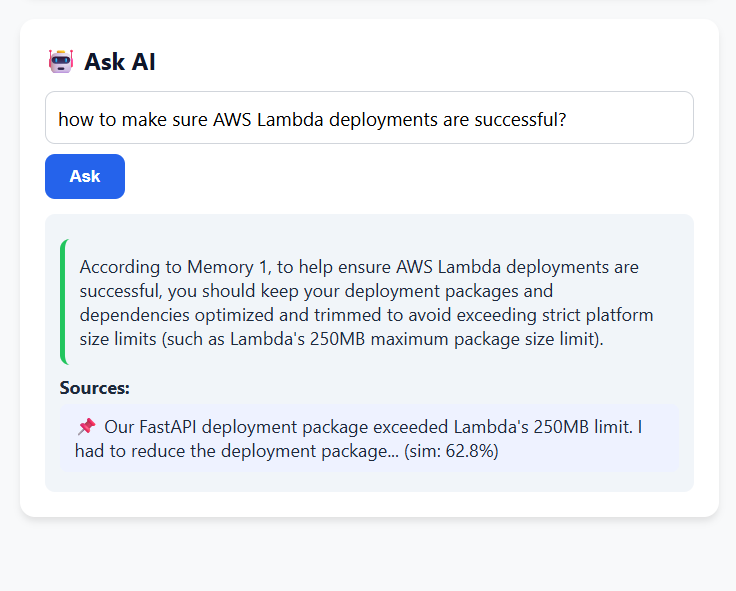
AskAI feature
Inspiration
Developers repeatedly solve difficult problems, but the lessons from those experiences are often lost in chat histories, terminal sessions, and scattered notes. We wanted to build a system that could turn those experiences into persistent, reusable developer memory.
What it does
DevMeM captures engineering learnings, extracts the important technical context, generates semantic embeddings, and stores the resulting memories in CockroachDB.
When a developer asks a question later, DevMeM retrieves relevant memories using CockroachDB vector search and uses them to generate a contextual answer. It also detects duplicate and related learnings so the memory layer becomes more useful over time.
How we built it
The application uses CockroachDB as its persistent memory layer, storing memories, relationships, metadata, and 384-dimensional embeddings together.
The backend is deployed on AWS Lambda behind API Gateway, while AWS-powered AI services handle memory extraction and answer generation. Hugging Face's MiniLM model generates the semantic embeddings used for similarity search.
The frontend is hosted on Netlify and communicates with the serverless backend through REST APIs.
Challenges we ran into
Building and deploying the system involved several real-world challenges, including choosing compatible AI models, handling Bedrock operation errors, working within AWS Lambda's deployment package and timeout constraints, configuring API Gateway routes and CORS, resolving Hugging Face endpoint and authentication issues, and testing the complete deployed pipeline rather than only the local application.
Accomplishments that we're proud of
We built a working end-to-end memory pipeline where a developer can capture a learning, persist it in CockroachDB, detect similar memories, and later retrieve those memories through a natural-language question.
Most importantly, CockroachDB is not being used as a passive data store - it serves as the application's persistent memory layer and semantic retrieval system.
What we learned
We learned that building an agentic application is more than connecting an AI model to an API. The difficult and valuable part is designing what should be remembered, how memories should be represented, how similarity should be measured, and how retrieved memories should influence future interactions.
We also gained practical experience deploying AI workloads on AWS Lambda and integrating CockroachDB's vector capabilities into a production-style serverless architecture.
What's next for DevMeM
Future versions could add automatic memory capture from developer workflows, stronger memory evolution and contradiction detection, authentication and multi-user support, and deeper integrations with developer tools such as VS Code and Cursor.
Built With
- amazon-web-services
- cockroachdb
- gemini
- lambda

Log in or sign up for Devpost to join the conversation.