-
-
Devilish Grin - Cuatico Studio
-

Cuatico - Studio - Devilish Grin
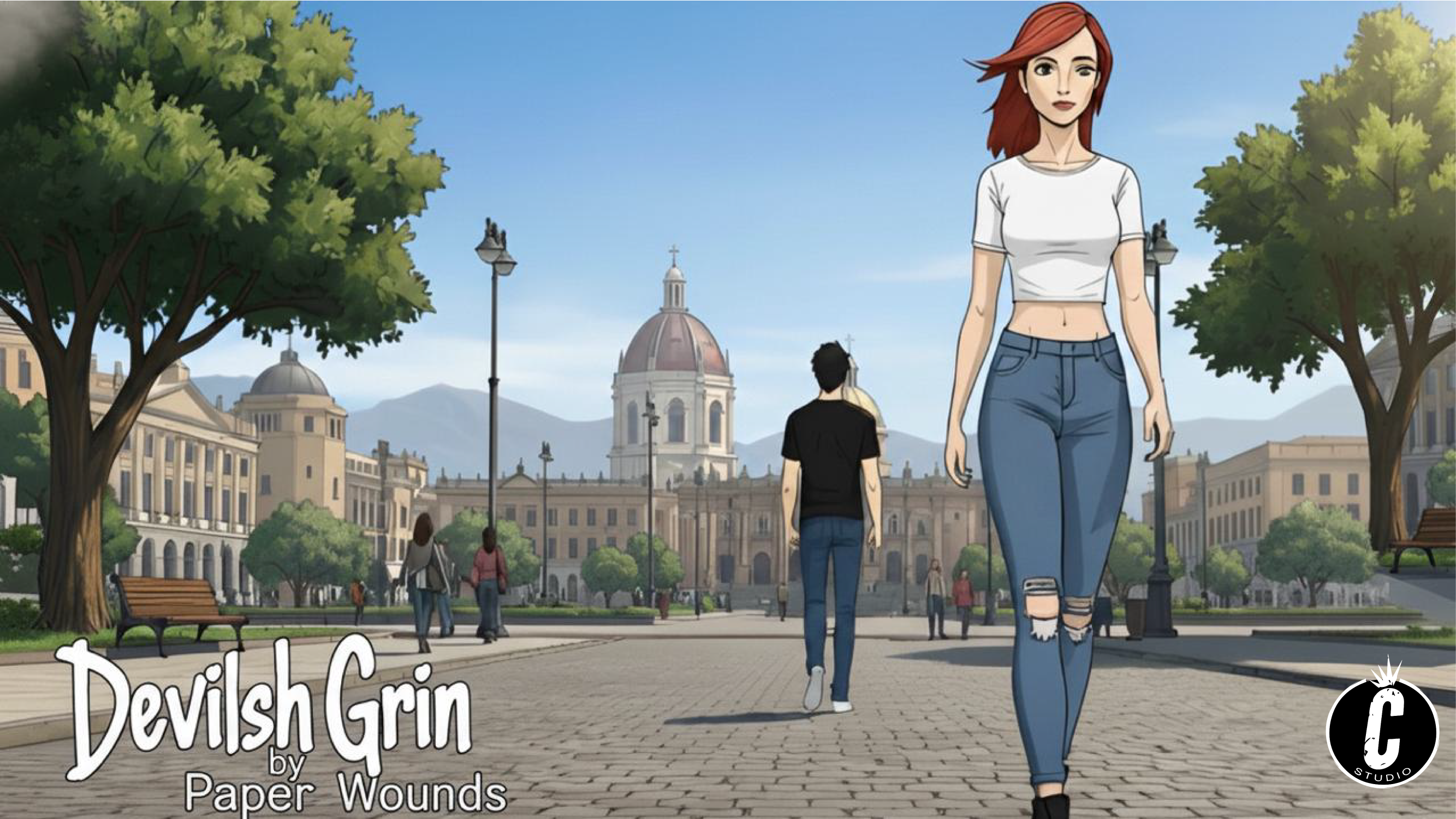

Inspiration Our inspiration was born from a frustration: the "uncanny valley" of AI-generated video. Most AI videos feel like fever dreams—technically impressive but emotionally empty. They lack intention.
We asked ourselves: What if, instead of just "asking" an AI to "generate a video," a human director could actually direct it?
Our inspiration wasn't to create a video with AI, but to prototype a new directorial workflow. We wanted to prove that a director's "vision" can be the catalyst to orchestrate AI's generative chaos into a piece with a soul.
What it does This video is a visual manifesto. It's the proof-of-concept for our hybrid "Human + AI" philosophy applied to cinematography.
Its function is to blur the line between a filmed shot and a generated prompt. It challenges the viewer to find the "seam" between human intention and the algorithm. It demonstrates that a director, armed with an AI "film crew," can create narratives that are physically impossible to shoot in the real world, yet feel emotionally coherent and completely intentional.
How we built it We didn't "generate" this video. We directed and edited it from AI-generated raw material. The process was a three-stage dialogue:
The Dialogue (Human): Our human director defined the why. Instead of a technical script, we wrote an "emotional script": a document detailing the rhythm, color palette, texture, and emotional arc of the piece.
The Visual Chaos (AI): We took this "emotional script" to the AIs (models like Midjourney, Runway, and Pika).
First, we created conceptual "key frames" and storyboards. We iterated hundreds of times, not to find the "correct" image, but the correct feeling.
Then, we "brought those frames to life." We used prompts like a director of photography uses commands: "slow zoom in," "ethereal light," "morning mist." We generated terabytes of raw footage, knowing most of it would be noise. We were looking for the "sparks" in the chaos.
The Editing Room (Human Fusion): This is the most critical stage. A human editor took these generated video "stems" into editing software (Adobe Premiere / DaVinci Resolve).
This is where the real direction happened. The editor selected, cut, re-timed, reversed, and orchestrated these disparate clips into a cohesive narrative.
Human sound design and color correction were applied (also by humans) to unify the different AI "styles" under a single aesthetic vision.
Finally, we merged it with our music, also created with a hybrid (Human + Suno) process.
Challenges we ran into The biggest challenge was coherence. Video AIs still struggle with consistency (a face changes mid-shot, physics makes no sense). Our challenge wasn't to generate coherent shots, but to impose coherence in the editing room. We learned to use incoherence as a stylistic effect, like a dream "glitch."
The second challenge was control. You can't tell an AI "move the camera 3 degrees to the left." It's a "black box." We learned to "negotiate" with the prompt, to "suggest" and "push" the AI in a direction, rather than simply "commanding" it. It was a new skillset.
Accomplishments that we're proud of We are proud that the final video feels like it has a point of view. It feels made by someone, not something.
Our greatest accomplishment is proving that the role of the "Director" isn't replaced by AI; it's expanded. The director can now be a "dream choreographer," an architect of impossible worlds. We proved that our workflow functions.
What we learned We learned that AI is the biggest, fastest, and most unpredictable film crew in the world. It has no ego, never gets tired, and doesn't know the rules of physics.
We learned that in this new era, post-production IS the new production. Human curation and editing are the most important skills. "Good taste" has become the most valuable technical skill.
And we learned that an "emotional script" is infinitely more powerful than a technical script for guiding AI.
What's next for Devilish Grin
This video is our "academic paper," our thesis. The next step is to take this workflow from manifesto to production.
We are now applying this process to create music videos, short films, and brand narratives that were previously "impossible" due to budget, time, or the simple laws of gravity, our name for the project, is no longer an experiment; it is the foundation of our studio.
Built With
- capcut
- chatgpt
- gemini
- googleaistudio
- grok
- nanobanana
- suno


Log in or sign up for Devpost to join the conversation.