Inspiration
DevFlowFix is an autonomous CI/CD failure remediation system built to make deployment failures a non-event for cloud engineering teams. It leverages AWS Lambda, SageMaker, and NVIDIA NIM models to automatically detect, analyze, and resolve CI/CD workflow failures especially those triggered by GitHub Actions, ArgoCD, or Kubernetes deployments.
At its core, DevFlowFix acts as an AI-driven responder that monitors workflow failures, diagnoses root causes using LLMs and embeddings, and applies intelligent fixes automatically often generating pull requests with detailed explanations and confidence scores.
What it does
Every engineer has faced this moment: A single deployment step fails. The logs look familiar, but the fix isn’t obvious. Hours are lost in debugging.
This recurring pain inspired us to build DevFlowFix, a system that could learn from the team’s collective experience and respond instantly to deployment incidents.
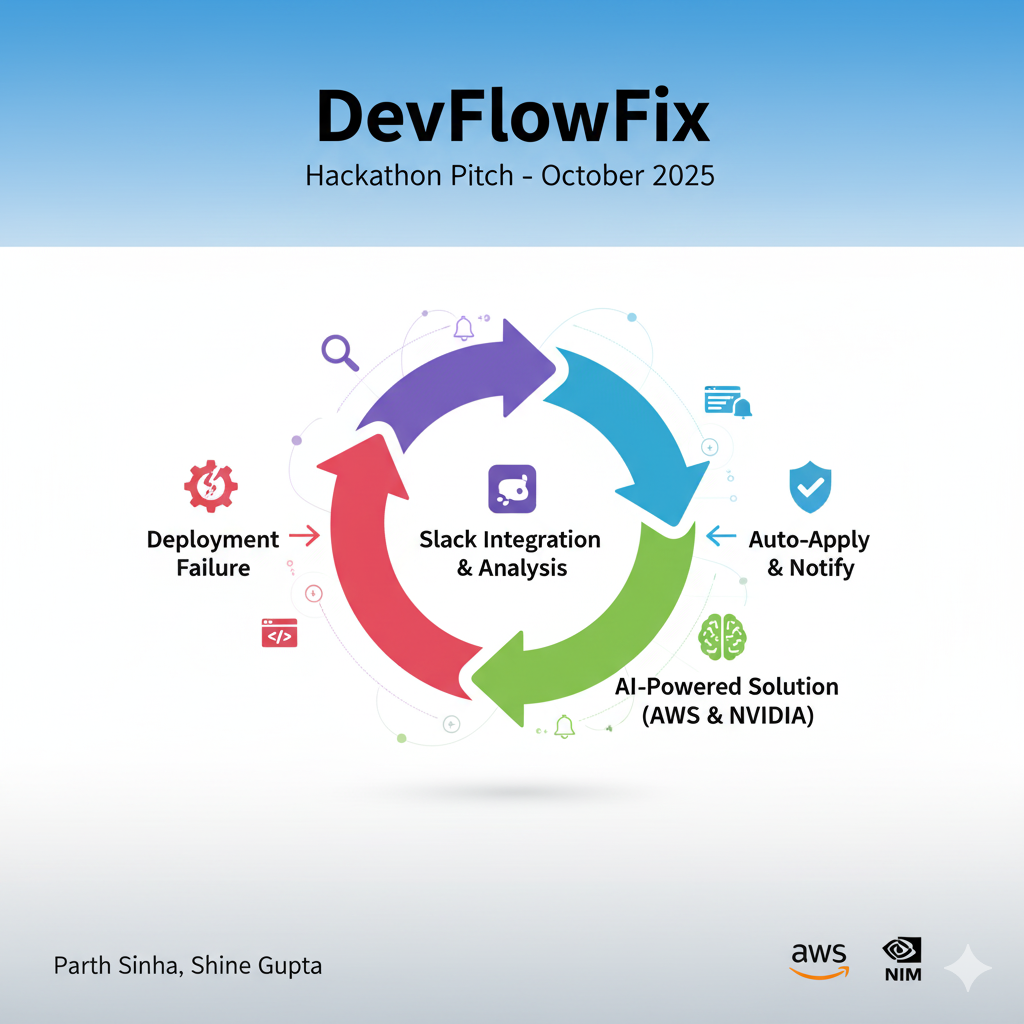
Our vision was simple: Deployment Failures ⇒ Autonomous Recovery
We wanted to build a copilot that doesn’t just detect problems but solves them intelligently by analyzing logs, searching past resolutions, and even recalling team discussions from Slack.
How we built it
1. Infrastructure Setup
We deployed DevFlowFix entirely on AWS, using:
- AWS Lambda for serverless compute and event-driven logic
- Amazon SageMaker for hosting NVIDIA NIM models:
- Llama 3.1 Nemotron for log analysis and reasoning
- NVIDIA Embedding Model for vectorizing incidents and resolutions
- API Gateway for secure webhook handling
- Secrets Manager for credential storage
- CloudWatch for logging and monitoring
The deployment is orchestrated via an idempotent Bash script (deploy.sh), which provisions all required resources automatically.
2. Autonomous Workflow
When a GitHub Actions workflow fails:
- A webhook event hits our API Gateway.
- The Lambda function retrieves detailed logs.
- The logs are analyzed via Llama 3.1 Nemotron to determine: Failure Type→Root Cause→Fix Recommendation
- The model’s recommendations are cross-referenced with:
- Historical incidents in S3/DynamoDB
- Slack discussions (via workspace API)
- If confidence > 90%, DevFlowFix:
- Clones the repo
- Applies the fix
- Opens a pull request with a structured remediation summary
What We Learned
Prompt Engineering Matters: Crafting structured, context-rich prompts for Llama 3.1 Nemotron was key to obtaining reliable root cause analyses.
Confidence Calibration: We developed a multi-source scoring model combining LLM confidence with Slack-derived relevance scores.
Serverless Scalability: Designing the Lambda to handle complex AI inference required optimizing for cold start latency and concurrency limits.
Trust Through Transparency: Developers trust automation when it’s explainable—hence, each pull request includes full context, logs, and rationale.
Challenges we ran into
Integration Complexity: Balancing GitHub, AWS, and Slack APIs within Lambda’s execution limits was non-trivial. We had to modularize the workflow and manage async responses carefully.
Latency Optimization: Running LLM inference via SageMaker endpoints added delays. We mitigated this by caching embeddings and batching similar incidents.
Data Security: Managing secrets (GitHub tokens, API keys, Slack credentials) safely across services was critical. AWS Secrets Manager became central to our architecture.
False Positives: Early versions sometimes applied fixes too aggressively. We introduced a confidence-based gating mechanism: If the probability of a correct fix is less than 0.9, then perform a manual review.
Continuous Learning: Capturing feedback loops—through merged PRs, failed fixes, and engineer reactions—turned out to be the most valuable mechanism for model improvement.
Accomplishments that we're proud of
- Autonomous CI/CD Fixes: Built a self-healing pipeline that detects, analyzes, and fixes deployment failures automatically.
- AI-Powered Insight: Integrated NVIDIA Llama 3.1 Nemotron and Embedding Models on AWS SageMaker for intelligent log analysis.
- Secure & Serverless: Deployed a fully serverless architecture with AWS Lambda, API Gateway, and Secrets Manager.
- Slack Intelligence: Enabled Slack-based knowledge retrieval to learn from past engineering discussions.
- Confidence Framework: Developed a weighted confidence model to apply safe, high-accuracy remediations.
- Continuous Learning: Implemented feedback loops from PR outcomes and engineer reviews to improve over time.
- Hackathon to Reality: Transformed a pain point—deployment failures—into a smart, reliable, and scalable solution.
We’re evolving DevFlowFix into a context-aware DevOps copilot, fully integrated with Slack. Soon, it will:
- Retrieve past discussions of similar errors
- Learn which fixes succeeded or failed
- Improve its confidence thresholds dynamically
Ultimately, our goal is to achieve: Mean Time to Resolution (MTTR) approaches 0
What's next for DevFlowFix
DevFlowFix isn’t just automation it’s institutional knowledge in motion. By combining AI reasoning, historical memory, and collaborative context, it transforms how engineering teams respond to failures.
From failure detection to autonomous recovery, in seconds, not hours.
Built With
- amazon-cloudwatch
- amazon-web-services
- api
- argocd
- bash
- docker
- github
- githubaction
- kubernetes
- lambda
- nvidia
- python
- sagemaker


Log in or sign up for Devpost to join the conversation.